Colleges for a 3.1 GPA
Is a 3.1 GPA good for college applications?
A 3.1 GPA can be competitive at many four-year colleges, particularly institutions with broad or moderate admissions selectivity. It is more useful to compare a 3.1 with specific colleges than to label it “above” or “below” a national average. High schools calculate GPA differently, and colleges have very different academic profiles. At this level, you can begin choosing among a meaningful range of four-year options instead of focusing only on whether a college will consider your GPA.
How do colleges interpret a 3.1 GPA?
A 3.1 GPA needs context from your high school transcript and grading system. A weighted 3.1 and an unweighted 3.1 are not directly interchangeable. Honors, AP, IB, dual-enrollment, plus/minus grades, and weighting rules can all affect the number. Some colleges may recalculate GPA using their own criteria. They may also consider course rigor and whether your academic performance is improving, stable, or declining. At 3.1, stronger recent grades in appropriately challenging courses can make the cumulative GPA more meaningful than the decimal by itself. Compare your complete academic profile with each institution’s current published admissions information.
What colleges may be a good fit with a 3.1 GPA?
Regional universities and a wide range of private colleges may fit naturally into your search. More-selective institutions may still be reaches, particularly where students typically present stronger grades or more rigorous coursework. At this GPA, start comparing colleges on:
- Program strength
- Cost and aid
- Student support
- Campus environment
- Outcomes
- Admission fit
How do you build a safety, match, and reach list with a 3.1 GPA?
Build your list conservatively and use more than GPA to decide whether a college is a safety, match, or reach.
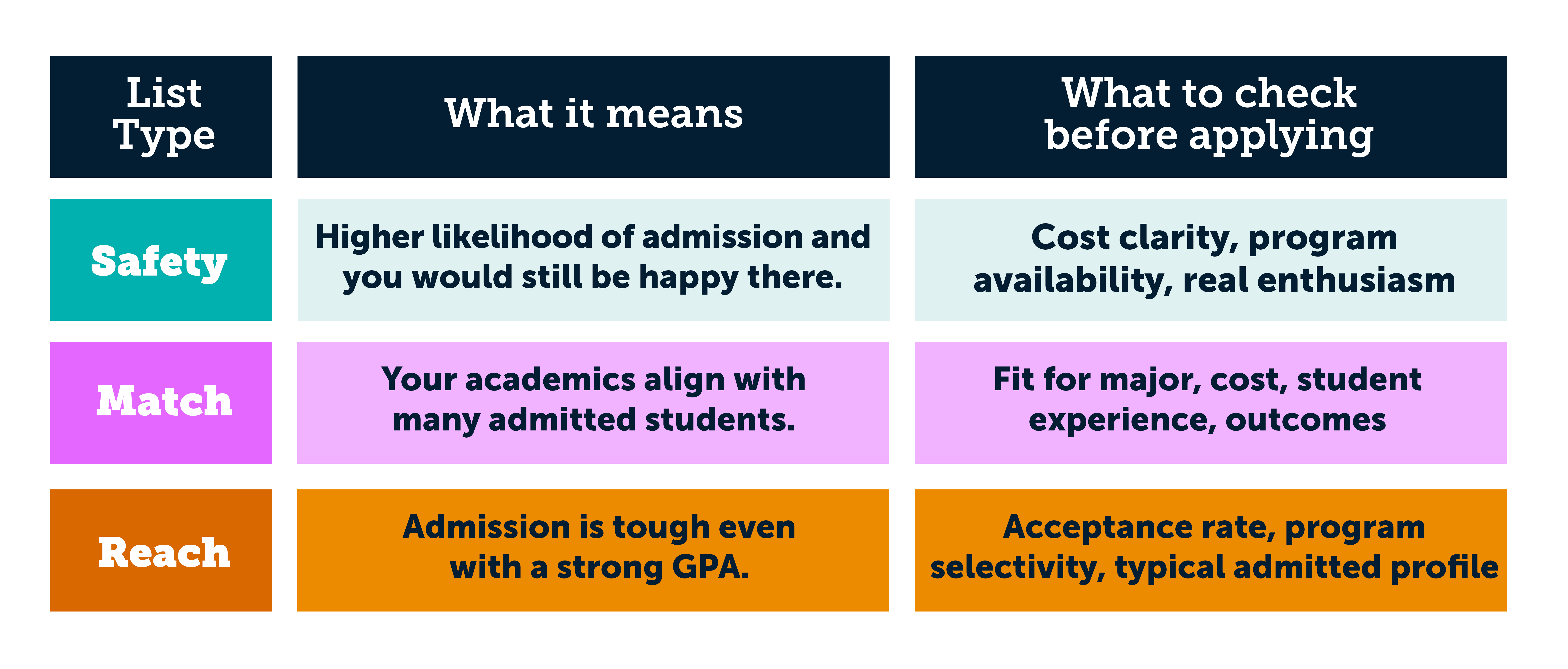
A 3.1 can support a broad middle section of your college list, but safety schools still need to be genuinely safe for your full record. Use schools with academic profiles near 3.1 as potential matches only after checking their selectivity, requirements, intended major, and the rest of your transcript. Do not assume a decimal match equals an admissions match.
How can you improve a 3.1 GPA?
Freshmen and sophomores
There is substantial time to move further into the low or mid-3s through stronger performance. Add rigor gradually rather than making a sudden jump in course difficulty.
Juniors
Stronger grades in appropriately challenging courses can improve both the GPA and the overall academic profile. A small decimal change is less useful if it comes with a weaker or less appropriate schedule.
Seniors
Maintaining your record and submitting well-built applications may deserve more attention than obsessing over a one-tenth increase.
What should you prioritize with a 3.1 GPA?
Use the range of options you have. The college search should begin shifting from “Where can I get in?” toward “Where will I have strong academic, financial, and personal options?”
Most useful next step: Identify several colleges where your 3.1 already fits comfortably, then use more-selective schools as purposeful reaches rather than allowing them to dominate the list.
Can you get merit scholarships with a 3.1 GPA?
A 3.1 can satisfy the academic requirement for some merit programs while missing others. Compare scholarship criteria early. At some colleges, your GPA may position you well for merit consideration; at others, it may not. Always compare the resulting net cost, not just the scholarship amount.
Would moving from 3.1 to 3.2 matter?
It can matter if the change affects eligibility or your position at a particular college, but there is no universal admissions benefit attached to one tenth of a point. Focus on stronger academic performance rather than the decimal alone.
Can extracurriculars make a 3.1 competitive at a selective college?
Extracurriculars can strengthen your overall application, but they do not replace the academic record. At selective institutions, GPA, course rigor, grade trend, activities, essays, recommendations, testing where considered, and other factors may all be evaluated according to that college’s own process.
What colleges look at besides your GPA
GPA is just one aspect colleges review when looking through your college application. Make sure to include as many aspects of your high school career as possible, including any (or all) of the following:
How to use the college list
The colleges below are included because their average GPA falls within 3.0–3.2. This range is intended to help you find colleges to research. It does not establish an admission requirement or guarantee. A college’s average GPA is not a minimum, and the school may calculate GPA differently from your high school. Admissions policies, program requirements, and student profiles can also change. Compare your full academic profile with each institution’s current information before deciding whether it belongs on your safety, match, or reach list.
Explore colleges for every GPA with Appily
Ready to explore colleges that accept a GPA like yours? We have a comprehensive database to help you find and research schools. There, you can see essential data points like acceptance rate, average financial aid award, average test scores, and application deadlines, including those for rolling admission, early decision, and early action schools.