The College of New Jersey

The College of New Jersey

Ewing, NJ, USA
Public
4 Year

Overview

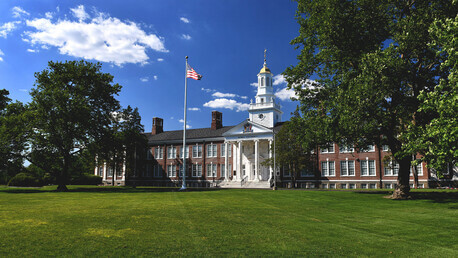
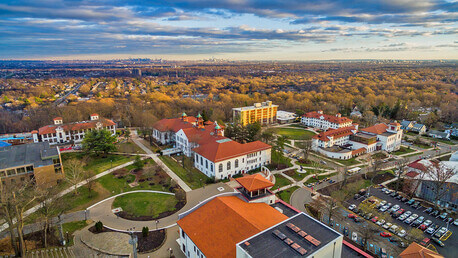
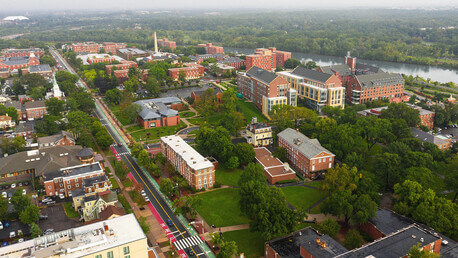
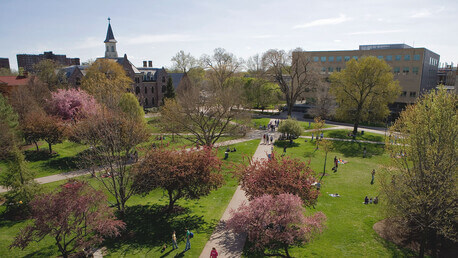
Founded in 1855 as the New Jersey State Normal School, The College of New Jersey is a 4-year public institution in the Trenton area. TCNJ is home to seven colleges and schools including the oldest teacher-training program in the state.  Today it is heralded by U.S. News & World Report as well as Barron’s as one of the most competitive schools in the nation, public or private. TCNJ serves a diverse student body, preparing graduates to excel as leaders in their chosen fields.  TCNJ has set the standard for public higher education. Students appreciate the atmosphere they find at TCNJ, a school large enough to provide a full range of academic and extracurricular choices, yet small enough to be a genuine residential community of friends and fellow learners. With professors committed to collaboration in and out of the classroom and facilities of enviable quality, TCNJ represents an exceptional value in higher education.

Acceptance Rate:
64%
Average Net Price:
$24,617
Campus Setting:
Suburb or town
Average GPA
3.7
Average ACT Composite
28
Average SAT Composite
1267

Tuition, Cost & Aid

Affordability & Cost

Average Net Price
$24,617
Calculate your net cost
Tuition
In-State Tuition In-state tuition is the tuition charged by institutions to those students who meet the state's or institution's residency requirements. In-district tuition is the tuition charged by the institution to those students residing in the locality in which they attend school and may be a lower rate than in-state tuition if offered by the institution.
$18,685
Out-of-State Tuition Out-of-state tuition is the tuition charged by institutions to those students who do not meet the state’s or institution’s residency requirements. Out-of-district tuition is the tuition charged by the institution to those students not residing in the locality in which they attend school.
$24,568
Additional Costs
Room and Board The weighted average for room and board and other expenses is generated as follows:
  • (amount for on-campus room, board and other expenses * # of students living on-campus.
  • + amount for off-campus (with family) room, board and other expenses * # of students living off-campus with family
  • + amount for off-campus (not with family) room, board and other expenses * # of students living off-campus not with family)
divided by the total # of students. Students whose living arrangements are unknown are excluded from the calculation. For some institutions the # of students by living arrangement will be known, but dollar amounts will not be known. In this case the # of students with no corresponding dollar amount will be excluded from the denominator.
$15,569
Books and Supplies
$1200
Average Net Price By Family Income
Income
Average Amount
< $30k
$10,521
$30k - $48k
$11,763
$48k - $75k
$20,107
$75k - $110k
$26,945
$110k+
$32,296
Financial Aid: visit page
Financial Aid Email: [email protected]

Aid & Grants

0
100
40%
Need Met
Students Receiving Gift Aid Percent of undergraduate students awarded federal gift aid. Federal gift aid includes any grant or scholarship aid awarded, from the federal government, a state or local government, the institution, and other sources known by the institution.
19%
Average Aid Per Year
$11,826
Students Receiving Grants Percent of undergraduate students awarded grant aid. Grant aid includes any grant or scholarship aid awarded, from the federal government, a state or local government, the institution, and other sources known by the institution.
19%
Average Federal Grant Aid Per Year
$5,536
Average Institution Grant Aid Per Year
$7,755


Students receiving state aid
18%
Average State Grant Aid Per Year
$8074
Students receiving federal aid
22%
Average Federal Grant Aid Per Year
$5,536
Total Needs Based Scholarships/Grants Total amount of grant or scholarship aid awarded to all undergraduates from the federal government, state/local government, the institution, and other sources known to the institution.
$38,928,800
Total Non-Need-Based Scholarships/Grants
$7,869,426

Student Loans

Students Borrowing Loans Loans to students - Any monies that must be repaid to the lending institution for which the student is the designated borrower. Includes all Title IV subsidized and unsubsidized loans and all institutionally- and privately-sponsored loans. Does not include PLUS and other loans made directly to parents.
50%
Average Loan Amount Per Year
$10,030
Average Debt at Graduation The median federal debt of undergraduate borrowers who graduated. This figure includes only federal loans; it excludes private student loans and Parent PLUS loans.
$20,934
Median Monthly Loan Payment The median monthly loan payment for student borrowers who completed, if it were repaid over 10 years at a 5.05% interest rate.
$224
Students receiving federal loans
49%
Average Federal Loans Per Year
$5,217
Average Other Loans Per Year
$18,704


Admissions

Key Admissions Stats

Institution Type
Public
  • Not for Profit
  • Coed

Need Aware

This school may consider an applicant’s financial situation when deciding admission

Level of Institution
4 Year
Campus Setting
Suburb or town
0
100
64%
Acceptance Rate
10302
Students Applied
45%
Transfer Acceptance Rate
300
Transfer Students Admitted

Admissions Requirements

SAT
SAT is not checked
No
ACT
ACT is not checked
No
Transcript
Transcript is checked
Yes
Test Optional
Item is checked
Yes
SAT Subject Tests
Item is checked
Yes
AP Course Credit
Item is checked
Yes
Dual Enrollment
Item is checked
Yes

Important Deadlines

Application TypeApplication DeadlineReply Deadline
Early Decision Acceptance is binding so student must attend college if accepted.November 1
Fall Regular DecisionFebruary 1
Spring Regular DecisionNovember 1
OtherJanuary 1
Application Fee
$75
Fee waivers available
Applications Accepted
Common Application
Common Application

Admitted Student Stats

In-State Students
95%
Out-Of-State Students
5%
4%
Submitting ACT
46%
Submitting SAT
Average ACT Composite: 28
0
36
Average SAT Composite: 1267
0
1600
SAT Percentiles

Math
25th
570
75th
680
Reading
25th
570
75th
670
3.7
Average GPA
Students Enrolled By Class Rank

Top 10%
30
Top 25%
66
Top 50%
95
Students Enrolled By Household Income

< $30k
131
$30k - $48k
90
$48k - $75k
91
$75k - $110k
106
$110k+
417

Admissions Resources

Admissions: visit page
Admissions Email: [email protected]
Admissions Telephone: 800-624-0967
For International Student Services: visit page
For Students with Disabilities: visit page
For Veteran Services: visit page

Academics

Key Academic Stats

Highest Degree Offered
Master's
Total Number of Students
7,629
Total Number of Undergrads
7,039
0
100
75%
Graduate in 4 Years US National: 28%
0
100
86%
Graduate in 6 Years US National: 52%
Student:Faculty Ratio
13:1
US National: 21:1
Academic Calendar

Semester

Non Traditional Learning
  • Online Classes
  • Online Undergrad Degrees
  • Summer Sessions
  • Combined Institution Double Degree Programs
  • Some Programs Requires Co-Op/Internship
Learning Options
  • ROTC Army
  • ROTC Air Force
  • Study Abroad
  • Honors Program
  • Teacher Certification Offered
Classroom Sizes

2-19 Students
41%
20-39 Students
55%
40-99 Students
3%
 

Degrees and Majors

MAJORS
60

Faculty Overview

0
100
56%
Faculty With Terminal Degree US National: 36%
Gender
Male
Female
Ethnicity

African American
Asian/Pacific Islander
White
Hispanic
Unknown

Campus Life

Key Campus Stats

Student Gender
Male
Female
43%
57%
Residency
In-State Students
95%
Out-Of-State Students
5%
Size of Town
Suburb or town
US States Represented
24
Countries Represented
4
Ethnicity
African American
5%
Asian/Pacific Islander
11%
Hispanic
18%
White
59%
Multiracial
3%
Unknown
3%
Percent of First Generation Students
21%
Student Organizations
205
LGBTQIA Student Resource Groups
Item is checked
Yes
On Campus Women's Center
Item is checked
Yes
Cultural Student Resource Groups
Item is checked
Yes

Housing

0
100
54%
Undergrads Living on Campus
On-campus living required of freshman
No
Disability Housing Available
No
0
100
45%
Freshman Living on Campus

Athletics

Divisional Sports Nickname
Lions
School Colors
blue and gold
Varsity Athletics Association
NCAA
Varsity Athletics Conference Primary
New Jersey Athletic Conference
Total Male Athletes
327
Total Female Athletes
274
Intramural Sports
13
Sports Club
13
Sports Team (Men)
  • Baseball
  • Basketball
  • Cross Country
  • Football
  • Soccer
  • Swimming
  • Tennis
  • Track and Field
  • Wrestling
Sports Team (Women)
  • Basketball
  • Cross Country
  • Field Hockey
  • Lacrosse
  • Soccer
  • Softball
  • Swimming
  • Tennis
  • Track and Field
The College of New Jersey Athletics: visit page

Campus Safety

24-HR security patrol
24-HR security patrol is checked
Yes
Campus emergency phones
Campus emergency phones is checked
Yes
24-HR escort safety rides
Item is checked
Yes
Mobile campus emergency alert
Item is checked
Yes

After Graduation

Post Grad Stats

Average Salary
6 years after graduation
$64,900
Top 5 Cities
New York
Philadelphia
Washington
Boston
Los Angeles
Top 5 Employers
The College of New Jersey
Johnson & Johnson
Merrill Lynch
Rutgers University
JP Morgan Chase
Top 5 Sectors
Education
Business Development
Operations
Sales
Healthcare Services
Average Debt at Graduation The median federal debt of undergraduate borrowers who graduated. This figure includes only federal loans; it excludes private student loans and Parent PLUS loans.
$20,934
Loan Default Rate
1%
National: 8%
Median Monthly Loan Payment The median monthly loan payment for student borrowers who completed, if it were repaid over 10 years at a 5.05% interest rate.
$224
College does change an individual, and I certainly am no exception. I went to TCNJ expecting to gain better writing skills and become immersed in learning about the journalistic world. In actuality, the real learning came from outside the classroom (may sound a tad cliche' but alas it is true). I came out of freshman year having learned valuable social skills, talents and how to live on my own. Most importantly, I learned to believe in myself. Oh, and I did learn about journalism.
Brianna from Matawan, NJ
This is a very, very good school, so the classes are rather intense, with a lot of outside work. I am a political science major, and sometimes have hundreds of pages of reading to do for each class, but after reading it and discussing it, I really do learn so much more about the topic.
Chelsea from Northfield, NJ
The College of New Jersey is a thriving academic community with wonderful staff and educational programs that will create the leaders of tomorrow. Enrolling into Biology program.
Armando from Teaneck, NJ
One of the top-ranked liberal arts schools in the northeast - for a reason. Nothing beat's TCNJ's small class sizes, professor interaction, and community feel. I couldn't see myself anywhere else.
Olivia from Atlantic Highlands, NJ
Depending on what you take classes can be challenging, but you will learn a lot. The work assigned isn't busy work, but actually helps you to understand and learn the material for the class.
Devon from Lincoln University, PA
The classes are seriously great. As a member of the School of Culture and Society, mine are small (around 25 students) and while there is work, its not too much to handle if you know how to balance your time. The professors are nice and informative, and the discussion that generates is not only intriguing, but helpful.
Alexandria from Westfield, NJ
The opportunity to be independent mixed with a quality college education is a winning combination that you are bound to take from.
Amanda from Jersey City, NJ
the college of new jersey is a great undergraduate college. the class atmosphere feels wonderful. the professors are are always willing to help in anything.
Zuleica from Newark, NJ
The College of New Jersey (TCNJ) has one of the most academically challenging curriculums in the state and country. The class size averages 22:1 and the professors are very knowledgeable. They will never teach you information from years ago because a majority of them have their own research which they conduct on campus and open up to their students so they can get hands-on experience from their sophomore year.
Sean from West Orange, NJ
The classes here can be pretty hard, depending on which ones you take, but it is worth it because you learn a lot from it. In fact, I wish I could take more classes than I'll ever have room to in my four years here.

Most of the professors here have the highest degree possible in their field, so they really know what they're teaching. Not all of them are the best at conveying their wealth of knowledge to you, but if you're willing to put in the extra time to understand the material, they're willing to put in the extra time to help you.

Also, this is a liberal arts school, so you'll be require to take a little of everything. That has its pros and cons. It's good because it makes you well-rounded and exposes you to new things that you might not have voluntarily chosen to study on your own. It's bad because sometimes it means you have to take a class in something you know you don't like, but high school usually does that anyway, so it's nothing new.

Also, this is a four-credit school, so instead of taking 5 3-credit classes each semester, you'll be taking 4 4-credit ones. What this means is you'll get to take less classes overall, compared to a three-credit school, but you'll cover more material in the classes you do take.
North Jersey Native