Colleges for a 3.8 GPA
Is a 3.8 GPA good for college applications?
A 3.8 GPA is an excellent academic record on a common unweighted 4.0 scale and can make you academically competitive at a wide range of selective colleges. It does not create an admission guarantee, particularly at highly selective institutions where many applicants also present outstanding grades. At this level, your strategy should focus less on proving that your GPA is “good enough” and more on course rigor, institutional context, college-list balance, affordability, and the rest of your application.
How do colleges interpret a 3.8 GPA?
A 3.8 still needs context because high schools do not use one universal GPA system. A weighted 3.8 and an unweighted 3.8 are not directly interchangeable. Honors, AP, IB, dual-enrollment, plus/minus grades, and local weighting rules can all affect GPA. Some colleges may recalculate GPA using their own criteria. They may also consider course rigor, grade trends, and the academic opportunities available at your high school. At 3.8, a high GPA does not remove the need for context. Selective institutions may look closely at the difficulty of your curriculum and the pattern of grades behind the number. Compare your full academic profile with each college’s current admissions information.
What colleges may be a good fit with a 3.8 GPA?
Many selective public and private universities are reasonable schools to investigate. At some institutions, a 3.8 may be typical or stronger than typical. At the most selective schools, it may simply place you among many academically qualified applicants. Use that distinction to build a list that includes:
- Selective reaches
- Genuine matches
- Safeties you would be excited to attend
- Colleges where your academic strength may produce significant merit aid
How do you build a safety, match, and reach list with a 3.8 GPA?
Build your list conservatively and use more than GPA to decide whether a college is a safety, match, or reach.
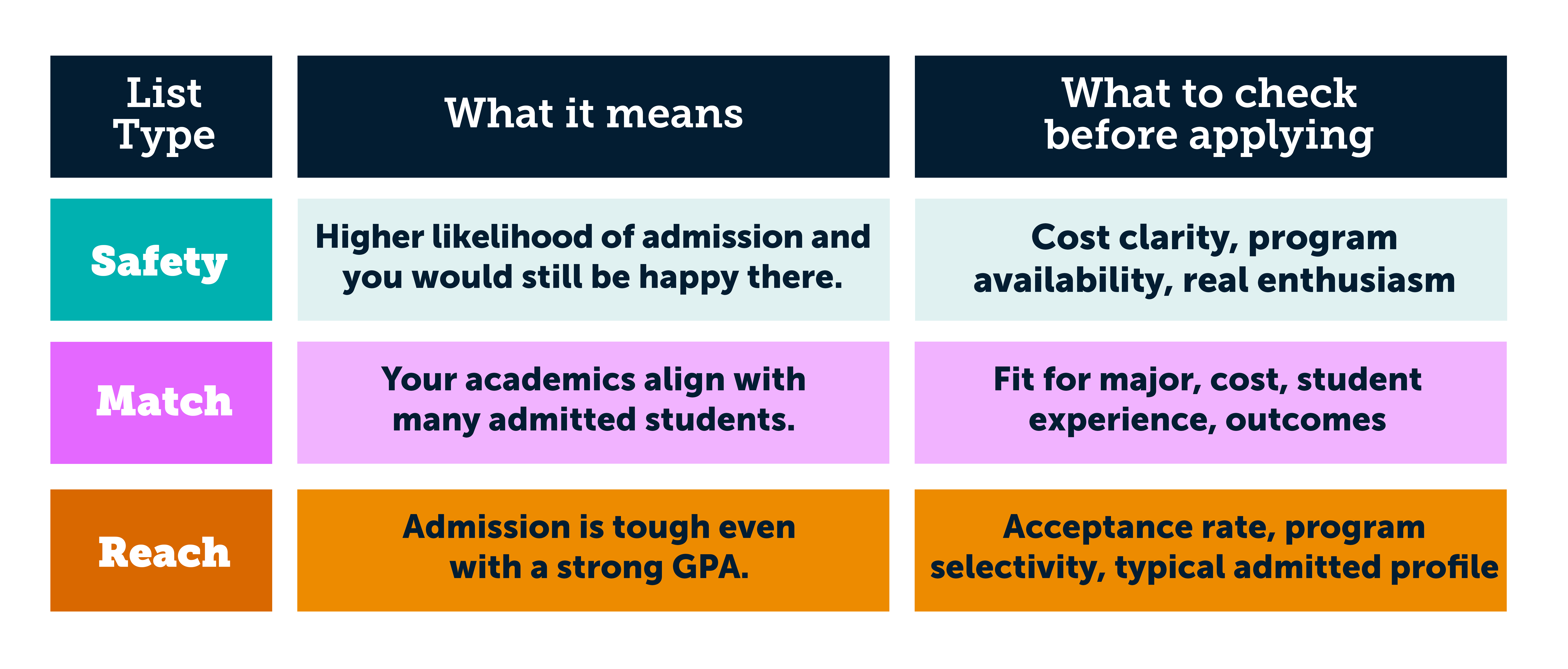
A 3.8 gives you the opportunity to build an excellent balanced list, but it does not eliminate the reach category. Keep highly selective colleges among your reaches. Identify matches where both your academic profile and the institution’s overall admission patterns make sense. Choose safeties that are financially and academically attractive, not just schools you assume will admit you.
How can you improve a 3.8 GPA?
Freshmen and sophomores
Continue strong performance while taking appropriately rigorous courses. Protecting a near-perfect number should not become a reason to avoid meaningful academic challenge.
Juniors
The combination of grades, rigor, and context matters more now than whether the GPA moves another tenth.
Seniors
A 3.8 already demonstrates strong academic performance on a common unweighted scale. Focus on maintaining it and creating the strongest overall applications you can.
What should you prioritize with a 3.8 GPA?
Be proud of your academic accomplishments (truly, a 3.8 is impressive), but avoid overconfidence. A high GPA can make you academically competitive at selective colleges without making admission probable at institutions with extremely competitive applicant pools.
Most useful next step: Keep highly selective colleges in the reach category and make sure your list also includes schools where a 3.8 creates clear academic and financial strength.
Can you get merit scholarships with a 3.8 GPA?
A 3.8 can create strong merit-aid opportunities at colleges where your academic profile stands toward the top of the applicant pool. That can be a strategically valuable alternative to using your GPA only to pursue increasingly selective institutions. Compare the full financial-aid package and expected net cost.
Is a 3.8 good enough for highly selective colleges?
It can make you academically competitive, but those colleges often evaluate many applicants with similarly strong records. Admission remains uncertain because GPA is only one part of the application.
Should you choose a more-selective college over one offering merit aid?
Not automatically. Compare academic fit, program strength, outcomes, financial aid, and actual net cost rather than treating selectivity as the main measure of value.
What colleges look at besides your GPA
GPA is just one aspect colleges review when looking through your college application. Make sure to include as many aspects of your high school career as possible, including any (or all) of the following:
How to use the college list
The colleges below are included because their average GPA falls within 3.7–3.9. This range is a discovery tool, not an admissions prediction. A reported average GPA is not a minimum, cutoff, or guarantee, and a college may calculate GPA differently from your high school. Current admission policies, program requirements, and academic profiles can change. Verify each college’s current information and compare your full academic profile before deciding whether the school is a safety, match, or reach.
Explore colleges for every GPA with Appily
Ready to explore colleges that accept a GPA like yours? We have a comprehensive database to help you find and research schools. There, you can see essential data points like acceptance rate, average financial aid award, average test scores, and application deadlines, including those for rolling admission, early decision, and early action schools.