Best Colleges for Students with Disabilities in 2026

There is no single best college for every student with a disability or learning difference. The strongest choice is a college that can meet your specific access and support needs while also fitting your academic goals, budget, admissions profile, location preferences, and preferred campus experience.
Depending on your needs, you may be looking for:
- Academic adjustments such as extended testing time, accessible course materials, captioning, interpreting, or reduced-distraction testing
- Accessible housing, transportation, classrooms, laboratories, or campus facilities
- Assistive technology and training
- Recurring academic coaching or executive-functioning support
- Autism or neurodivergence-focused transition and social support
- An inclusive postsecondary education program for a student with an intellectual disability
The colleges in this guide are not ranked. Use the comparison tools to identify schools and programs worth investigating, then verify eligibility, documentation, fees, capacity, applications, and housing deadlines directly with each college.
The TL;DR:
- The best college for students with disabilities is not the same for everyone. It depends on your support needs, academic goals, budget, location, and preferred campus environment.
- Colleges covered by federal disability laws must provide eligible students with reasonable accommodations or academic adjustments. What varies from school to school is the request process and the level of support available beyond those legal requirements.
- Some colleges offer basic accommodations, while others have specialized programs for learning disabilities, ADHD, dyslexia, autism, executive functioning, physical disabilities, sensory disabilities, or intellectual disabilities.
- Students with learning differences should look closely at coaching, tutoring, assistive technology, executive functioning support, writing help, advising, and transition programs.
- Some specialized disability-support programs cost extra, so always ask whether support is included in tuition or requires a separate fee.
- Before choosing a college, contact the disability services office, ask what documentation is required, and find out how accommodations work in real classes, housing, testing, and campus life.
- Appily can help you compare schools by cost, acceptance rate, location, majors, and campus resources so you can build a college list that fits your needs.
Bottom line: Don’t choose a college just because it appears on a list. Use the list to start your search, then verify the support, cost, accessibility, and fit for your specific needs.
How to use this list
This list is a starting point, not a one-size-fits-all ranking.
As you compare colleges, look for:
- The type of support offered for your disability or learning difference
- Whether the school has a disability services office, specialized program, or both
- Whether support is included or fee-based
- Academic accommodations, like extended test time, note-taking support, alternate formats, or reduced-distraction testing
- Structured support, like coaching, tutoring, executive functioning help, or weekly check-ins
- Housing and physical accessibility
- Assistive technology and accessible course materials
- Social, sensory, transition, or career support
- Academic fit, cost, location, and admissions chances
A school can have strong disability services and still not be the best fit for you. The goal is to find a college where the support matches your needs, and the rest of the college experience still makes sense.
This list is not a numerical ranking. Colleges were included based on publicly available information about their disability services, specialized support programs, accessibility resources, or inclusive postsecondary opportunities.
The best colleges for students with disabilities
American International College
American International College
Location: Springfield, Massachusetts
Support model: Standard accommodations plus fee-based enhanced academic support
Students served: Students with disabilities, including students with learning disabilities
Primary program or office: Center for Accessibility Services and Academic Accommodations; Supportive Learning Services
Additional fee: Yes, for Supportive Learning Services
Separate application: Students must enroll separately in Supportive Learning Services
Degree status: Support for enrolled degree-seeking students
Last verified: July 2026
American International College’s Center for Accessibility Services and Academic Accommodations coordinates approved academic and campus accommodations. Students who need more intensive academic help can also enroll in Supportive Learning Services, which provides individualized tutoring and support with reading, writing, organization, study strategies, and executive functioning.
Adelphi University
Adelphi University
Location: Garden City, New York
Support model: Standard accommodations plus two fee-based enhanced-support programs
Students served: Students with learning disabilities, ADHD, autism, nonverbal learning disabilities, and related executive-function or social challenges
Primary programs or offices: Student Access Office; Learning Resource Program; Bridges to Adelphi
Additional fee: Yes, for the Learning Resource Program and Bridges to Adelphi
Separate application: Yes; enhanced programs have additional enrollment requirements
Degree status: Support for enrolled degree-seeking students
Last verified: July 2026
Adelphi offers standard disability accommodations as well as two structured support options. The Learning Resource Program provides individualized academic support for students with learning disabilities or ADHD, while Bridges to Adelphi adds academic, social, vocational, and executive-function coaching for autistic and otherwise neurodivergent students.
Augsburg University
Augsburg University
Location: Minneapolis, Minnesota
Support model: Standard disability accommodations with integrated academic-support resources
Students served: Students with learning disabilities, ADHD, autism, mental health conditions, chronic health conditions, and physical or sensory disabilities
Primary program or office: Center for Learning and Accessible Student Services
Additional fee: No fee for approved accommodations
Separate application: No separate academic program application; students complete the accommodation-request process
Degree status: Support for enrolled degree-seeking students
Last verified: July 2026
Augsburg’s Center for Learning and Accessible Student Services coordinates individualized accommodations and helps students develop strategies for navigating academic expectations. Support is available to students with a broad range of documented disabilities and health conditions.
Baylor University
Baylor University
Location: Waco, Texas
Support model: Standard disability accommodations
Students served: Students with documented physical, sensory, learning, psychological, and health-related disabilities
Primary program or office: Office of Access and Learning Accommodation
Additional fee: No fee for approved accommodations
Separate application: No separate support-program application; students submit an accommodation request
Degree status: Support for enrolled degree-seeking students
Last verified: July 2026
Baylor’s Office of Access and Learning Accommodation coordinates individualized academic, testing, housing, and campus-access accommodations. Students should not expect a separate enhanced coaching program unless the university confirms that one is currently available.
Beacon College
Beacon College
Location: Leesburg, Florida
Support model: College designed specifically for students with learning differences
Students served: Students with learning disabilities, ADHD, autism, and related learning differences
Primary program or office: Support is integrated throughout the college
Additional fee: No separate enhanced-program fee
Separate application: No separate support application beyond admission to Beacon
Degree status: Accredited associate and bachelor’s degree programs
Last verified: July 2026
Beacon College is an accredited institution designed specifically for students with learning disabilities, ADHD, autism, and related learning differences. Academic advising, learning support, career preparation, and skill development are integrated into the college experience rather than offered as an optional add-on.
Bellevue College
Bellevue College
Location: Bellevue, Washington
Support model: Standard accommodations plus a structured neurodiversity-support program
Students served: Autistic and otherwise neurodivergent students
Primary programs or offices: Disability Resource Center; Neurodiversity Navigators
Additional fee: Check with the Neurodiversity Navigators program for any additional fees
Separate application: Yes, for Neurodiversity Navigators
Degree status: Support for Bellevue students pursuing degrees or certificates
Last verified: July 2026
Bellevue College’s Disability Resource Center coordinates standard accommodations. Neurodiversity Navigators provides additional classes, cohort activities, advising, and skills-based support for autistic and otherwise neurodivergent students. A formal diagnosis is not necessarily required for participation, but availability and enrollment requirements should be confirmed directly.
Centenary University
Centenary University
Location: Hackettstown, New Jersey
Support model: Standard accommodations plus fee-based enhanced support
Students served: Students with learning, attention, executive-function, and related support needs
Primary programs or offices: Accessibility Services Office; Access+
Additional fee: Yes, for Access+
Separate application: Yes; students enroll in Access+ separately
Degree status: Support for enrolled degree-seeking students
Last verified: July 2026
Centenary’s Accessibility Services Office coordinates approved accommodations. Access+ provides more intensive support through individual meetings, academic assistance, tutoring coordination, executive-function strategies, and community-building opportunities such as the Bridges social group.
Curry College
Curry College
Location: Milton, Massachusetts
Support model: Standard accommodations plus a fee-based, credit-bearing academic-support program
Students served: Students with diagnosed learning differences, ADHD, and executive-function challenges
Primary program or office: Program for Advancement of Learning
Additional fee: Yes
Separate application: Yes, students apply to the Program for Advancement of Learning
Degree status: Support for enrolled degree-seeking students
Last verified: July 2026
Curry College’s Program for Advancement of Learning offers credit-bearing courses and individualized academic support for students with learning differences. Students work on study strategies, writing, organization, self-advocacy, and executive functioning while completing their regular degree requirements.
College of Charleston
College of Charleston
Location: Charleston, South Carolina
Support model: Standard disability services plus a separate inclusive postsecondary program
Students served: Degree-seeking students with disabilities and students with intellectual or cognitive disabilities seeking an inclusive college experience
Primary programs or offices: Center for Disability Services; REACH Program
Additional fee: No fee for approved accommodations; REACH has separate program costs
Separate application: Yes, for REACH
Degree status: Disability services support degree-seeking students; REACH is a separate nondegree program
Last verified: July 2026
Daemen University
Daemen University
Location: Amherst, New York
Support model: Standard accommodations plus autism-focused enhanced support
Students served: Autistic degree-seeking students and other students with documented disabilities
Primary programs or offices: Accessibility Services; Center for Autism Training and Support
Additional fee: Check the College Autism Transition Support (CATS) for current fees/costs
Separate application: No
Degree status: Support for enrolled degree-seeking students
Last verified: July 2026
Daemen’s Center for Autism Training and Support provides structured transition and coaching support for autistic students enrolled in degree programs. Services include recurring meetings and assistance with academic habits, campus navigation, life skills, and social or executive-function needs. Daemen is also launching ASCEND, a separate career-focused credential program for students with intellectual and developmental disabilities, beginning in fall 2026.
Dean College
Dean College
Location: Franklin, Massachusetts
Support model: Fee-based cohort and coaching program
Students served: Students with diagnosed learning disabilities and other learning challenges
Primary program or office: Arch Learning Community
Additional fee: Yes
Separate application: Students indicate interest and submit additional materials as part of the admissions process
Degree status: Support for enrolled degree-seeking students
Last verified: July 2026
Dean College’s Arch Learning Community combines specialized courses, individualized coaching, weekly seminars, and academic advising. Students no longer complete the former standalone Arch application, but they must indicate interest and follow the current supplemental admissions process.
Defiance College
Defiance College
Location: Defiance, Ohio
Support model: Fee-based autism-support program
Students served: Autistic degree-seeking students
Primary program or office: ASD Affinity Program
Additional fee: Yes; $1,550 per semester for 2026–27.
Separate application: Yes
Degree status: Support for enrolled degree-seeking students
Last verified: July 2026
The ASD Affinity Program provides autistic students with weekly individual support, a dedicated community space, peer mentoring, an additional advisor, and career or internship preparation. Participation requires a separate program application in addition to admission to Defiance College.
DePaul University
DePaul University
Location: Chicago, Illinois
Support model: Standard accommodations plus fee-based educational support
Students served: Students with learning, attention, psychological, physical, sensory, and other documented disabilities
Primary programs or offices: Center for Students with Disabilities; Education Support Services
Additional fee: Yes, for Education Support Services
Separate application: Students register with the disability center and enroll separately in the paid service
Degree status: Support for enrolled degree-seeking students
Last verified: July 2026
DePaul’s Center for Students with Disabilities coordinates approved accommodations. Students who need more structured assistance can use fee-based Education Support Services for recurring work with a learning specialist on executive functioning, academic strategies, organization, and self-advocacy.
Eastern Michigan University
Eastern Michigan University
Location: Ypsilanti, Michigan
Support model: Autism-focused enhanced support
Students served: Autistic degree-seeking students
Primary program or office: College Supports Program
Additional fee: Yes; $6,500 per semester as of 2026-27
Separate application: Yes
Degree status: Support for enrolled degree-seeking students
Last verified: July 2026
Eastern Michigan University’s College Supports Program provides individualized assistance for autistic students completing undergraduate degree programs.
Framingham State University
Framingham State University
Location: Framingham, Massachusetts
Support model: Standard accommodations plus an inclusive postsecondary program
Students served: Degree-seeking students with disabilities and students ages 18–22 with intellectual disabilities or autism
Primary programs or offices: Accessibility Services; Massachusetts Inclusive Postsecondary Education Initiative
Additional fee: No fee for approved accommodations
Separate application: Yes, for MAIPSE
Degree status: Accessibility Services supports degree-seeking students; MAIPSE is an inclusive nondegree experience
Last verified: July 2026
Framingham State’s MAIPSE program allows eligible students with intellectual disabilities or autism to participate in college courses, internships, campus activities, and transition-focused learning. Framingham State’s MAIPSE program allows eligible students with intellectual disabilities or autism to participate in college courses, internships, campus activities, and transition-focused learning. MAIPSE is an inclusive nondegree postsecondary program, not a disability-support service for students pursuing a traditional bachelor’s degree.
Gallaudet University
Gallaudet University
Location: Washington, DC
Support model: Bilingual university designed primarily for Deaf and hard-of-hearing students
Students served: Deaf and hard-of-hearing students, with limited undergraduate pathways for qualified hearing students
Primary program or office: Support is integrated throughout Gallaudet’s ASL-English academic environment
Additional fee: No separate enhanced-support fee
Separate application: No separate support application beyond Gallaudet’s admissions requirements
Degree status: Accredited undergraduate and graduate degree programs
Last verified: July 2026
Gallaudet University is a bilingual American Sign Language and English institution designed primarily for Deaf and hard-of-hearing students. Accessibility, language access, Deaf culture, and visual communication are integrated into the broader academic and campus environment rather than confined to a separate support program.
Hofstra University
Hofstra University
Location: Hempstead, New York
Support model: Standard accommodations plus fee-based academic support
Students served: Students with specific learning disabilities, ADHD, and other documented disabilities
Primary programs or offices: Student Access Services; Program for Academic Learning Skills (PALS)
Additional fee: Yes, for PALS
Separate application: Yes; program admission includes an additional review or interview process
Degree status: Support for enrolled degree-seeking students
Last verified: July 2026
Hofstra’s Program for Academic Learning Skills offers structured, individualized work with a learning specialist for eligible students with learning disabilities or ADHD. Enrollment is limited, carries an additional fee, and is separate from the process of registering for standard accommodations through Student Access Services.
Kent State University
Kent State University
Location: Kent, Ohio
Support model: Standard disability accommodations
Students served: Students with documented learning, attention, psychological, sensory, physical, and health-related disabilities
Primary program or office: Student Accessibility Services
Additional fee: No fee for approved accommodations
Separate application: No separate program application; students register for accommodations
Degree status: Support for enrolled degree-seeking students
Last verified: July 2026
Kent State’s Student Accessibility Services office coordinates individualized academic and campus accommodations. The university’s current accessibility information does not list a separate fee-based coaching or disability-specific degree-support program.
Landmark College
Landmark College
Location: Putney, Vermont
Support model: College designed specifically for neurodivergent students
Students served: Students with learning disabilities, dyslexia, ADHD, autism, and executive-function challenges
Primary program or office: Support is integrated throughout the college
Additional fee: No separate enhanced-program fee; support is part of the educational model
Separate application: No separate support application beyond admission to Landmark
Degree status: Accredited associate and bachelor’s degree programs
Last verified: July 2026
Landmark College is designed specifically for neurodivergent students and integrates learning strategies, advising, executive-function development, and academic support throughout its programs.
Lesley University
Lesley University
Location: Cambridge, Massachusetts
Support model: Separate supportive college-experience program
Students served: Neurodivergent young adults who need support with academics, career preparation, social development, and independent living
Primary program or office: Threshold Program
Additional fee: Yes
Separate application: Yes
Degree status: Nondegree program
Last verified: July 2026
Lesley’s Threshold Program is a non-degree program that combines coursework, internships, independent-living instruction, social development, and career preparation.
Loras College
Loras College
Location: Dubuque, Iowa
Support model: Standard accommodations plus fee-based autism support
Students served: Autistic degree-seeking students and students with other documented disabilities
Primary programs or offices: Lynch Learning Center; Autism Resources for Career and Higher Education
Additional fee: Yes, for ARCH
Separate application: Yes
Degree status: Support for enrolled degree-seeking students
Last verified: July 2026
Loras College’s four-year ARCH program supports autistic students with recurring staff meetings and help developing organization, self-advocacy, stress-management, social, career, and independent-living skills. Standard disability accommodations are separate from the enhanced ARCH service.
Lynn University
Lynn University
Location: Boca Raton, Florida
Support model: Fee-based academic coaching and learning support
Students served: Students with ADHD, dyslexia, autism, and other learning differences
Primary program or office: Institute for Achievement and Learning
Additional fee: Yes
Separate application: Yes; students complete a separate registration process
Degree status: Support for enrolled degree-seeking students
Last verified: July 2026
Lynn’s Institute for Achievement and Learning provides individualized academic coaching, tutoring, writing support, assistive-technology guidance, and executive-function assistance.
Manhattanville University
Manhattanville University
Location: Purchase, New York
Support model: Fee-based academic and neurodivergence support
Students served: Students with learning disabilities, ADHD, autism, and other executive-function or neurodivergence-related needs
Primary programs or offices: Valiant Learning Support Program; Pathways and Connections
Additional fee: Yes
Separate application: Yes
Degree status: Support for enrolled degree-seeking students
Last verified: July 2026
Manhattanville currently offers the Valiant Learning Support Program for individualized learning-strategy and executive-function support and Pathways and Connections for college-ready neurodivergent students.
Marist University
Marist University
Location: Poughkeepsie, New York
Support model: Standard accommodations plus fee-based academic support
Students served: Students whose primary diagnosis is a learning disability or ADHD
Primary programs or offices: Accessibility and Accommodations; Learning Support Program
Additional fee: Yes; currently $3,085 per semester.
Separate application: Yes, through a supplemental Learning Support Program application
Degree status: Support for enrolled degree-seeking students
Last verified: July 2026
Marshall University
Marshall University
Location: Huntington, West Virginia
Support model: Fee-based autism-support program
Students served: Degree-seeking students with autism
Primary program or office: College Program for Students with Autism Spectrum Disorder
Additional fee: Yes; currently $5,000 per semester
Separate application: Yes, separate from admission to Marshall
Degree status: Support for enrolled degree-seeking students
Last verified: July 2026
Marshall’s College Program for Students with Autism Spectrum Disorder provides individualized academic, social, career, daily-living, and executive-function support. Students must be admitted to Marshall and complete a separate program application before participating.
Mercyhurst University
Mercyhurst University
Location: Erie, Pennsylvania
Support model: Autism-focused enhanced support
Students served: Degree-seeking students with autism
Primary program or office: Autism Initiative at Mercyhurst
Additional fee: Yes
Separate application: Yes
Degree status: Support for enrolled degree-seeking students
Last verified: July 2026
The Autism Initiative at Mercyhurst supports autistic students as they adjust to college and develop academic, social, career, self-advocacy, and independent-living skills.
Messiah University
Messiah University
Location: Mechanicsburg, Pennsylvania
Support model: Standard accommodations plus broadly available academic coaching
Students served: Students with documented disabilities and undergraduates seeking help with academic habits
Primary programs or offices: Office of Academic Accessibility; Academic Coaching
Additional fee: No additional fee
Separate application: No separate enhanced-program application; students request accommodations or schedule coaching
Degree status: Support for enrolled degree-seeking students
Last verified: July 2026
Messiah’s Office of Academic Accessibility coordinates approved accommodations. Undergraduate students can also use academic coaching to work on organization, time management, test preparation, study strategies, and other college-success skills.
Mitchell College
Mitchell College
Location: New London, Connecticut
Support model: Separate residential pre-college transition program
Students served: Students with learning differences or students who need additional preparation before entering college
Primary program or office: Thames at Mitchell College
Additional fee: Yes; Thames has a comprehensive program fee
Separate application: Yes
Degree status: Nondegree pre-college transition program, with opportunities to earn some college credit
Last verified: July 2026
Thames is a residential transition program that helps students strengthen academic, executive-function, self-advocacy, social, and independent-living skills before entering a degree program. It is not a disability-support service automatically available to all degree-seeking students.
Missouri State University - Springfield
Missouri State University – Springfield
Location: Springfield, Missouri
Support model: Standard disability accommodations
Students served: Students with documented physical, sensory, learning, psychological, and health-related disabilities
Primary program or office: Disability Resource Center
Additional fee: No fee for approved accommodations
Separate application: No separate support-program application; instead, students submit an accommodation request
Degree status: Support for enrolled degree-seeking students
Last verified: July 2026
Muskingum University
Muskingum University
Location: New Concord, Ohio
Support model: Standard accommodations plus tiered, fee-based learning support
Students served: Students with learning disabilities, ADHD, autism, executive-function challenges, and other academic-support needs
Primary programs or offices: Disability Resources; PLUS Program
Additional fee: Yes; fees vary by service level, up to $4,500 per semester for 2026–27
Separate application: Yes, for PLUS
Degree status: Support for enrolled degree-seeking students
Last verified: July 2026
Muskingum’s PLUS Program offers multiple levels of individualized assistance, including work with professional learning consultants, content tutoring, executive-function support, and social or transition guidance. You should make sure to compare the service levels carefully, because the intensity and cost vary.
Nicholls State University
Nicholls State University
Location: Thibodaux, Louisiana
Support model: Standard accommodations plus specialized, fee-based learning support
Students served: Students with dyslexia, related learning disabilities, and ADHD
Primary programs or offices: Student Access Center; Louisiana Center for Dyslexia and Related Learning Disorders
Additional fee: Yes; materials are listed at $525 per semester.
Separate application: Yes, separate from admission to Nicholls
Degree status: Support for enrolled degree-seeking students
Last verified: July 2026
The Louisiana Center provides individualized assistance with coursework, planning, remediation, assistive technology, and learning strategies. Students must be admitted to Nicholls and complete the center’s separate admission process.
Pennsylvania Western University, Edinboro
Pennsylvania Western University, Edinboro
Location: Edinboro, Pennsylvania
Support model: Standard disability accommodations
Students served: Students with documented learning, physical, sensory, psychological, and health-related disabilities
Primary program or office: Office for Students with Disabilities
Additional fee: No fee for approved accommodations
Separate application: No separate program application; students register for accommodations
Degree status: Support for enrolled degree-seeking students
Last verified: July 2026
Rutgers University
Rutgers University
Location: New Brunswick, New Jersey
Support model: Autism- and ADHD-focused enhanced support
Students served: Rutgers students with autism or ADHD
Primary program or office: College Support Program
Additional fee: $2,000 per year for Tier 1 services; $7,000 per year for Tier 2
Separate application: Yes; the process includes additional materials and an interview
Degree status: Support for enrolled Rutgers degree-seeking students
Last verified: July 2026
Rutgers’ College Support Program provides holistic academic, social, executive-function, and campus-transition support for students with autism or ADHD. Admission to Rutgers does not guarantee admission to the program.
Southern Illinois University - Carbondale
Southern Illinois University – Carbondale
Location: Carbondale, Illinois
Support model: Standard disability accommodations
Students served: Students with learning, physical, sensory, psychological, and health-related disabilities
Primary program or office: Office for Access and Accommodations
Additional fee: No fee for approved accommodations
Separate application: No separate program application; students submit an accommodation request
Degree status: Support for enrolled degree-seeking students
Last verified: July 2026
Southern Illinois University Carbondale’s Office for Access and Accommodations coordinates academic, housing, transportation, testing, alternative-format, interpreting, and speech-to-text accommodations.
Saint Vincent College
Saint Vincent College
Location: Latrobe, Pennsylvania
Support model: Inclusive transition program
Students served: Young adults ages 18–21 with intellectual or developmental disabilities
Primary program or office: Bearcat B.E.S.T.
Additional fee: While often district-sponsored, privately paid tuition is currently $18,531 per semester
Separate application: Yes
Degree status: Nondegree college-transition experience
Last verified: July 2026
Bearcat B.E.S.T. provides academic, vocational, independent-living, and social development within a college environment. It is a transition program rather than a bachelor’s-degree support service.
SUNY Cortland
SUNY Cortland
Location: Cortland, New York
Support model: Standard disability accommodations
Students served: Students with documented learning, attention, psychological, physical, sensory, and health-related disabilities
Primary program or office: Disability Resources Office
Additional fee: No fee for approved accommodations
Separate application: No separate program application; students register for accommodations
Degree status: Support for enrolled degree-seeking students
Last verified: July 2026
SUNY Cortland’s Disability Resources Office coordinates academic, testing, assistive-technology, accessible-text, housing, and other individualized accommodations.
Texas Tech University
Texas Tech University
Location: Lubbock, Texas
Support model: Nondegree transition and employment program
Students served: Adults with autism and adults with related developmental disabilities, generally ages 18–30
Primary program or office: Burkhart Center Transition Academy
Additional fee: Varies
Separate application: Yes
Degree status: Nondegree, nonresidential transition program
Last verified: July 2026
The Burkhart Center Transition Academy helps participants prepare for employment, independent living, and adult responsibilities. It is not a program for traditional Texas Tech students.
Ursuline College
Ursuline College
Location: Pepper Pike, Ohio
Support model: Standard accommodations plus fee-based academic support
Students served: Students with documented disabilities, including learning disabilities and ADHD
Primary programs or offices: Disability Services; FOCUS
Additional fee: Yes, for FOCUS (fee tiers range from $800 to $4,800 per semester)
Separate application: Students enroll separately in FOCUS
Degree status: Support for enrolled degree-seeking students
Last verified: July 2026
FOCUS provides additional transition, organization, time-management, study-skills, campus-navigation, and self-advocacy support.
University of Alabama
University of Alabama
Location: Tuscaloosa, Alabama
Support model: Fee-based autism-support program
Students served: Degree-seeking students with autism
Primary program or office: University of Alabama Autism Spectrum Disorders College Transition and Support Program
Additional fee: Yes; currently listed at $4,000 per semester
Separate application: Yes
Degree status: Support for enrolled degree-seeking students
Last verified: July 2026
UA-ACTS provides individualized academic, social, daily-living, transition, and self-advocacy support for autistic students. Students apply separately to the program after or alongside the university admissions process.
University of Arizona
University of Arizona
Location: Tucson, Arizona
Support model: Fee-based learning and attention support
Students served: Students with mild-to-moderate learning and attention challenges
Primary program or office: Strategic Alternative Learning Techniques Center
Additional fee: Yes
Separate application: Yes; students apply separately to the university and the SALT Center
Degree status: Support for enrolled degree-seeking students
Last verified: July 2026
The SALT Center provides individualized work with learning specialists, tutoring, educational technology, and support for academic strategies and executive functioning. Participation is separate from standard disability accommodations and requires an additional application and program fee.
University of California - Irvine
University of California – Irvine
Location: Irvine, California
Support model: Standard disability accommodations
Students served: Students with documented physical, sensory, learning, psychological, and health-related disabilities
Primary program or office: Disability Services Center
Additional fee: No fee for approved accommodations
Separate application: No separate program application; students register with the center
Degree status: Support for enrolled degree-seeking students
Last verified: July 2026
UC Irvine’s Disability Services Center coordinates academic, testing, communication-access, housing, and other individualized accommodations. The center also offers disability-management guidance and faculty liaison support, but it does not provide personal attendants or mobility training.
University of Connecticut
University of Connecticut
Location: Storrs, Connecticut
Support model: Standard accommodations plus fee-based enhanced support
Students served: Students with disabilities who want recurring academic, executive-function, social, well-being, or career support
Primary programs or offices: Center for Students with Disabilities; Beyond Access
Additional fee: Yes, for Beyond Access
Separate application: Yes, for Beyond Access
Degree status: Support for enrolled degree-seeking students
Last verified: July 2026
UConn’s Center for Students with Disabilities coordinates approved accommodations. Beyond Access is a separate fee-for-service program that pairs students with a strategy instructor to work on individualized academic, executive-function, social, well-being, and career-readiness goals.
University of Denver
University of Denver
Location: Denver, Colorado
Support model: Standard disability accommodations
Students served: Degree- and nondegree-seeking students with documented disabilities
Primary program or office: Student Disability Services
Additional fee: No fee for approved accommodations
Separate application: No separate program application; students submit an accommodation request
Degree status: Support for enrolled degree- and nondegree-seeking students
Last verified: July 2026
The University of Denver’s Student Disability Services office coordinates individualized academic and campus accommodations at no additional cost.
University of Indianapolis
University of Indianapolis
Location: Indianapolis, Indiana
Support model: Standard accommodations plus fee-based enhanced academic support
Students served: Students whose disabilities affect learning, organization, transition, or academic performance
Primary programs or offices: Disability Services; Build
Additional fee: Yes, for Build
Separate application: Students enroll separately in Build
Degree status: Support for associate and bachelor’s degree students
Last verified: July 2026
Build is a fee-for-service program that provides additional academic, social, and emotional support for students whose disabilities interfere with learning.
University of Iowa
University of Iowa
Location: Iowa City, Iowa
Support model: Comprehensive inclusive postsecondary program
Students served: College-age students with intellectual, cognitive, or learning disabilities
Primary program or office: UI REACH
Additional fee: Yes; UI REACH has separate tuition, housing, meal, and program expenses
Separate application: Yes
Degree status: Certificate program rather than a traditional bachelor’s degree
Last verified: July 2026
UI REACH is a comprehensive transition and postsecondary certificate program combining academics, campus life, career development, independent living, and residential experience. It is separate from the University of Iowa’s undergraduate degree programs and standard disability accommodations.
University of Montana
University of Montana
Location: Missoula, Montana
Support model: Autism-focused academic and executive-function support
Students served: Students with autism and students with related support needs
Primary program or office: Mentoring, Organization, and Social Support for Autism Inclusion on Campus
Additional fee: $25 per semester for social activities
Separate application: Yes, for enhanced executive-function support
Degree status: Support for enrolled degree-seeking students
Last verified: July 2026
MOSSAIC provides autistic students with mentoring, executive-function assistance, campus-transition support, and opportunities to build academic and social skills. Students should verify the current service levels, availability, costs, and application requirements directly with the program.
University of North Texas
University of North Texas
Location: Denton, Texas
Support model: Multiple neurodiversity and inclusive postsecondary programs
Students served: Neurodivergent degree-seeking students and, through a separate program, students with intellectual disabilities
Primary programs or offices: Neurodiversity Network; ENGAGE; ELEVAR
Additional fee: ELEVAR fees are $6,000 per semester
Separate application: Yes, for ENGAGE and ELEVAR
Degree status: ENGAGE supports degree-seeking students; ELEVAR is a separate inclusive postsecondary program
Last verified: July 2026
UNT’s Neurodiversity Network includes ENGAGE, which provides academic, vocational, social, and personal-development support for neurodivergent degree-seeking students, and ELEVAR, a distinct inclusive postsecondary option for students with intellectual disabilities.
University of Tennessee - Chattanooga
University of Tennessee – Chattanooga
Location: Chattanooga, Tennessee
Support model: Standard disability accommodations
Students served: Students with documented learning, attention, psychological, physical, sensory, and health-related disabilities
Primary program or office: Center for Student Accessibility
Additional fee: No fee for approved accommodations
Separate application: No separate program application; students register for accommodations
Degree status: Support for enrolled degree-seeking students
Last verified: July 2026
UTC’s Center for Student Accessibility coordinates individualized academic, testing, assistive-technology, and campus-access accommodations.
University of the Ozarks
University of the Ozarks
Location: Clarksville, Arkansas
Support model: Standard accommodations plus comprehensive fee-based learning support
Students served: Students with learning disabilities, ADHD, autism, and related learning differences
Primary programs or offices: Disability Services; Jones Learning Center
Additional fee: Yes, for the Jones Learning Center
Separate application: Students complete a separate Jones Learning Center enrollment process
Degree status: Support for enrolled degree-seeking students
Last verified: July 2026
The Jones Learning Center is a fee-based-program that provides individualized academic support, professional tutoring, mentoring, testing assistance, and executive-function guidance.
University of South Florida
University of South Florida
Location: Tampa, Florida
Support model: Nondegree transition program
Students served: Young adults with autism who are preparing for employment, college, and greater independence
Primary program or office: LAUNCH Academy
Additional fee: $9,900 annually
Separate application: Yes
Degree status: Nondegree transition program
Last verified: July 2026
LAUNCH Academy is a 30-week, two-semester transition program focused on employment readiness, college preparation, independent living, and adult responsibilities. It is distinct from accommodations or enhanced support for students completing a University of South Florida degree.
West Virginia Wesleyan College
West Virginia Wesleyan College
Location: Buckhannon, West Virginia
Support model: Standard accommodations plus optional fee-based academic coaching
Students served: Students with learning disabilities, ADHD, other disabilities, and students seeking additional academic support
Primary program or office: Learning Center
Additional fee: Yes, for enhanced coaching or comprehensive support
Separate application: Students enroll separately in the enhanced service
Degree status: Support for enrolled degree-seeking students
Last verified: July 2026
West Virginia Wesleyan offers standard accessibility services as well as optional individualized academic coaching and comprehensive educational support. Enhanced services may include professional tutoring and help with reading, writing, organization, study strategies, and executive functioning.
Western Kentucky University
Western Kentucky University
Location: Bowling Green, Kentucky
Support model: Fee-based autism-support program
Students served: Degree-seeking students with autism
Primary program or office: Kelly Autism Program Circle of Support
Additional fee: Yes; currently $5,000 per semester, separate from tuition and housing
Separate application: Yes; students complete an interest meeting and additional application process
Degree status: Support for enrolled degree-seeking students
Last verified: July 2026
The Circle of Support provides structured study time, mentoring, social activities, counseling access, and recurring work with a program advisor. Students must first be accepted to Western Kentucky University and then complete the Kelly Autism Program’s separate participation process.
Western Michigan University
Western Michigan University
Location: Kalamazoo, Michigan
Support model: Standard accommodations plus fee-based autism and neurodiversity support
Students served: Degree-seeking students with autism or other neurodivergencies, including some students without a formal diagnosis
Primary programs or offices: Disability Services for Students; Autism Services Center
Additional fee: Yes; currently $2,500 per semester for full Autism Services Center participation
Separate application: Yes; students apply after being accepted to Western Michigan
Degree status: Support for enrolled degree-seeking students
Last verified: July 2026
Western Michigan’s Autism Services Center provides support beyond standard accommodations, including weekly individual meetings, structured study times, workshops, social activities, and help with academic, employment, independent-living, and communication goals. Fall 2026 participation requires a separate application, support-system questionnaire, and interview, and services are available until capacity is reached.
**This list of colleges and universities is not exhaustive. While we’ve highlighted some institutions known for their disability support services, many other schools have excellent programs too. We encourage you to research further and contact schools directly to find the best fit for your unique needs. You can also read about colleges with exceptional support for neurodivergent students.
How Appily selected these colleges
This is a non-ranked starting list, not a declaration that one college is best for every student.
We considered colleges when official institutional sources documented one or more of the following:
- Structured academic coaching or executive-functioning support
- A specialized program for students with learning disabilities, ADHD, autism, or other forms of neurodivergence
- Disability-specific transition, mentoring, social, sensory, or career support
- Clearly documented physical, sensory, digital, housing, or transportation accessibility resources
- An inclusive postsecondary education program for students with intellectual disabilities
- Specific services that went beyond a general nondiscrimination statement
We compared factors such as:
- Type and level of support
- Students and needs served
- Program eligibility
- Support frequency
- Separate applications
- Additional fees
- Program capacity
- Housing and accessibility resources
- Transparency of official program information
Program information was reviewed using publicly available sources. Because services, eligibility, fees, and program availability can change, verify every detail directly with the college before applying or enrolling.
What makes a college a strong choice for a student with a disability?
A strong-fit college provides the accommodations and accessibility you need, explains its request process clearly, and offers an environment that works for you academically, financially, physically, and socially.
Some students need standard academic adjustments. Others may benefit from structured coaching, mentoring, transition support, social programming, or a specialized learning-support program.
One type of support is not automatically better than another. The right level depends on how you learn, live, organize your work, navigate the campus, and manage college responsibilities.
Disability services vs. specialized support programs
Many colleges have an accessibility or disability services office. At other schools, accommodation requests may be handled by an ADA or Section 504 coordinator or another designated administrator. Students may seek support for a disability, a learning difference, or another access need. Eligibility for legally required academic adjustments is determined individually through the college’s process. That office helps eligible students request accommodations, such as extended test time, accessible course materials, reduced-distraction testing, housing accommodations, ASL interpreting, captioning, note-taking support, or assistive technology.
Some colleges also offer more structured support programs. These may include academic coaching, executive functioning support, social skills support, transition programs, specialized advising, tutoring, mentoring, or regular meetings with learning specialists.
Both can be helpful. They just do different things.
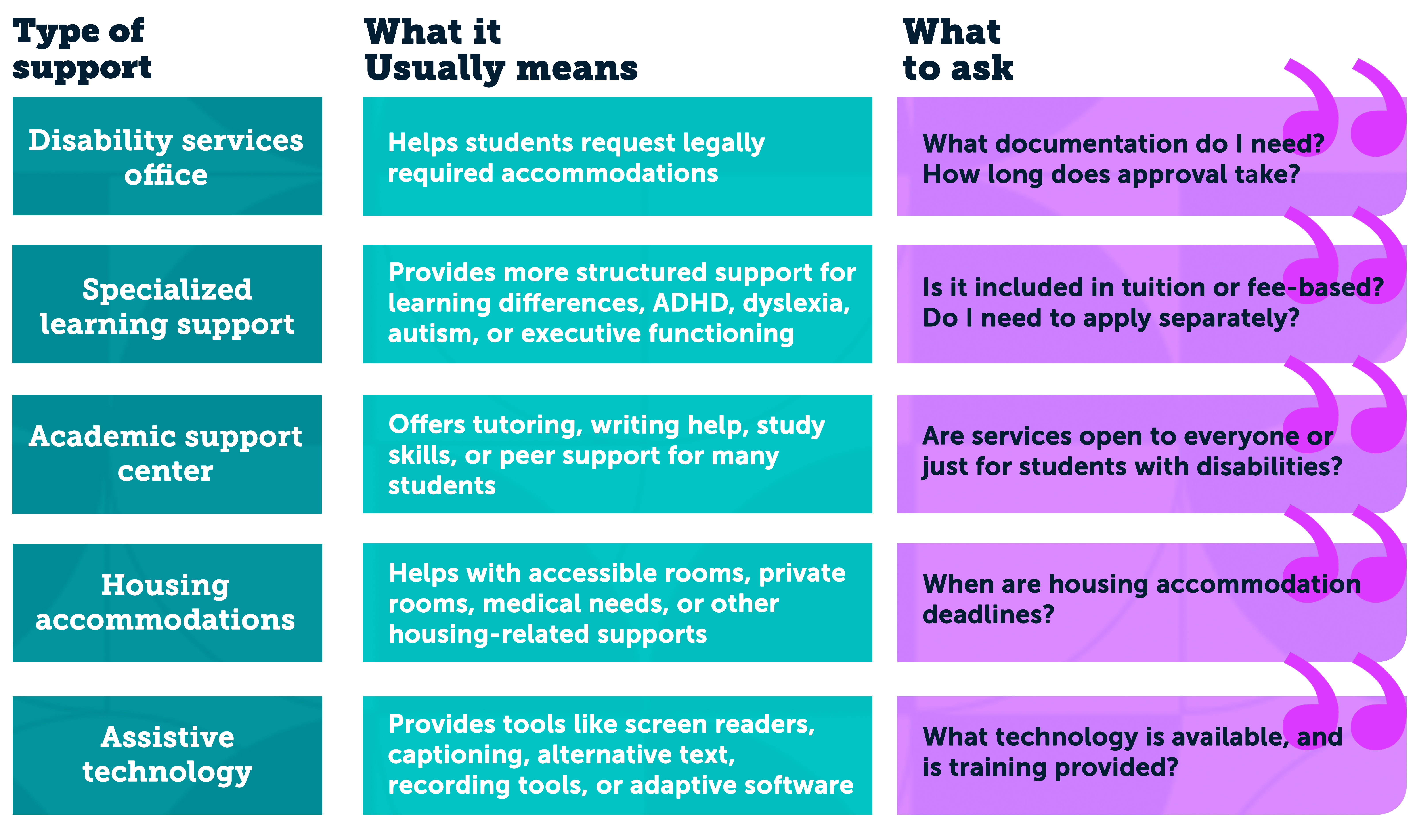
The U.S. Department of Education notes that postsecondary schools must provide appropriate academic adjustments when needed to avoid disability discrimination, but college is different from high school. Students often need to identify their needs and request support through the college’s process.
What to look for in colleges for learning differences and disabilities
When researching colleges for students with learning disabilities, learning differences, ADHD, autism, or other disabilities, look beyond the phrase “disability services available.”
A strong-fit college may offer:
- A clear disability services office with easy-to-find contact information
- Support for learning disabilities, ADHD, dyslexia, autism, executive functioning, or other learning differences
- Academic coaching, tutoring, writing support, or study-skills help
- Assistive technology and accessible course materials
- Reduced-distraction testing, extended time, note-taking support, or alternate-format materials
- Housing accommodations and accessible campus facilities
- Transition programs for first-year students
- Faculty communication support
- Peer mentoring, social support, or neurodiversity-focused programming
- Career support, internships, and help with self-advocacy after college
- Clear information about costs, especially for fee-based programs
Some students only need standard accommodations. Others may benefit from a more structured program with regular coaching or transition support. Neither is “better” for everyone. What matters is finding the level of support that fits how you learn, live, and manage college responsibilities.
Match support to your needs
Different students need different kinds of support. Use this as a quick guide when comparing schools.
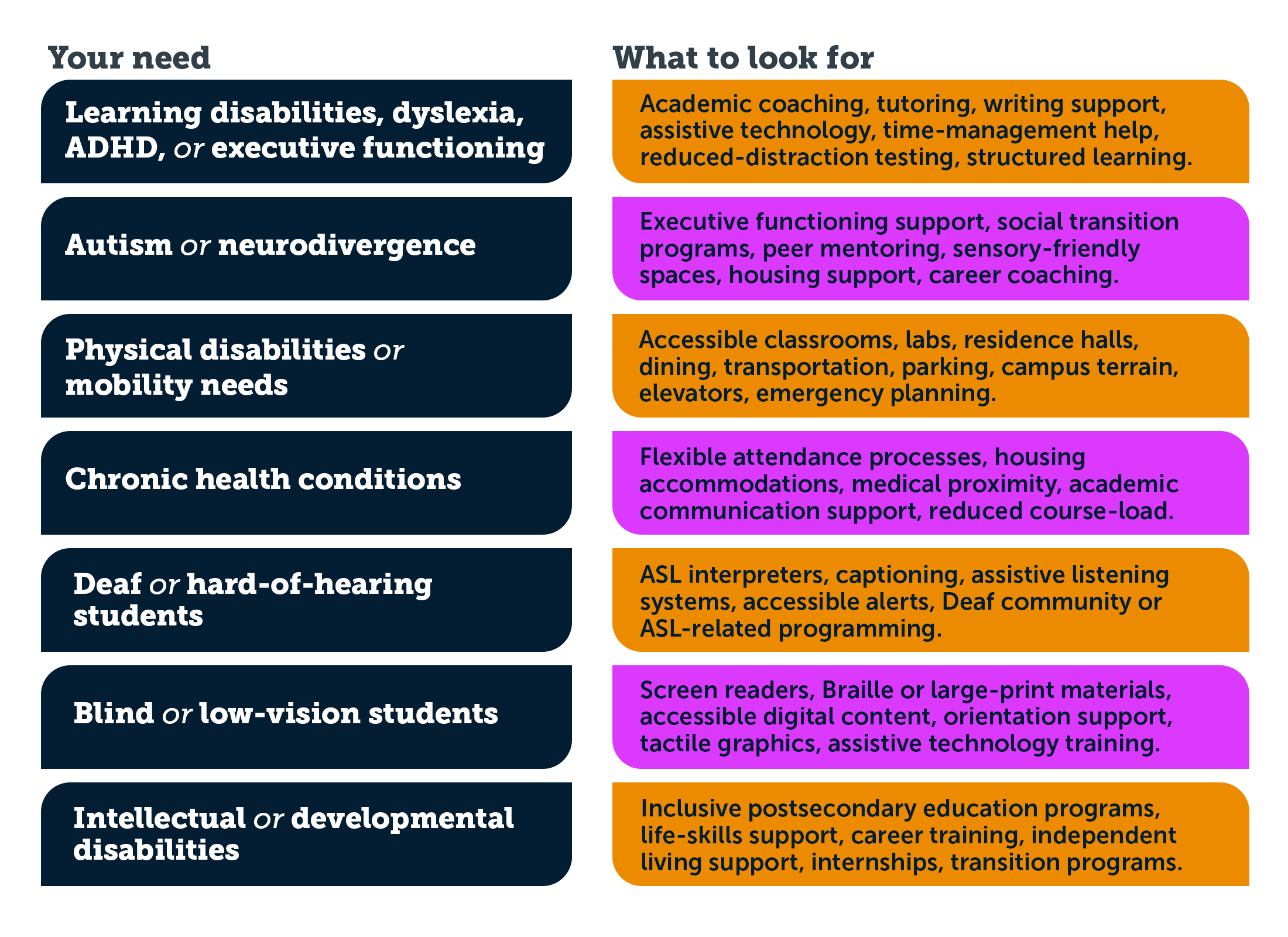
The U.S. Department of Education lists many examples of auxiliary aids and services, including note-takers, interpreters, readers, Braille materials, assistive listening devices, captioning, electronic readers, and other tools, depending on a student’s disability and needs.
Questions to ask disability services before you apply
Before you apply, deposit, or remove a school from your list, reach out to the disability services office. Ask specific questions, not just “Do you support students like me?”
Try asking:
- What accommodations are available for students with my disability or learning difference?
- What documentation do I need to request accommodations?
- When should I start the accommodations process?
- Are accommodations handled through one office or multiple offices?
- Do students need to apply separately for specialized support programs?
- Are coaching, tutoring, or learning support programs included in tuition or fee-based?
- How often can students meet with a learning specialist, advisor, or coach?
- Are housing accommodations available, and what are the deadlines?
- What assistive technology is available?
- How are faculty notified about approved accommodations?
- Are there supports for executive functioning, time management, or organization?
- Are there peer mentors, transition programs, or student groups?
- What happens if an accommodation is denied or doesn’t work well?
- How does the school support students during internships, labs, study abroad, or clinical placements?
- Can I talk with a current student who uses disability services?
Email template for contacting disability services
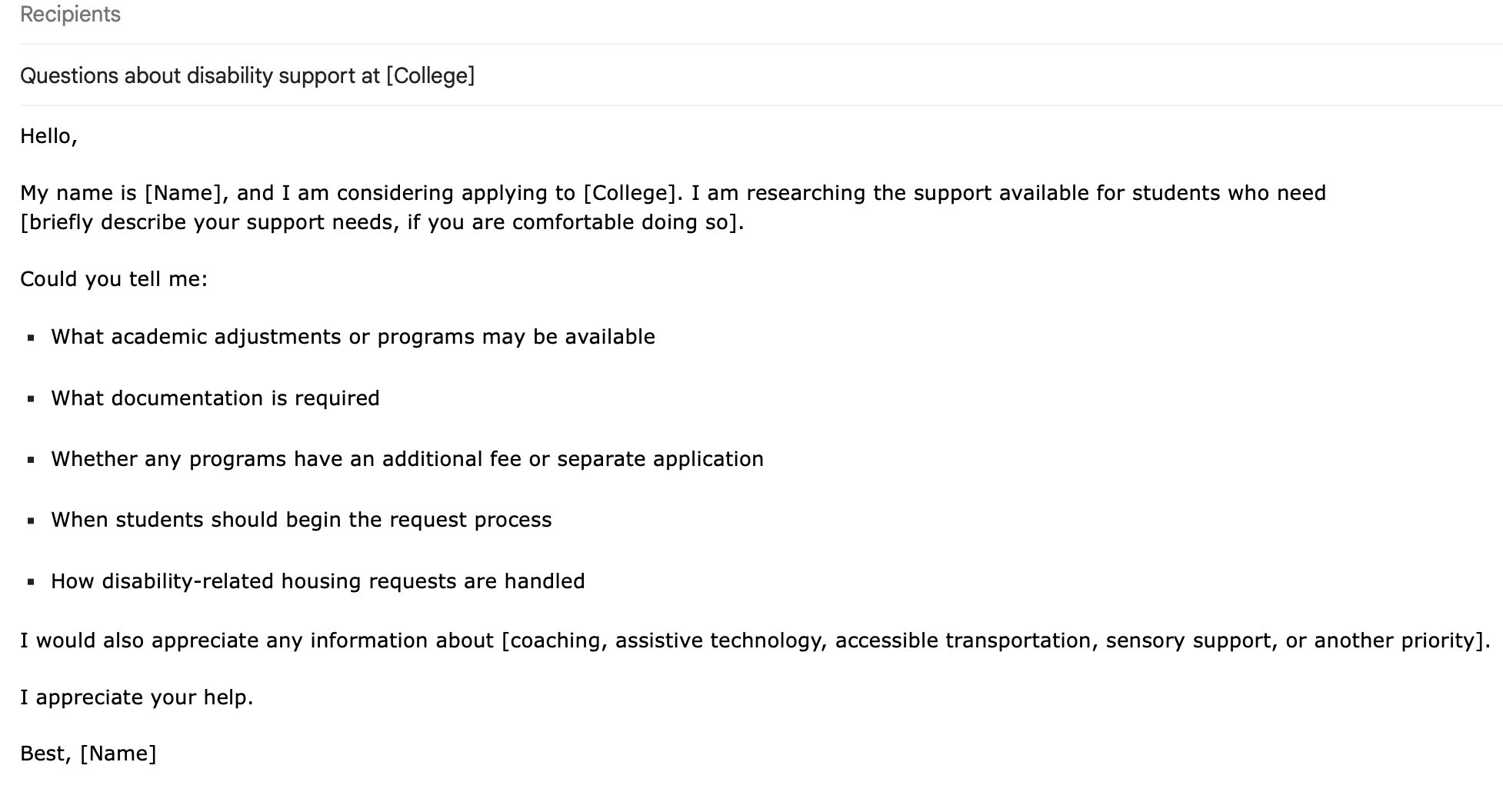
What changes from high school to college?
If you had an IEP, 504 plan, or school-based support in high school, college may feel different.
In high school, your school may have helped identify your needs and coordinate services. In college, you usually need to contact the disability services office, disclose your disability if you want accommodations, provide documentation if required, and follow the college’s process.
That does not mean you are on your own. It means self-advocacy becomes more important.
A college covered by applicable federal disability law cannot deny admission solely because you have a disability if you otherwise meet its essential admission requirements. But you do need to work with the college’s disability services office to request academic adjustments, auxiliary aids, housing accommodations, or other support.
When should you request academic adjustments?
Begin researching the process while building your college list, especially if you may need accessible housing, interpreters, alternative-format materials, assistive technology, or another service that can take time to arrange.
While building your college list
- Identify the support you use now
- Decide what support may be important in college
- Compare disability services and specialized programs
- Ask about fees and separate applications
Before applying
- Review documentation requirements
- Check whether specialized programs require separate applications
- Ask about disability-related housing deadlines
- Confirm whether the program has limited capacity
After admission
- Contact the disability services office
- Submit requested documentation
- Begin the housing process when applicable
- Review appeal and grievance procedures
Before classes begin
- Confirm approved academic adjustments
- Learn how professor notification works
- Arrange assistive technology or accessible materials
- Locate testing and accessibility offices
- Ask what to do if an adjustment is not working
The Department of Education recommends requesting academic adjustments as early as possible because some services take longer to arrange.
Red flags to watch for
A college deserves closer investigation when:
- Program fees are difficult to find
- The website does not explain how to request academic adjustments
- There is no named office or clear contact information
- Program descriptions make broad promises without identifying specific services
- A separate application is mentioned only late in the process
- Housing deadlines or responsibilities are unclear
- Program capacity is limited, but the selection process is not explained
- Staff cannot explain how frequently structured support is provided
- Appeal or grievance information is difficult to find
- The college does not explain what happens when an adjustment is ineffective
- Accessibility claims are not supported with specific information
- Program descriptions use outdated or demeaning disability terminology
One red flag does not automatically make a college a poor choice. It means you should ask more questions before making a decision.
Scholarships for Students with Disabilities
Scholarships may be available for students with disabilities, learning differences, chronic health conditions, or specific access needs. Some awards are based on a particular disability, while others consider factors such as intended major, career goals, financial need, location, leadership, or community involvement.
Scholarship availability, award amounts, eligibility requirements, and deadlines can change each year. Always verify the current application cycle on the scholarship provider’s official website before applying.
Before adding a scholarship to your list, confirm:
- The scholarship is accepting applications for your intended enrollment year
- You meet its disability, academic, residency, or degree requirements
- The current award amount and deadline
- Whether documentation is required
- Whether the scholarship is open to undergraduate, graduate, community college, or technical students
- Whether the award is renewable
Take a look at each college’s official accessibility or disability-services information to verify the specific support you need. Then, once you have narrowed your college list, use Appily to search for current scholarship opportunities and compare colleges by cost, financial aid, majors, location, and campus resources.
Ready to get started? Create your free Appily account now and take the first step towards finding the perfect college for you.
FAQs on the best colleges for students with disabilities
What are the best colleges for students with learning disabilities?
The best colleges for students with learning disabilities are schools that offer the right mix of academic accommodations, learning support, coaching, tutoring, assistive technology, and campus fit. Some students need a specialized program, while others do well with a strong disability services office and general academic support.
What should students with learning differences look for in a college?
Students with learning differences should look for support with executive functioning, time management, reading, writing, study skills, tutoring, assistive technology, and self-advocacy. It also helps to ask whether support is included in tuition or requires a separate fee.
Are colleges required to provide disability accommodations?
Colleges covered by Section 504, the ADA, or both must provide eligible students with reasonable accommodations or academic adjustments. However, the request process, documentation requirements, available services, and specialized support programs can vary by school.
Do IEPs and 504 plans transfer to college?
Your high school IEP or 504 plan does not automatically transfer to college. IDEA and IEP requirements no longer apply, but eligible college students may still be protected under Section 504 and the ADA. Your plan may help document your history, although the college may reasonably request additional information.
What is the difference between accommodations and specialized support programs?
Accommodations are changes that help provide equal access, such as extended time, accessible materials, or reduced-distraction testing. Specialized support programs may offer additional coaching, tutoring, executive functioning help, mentoring, or transition support. These programs may be optional, limited, application-based, or fee-based.
Do disability support programs cost extra?
Some do. Colleges cannot charge students for academic adjustments or auxiliary aids they are legally required to provide. However, optional coaching, executive-functioning support, transition programs, or other enhanced services may have separate fees. Ask the college which services are required access supports and which are optional programs.
What questions should I ask a college disability services office?
Ask what accommodations are available, what documentation is required, how long approval takes, whether support programs cost extra, how housing accommodations work, and whether students can access coaching, tutoring, assistive technology, or peer mentoring.
Are there scholarships for students with disabilities?
Yes. Some scholarships are for students with specific disabilities, such as blindness, hearing loss, learning disabilities, ADHD, autism, or mobility disabilities. Others are based on major, career goal, financial need, or identity. Always check eligibility and deadlines directly with the scholarship provider.
