Best Colleges for Neurodivergent Students (2026-27)

Finding the right college is already a lot to sort through. If you're neurodivergent, there can be another big question on top of academics, cost, and campus life: Will I actually have the support I need once I'm there?
The best colleges for neurodivergent students provide consistent, individualized support beyond standard disability accommodations. Depending on the school, that can include weekly executive functioning coaching, academic planning, mentoring, transition support, social connection, independent-living guidance, or career preparation.
Neurodivergence is an umbrella term for differences in how people think, learn, communicate, process information, or navigate daily life. It can include ADHD, autism, dyslexia, dyspraxia, and other learning or cognitive differences.
There is no single best college for every neurodivergent student. Think of this list as a place to start, not a list of schools you “should” choose. The right fit depends on the kind of support you want, how often you want it, what you're eligible for, and what fits your budget.
As you compare programs, focus on seven things: who the program serves, individual meeting frequency, program duration, staffing, eligibility, cost, and current capacity.
Program information last reviewed: October 2, 2026. Fees, eligibility, staffing, application status, and capacity can change during an admissions cycle. Availability notes below reflect what colleges reported on their official websites on that date. Use each linked program page to confirm current details before applying, depositing, or enrolling.
TL;DR: Best colleges for neurodivergent students
- The 30 colleges in this guide met Appily's criteria for sustained, individualized support beyond generic tutoring or drop-in help.
- Support can include executive functioning coaching, academic planning, mentoring, transition help, social support, independent-living guidance, and career preparation.
- Disability accommodations and specialized neurodiversity programs aren’t the same thing. Specialized programs can have separate applications, eligibility requirements, capacity limits, and fees.
- Compare programs by who they serve, meeting frequency, duration, staffing, eligibility, cost, capacity, and whether support can become more or less intensive over time.
- Beacon College and Landmark College build learning support into the broader undergraduate experience. Schools such as Auburn, George Mason, Rutgers, Syracuse, and UConn offer specialized programs within a larger college or university.
- If a specialized program is a big reason you're considering a college, verify your eligibility, program admission status, current capacity, and total additional cost before you commit.
What support should neurodivergent college students look for?
Start with the support you can picture yourself actually using each week. A college can have a long list of services and still not offer the kind of help that matters most to you.
The six areas worth comparing most closely are academic accommodations, executive functioning, college transition, social connection, independent living, and career preparation.
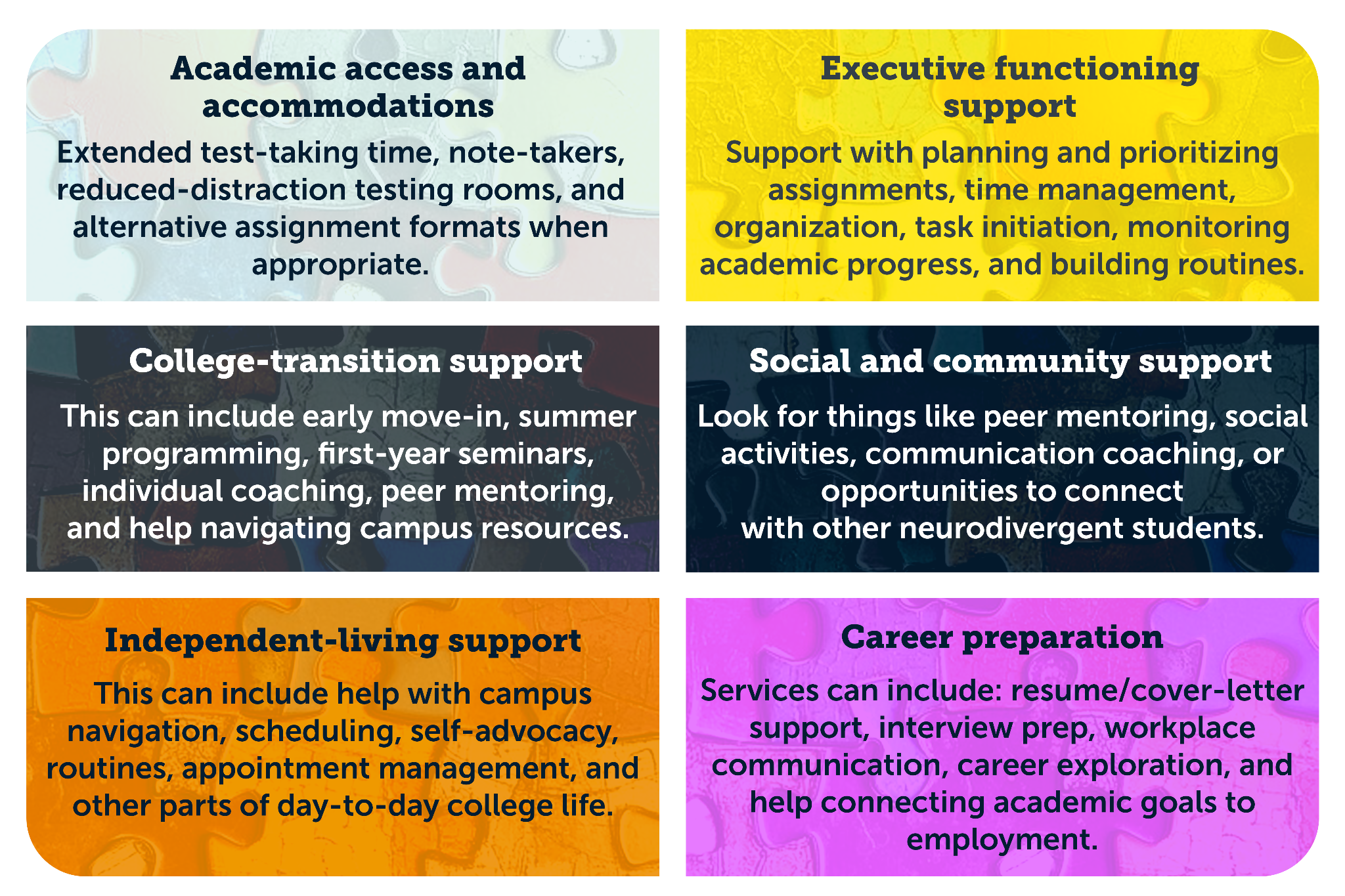
Academic access and accommodations
Academic accommodations are adjustments that give eligible students equal access to courses and college programs.
Depending on your disability and individual needs, adjustments can include extended testing time, reduced-distraction testing, accessible technology, note-taking support, or other access-related changes.
Colleges aren’t required to lower or substantially modify essential academic requirements or fundamentally alter a course or program.
For every college on your list, save the accessibility-services page and note the documentation process, testing procedures, and timeline for requesting accommodations. It's much easier to compare schools when you have those details in one place.
Executive functioning support
If planning, starting assignments, organization, or time management tends to trip you up, look for recurring individual coaching rather than relying only on tutoring.
Executive functioning support can focus on:
- Planning and prioritizing assignments
- Time management
- Organization
- Task initiation
- Breaking large assignments into smaller steps
- Monitoring academic progress
- Building weekly routines
Pay attention to how often meetings happen, who provides the coaching, and whether you can work on your actual assignments and calendar during those meetings.
College-transition support
If the move from high school to college feels like the biggest adjustment, look at what happens before and during the first semester.
Useful transition support can include:
- Early move-in
- Pre-semester or summer programming
- First-year seminars
- Orientation programming
- Individual coaching
- Peer mentoring
- Help navigating campus resources
Find out exactly when the support starts and whether it continues after the first few weeks. A great orientation program and a full year of transition support are two very different things.
Social and community support
If finding your people matters to you, look beyond whether a school simply says it offers “social support.”
Compare whether the program offers:
- Peer mentoring
- Neurodivergent student groups
- Structured social activities
- Communication coaching
- Professionally facilitated groups
- Opportunities to connect with other neurodivergent students
Also check how often activities happen and whether they're optional or required. One student may love a packed calendar of structured events; another may want community without another weekly commitment.
Independent-living support
If living away from home will mean learning a lot of new routines at once, look for support that goes beyond academics.
That can include help with campus navigation, scheduling, self-advocacy, residential routines, appointment management, and other parts of day-to-day college life.
Before you compare schools, think about the two or three everyday tasks you'd most want help figuring out. Then see whether the program actually addresses them.
Career preparation
If you'd like support to continue into internships and your first job, check whether career preparation is built into the neurodiversity program.
Services can include:
- Resume and cover-letter support
- Interview preparation
- Workplace communication
- Career exploration
- Internship preparation
- Help connecting academic goals to employment
Also look at when career support starts. Some programs introduce it early, while others focus on it once students are closer to internships or graduation.
Before you move into the college list below, write down the two or three support areas that matter most to you. They'll make it much easier to spot the programs worth a closer look.
Disability services vs. specialized neurodiversity programs: What's the difference?
Disability or accessibility services provide eligible students with academic adjustments and auxiliary aids for equal access. Specialized neurodiversity programs provide additional coaching, structure, mentoring, transition support, or other services beyond those accommodations.
This distinction is easy to miss, but it matters.
Disability-service adjustments can include extended testing time, reduced-distraction testing, accessible technology, note-taking support, or other approved adjustments based on an eligible student's individual needs.
A specialized program can add services such as:
- Weekly executive functioning coaching
- Academic planning
- Mentoring
- Transition support
- Social programming
- Independent-living support
- Career preparation
Those specialized programs can also have their own eligibility rules, applications, capacity limits, and fees.
Under U.S. Department of Education Office for Civil Rights guidance, colleges must provide eligible students with appropriate academic adjustments and auxiliary aids or services needed for equal access, but they are not required to fundamentally alter essential academic requirements. Optional programs that provide services beyond required accommodations can operate separately and charge additional fees.
For every college you're seriously considering, answer these two questions separately:
- What academic adjustments could I qualify for through disability or accessibility services?
- What recurring support is available beyond those accommodations?
Save both the accessibility-services page and the specialized-program page with your college notes. That way, you'll know exactly which office provides which kind of help.
Best colleges for neurodivergent students
Every college on this list met Appily's criteria for sustained, individualized support for neurodivergent students. The list isn't ranked, because the program that's right for you depends on your support needs, eligibility, budget, and how much structure you want.
Use the linked official program pages to confirm fees, eligibility, application procedures, availability, and capacity before making an enrollment decision.
Adelphi University
Program name: Bridges to Adelphi |
|

It might fit if: You want academic, social, executive functioning, and career coaching in one program.
Adelphi's Bridges to Adelphi supports students who self-disclose as autistic or who have other nonverbal or social-communication differences.
Individual support: The program combines individualized academic, social, and executive functioning support with vocational and career preparation.
What stands out: Students can work on resumes, interviews, internships, workplace communication, and other areas beyond academics.
Current cost and eligibility: Adelphi lists the 2026–27 Bridges to Adelphi fee at $5,095 per semester. Diagnostic documentation isn’t required for participation in Bridges, although disability accommodations through the university can have separate documentation requirements.
Auburn University
Program name: SKILL Academic Coaching |
|

It might fit if: You want consistent weekly accountability and executive functioning coaching.
Auburn's SKILL Academic Coaching pairs students who learn differently with a professional academic coach.
Individual support: Students meet one-to-one with the same coach each week and develop a weekly action plan.
What stands out: Coaching can address grade monitoring, time management, organization, study strategies, self-advocacy, and professional communication.
Current cost and eligibility: Auburn lists weekly SKILL at $2,200 per semester beginning Fall 2026. Students must qualify for accommodations through Auburn's Office of Accessibility. Limited need-based fee waivers are available.
Austin Peay State University
Program name: Full Spectrum Learning |
|

It might fit if: You want support that grows with you from the transition into college through career preparation.
Austin Peay's Full Spectrum Learning supports autistic students through case management, individualized academic help, mentoring, and a four-year seminar sequence.
Individual support: Students receive weekly case-management meetings.
What stands out: Support progresses from transition and self-advocacy to independent living, career readiness, and employment.
Current cost: Austin Peay's public program materials include older pricing information rather than a verified 2026–27 fee. Use the official Full Spectrum Learning page to request the current program cost before including it in your college budget.
Beacon College
Program name: Beacon College Academic Advising |
|
It might fit if: You want learning support built into the college experience instead of adding a separate support program.
Beacon College uses an integrated academic advising and learning-support model designed for students who learn differently.
Individual support: Students meet weekly with a learning specialist who serves as an academic and life advisor, developmental mentor, and student advocate.
What stands out: The model addresses task management, self-advocacy, social-emotional development, and the transition to independent college life as part of the undergraduate experience.
When comparing Beacon with fee-based support programs elsewhere, use Beacon's full cost of attendance rather than looking for a separate neurodiversity-program fee.
Bellevue College
Program name: Neurodiversity Navigators |
|

It might fit if: You want a neurodiversity-affirming program where a medical diagnosis isn't the center of participation.
Bellevue's Neurodiversity Navigators combines individual support with a structured cohort curriculum for self-identified neurodivergent students.
Individual support: Students meet weekly for approximately 45 minutes with a peer mentor and also participate in group-based programming.
What stands out: The curriculum addresses neurodivergent identity, executive functioning, self-advocacy, self-regulation, social interaction, and career preparation.
Current cost: Bellevue says there is no separate charge for program services. Students pay tuition for required academic-credit cohort classes, which the program currently estimates at approximately $300–$400 per quarter.
Bowling Green State University
Bowling Green State University Program name: Falcon Learning Your Way (FLY) Program |
|

It might fit if: You want weekly academic coaching focused on executive functioning and practical routines.
Bowling Green's Falcon Learning Your Way (FLY) Program serves students with ADHD, specific learning differences, and executive functioning challenges.
Individual support: Students meet weekly with a trained learning specialist.
What stands out: Support can include individualized planning, time management, organization strategies, learning strategies, transition support, self-advocacy, and social connection.
Current cost and application: BGSU lists the program at $5,000 per academic year and a May 1 application deadline. Students can continue in FLY throughout their undergraduate experience.
Bradley University
Program name: Moss Scholars Program |
|

It might fit if: You like the idea of having more support at first and less as you become more independent.
Bradley's Moss Scholars Program offers several levels of support.
Individual support: Levels 1 and 2 include weekly individual coaching meetings. Level 3 includes monthly coaching meetings.
What stands out: Coaches help students manage deadlines, strengthen executive functioning, communicate with instructors, solve academic problems, and build independence.
Current cost: Bradley currently lists Level 1 at $3,500 per semester, Level 2 at $2,500 per semester, and Level 3 at $1,500 per semester.
Bridgewater College
Program name: Bridgewater Academic and Social Experience (BASE) |
|
It might fit if: You want academic support connected to the residential and social sides of college.
The Bridgewater Academic and Social Experience (BASE) is a two-year transition program.
Individual support: Students receive weekly staff and mentor contact along with academic coaching.
What stands out: BASE connects classroom support with early move-in, social activities, life-skills development, campus navigation, and career or employment coaching.
2026–27 availability and cost: Bridgewater says BASE is at capacity for the 2026–27 academic year and is accepting students for its waitlist. The program fee is $1,750 per semester.
California Polytechnic State University-San Luis Obispo
California Polytechnic State University-San Luis Obispo Program name: Student Strategy and Success Program |
|

It might fit if: You want strengths-based strategy coaching without having to register with the Disability Resource Center.
Cal Poly's Student Strategy and Success Program offers individualized strategy coaching around academic and campus-life goals.
Individual support: Students receive weekly coaching.
What stands out: Coaching can address organization, weekly scheduling, communication, self-advocacy, social connection, and career goals.
2026–27 pilot status: The program launched in Spring 2026 and is scheduled to continue through Spring 2027. Cal Poly says enrollment is first-come, first-served based on coaching-staff availability and that the pilot is offered at no additional cost.
If you're considering Cal Poly after Spring 2027, use the official program page to verify whether the program is continuing and whether its cost or participation rules have changed.
Eastern Illinois University
Program name: Students with Autism Transitional Education Program (STEP) |
|
It might fit if: You want autism-focused support that covers academics, social life, daily living, and career preparation.
Eastern Illinois University's Students with Autism Transitional Education Program (STEP) serves autistic students.
Individual support: Students receive individualized support focused on academics, executive functioning, communication, and college-life problem-solving.
What stands out: STEP combines planning, prioritization, assignment tracking, task initiation, social programming, transition support, and career preparation.
Current application and cost: STEP admits new students once per year and is accepting inquiries and applications for Fall 2027. The program says incoming cohorts often fill by late March or early April. Current listed fees are $4,000 per semester for Full STEP and $2,000 per semester for the less-intensive Maintenance level.
Fordham University
Program name: MINDS program |
|

It might fit if: You want a university program with separate support paths for autism and ADHD.
Fordham's MINDS program includes separate support options for autistic students and students with ADHD.
Individual support: Students receive recurring academic coaching connected to current coursework and personal goals.
What stands out: The autism-focused track combines executive functioning coaching, social communication practice, campus connection, self-advocacy, and career development.
Use Fordham's MINDS program page to verify the current eligibility rules, fee, capacity, and application steps for the track that applies to you before adding the program to your final comparison.
George Mason University
Program name: Mason Autism Support Initiative (MASI) |
|
It might fit if: You want higher-contact autism support with individual coaching, a structured seminar, and social programming.
The Mason Autism Support Initiative (MASI) serves autistic students.
Individual support: Students receive one or two individual strategy sessions each week.
What stands out: MASI combines organization, planning, goal setting, and self-monitoring with a yearlong seminar, autism identity, self-advocacy, social programming, and career preparation.
2026–27 availability and cost: George Mason lists the 2026–27 MASI fee at $7,200. The 2026–27 application window is closed; the program page directs prospective students to watch for 2027–28 application information.
Hiram College
Program name: Thrive Learning Center |
|

It might fit if: You want relationship-based support in a small-college environment.
Hiram's Thrive Learning Center serves degree-seeking students with documented disabilities, diagnoses, or learning differences.
Individual support: Students receive weekly progress check-ins and individualized professional tutoring.
What stands out: Thrive combines academic strategy, planning, self-advocacy, emotional-wellness support, community building, and career development.
Current cost: Thrive is a fee-based program, but Hiram's current public program page does not list a 2026–27 amount. Use the Thrive page to get the current semester fee before comparing Hiram's total cost with other colleges.
Hofstra University
Program name: Program for Academic Learning Skills (PALS) |
|
It might fit if: You want the consistency of working with the same professional during the first-year transition.
Hofstra's Program for Academic Learning Skills (PALS) serves eligible students with documented learning disabilities and/or ADHD.
Individual support: Students meet weekly for 50 minutes with an assigned professional learning specialist and typically work with the same specialist throughout the academic year.
What stands out: Students can work on executive functioning, organization, assignment management, study strategies, self-advocacy, campus resources, and social adjustment. Optional study hall and peer mentoring provide additional support.
Current cost and capacity: Hofstra lists the PALS fee for the 2026–27 cohort at $4,316 per semester during the first year and $2,967 per semester in subsequent years. Seats are limited and filled on a first-come basis among eligible admitted students.
Landmark College
Program name: Landmark’s academic advising and learning-support model |
|

It might fit if: You want a college designed around students with learning differences rather than a separate optional support program.
Landmark College's academic advising and learning-support model is built into a college designed for students with learning disabilities, ADHD, autism, and related learning differences.
Individual support: Advising and academic support are integrated into the undergraduate experience.
What stands out: Academic strategy, self-advocacy, executive functioning development, and preparation for life after college are part of the institution-wide model.
Use Landmark's admissions and cost-of-attendance information to compare the full college cost with schools that charge tuition plus a separate specialized-program fee.
Muskingum University
Program name: PLUS Program |
|

It might fit if: You want to choose a specific amount of individualized academic support.
Muskingum's PLUS Program offers five service levels beginning Fall 2026.
Individual support: Students can receive one to five hours of scheduled individualized support each week, depending on the level selected.
What stands out: Professional learning specialists can combine academic monitoring, tutoring, executive functioning coaching, self-advocacy, transition support, social navigation, independent-living help, and career preparation.
2026–27 cost: Muskingum lists semester fees of $900 for one hour per week, $1,800 for two hours, $2,700 for three hours, $3,600 for four hours, and $4,500 for five hours. Optional peer mentoring is listed separately.
Ohio Wesleyan University
Program name: Bishop ACCESS |
|

It might fit if: You want weekly executive functioning coaching that you can continue semester by semester.
Ohio Wesleyan's Bishop ACCESS pairs students with a professional academic coach.
Individual support: Students receive a 60- to 90-minute meeting each week.
Program duration: Students enroll one semester at a time and can re-enroll in later semesters.
What stands out: Individualized semester plans address schedules, assignments, organization, time management, communication, and career development.
Current cost: Ohio Wesleyan lists Bishop ACCESS at $2,700 per semester. Limited need-based scholarships covering up to 50% of the program fee may be available.
Rochester Institute of Technology
Rochester Institute of Technology Program name: Spectrum Support Program |
|

It might fit if: You want neurodivergence support at a university with technical, computing, design, and creative programs.
RIT's Spectrum Support Program provides tiered support.
Individual support: Level 1 includes weekly one-to-one coaching. At Level 2, students meet regularly with an individual coach while becoming more independent. Level 3 focuses more heavily on later-college and career transition support.
What stands out: The program combines executive functioning, transition support, social connection, self-advocacy, co-op preparation, and career planning.
Current cost: RIT lists Level 1 at $3,000 per academic term, Level 2 at $2,000 per academic term, and Level 3 at $1,450 per academic term.
Rutgers University-New Brunswick
Rutgers University-New Brunswick Program name: College Support Program |
|

It might fit if: You want broad support within a large public university.
Rutgers' College Support Program serves undergraduate students at the New Brunswick-Piscataway campus with autism and/or ADHD.
Individual support: Students receive weekly individual coaching, with the level of support determined by their program tier.
What stands out: Students can work on executive functioning, academic planning, self-advocacy, social connection, independent living, and employment preparation. More intensive services can include weekly coordinator meetings and academic coaching.
Current eligibility and cost: Rutgers requires an official autism and/or ADHD diagnosis for CSP applicants. The program lists a $7,000 academic-year fee, separate from university tuition and fees, and uses a separate application process from Rutgers undergraduate admission.
Southern Illinois University-Carbondale
Southern Illinois University-Carbondale Program name: Achieve Program |
|

It might fit if: You want intensive case management that connects academics, accountability, and the rest of college life.
Southern Illinois University's Achieve Program serves students with learning disabilities, ADHD, autism, and related learning differences or academic difficulties.
Individual support: At the most intensive level, students meet with staff at least twice per week. The next level includes weekly meetings.
What stands out: Achieve combines academic progress monitoring and accountability with organization, planning, scheduling, tutoring, social networking, and career-building support.
Current cost: SIU lists Level 1 at $3,200 per semester and Level 2 at $2,800 per semester. Lower-intensity service levels are also available. New first-year Achieve students begin at the most intensive level.
SUNY Purchase College
Program name: Cornerstone Connect |
|

It might fit if: You want professional executive functioning support plus peer and social programming.
SUNY Purchase's Cornerstone Connect pairs students with a professional learning specialist.
Individual support: Students receive one customized 45-minute session each week.
What stands out: Weekly meetings are supplemented by workshops, open-support sessions, peer mentoring, and social events focused on executive functioning, communication, social skills, and community.
Current application and cost: SUNY Purchase lists the fee at $3,100 per semester. A Spring 2027 application is currently available, and applications are reviewed as space permits.
Syracuse University
Program name: OnTrack at SU |
|

It might fit if: You want a high-contact first-year transition program and don't mind applying separately for a limited-capacity program.
Syracuse's OnTrack at SU is a fee-based coaching program for first-year students with disabilities who want added structure during the transition to college.
Individual support: First-year participants meet with a coach twice weekly. Students who continue into a second year meet weekly.
What stands out: OnTrack focuses on time management, organization, self-advocacy, independence, goal setting, social connection, decision-making, and navigating campus resources.
Fall 2026 availability: Syracuse says OnTrack is full for Fall 2026 and is accepting applications for its waitlist. The university reports accepting approximately 60 first-year students on average.
Current cost: Syracuse lists the program at $3,200 per semester for first-year participants and $1,650 per semester for second-year participants.
If OnTrack is a major reason you're considering Syracuse, verify your program admission status through the OnTrack page before committing to the university.
University of Arizona
Program name: SALT Center |
|

It might fit if: You want comprehensive academic support for learning and attention differences.
The University of Arizona's SALT Center provides academic support for students with learning and attention differences.
Individual support: Lower-division students meet weekly for approximately 30 minutes with a student support specialist.
What stands out: Individual strategy work is backed by tutoring, workshops, educational technology, transition support, self-advocacy development, and other academic resources.
Current cost and capacity: For main-campus students, SALT lists comprehensive service at $3,500 per semester for lower-division students and $1,700 per semester for upper-division students. Upper-division tutoring is billed separately. The center can reach capacity and establish a waitlist, so if SALT is important to your decision, review its current availability before committing to Arizona.
University of Connecticut
Program name: Beyond Access |
|

It might fit if: You want flexibility in how many hours of individualized strategy support you receive.
UConn's Beyond Access offers several support tracks.
Individual support: Students receive one to three hours of weekly meetings with a strategy instructor, depending on the track selected.
What stands out: Goals can address executive functioning, academics, social engagement, self-advocacy, communication, and career preparation. Students can request a change in support level, subject to staff availability.
Current cost: UConn lists semester rates from $2,000 for one hour of weekly support to $3,950 for three hours per week.
University of Denver
Program name: Learning Effectiveness Program (LEP) |
|

It might fit if: You want weekly professional academic counseling tied directly to your current workload.
The University of Denver's Learning Effectiveness Program (LEP) provides specialized academic support for students with documented learning disabilities and/or neurodivergence.
Individual support: Students meet weekly with an LEP specialist for up to one hour.
What stands out: LEP connects executive functioning, organization, time management, assignment planning, and workload management with a student's current quarter. Students also have access to tutoring, social programming, and transition resources.
2026–27 cost: DU lists LEP at $1,750 per quarter, or $5,250 for the fall, winter, and spring quarters. Need-based LEP scholarships are available through a separate application.
University of Idaho
Program name: Raven Scholars Program |
|

It might fit if: You want recurring neurodivergence support without a formal diagnosis requirement or separate program fee.
The University of Idaho's Raven Scholars Program serves autistic and otherwise neurodivergent students.
Individual support: Tier 1 includes weekly one-to-one planning meetings of up to 90 minutes. Tier 2 uses biweekly planning meetings. Tier 3 offers optional monthly meetings or meetings by request.
What stands out: A formal autism diagnosis or related-condition diagnosis isn’t required for program participation. Students can receive personalized planning, advocacy support, social and academic coaching, peer mentoring, and community programming.
Current cost: Raven Scholars is a free, donation-supported program. Students seeking formal classroom or housing accommodations must separately meet disability-services documentation requirements.
University of Oklahoma
Program name: SPARK360 |
|

It might fit if: You want autism support that covers academics, social life, independent living, and employment preparation.
The University of Oklahoma's SPARK360 serves autistic students.
Individual support: Students receive individualized support and planning across the academic year.
What stands out: Support extends from time management and organization to social connection, self-advocacy, independent living, and employment preparation.
2026–27 cost: The program lists a $3,000-per-semester fee for Fall 2026 and Spring 2027.
University of Tennessee-Knoxville
University of Tennessee-Knoxville Program name: Postsecondary Autism Support Service (PASS) |
|

It might fit if: You want individualized autism coaching plus direct instruction in skills that can make college life more manageable.
UT Knoxville's Postsecondary Autism Support Service (PASS) serves autistic students.
Individual support: Students receive weekly individualized coaching.
What stands out: PASS combines academic problem-solving with executive functioning, self-advocacy, relationships, social connection, independent living, peer mentoring, and career preparation.
Current cost and application: UT Knoxville lists PASS at $5,000 per semester. Applications are accepted on a rolling basis, and the process includes an intake interview and evaluation information.
West Chester University of Pennsylvania
West Chester University of Pennsylvania Program name: Dub-C Autism Program (D-CAP) |
|

It might fit if: You want tiered support that can decrease as you become more independent.
West Chester's Dub-C Autism Program (D-CAP) serves autistic students.
Individual support: Tier 1 includes a weekly one-hour individual skill-development meeting. Tier 2 reduces individual meetings to every other week while retaining other group, social, and academic-support components.
What stands out: The tiered model allows students to stay connected to academic planning, executive functioning support, social programming, independent-living development, and career preparation while changing the amount of individual support.
Current cost: West Chester lists Tier 1 at $4,480 per semester, Tier 2 at $2,480 per semester, and Tier 3 at $1,440 per semester.
West Virginia University
Program name: WVU Autism Support Program |
|

It might fit if: You want concrete planning tools along with academic, social, and independent-living support.
West Virginia University's Autism Support Program serves autistic students.
Individual support: Students receive weekly check-ins and participate in a weekly program course.
What stands out: The program uses individualized assignment trackers, weekly and monthly calendars, goal reflection, one-to-one peer mentoring, social activities, and support for everyday campus routines.
Current cost and application: WVU lists the Autism Support Program at $5,000 per semester. Admission to WVU and admission to the Autism Support Program are separate processes, and program applicants complete an interview.
Once you've found your strongest matches, narrow the list to three to five colleges and put the program fee, meeting frequency, eligibility, capacity, and total college cost next to each other. You don't need to keep 30 schools in your head at once.
How we chose the best colleges for neurodivergent students
Every college on this list had to document recurring individualized support, individualized planning, academic or executive functioning support, and multiple forms of support beyond coursework. Appily reviewed 2026–27 program information using official college sources or written institutional confirmation.
Institution eligibility
We identified candidates through national program directories and official-source searches for autism, ADHD, learning-disability, and executive functioning support.
We considered accredited public and private nonprofit U.S. colleges offering bachelor's degrees and either:
- An active, college-administered support program, or
- A degree experience designed for these students.
We assessed qualifying services for full-time undergraduate participants using each institution's definition of full-time enrollment. Programs could also serve part-time students.
Directory membership alone did not establish eligibility. Every selected college had to meet the program requirements below.
Program requirements
Sustained individual support: Programs documented recurring one-to-one meetings throughout academic terms, available to full-time participants for at least a full academic year. Drop-in-only support did not qualify.
Individualized planning: Each participant had personal goals or a support plan reviewed at least once per academic term.
Academic and executive functioning support: Programs provided individualized academic help and explicit coaching or instruction in at least two of these areas:
- Organization
- Time management
- Assignment planning
- Task initiation
- Progress tracking
Generic tutoring alone did not establish these services.
Support beyond coursework: Programs provided at least two distinct targeted components from the following:
- College transition
- Self-advocacy or communication
- Social connection
- Independent living
- Career preparation
Self-advocacy and communication counted as one component.
Sources and verification
We reviewed 2026–27 information through official college sources or written institutional confirmation. Our review included available information about:
- Staff training or experience
- Professional oversight of peer support
- Meeting frequency
- Eligibility
- Enrollment and documentation requirements
- Capacity limits
- Program fees for the qualifying program or tier
Because colleges can change program fees, staffing, availability, capacity, and eligibility requirements, students should confirm current information directly with the college before applying or enrolling.
The list isn’t a numerical ranking. Our review did not establish superior graduation or employment outcomes or determine that any one program is suitable for every student.
How to compare neurodiversity support programs
Compare programs using meeting frequency, staff consistency, duration, services, eligibility, application requirements, capacity, cost, and flexibility. Those details tell you much more about what your week might actually look like than a broad phrase such as “comprehensive student support.”
1. How often will I get individual support?
Write down the actual meeting schedule for each program.
Programs in this guide range from twice-weekly individual support to weekly, biweekly, monthly, or tier-based schedules.
If you know regular accountability helps you, make sure you're comparing scheduled individual meetings with other scheduled individual meetings, not with drop-in hours or optional workshops.
2. Will I work with the same person?
Find out whether you'll have a consistent coach, specialist, advisor, or case manager.
Having the same person each week can be useful if you want someone who already knows your goals, routines, current workload, and what's been difficult lately.
Record both the staff role and whether you typically meet with the same person.
3. How long can I participate?
Check how many semesters or years the support can continue.
Programs in this guide include first-year-focused support, two-year transition programs, semester-by-semester enrollment, four-year sequences, and institution-wide support that continues through the undergraduate experience.
Don't assume a program that sounds great freshman year will still be available sophomore year. Always check.
4. What does the program actually help with?
Match the program's services to the tasks you know are hardest for you.
That might include:
- Time management
- Organization
- Assignment planning
- Task initiation
- Academic progress
- Self-advocacy
- Social communication
- Campus involvement
- Independent living
- Career preparation
Keep in mind that a longer list isn't automatically better. If your biggest challenge is starting assignments, a program with consistent weekly help in that area may be a better fit than one advertising 15 services you probably won't use.
5. Who provides the support?
Find out who you'll actually be meeting with.
That could be professional staff, learning specialists, counselors, graduate students, trained peer mentors, or a combination.
If peer mentors provide individual support, look for information about their training and whether professional staff supervises the program.
6. Who is eligible?
Don't assume a program is open to every neurodivergent student.
Some programs in this guide are specifically for autistic students. Others serve students with ADHD and/or learning disabilities. Some serve a broader neurodivergent population. Raven Scholars at the University of Idaho does not require a formal autism diagnosis for participation.
Check specialized-program eligibility separately from the requirements for formal disability accommodations.
7. Is there a separate application?
Treat college admission and specialized-program admission as two separate processes unless the program clearly says otherwise.
Record:
- Whether a separate application is required
- The current deadline
- Whether an interview is required
- Whether space is limited
- Whether a waitlist exists
This isn't a minor detail. Bridgewater BASE is at capacity for 2026–27, George Mason MASI has closed its 2026–27 application window, and Syracuse OnTrack is full for Fall 2026 and accepting waitlist applications.
8. Does the program cost extra?
Add the specialized-program fee to the college's estimated annual cost before you compare financial-aid offers.
Among programs in this guide with current published prices, costs range from no separate program fee at the University of Idaho's Raven Scholars Program to more than $5,000 per semester at some schools.
If a program has several tiers, compare both the price and the amount of support included. A cheaper tier isn't necessarily cheaper for you if it doesn't include the help you need.
9. Can the level of support change?
Think about what happens if you need more or less support later.
Bradley, Muskingum, RIT, UConn, West Chester, and other tiered programs in this guide offer different levels of support.
Write down whether you can move between levels and how that would change the program fee.
A simple comparison sheet with these nine categories can make this much easier. The goal isn't to find the program with the most features. It's to see which one lines up best with how you actually work.
Questions to ask disability or accessibility services
Research disability services separately from the specialized neurodiversity program. They may work together, but they don't necessarily do the same job.
The accessibility office should be your source for documentation requirements, academic adjustments, testing procedures, and other formal access needs.
Before enrollment, get answers to these questions:
- What is the process for requesting academic adjustments?
- What documentation do I need to submit?
- When can incoming students submit documentation?
- How long does the review process typically take?
- How are approved accommodations communicated to professors?
- How does reduced-distraction testing work on this campus?
- Who should I contact if an approved accommodation isn’t working?
- Do I need to renew or update accommodations each semester or year?
- Are accessible or quiet study spaces available?
- Where is the college's current disability-services policy published?
If you also want executive functioning coaching, mentoring, transition help, or social support, identify which office or specialized program provides those services instead of assuming they come through disability services.
Save the accessibility-services page, documentation requirements, and testing procedures for each finalist college alongside your specialized-program notes.
What are signs of a well-defined support program?
A well-defined program shouldn't make you guess what you're signing up for. You should be able to figure out what students receive, how often they receive it, who provides it, who qualifies, what it costs, and how to apply.
Before relying on a program in your college decision, verify:
- Frequency: How often do students receive individual support?
- Consistency: Will you meet with the same person regularly?
- Duration: Can support continue beyond the first semester or first year?
- Scope: Does the program address the areas where you want help?
- Staffing: Who provides coaching, mentoring, or academic support?
- Eligibility: Who can participate, and what documentation is required?
- Application process: Is program admission separate from college admission?
- Capacity: Is enrollment limited or is there a waitlist?
- Cost: Is the program included in tuition or separately billed?
- Flexibility: Can the amount of support change as your needs change?
A polished program webpage isn't the goal. Clear answers are.
Compare at least three finalist programs using the same criteria so you can see the differences more easily.
What should make you ask more questions?
If you can't verify the support schedule, eligibility, cost, staffing, or availability, don't treat the program as a sure thing yet.
Dig a little deeper if:
- The school doesn't state how often students receive individual support.
- Program eligibility or documentation requirements are unclear.
- The current program fee isn’t published.
- The program doesn't identify who provides coaching or mentoring.
- Enrollment is limited but the admission process is unclear.
- Different official college webpages provide conflicting information.
- Program staff says the service has changed from what is described online.
- The services don't address the areas where you know you need help.
If one of those issues applies, use the program's official webpage and listed contact information to get a clear answer before you rely on the service in an enrollment decision.
Tips for applying to college as a neurodivergent student
Your college application is generally the same application other students complete, but disability accommodations and specialized programs can add a few extra things to keep track of.
The easiest way to handle that is to separate the regular college application, disability-services process, and specialized-program application instead of treating them like one big task.
Do you have to disclose a disability during admissions?
No. You aren’t required to disclose a disability simply to apply to college. Under U.S. Department of Education Office for Civil Rights guidance, disability disclosure during the admissions process is voluntary.
If you later want an academic adjustment, you generally need to identify yourself to the appropriate college office and follow that school's process for requesting accommodations.
When should you research specialized support programs?
Research specialized programs while you're building your college list, not after you receive an admission offer.
For each school, record:
- Who the program serves
- Whether a separate application is required
- Individual meeting frequency
- Current capacity
- Current program fee
- How many semesters or years students can participate
Doing this now can save you from a frustrating surprise later, like finding out a program is full, you're not eligible, or it costs more than you expected.
When should you check documentation requirements?
Review disability-services documentation requirements by the summer before senior year for colleges already on your list, then check them again after you decide where to enroll.
An IEP or high school 504 plan can provide useful information about past services, but college accommodations work differently from K–12 services.
According to U.S. Department of Education Office for Civil Rights guidance, colleges can set reasonable documentation standards. An IEP or Section 504 plan can help document past support but is generally not sufficient by itself to establish what academic adjustments are needed in college.
Save the documentation page for each accessibility office and note whether an updated evaluation or other records are required.
When should you request college accommodations?
After you choose a college, review its accessibility-services intake timeline and submit your request as soon as you have the required documentation and the college allows incoming students to begin the process.
Students can request adjustments after college begins, but the U.S. Department of Education recommends requesting them as early as possible because certain adjustments take longer to arrange.
There's no one deadline that works for every college, so follow the timeline published by your school's accessibility office.
Does a specialized program have its own deadline?
It can. College admission does not automatically give you access to a specialized neurodiversity program.
For example:
- BGSU lists a May 1 application deadline for FLY.
- Bridgewater BASE is currently at capacity for 2026–27 and using a waitlist.
- George Mason MASI has closed its 2026–27 application window.
- Syracuse OnTrack is full for Fall 2026 and accepting waitlist applications.
- Eastern Illinois STEP is already accepting applications for Fall 2027.
If a program is important to your college plan, put its application status and deadline on your tracker separately from the university's general admissions deadlines.
What transition support should you look for?
If the move from high school to college is one of your biggest concerns, prioritize programs that start supporting students before or during the first semester.
Look for:
- Early move-in
- Summer or pre-semester programming
- Peer mentoring
- First-year seminars
- Executive functioning workshops
- Orientation connected to disability services or specialized support
As you compare programs, note which support starts before classes and which continues throughout the first year.
What self-advocacy skills should you practice before college?
Practice the everyday tasks you'll probably need to handle more independently once you're enrolled.
Before your first semester, practice:
- Writing an email to a professor
- Scheduling an appointment
- Explaining what type of help you need
- Asking questions when instructions are unclear
- Tracking deadlines in one calendar
- Following up when an accommodation or support plan isn't working
You don't need to be perfect at all of this before move-in day. The goal is to get more comfortable noticing when something isn't working, finding the right person, and asking for help.
How to find the right college for your support needs
Start with the parts of college life you expect to be hardest, then look for schools that offer recurring support in those areas.
You don't need the “most supportive” college on paper. You need support that makes sense for you.
If deadlines, starting assignments, or organization are hardest
Prioritize programs with scheduled executive functioning coaching and recurring individual meetings.
Look at whether a coach can work directly with your assignments, priorities, and calendar.
For each finalist, compare the meeting frequency and annual program cost so you can see how much support you're actually getting for the price.
If the transition away from home feels like the biggest challenge
Prioritize programs that combine academic support with first-semester transition, campus navigation, social support, or independent-living skills.
Look for early move-in, summer programming, first-semester coaching, peer mentoring, or help establishing daily routines.
If finding community is important
Prioritize programs with recurring social programming, mentoring, and structured opportunities to connect with other neurodivergent students.
Check how often activities happen, whether they're optional or required, and whether peers or professional staff facilitate them.
If you want support that can continue for several years
Check how long you can stay in the program rather than assuming it continues after freshman year.
Programs in this guide range from first-year-focused support to four-year sequences and institution-wide models.
Compare what support looks like in sophomore, junior, and senior year and whether the price changes as meeting frequency decreases.
If cost is a major factor
Add the specialized-program fee to the college's annual cost before comparing schools.
Published fees in this guide range from no separate program fee to more than $5,000 per semester.
Also check:
- Whether different support tiers have different prices
- Whether scholarships or fee waivers are available
- Whether the program fee changes after the first year
- Whether vocational-rehabilitation funding can be used
A program can be a great fit and still change what a college really costs your family, so include it when you're comparing financial-aid offers.
If you don’t have a formal diagnosis
Focus on programs whose eligibility rules match the documentation you actually have.
The University of Idaho's Raven Scholars Program, for example, states that a formal autism diagnosis or related-condition diagnosis is not required to participate.
That doesn't mean the same rule applies to disability accommodations. Formal classroom or housing accommodations can have separate documentation requirements through the accessibility office.
Once you know the support model that fits you best, use those criteria to narrow your college list instead of comparing schools by who advertises the longest list of services.
Find a school that fits your needs
Choosing the right school as a neurodivergent student is not about the “rankings." It’s about finding a place where you feel the most supported, understood, and set up for success. The schools highlighted above offer excellent accommodations, specialized programs, and inclusive communities designed to meet a wide range of learning needs.
As you explore your options for college, pay attention to how each school approaches accessibility, how responsive their disability services office is, and whether or not the environment feels welcoming to you. The best school is one that gives you the tools, flexibility, and support you need to thrive both in and outside of the classroom.
FAQs about colleges for neurodivergent students
What are the best colleges for neurodivergent students?
There isn't one best college for every neurodivergent student. The 30 colleges in this guide met Appily's criteria for sustained individualized support, including academic or executive functioning help plus support beyond coursework.
Examples include Beacon College, Landmark College, the University of Arizona, Rochester Institute of Technology, George Mason University, Rutgers University-New Brunswick, and the University of Denver.
The list isn't ranked. Compare programs based on population served, meeting frequency, duration, eligibility, cost, capacity, and how closely the support matches what you want.
What colleges offer support for students with ADHD and executive functioning challenges?
The guide includes programs at Auburn University, Bowling Green State University, Hofstra University, the University of Arizona, the University of Denver, and UConn that provide recurring support connected to organization, time management, assignment planning, task initiation, or academic progress.
Eligibility isn't the same everywhere, so use each linked program page to verify whether it serves students with ADHD specifically, broader learning differences, or another defined population.
Which colleges have autism support programs beyond accommodations?
Seven examples in this guide are Austin Peay State University's Full Spectrum Learning, Eastern Illinois University's STEP, George Mason University's Mason Autism Support Initiative, RIT's Spectrum Support Program, the University of Tennessee-Knoxville's PASS, West Chester University's D-CAP, and West Virginia University's Autism Support Program.
Their services differ and can include executive functioning coaching, mentoring, social support, independent-living skills, transition help, and career preparation.
Do I need a diagnosis to get accommodations in college?
Colleges can require documentation showing that you have a disability and need an academic adjustment. Documentation standards differ by institution.
Use the disability or accessibility-services page for every college you're considering to see exactly what that school requires.
Optional neurodiversity programs can use different eligibility rules from disability services. For example, the University of Idaho's Raven Scholars Program does not require a formal autism diagnosis for program participation.
Does my IEP or 504 plan transfer to college?
No. An IEP or high school Section 504 plan does not continue in college in the same way it did in K–12 education.
In college, students generally need to identify themselves to the appropriate office, request academic adjustments, and follow the institution's documentation procedures.
According to U.S. Department of Education guidance, an IEP or Section 504 plan can provide useful information about past support but is generally not sufficient documentation by itself.
Should I disclose ADHD, autism, or another disability on my college application?
Disclosure is voluntary. You don’t need to disclose a disability simply to apply to college.
If you want academic adjustments after enrolling, you generally need to notify the appropriate accessibility or disability-services office and follow its process for requesting them.
Are disability accommodations free in college?
Colleges generally cannot charge eligible students with disabilities for the academic adjustments or auxiliary aids and services the institution is required to provide for equal access.
Optional specialized programs that provide additional coaching, tutoring, mentoring, case management, or structured support can charge separate fees.
In this guide, published specialized-program fees range from no separate fee to more than $5,000 per semester, so make sure you're including those costs when you compare colleges.
Do specialized neurodiversity programs require a separate application?
Several do.
Examples include Rutgers' College Support Program, West Virginia University's Autism Support Program, and Syracuse University's OnTrack. Other programs have their own capacity limits, interviews, deadlines, or waitlists.
Unless a program clearly says otherwise, treat specialized-program admission as a separate item on your application tracker.
What questions should I ask a neurodiversity support program before enrolling?
Start with these 10:
- How often will I meet individually with someone?
- Will I meet with the same person?
- What can we work on during those meetings?
- Who provides the support?
- How long can I stay in the program?
- Who is eligible?
- Is a separate application required?
- Is enrollment limited?
- What is the current fee?
- Can I change my level of support later?
Write down the answers for each finalist college in the same format. It's much easier to compare real support when you're looking at the same information for every school.
