Accelerated College Programs: What Are They and How Do They Work?

College takes time, but a four-year bachelor’s timeline isn’t the only option. Accelerated college programs can shorten the path to a certificate or degree. Depending on the program, you could earn a bachelor’s degree in three years or complete a bachelor’s and master’s in about five.
That shorter timeline often comes with summer classes and a heavier weekly workload. Some programs also require a fixed course sequence or specific academic qualifications.
This guide covers the main types of accelerated college programs, how they work, what they may cost, and what to check before you apply.
The TL;DR:
- Accelerated college programs can shorten the time it takes to earn a certificate or degree through options such as three-year bachelor’s programs, 4+1 bachelor’s-to-master’s pathways, compressed courses, or year-round enrollment.
- A shorter timeline can mean a heavier weekly workload, required summer classes, or less flexibility in your course schedule.
- Finishing sooner may reduce some college and living costs, but summer tuition, financial aid, and partner-school costs can affect how much you actually save.
- AP, IB, dual-enrollment, and transfer credits may help you graduate earlier if the college accepts them and applies them to requirements in your degree.
- Before choosing an accelerated program, compare the eligibility requirements, full course sequence, total cost, financial aid, and what happens if you change majors or need more time.
What are accelerated college programs?
Accelerated college programs are courses or academic pathways designed to help students complete a credential sooner than they would through a traditional schedule. You may also see accelerated degree programs described as fast-track degree programs, although colleges use different names for them.
Depending on the program, students may take shorter courses, enroll year-round, transfer eligible college credits, or count approved courses toward more than one degree.
Accelerated programs compress the schedule rather than reduce the academic requirements. Students may complete the same number of credits over fewer semesters or cover course material over a shorter term, which can increase the amount of work due each week.
You can find accelerated options in fields such as:
Finishing sooner may reduce the number of semesters you pay certain college or living expenses and may allow you to begin full-time work earlier. Your actual savings will depend on tuition, summer enrollment, financial aid, and the program’s credit requirements.
Hong Joo Ryoo, who completed four majors at the University of California-Berkeley in 3.5 years and is now pursuing a PhD in physics and a master’s degree in philosophy at Johns Hopkins University, told Appily that accelerated routes can make sense for students working against a tight timeline.
Students do not always need a formal accelerated program to graduate early. As Ryoo notes,
“If you are already on a standardized path, it is worthwhile to consult your counselor or advisor to see if you can take on a heavier course load.”
Before adding classes, review the maximum course load, tuition structure, and graduation requirements with your academic adviser.
What are the types of accelerated college programs?
Accelerated programs shorten the college timeline in different ways. Common options include three-year bachelor’s degrees, combined bachelor’s-to-master’s programs, dual degrees, accelerated certificates, and individual courses offered on a compressed schedule.
Three-year bachelor’s degree programs
Three-year bachelor’s programs allow students to complete an undergraduate degree in three years instead of the traditional four-year schedule.
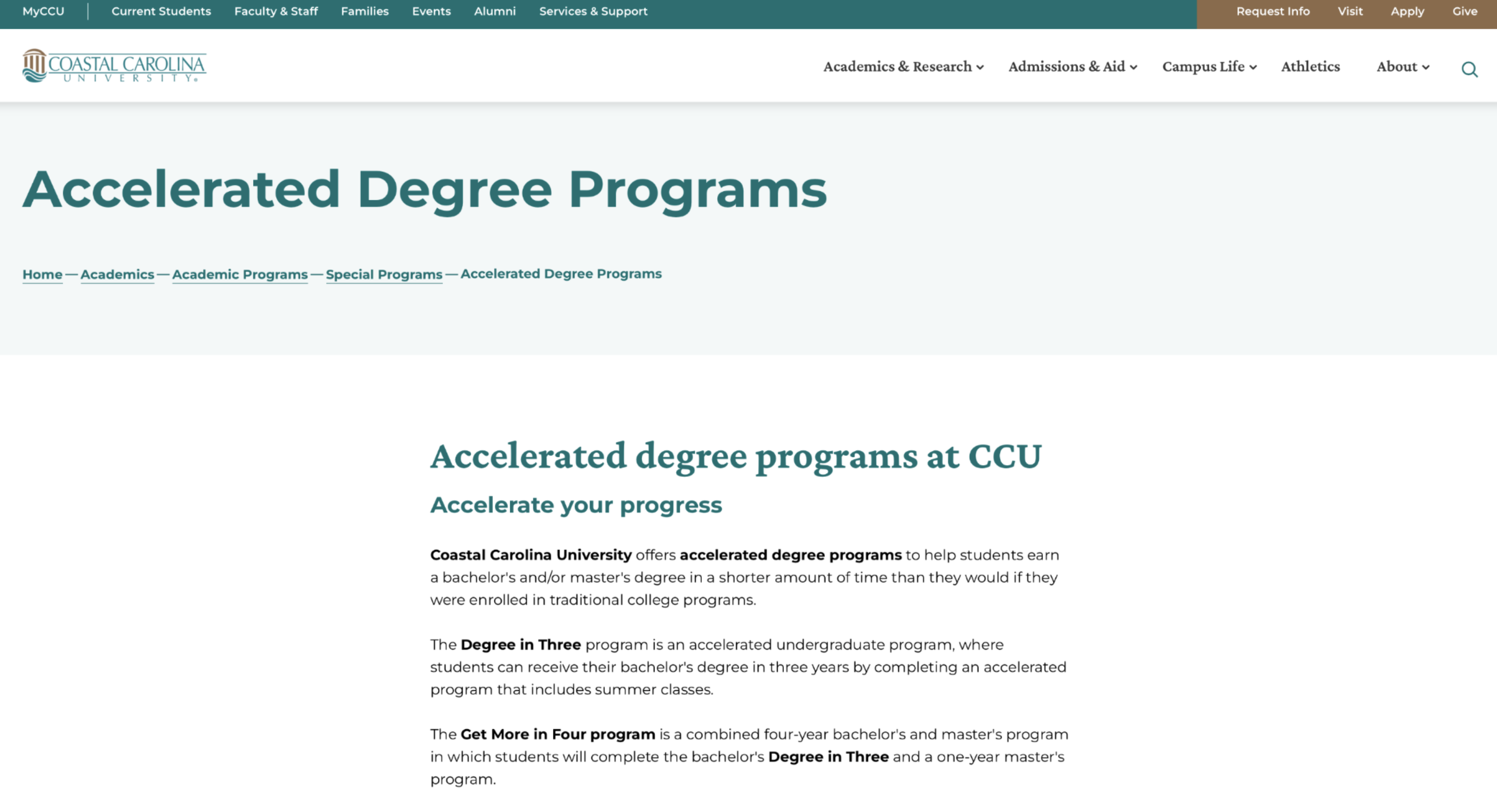
These programs often rely on summer courses, a structured degree plan, or college credits earned before enrollment. For example, Coastal Carolina University’s Degree in Three program requires participants to complete the same number of credits as students in its traditional four-year programs.
Review the three-year degree map for your intended major before enrolling. It should show when required courses are offered and whether you need summer classes or incoming credit to stay on schedule.
Accelerated bachelor’s-to-master’s programs
Accelerated bachelor’s-to-master’s programs allow eligible undergraduates to begin approved graduate coursework before completing their bachelor’s degree.
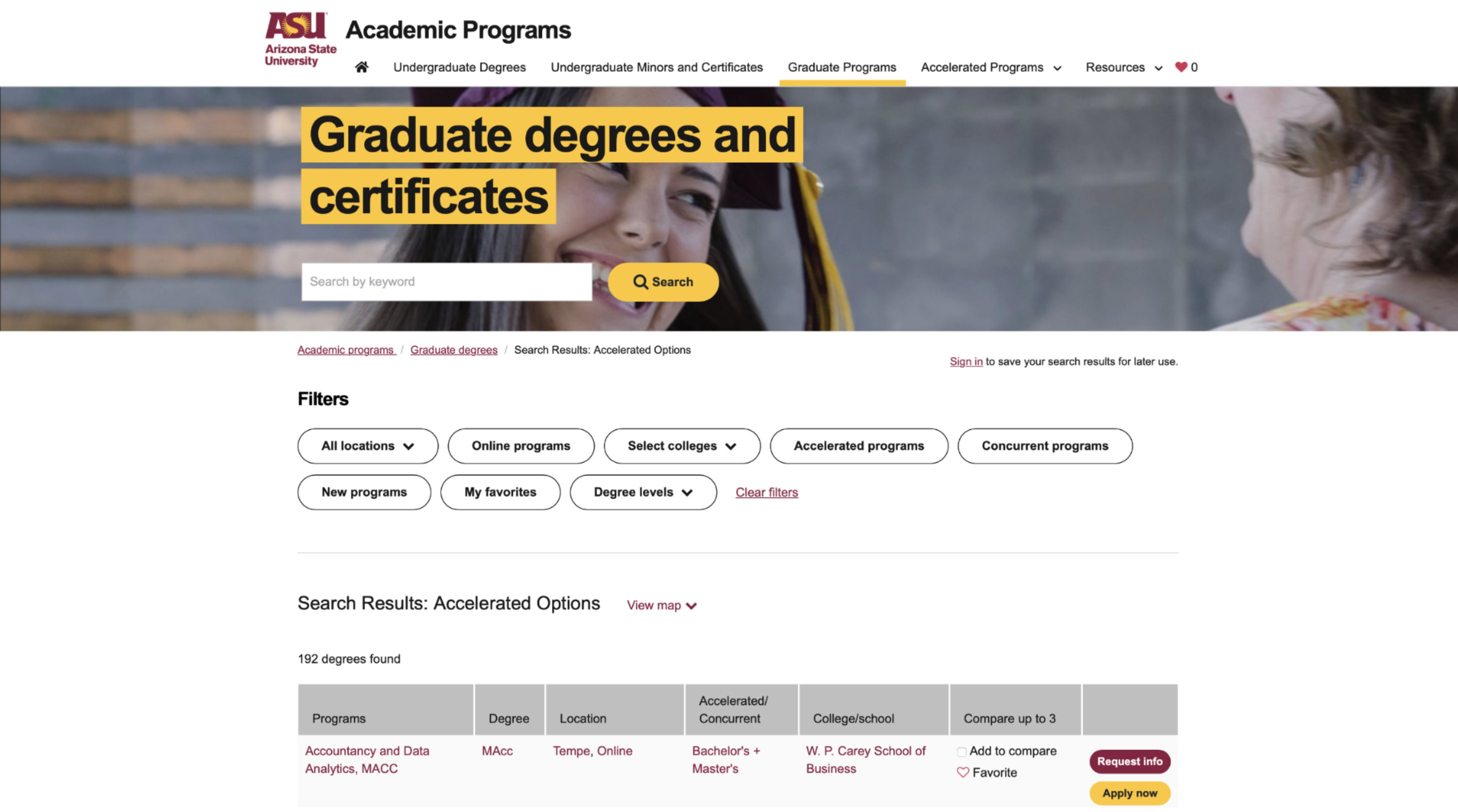
Some programs allow a limited number of credits to count toward both degrees. At Arizona State University, accelerated bachelor’s and master’s pathways can allow students to earn both degrees in five years rather than the typical six, although each program sets its own eligibility requirements.
You may also see these described as 4+1 programs.
Check the eligibility rules before building your college plan around a five-year timeline. GPA requirements, required credits, application timing, and eligible majors can differ even within the same university.
Dual-degree programs
Dual-degree programs use a coordinated academic plan to help students work toward two separate degrees.
A 3+2 engineering program is one example. Students typically spend three years at one institution before completing two years at a partner engineering school. Earning two bachelor’s degrees this way can take less time than pursuing each degree separately.
Admission to the second institution may require a separate application, so review both schools’ requirements before enrolling in the first part of the program.
Accelerated certificate programs
Accelerated certificate programs provide focused training over a shorter period than a degree.
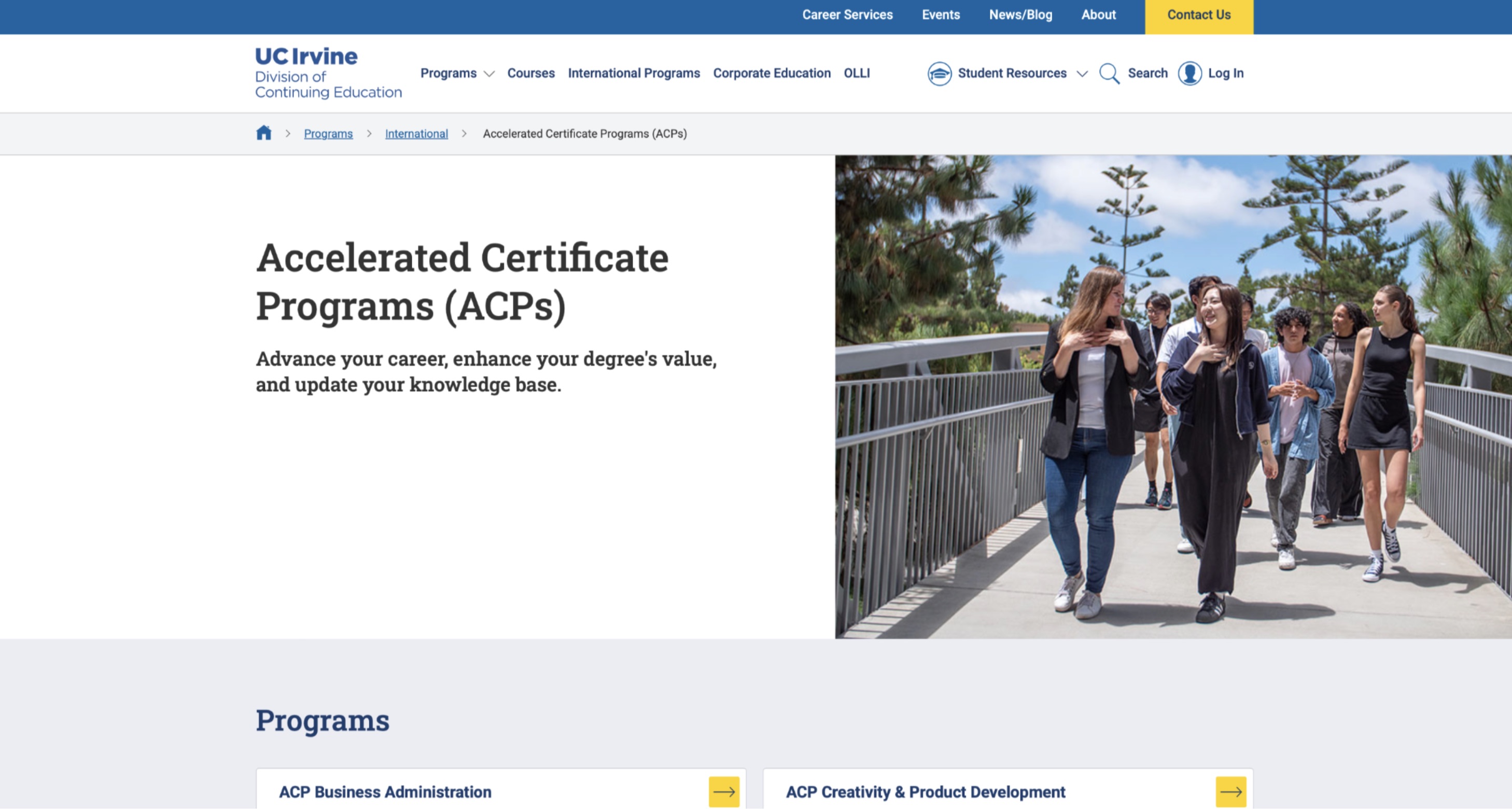
Program length depends on the credential and course schedule. UC Irvine’s current Accelerated Certificate Program, for example, includes options in business administration, data science, digital marketing and communications, project management, and other areas. Its Data Analytics for Business certificate is a three-month, 15-unit program taught on the UC Irvine campus.
Use the program’s current academic calendar to confirm which certificate is offered during the term you want to attend.
Individual accelerated courses
Some colleges offer individual courses in shorter sessions than a traditional semester. The course material is condensed into fewer weeks, so assignments, exams, and class meetings may be closer together.
Before registering, compare the accelerated course dates with your other classes, work schedule, and activities. A shorter course may require more time each week even when the total credit value stays the same.
Combined degree and certificate programs
Some colleges let students combine a degree with a related certificate.
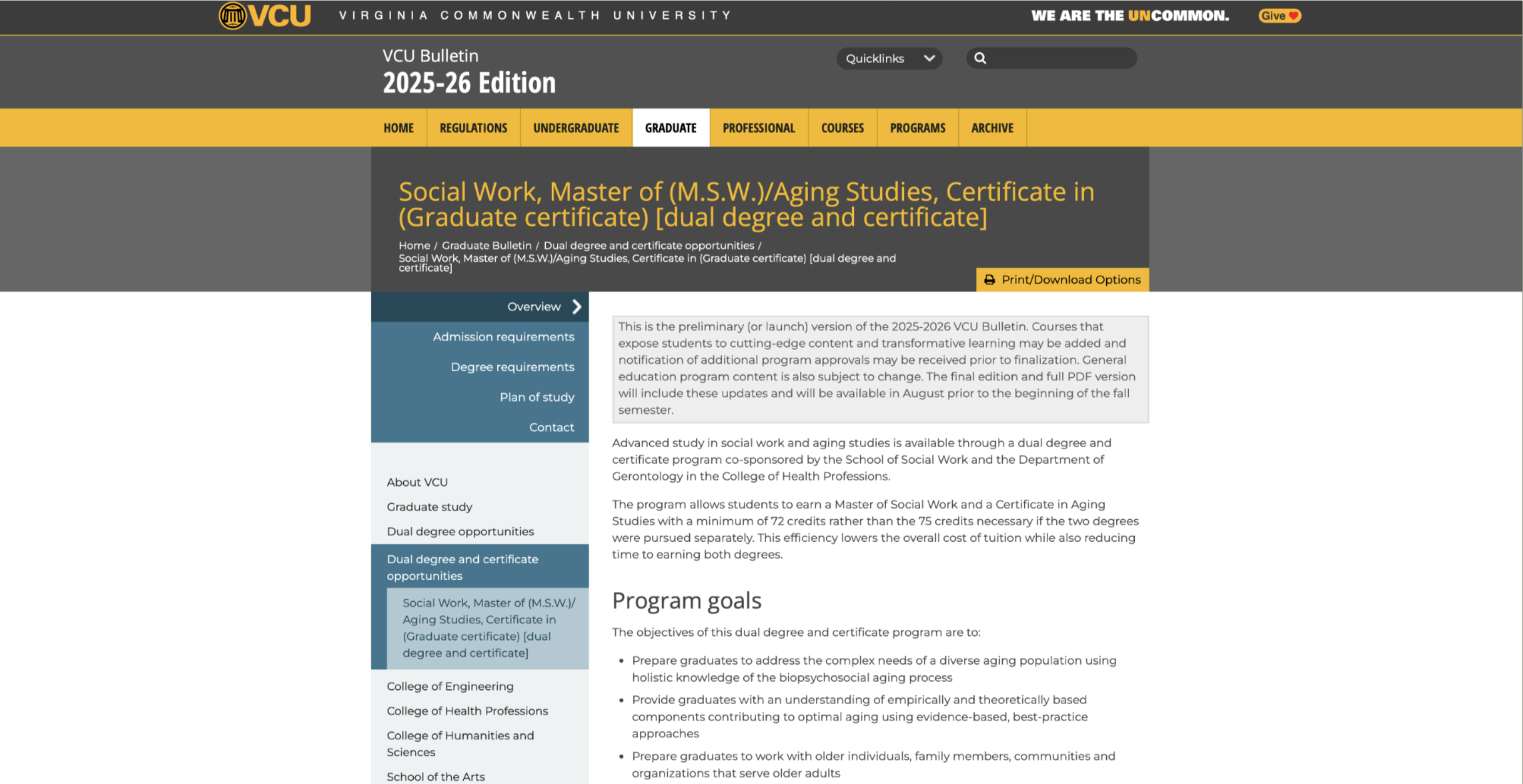
At Virginia Commonwealth University, students can pursue a master’s degree in social work along with a graduate certificate in aging studies.
Students must meet the admission requirements for both VCU programs. After being accepted into the MSW program, a student can apply for the Aging Studies certificate and work with advisers from both programs on a plan of study.
Source: Virginia Commonwealth University
How do accelerated college programs work?
Accelerated college programs shorten the timeline by changing the course schedule, sequencing degree requirements, or allowing eligible credits to serve more than one requirement.
A bachelor’s program might require summer enrollment and a specific sequence of courses. A bachelor’s-to-master’s program may allow qualified students to begin graduate coursework during their senior year.
Accelerated courses can also run for fewer weeks than traditional semester-long classes. Because the material is covered on a shorter schedule, students may have less time between assignments and exams.
Online and asynchronous courses can appear in accelerated programs, but the course format does not tell you how quickly you can complete it. An asynchronous course can still have weekly deadlines and a fixed end date.
Ryoo told Appily that accelerated programs often use a carefully sequenced curriculum so related concepts and requirements build on one another. Prior college coursework can shorten the timeline further when the college accepts those credits and applies them to requirements in your degree.
If you already have college credit, review the school’s transfer-credit policy before planning your graduation date. Learn more about transferring college credits.
Is an accelerated program the same as a self-paced program?
An accelerated program follows a shorter scheduled timeline for completing a course or degree. A self-paced or competency-based program allows students to progress based on the program’s rules for completing coursework or demonstrating mastery.
An asynchronous course may still have fixed deadlines, while a self-paced course may allow more control over when you complete individual units.
Before enrolling, look at the course calendar for required meeting times, assignment deadlines, start and end dates, and any minimum or maximum completion period.
Can AP, IB, dual-enrollment, or transfer credits help you graduate early?
AP, IB, dual-enrollment, and transfer credits can shorten your college timeline when a school accepts the credit and applies it to a requirement you need for your degree.
A college may award credit for an AP exam without letting that credit replace a required course in your major. Transfer courses may also count as electives rather than satisfying a specific graduation requirement.
Review the college’s official credit policy and answer these questions before assuming a credit will save you time:
- Does the college accept the exam or course?
- What score or grade do you need?
- Which graduation requirement will the credit satisfy?
- Does your major limit how outside credits can be applied?
- How many transfer or exam credits can count toward the degree?
Students interested in a three-year degree should do this before choosing their first-semester schedule. Coastal Carolina, for example, encourages Degree in Three students to submit college credits earned in high school before meeting with a program coordinator.
4 examples of accelerated college programs
The programs below show how different accelerated models work. Compare the eligibility requirements and schedule along with the advertised completion time.
1) Arizona State University's Combined Bachelor’s and Master’s Degree Program
Source: Arizona State University
At Arizona State University (ASU), students in participating programs can combine undergraduate and graduate coursework and earn both degrees in as few as five years.
Eligibility depends on the academic program. ASU’s W. P. Carey School of Business, for example, currently requires applicants to:
- Be enrolled in an undergraduate program with an accelerated master’s option
- Have at least a 3.25 cumulative GPA and 3.25 major GPA
- Have at least 75 earned undergraduate credits
- Have one or two full semesters remaining before completing the bachelor’s degree
W. P. Carey recommends applying by June 1 for fall accelerated coursework or December 1 for spring coursework. Other ASU schools set their own requirements and application timelines.
Use the ASU accelerated degree search to find the pathway connected to your undergraduate major, then review that program’s eligibility rules.
2) Coastal Carolina University’s Degree in Three Program
Source: Coastal Carolina University
The Degree in Three program at Coastal Carolina University (CCU) allows students in participating majors to complete the same number of credits as a traditional four-year degree on a three-year schedule that includes fall, spring, and summer coursework.
Available options include programs in fields such as:
Requirements differ by academic area. For current College of Science Degree in Three programs, students need a 3.5 high school GPA plus an 1100 SAT score or 24 ACT score. Students entering most of those science programs must also place into Math 160 Calculus. Computer Science and Information Systems are exceptions to that calculus-placement requirement.
CCU notes that program coordinators may modify or waive its published admission benchmarks in individual cases. Students first apply to Coastal Carolina, submit college credits earned in high school, and schedule a meeting with a Degree in Three program coordinator.
Use CCU’s Degree in Three program page to confirm the current requirements and three-year plan for your intended major.
3) University of California - Irvine’s Accelerated Certificate Program
Source: The University of California - Irvine
The University of California-Irvine currently lists nine Accelerated Certificate Programs through its Division of Continuing Education. Options include business administration, data science, international finance, project management, and other business and technology fields.
Program details differ by certificate. The Data Analytics for Business certificate, for example, is a three-month, 15-unit program taught on the UC Irvine campus. Its current listed approximate tuition is $7,900.
Availability also changes by term. Use UC Irvine’s current ACP page and academic calendar to confirm the program dates, tuition, and application deadline for the certificate you want.
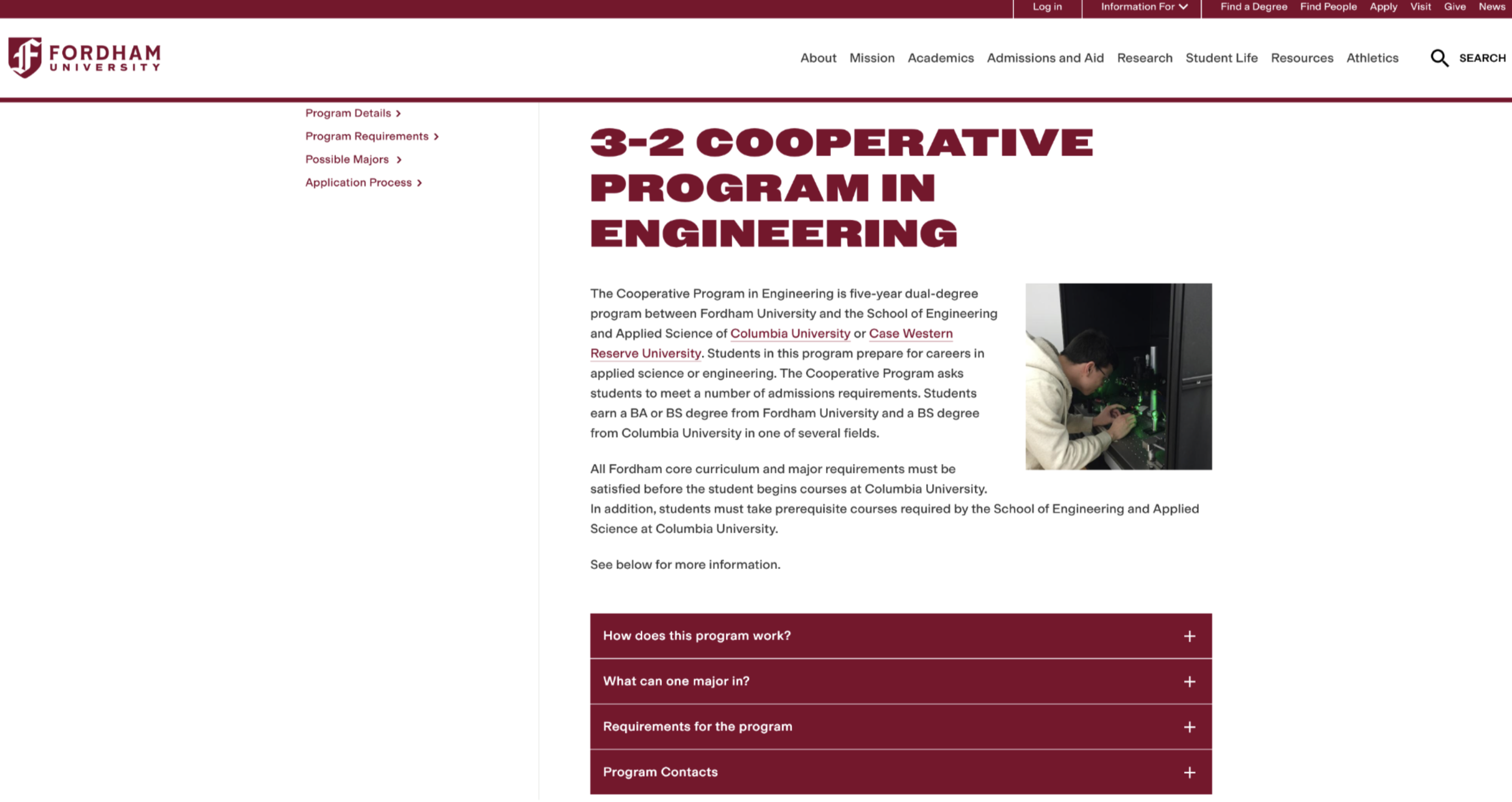
4) Fordham University’s 3-2 Cooperative Program in Engineering
Source: Fordham University
Fordham University offers a five-year dual-degree engineering program in partnership with Columbia University and Case Western Reserve University (CWRU).
Students spend six semesters at Fordham and four semesters at the engineering school. They apply to Columbia, Case Western Reserve, or both during the spring of their junior year.
Admission to the partner engineering school is not guaranteed. Fordham currently lists a 3.3 cumulative GPA and at least a B in each required math and science course among Columbia’s guidelines. Students applying to Case Western Reserve must maintain at least a 3.0 cumulative GPA.
Students who complete both portions of the program earn a bachelor’s degree from Fordham and a bachelor’s degree in engineering from the partner school.
Review Fordham’s required math, science, and computer science courses before choosing your first-year schedule. Students planning to apply to Columbia should also know that Columbia does not accept online courses toward the program’s transfer requirements.
Are accelerated college programs harder?
An accelerated schedule can create a heavier weekly workload because students have less time to complete course material and assignments.
Degree programs may also require summer enrollment or a fixed sequence of classes. Missing or withdrawing from one required course could affect when the next course is available and change your graduation timeline.
Compare the program’s sample schedule with the time you need for work, family responsibilities, sports, clubs, and internships. Ask the program adviser what happens if you need to retake or postpone a required course before you commit to the accelerated plan.
Do accelerated college programs cost less?
Accelerated programs can reduce certain costs when they eliminate semesters of tuition, fees, housing, or other living expenses. Summer tuition, heavier credit loads, and tuition at a partner institution can offset those savings.
Compare the full cost of both paths rather than focusing only on the number of years.
For each option, calculate:
- Tuition and required fees for every term
- Summer tuition and housing, if required
- Grants and scholarships you can use during summer terms
- Tuition changes if you transfer to a partner school
- Housing, meals, transportation, and other living costs
For a 3+2 program, review financial aid at both institutions. Fordham notes that students receive financial aid from the engineering school during the final two years rather than continuing under Fordham’s financial aid arrangements.
Use each college’s current tuition and financial aid pages to compare the total estimated cost before choosing the faster route.
What should you know before choosing an accelerated college program?
Check the program’s eligibility, course schedule, total cost, and backup options before you enroll.
Ask:
- Does the program include your intended major?
- What GPA, test score, prerequisite, or completed-credit requirements apply?
- Are summer classes required?
- How will your AP, IB, dual-enrollment, or transfer credits apply?
- What will tuition, fees, and living costs total across the full program?
- Will your grants and scholarships cover summer or partner-school enrollment?
- What happens to your graduation timeline if you change majors or miss a required course?
- Is admission to every stage or partner institution guaranteed?
Also look at the time you want for internships, work, study abroad, and campus activities. Compare the accelerated degree map with the traditional program semester by semester before deciding.
Are accelerated college programs right for you? Find out with Appily
Accelerated college programs can shorten your path to a degree or certificate, but the schedule needs to fit your major, budget, and available time.
Use Appily to compare colleges based on academics, location, cost, and admission fit. Build a shortlist first, then visit each college’s official academic program page to compare accelerated options, eligibility requirements, summer coursework, and total costs.
Create a free Appily account to start comparing colleges and building your list.
FAQs on colleges with accelerated programs
How do I choose an accelerated college program?
Start with the credential and major you want. Then compare accreditation, total cost, program length, admission requirements, financial aid, and how your existing credits will apply.
Look at the course sequence too. A three-year program that requires summer classes may fit your plans differently than a five-year bachelor’s-to-master’s program that allows undergraduate and graduate credits to overlap.
Once you have two or three options, compare the schedules and estimated costs side by side.
What are the alternatives to accelerated college programs?
You can pursue a traditional degree and still look for ways to shorten your timeline. Depending on your college’s policies, AP, IB, dual-enrollment, transfer credits, or additional courses may satisfy requirements earlier.
You can also complete a certificate separately if you want specialized training without committing to a combined degree program.
Review your degree audit or planned course sequence with an academic adviser before adding credits just to graduate sooner.
Can you finish a bachelor’s degree in three years?
Yes, some colleges offer three-year bachelor’s degree pathways. These programs may require summer classes, a specific course sequence, or college credits earned before enrollment.
Check the degree map for your intended major to see whether all required courses are available on the accelerated schedule.
Can you earn a bachelor’s and master’s degree in five years?
Some colleges offer accelerated bachelor’s-to-master’s or 4+1 programs that allow eligible students to begin graduate coursework before finishing their bachelor’s degree.
Eligibility rules differ by program and may include GPA requirements, a minimum number of completed credits, or a separate graduate-school application.
Do accelerated college programs require summer classes?
Some do. Three-year bachelor’s programs often use summer terms to fit the required credits into a shorter timeline.
Other accelerated programs shorten the timeline through shared credits, compressed courses, or prior college credit instead. Review the program’s sample schedule to see which terms you are expected to attend.
Can dual-enrollment credits help you graduate college early?
They can if the college accepts the credits and applies them to requirements in your degree.
A college may accept a dual-enrollment course as an elective without letting it replace a required major or general education course. Review the school’s transfer-credit policy before assuming a course will shorten your graduation timeline.
Are accelerated college programs cheaper?
They can be, but a shorter timeline does not guarantee a lower total cost.
Finishing in fewer semesters may reduce some tuition, housing, or living expenses. Summer tuition, heavier credit loads, or tuition at a partner institution can reduce those savings.
Compare the full estimated cost of the accelerated and traditional pathways before choosing one.
Are accelerated college programs harder than traditional programs?
They can feel more demanding because students may complete the same amount of coursework in fewer weeks or take classes during additional terms.
Before enrolling, compare the program schedule with the time you need for work, family responsibilities, internships, activities, and other commitments.
Can you switch out of an accelerated college program?
That depends on the college and program.
Some students can move into the traditional version of the degree, while others may need to adjust their course sequence or graduation date. Ask the program adviser what happens if you change majors, drop a required course, or decide the accelerated schedule no longer works for you.
Are accelerated college programs available online?
Some are. Colleges may offer accelerated courses or degree pathways online, in person, or in a hybrid format.
Online does not automatically mean self-paced. An online accelerated course may still have weekly deadlines, scheduled exams, and a fixed end date.
