How to Transfer College Credits (& What Happens to Your GPA?)

Thinking about changing colleges and wondering how to transfer college credits without losing time, money, or momentum? You’re not alone. Around 1.2 million undergraduate students transfer schools every year, and one of the biggest stress points is figuring out what happens to the credits (and GPA) you’ve already earned.
To transfer college credits, you’ll need to check the receiving college’s policies, send the required transcripts, and review its credit evaluation. Then, you should confirm which accepted credits satisfy requirements for your intended degree. A college can accept a course without applying it to a requirement you still need, so be sure to compare the classes, time, and cost remaining, and not just the credits accepted.
Before you start your transfer journey, it helps to separate three decisions:
Admission:
The college offers you a place as a student.
Credit acceptance:
The college awards transfer credit for previous coursework.
Degree requirements:
The college determines how those credits count toward your major, general education, or available elective requirements.
Getting admitted doesn’t guarantee that every credit will transfer, and accepted credit doesn’t necessarily fill a requirement you still need. Before choosing a college, check both which credits it accepts and how those credits apply to your intended degree. It’s also important to ask when the college will issue your official credit evaluation. A course-equivalency lookup can help you plan, but it’s not necessarily the college’s final decision, and things can fluctuate with different catalogue years.
You can use the comparison and course record below to compare two colleges against the same goal: completing your intended degree. You’ll track which credits count, what each college has confirmed, and which questions still need an answer
The TL;DR
You can break the college transfer process into these six steps:
- Check your new college’s transfer policies and course equivalencies.
- Gather your transcripts, course descriptions, and syllabi.
- Ask advisors which courses count toward your intended degree.
- Apply and submit the required academic records.
- Review your credit evaluation and remaining degree requirements.
- Build a term-by-term plan and compare the cost of finishing your degree.
The number of credits a college accepts is only part of the picture. Compare the requirements you would still need to complete, the terms those courses would take, and your estimated remaining costs.
Your next step: Choose one college you’re considering and gather the course numbers, credits, grades, and completion terms for the classes you want evaluated.
How do I know if my college credits will transfer?
To know if your credits will transfer, start with the receiving college’s official course-equivalency guide or transfer database. Treat the result as planning information unless the college identifies it as your official evaluation. For example, the University of Illinois describes its Transferology results as an estimate and makes its final decision after reviewing official transcripts.
As you go through the process, keep two questions separate:
“What credit would the college award for this course?” “Which requirement would that credit satisfy in my intended degree?”
Document both answers, their sources, and anything awaiting confirmation somewhere handy; a notebook, your “notes” app, or whatever you use to keep organized. Step 1 in our guide further breaks down how to find the right resources.
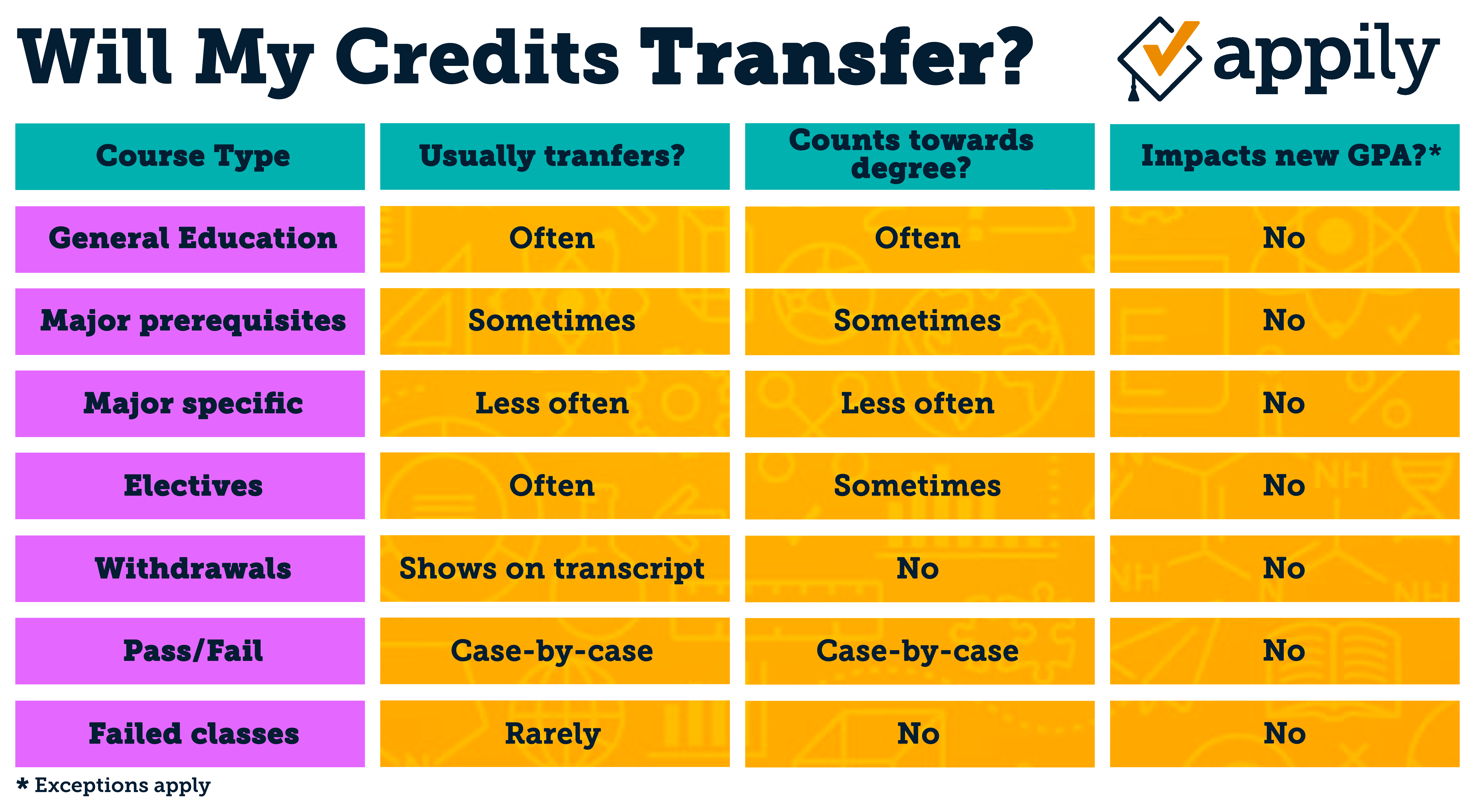
When should I check my transfer credits?
You should begin researching transfer credits before applying to a new school, and if you’re looking out further than a semester for a potential transfer, do that research before choosing your next term’s classes. Here’s a helpful way to organize your steps:
Before applying:
Research course equivalencies and major requirements. Ask whether a preliminary review is available. Record application, transcript, and transfer-scholarship deadlines from each college’s official pages.
After admission, before committing:
Review any available credit evaluation and financial aid offer. Ask which results are confirmed, which are pending, and whether the official evaluation will arrive before your deposit deadline.
Before registering at your new college:
Review your remaining requirements with an advisor. Confirm prerequisites, possible duplicate courses, and any outstanding evaluations or appeals.
Add the dates that apply to your colleges to your calendar. Don’t assume every school evaluates credits at the same stage; Pennsylvania's official college transfer page explains that evaluation timing and whether a review is official differ by institution.
How to transfer college credits in six steps
Step 1: Look Up Your New School’s Transfer Policies
For each college you’re considering, identify your intended major and entry term. Check the transfer policies and degree requirements for the catalog year that would apply to you. For each course you want evaluated, record the college where you took it, its exact course number, and the term you completed it.
Start with the transfer admissions or registrar’s website. A course-equivalency guide shows how previous coursework has been evaluated. An articulation agreement describes a transfer arrangement between institutions; read its conditions rather than assuming it covers every major or entering class.
For example, ASU’s transfer guidance points to individual course-equivalency searches and major pathways. Check both: the course result tells you what the class may transfer as, while the pathway helps you investigate how it fits your intended degree.
For a step-by-step lookup example, Illinois’s Transferology instructions tell students to create a Transferology account, add their courses, select “Search for Matches,” and choose the University of Illinois Urbana-Champaign. Results can include direct course matches, elective credit, or courses not yet reviewed.
Record the course result separately from its possible degree use. Then ask the receiving college to confirm any requirement the lookup does not establish. At ASU, for example, the college of your major determines how transfer courses fulfill that major’s requirements.
Step 2: Gather Your Academic Documents
Follow the receiving college’s instructions for sending official transcripts from each college you attended. If you’ve transferred before, don’t assume your latest transcript replaces records from earlier schools.
Keep an unofficial transcript for your own planning, plus course descriptions and syllabi from the terms when you took the classes. The college may need these to evaluate a course that isn’t already in its database.
If you’re still taking classes, ask when to send a final transcript with your completed grades. Keep a record of what you requested, when you sent it, and whether the receiving college has marked it as received.
Step 3: Talk to Academic Advisors
Meet with an advisor at your current college and a transfer or major advisor at the school you’re considering. Bring your unofficial transcript, intended major and entry term, and the degree requirements you found. Start a course record using the model below, and bring any questions you could not resolve through the college’s official resources.
Ask specific questions:
- Which courses satisfy requirements in my intended major?
- Which count toward general education or electives I still need?
- Does a department need to review any courses separately?
- Which classes should I take next, and which could duplicate credit I already have?
Not sure how to start the conversation? Copy and personalize this email:
“Subject: Transfer-credit questions for [Intended Major]
Hello [Advisor’s Name or Transfer Advising Team],
I’m considering transferring from [Current College] to [College Name] for [Entry Term] to study [Intended Major].
Could you help me understand which of my completed courses may count toward my major, general education requirements, or available electives? I’d also like to know whether a preliminary review is available before I commit to enrolling and when the official evaluation would be completed.
I can provide my unofficial transcript, course descriptions, and syllabi. Please let me know how to submit them or which office I should contact.
Thank you for your help!
[Your Name]”
Add the answers to your course record. Record the person or office, the date, and whether the answer is preliminary or confirmed. Keep the credit result separate from the explanation of how it applies to your degree.
Step 4: Submit Your Application and Records
Submit the application type the college requires and send transcripts and required forms by its deadlines. Ask when you’ll receive an evaluation and whether it will be preliminary or official.
A lookup result helps you plan. Your official credit award comes from the receiving college’s evaluation of the required records. How those credits apply to your major may need a separate review.
Don’t assume you’ll get the final answer before paying a deposit. USC’s Transfer Credit Services says its Transfer Credit Report is generated for admitted undergraduates who have paid the commitment deposit and will be available by orientation.
If your deposit deadline comes first, ask:
Can I get a preliminary review of the courses that matter most for my major? Which results are confirmed, and which could change? When will the official evaluation and degree review be available? Is an extension possible, and what is the deposit refund policy?
Keep unconfirmed credits separate from confirmed results. If a pending decision could change a major requirement, ask an advisor what your remaining-course plan would look like with and without that credit. Record when you expect an answer and whether that date falls before or after your deposit deadline.
Step 5: Review the Transfer Decision
Read your transfer credit report alongside your degree audit, the record showing which graduation requirements you’ve completed and which remain. A degree audit can also include courses in progress, so check the status rather than assuming every listed course is complete. If you don’t have an audit yet, ask an advisor to explain how your credit report fits your intended program.
Look for the requirement, the course applied to it, and its completion status. Here’s a simplified example:
Degree requirement: Written communication Transfer course applied: ENG 101 from your previous college. Requirement status: Complete Credits applied toward the degree: 3 |
Degree requirement: Written communication
Transfer course applied: ENG 101 from your previous college.
Requirement status: Complete
Credits applied toward the degree: 3
This illustrates what to check, not a particular college’s audit layout or a guaranteed transfer outcome.
For each course, record which of these five planning outcomes applies. These are categories for organizing your comparison, not necessarily the labels your college uses.
Satisfies a named requirement:
The credit fulfills a specific major or general education requirement. Record the requirement’s name and the number of credits that count toward your degree.
Counts as an elective you still need:
The college accepts the credit, and your degree has room for it within an elective requirement. Confirm how much elective credit remains available before counting it toward your plan.
Is accepted but does not advance this degree plan:
The college awards credit, but it does not fill a remaining requirement. Keep it in your accepted-credit total, but do not subtract it from the coursework you still need to complete.
Is awaiting evaluation:
The college has not issued a credit decision yet. Record any missing documents, who is reviewing the course, and when you expect an answer. Do not count pending credit as confirmed.
Was not accepted:
The college has reviewed the course and declined to award credit. Record the reason and ask whether a review or appeal is available. A missing database entry alone does not mean a course was rejected.
Use the troubleshooting section below when a course is missing, the result seems incorrect, or accepted credit does not satisfy the requirement you expected.
Step 6: Plan Your Remaining Coursework
Work with your new advisor to build a term-by-term plan. Include prerequisites, required course sequences, and classes offered only in certain terms. Confirm how much coursework you must complete at the college awarding your degree.
Compare costs using that plan, not just one year’s tuition. An extra term may affect tuition, housing, and other expenses. Appily’s sticker price and net price guide explains the cost terms you’ll encounter, including the difference between the published price and the amount remaining after grants and scholarships.
Ask each college’s financial aid office for an estimate that applies to you as a transfer student. Ask about transfer-scholarship eligibility, application deadlines, renewal requirements, and how many terms an award can cover.
Record your planned remaining terms and estimated costs together. That gives you a more useful comparison than either a credit total or a first-year price alone.
How to compare transfer credits at two colleges
The college that accepts the most credits isn’t necessarily the college that leaves you with the least work to graduate. You should compare how many accepted credits fulfill requirements in your intended degree, then look at the courses, time, and costs that remain.
Example scenario: You’ve earned 60 semester credits and plan to enter a psychology bachelor’s program in fall 2027. College A and College B each require 120 semester credits for this example. Assume all coursework has been evaluated. The colleges, program details, and credit outcomes below are invented assumptions, not actual transfer decisions.
Credit comparison | College A | College B |
Credits you’ve earned | 60 | 60 |
Credits the college accepts | 54 | 48 |
Accepted credits that apply to this degree | 42 | 45 |
Accepted credits that don’t apply to this degree | 12 | 3 |
Total credits required for this degree | 120 | 120 |
Credits still needed toward the total | 78 | 75 |
College A accepts more credits, but College B applies more toward your degree. Subtract the credits that apply from the degree total: 120 − 42 = 78 at College A, compared with 120 − 45 = 75 at College B.
The 42 and 45 credits can include major, general education, and usable elective credits. Count each credit once in the total, even if a course satisfies more than one requirement.
All 60 starting credits are accounted for. At College A, 42 apply to the degree, 12 are accepted but do not apply, and 6 are not accepted. At College B, 45 apply, 3 are accepted but do not apply, and 12 are not accepted.
College B leaves three fewer credits toward the degree total, but that does not establish an earlier graduation date or a lower cost. Required course sequences, prerequisites, course availability, and academic residence requirements can still affect the plan.
For your own comparison, ask each advisor to identify the remaining requirements and arrange them into a term-by-term schedule. Then compare the estimated cost of those remaining terms, including the grants and scholarships available to you. Use the credit totals to identify what to investigate next, not to choose a college by themselves.
Track one course from equivalency to degree requirement
Suppose one of your courses is called PSY 214: Thinking and Decision-Making, worth three semester credits. For this example, College A accepts it as a psychology elective, but your plan there has no remaining space for that elective. College B accepts it as an equivalent to a required psychology course, so all three credits apply to your major.
Here’s a fictional course record for College B that you can use as a model. Its three credits are already included in College B’s 45-credit total above. The equivalency and degree use are invented assumptions, not findings from an official college tool. When tracking your own course, record the credit-evaluation source separately from the source confirming its degree use.
Copy this table into a document or spreadsheet, replace the fictional details with your own information, and repeat it for each course and college you’re comparing.
What to record | College B example |
Original course and credits | PSY 214: Thinking and Decision-Making; 3 semester credits; grade B; completed spring 2026 |
Destination and degree | College B; BA in Psychology; fall 2027 entry |
Assumed equivalency | PSY 220: Cognition; 3 semester credits |
Assumed degree use | Fills the required cognition course in the psychology major; all 3 credits count toward the degree |
Credit-result source, date, and status | This is a fictional assumption, so for your own course, be sure to record the official evaluation document or equivalency-page URL, the date checked, and whether the result is preliminary, official, or pending. |
Degree-use source, date, and status | This is a fictional assumption, so for your own course, be sure to record the relevant degree audit, program requirements, or advisor confirmation, the date checked, and whether the requirement use is confirmed or awaiting review. |
Unanswered question | Does this credit also satisfy the prerequisite for PSY 320: Advanced Cognition, or is department approval required? |
Next action | Ask the psychology department whether this transferred course satisfies the prerequisite for PSY 320 or requires separate approval before planning to take that class. |
Repeat this record for your own courses at each college. Label preliminary results clearly and ask the college to confirm the degree use and any unanswered questions. A course can fill one requirement while still leaving you with a question about what you can take next.
Find out where your college credits may transfer
You can search for the colleges you’re considering in Appily’s College Transfer Equivalency Database, and use the college’s official resources to check how your courses may transfer. Then, reach out directly to the institutions you’re considering to ask which credits would count toward your intended degree. And remember to treat lookup results as planning information unless the college identifies them as an official evaluation.
Transfer policies that can change your credit total
Credit limits, academic residence requirements, credit units, and course-eligibility rules can affect your transfer plan. Be sure to check these details before comparing two credit reports.
How many college credits can I transfer?
There’s no single transfer-credit limit. It varies school by school, and sometimes, program by program. ASU, for example, generally accepts up to 64 lower-division semester credits from two-year colleges, with exceptions for some programs. Illinois does not cap transfer credits, but degree and academic residence requirements still apply. Check the policy for your previous college type and intended program, then confirm how many accepted credits will count toward graduation.
Academic residence requirements
These specify how much coursework you must complete at the college awarding your degree. They’re separate from state residency rules for tuition. For example, Illinois requires at least 45 credit hours at Illinois, including 21 at the 300- or 400-level, even though it doesn’t cap the number of credits that can transfer.
Semester vs. quarter credits
Compare totals in the same units. PA College Transfer explains the conversion: one quarter credit equals two-thirds of a semester credit, so three quarter credits equal two semester credits. Ask your college how it handles rounding and whether the converted amount meets a specific course requirement.
Course eligibility
Check minimum grades, the college’s accreditation requirements, repeated-course rules, and any limits on older coursework. Admission eligibility and a course’s eligibility for credit are separate checks. Record any course that needs further review rather than counting it as confirmed credit.
Does your GPA reset when you transfer colleges?
Typically, your GPA resets when you transfer colleges. However, there are exceptions, and it depends on the context (and on the college). Your new college may calculate its own GPA using only courses you take there, but it may also report a transfer GPA or a combined GPA. Transferring doesn’t erase your earlier grades.
For example, Arizona State University’s academic catalog says its cumulative GPA includes only ASU coursework, although previous grades are considered for admission. The University of Illinois Urbana-Champaign’s registrar explains that its transcript reports a Total Institution GPA, a Total Transfer GPA, and an Overall GPA that combines the two, along with a term GPA.
Whether you’re transferring from a community college or another university, you should ask which GPA the school uses for admission, your intended major, scholarships, and graduation. Ask the new college how transfer work will appear on its transcript, too. Record the answers alongside the credit policies you’re comparing.
What if my college credits don’t transfer?
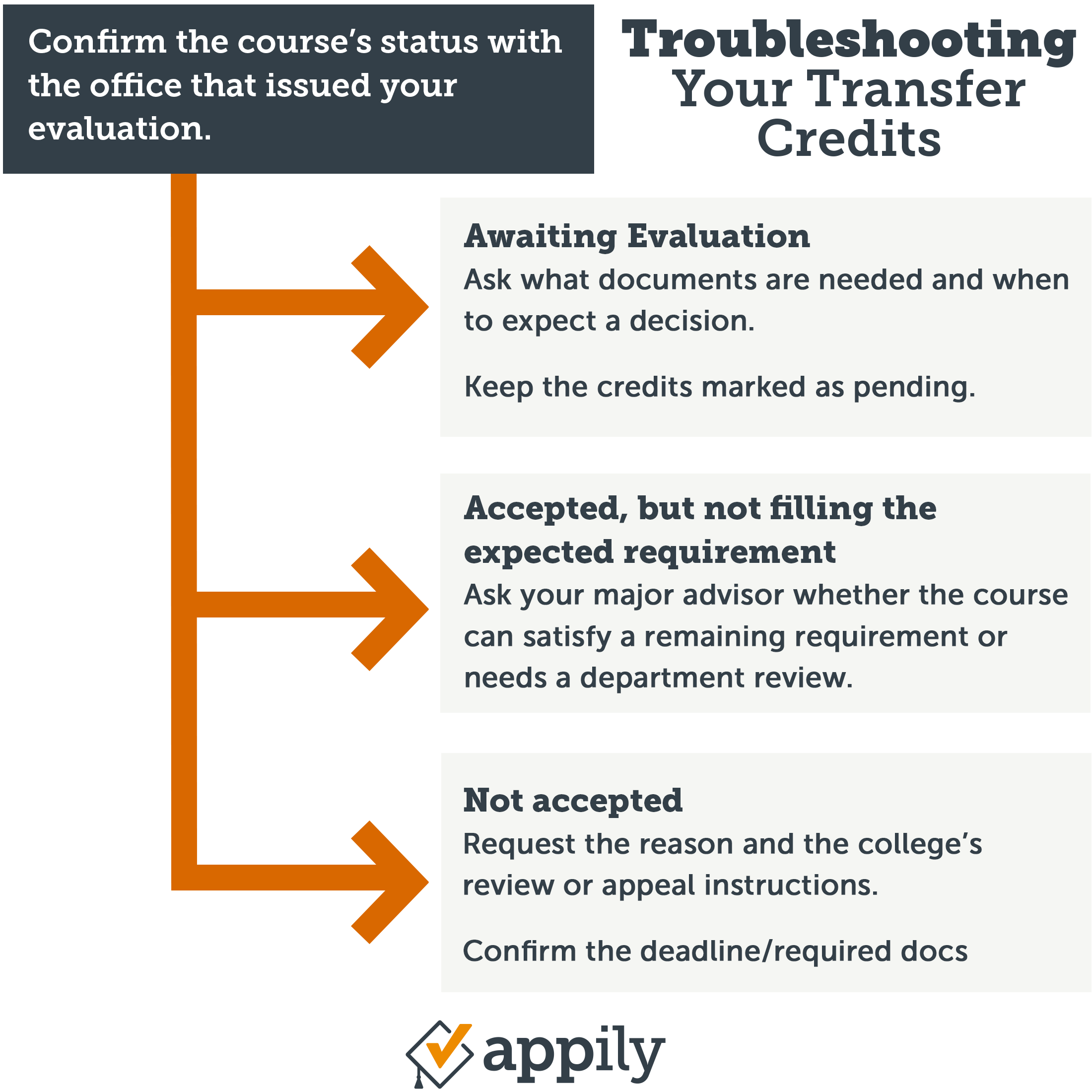
If your credits won’t transfer, there are a few steps you should take before you start unpacking your bags. First, find out whether the course was rejected, is still awaiting evaluation, or was accepted without fulfilling the requirement you expected. Those situations call for different questions.
Confirm the status:
Contact the office that issued your credit evaluation. Ask which policy or missing information explains the result. A course that hasn’t been evaluated needs a review, not necessarily an appeal.
Separate credit acceptance from degree use:
If the course was accepted as an elective, ask your major advisor whether it can satisfy a requirement you still need or whether a department review is appropriate. Accepted elective credit is not the same as rejected credit.
Ask about reconsideration:
Request the college’s review or appeal instructions, submission deadline, and required documents. For example, ASU’s academic catalog directs prospective students with transfer-credit appeals to Admission Services or Academic Transfer Credit Solutions, while admitted students can contact their advisor or academic unit.
Provide the right evidence:
Gather the syllabus from the term and instructor you took the course with, the official course description, and the course’s learning outcomes: the knowledge and skills it was designed to teach. Then follow the receiving college’s stated review process, document requirements, and deadline.
Use the instructions for your type of request. For example, USC’s petition procedures specify supporting materials and distinguish requests to change a course evaluation from other situations. Submitting documents does not guarantee that the decision will change.
If the decision doesn’t change, ask your advisor to update your remaining-course plan. Before registering for a replacement class, confirm which requirement it would fulfill and how it affects your schedule.
Before you choose a transfer college
Review these four parts of your transfer plan before deciding:
Unresolved courses:
Identify any course awaiting evaluation or reconsideration. Record who is reviewing it, what documents are needed, and when you expect an answer.
Remaining degree requirements:
Confirm which major, general education, and elective requirements your accepted credits satisfy. Keep confirmed degree use separate from preliminary guidance.
Remaining terms:
Ask an advisor to arrange the courses you still need into a term-by-term plan. Include prerequisites, course availability, and coursework you must complete at the college awarding your degree.
Remaining cost:
Ask the financial aid office for an estimate covering your expected remaining terms and your eligibility for transfer aid. Use Appily’s sticker price and net price guide to understand the cost terms you are comparing.
If your final evaluation will arrive after the deposit deadline, use the questions in Step 4 to document what remains uncertain. Start with the unresolved course most likely to change your major requirements or next term’s schedule.
Transferring from a community college to a university
If you’re moving from a community college to a four-year university, check for a transfer agreement that fits your intended major. Read its conditions, including required courses, grades, and entry terms.
Not every agreement is going to provide the same benefit. Look for whether it addresses admission, a general education block, individual course equivalencies, or a particular degree pathway. For example, USC’s community college articulation agreements identify transferable courses, course equivalents, and courses meeting general education and other core requirements.
Earning an associate degree alone doesn’t tell you which requirements remain in your chosen bachelor’s program. Ask the university’s transfer or major advisor to identify those requirements and explain whether admission to the university and admission to your intended major have separate conditions.
Before choosing your next community college classes, compare them with the agreement and the bachelor’s program requirements.
Take the next step toward your transfer
Your transfer decision is about more than how many credits a college accepts! You should still compare the classes you still need, the time it could take to graduate, the cost of finishing your degree, and whether your new school is truly the right fit for you.
As you explore your options, check each college’s transfer-scholarship requirements and use Appily’s scholarship database to look for additional funding opportunities.
Ready to organize your options? Create a free Appily account to save the colleges you’re considering and build your college list.
FAQs about transferring college credits
Can I Transfer College Credits Earned in High School?
College coursework completed through dual enrollment may qualify for transfer credit, but the receiving college decides what it accepts and how it applies. For example, New York Tech considers college courses completed during high school and asks students to have the sponsoring college send an official transcript showing the courses, credits, and grades. Don’t assume your high school transcript replaces that college record.
Having college credits also doesn’t automatically tell you which admission application to use. ASU, for example, defines transfer applicants as those using qualifying credits completed after high school. Ask each college’s admissions office whether you should apply as a first-year or transfer student.
Do College Credits Transfer Between States?
Yes, credits can transfer across state lines. The receiving college decides what it accepts and how the credits apply to your degree. Check its course equivalencies and major requirements, and confirm whether any agreement you’re relying on includes the out-of-state college.
Can I Transfer Credits From More Than One College?
You can submit coursework from multiple colleges for evaluation. Follow the receiving school’s transcript requirements and request records from each original institution. Credit accepted at one college isn’t automatically accepted at the next.
Can I Transfer Old College Credits?
Older coursework may still qualify, but age limits depend on the college and subject. For example, New York Tech requires nursing, math, and science courses to have been completed within the past seven years to be considered for transfer. Ask your intended program about its rules before assuming an older course will count or needs to be repeated.
What if My Course Isn’t in the Transfer Database?
A missing course may simply be awaiting evaluation. Send the course description or syllabus the college requests and ask who will review it. Keep the outcome marked as pending until you receive an answer; absence from the database is not a rejection.
