Colleges for a 2.6 GPA
Is a 2.6 GPA good for college applications?
A 2.6 GPA can support admission at a growing range of four-year colleges, especially institutions with broader or moderate admissions access. It will still be below the typical academic profile at many more-selective schools.
At this level, avoid letting the GPA define your entire college search. You may have realistic four-year options now, while continued academic improvement could create additional possibilities.
The most productive strategy is usually appropriate rigor plus stronger performance, not taking the hardest schedule available simply to make the transcript look more impressive.
How do colleges interpret a 2.6 GPA?
A 2.6 GPA does not have one universal meaning because high schools calculate GPA differently.
A weighted 2.6 and an unweighted 2.6 are not directly interchangeable. Honors, AP, IB, dual-enrollment, plus/minus grades, and school-specific weighting policies can all affect the reported number.
Some colleges may recalculate GPA using their own criteria. They may also consider course rigor and whether your grades are improving, stable, or declining.
At 2.6, stronger recent performance in an appropriately challenging schedule may provide more useful context than taking harder courses that cause your grades to fall.
Compare your full academic profile with each college’s current admissions information.
What colleges may be a good fit with a 2.6 GPA?
Regional universities, private colleges with moderate or broader admission, and transfer-friendly institutions may all be realistic areas to investigate.
If your academic record has improved, schools that evaluate applicants using multiple parts of the transcript may also deserve research.
Check school- and program-level requirements before assuming a college is a fit.
How do you build a safety, match, and reach list with a 2.6 GPA?
Build your list conservatively and use more than GPA to decide whether a college is a safety, match, or reach.
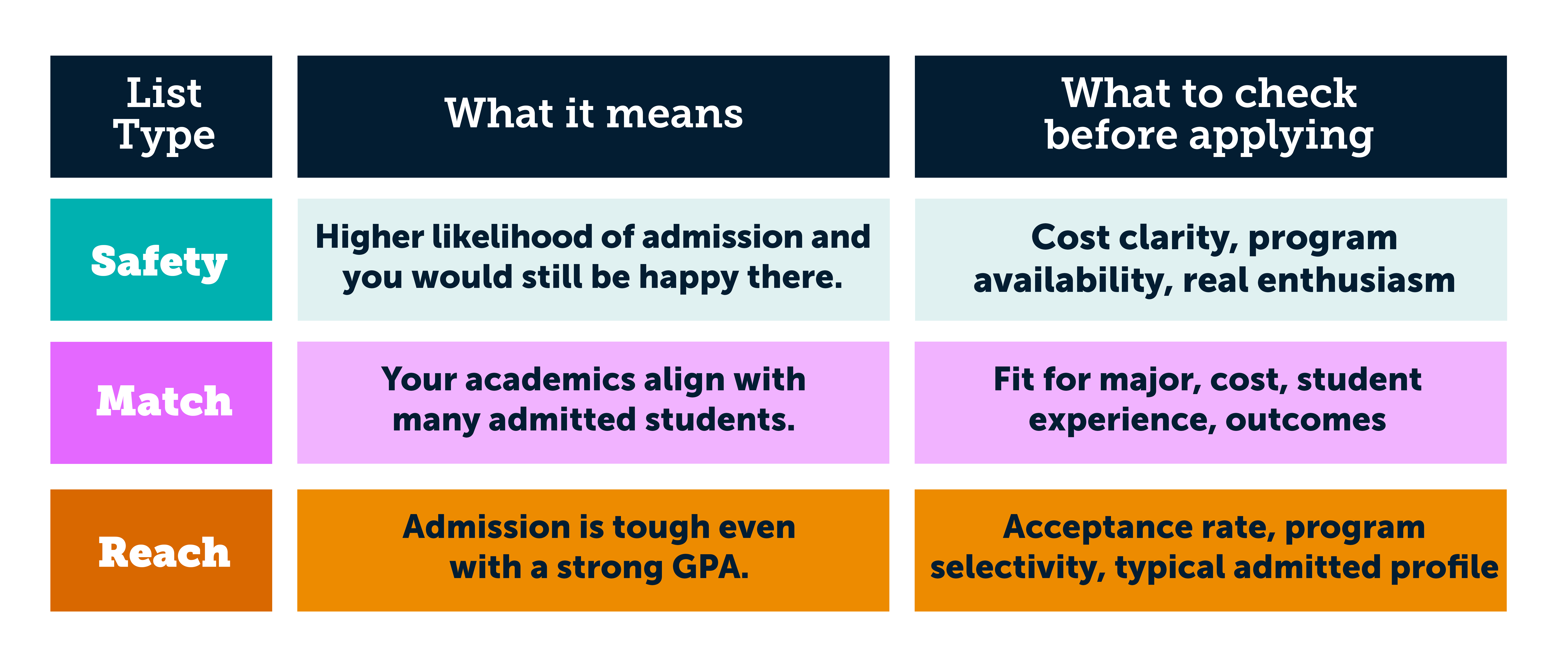
Safeties should fit your academic record comfortably. Matches should make sense based on your current transcript, not a hoped-for future GPA.
Reaches can stretch beyond your current profile, particularly if other parts of your application are strong, but admission should not be presented as probable.
How can you improve a 2.6 GPA?
Freshmen and sophomores
Consistent stronger grades can still move the cumulative record noticeably.
Focus on building a dependable academic foundation before increasing course difficulty significantly.
Juniors
Improvement remains worthwhile, but the quality of your grade trend may be more meaningful than a tiny decimal change.
Protect grades in core classes while choosing manageable academic challenge.
Seniors
A strong finish can reinforce the idea that your current performance is better represented by recent work than earlier grades.
Build your college list from the GPA and transcript you have now.
Is 2.6 close enough to 3.0?
A 3.0 may or may not be mathematically realistic depending on how many credits you have already completed and how your school calculates GPA.
Do not build your strategy around reaching 3.0 until you know what is possible.
Most useful next step: Ask your counselor to help you calculate realistic GPA outcomes, then identify whether any of your priority colleges or scholarships use a threshold you could realistically reach.
Tips for your college search and planning with a 2.6 GPA
|
|
|
|
|
|
Can you get merit scholarships with a 2.6 GPA?
GPA-based awards exist at different thresholds, so a 2.6 may qualify for some opportunities and miss others.
Investigate academic awards, but also prioritize scholarships without GPA requirements and colleges with strong need-based aid.
Should you take AP or other advanced classes with a 2.6 GPA?
Take challenging coursework when you are prepared to succeed in it.
Rigor can add useful context, but adding advanced courses simply for appearance is not helpful if it causes your overall academic performance to decline.
What colleges look at besides your GPA
GPA is just one aspect colleges review when looking through your college application. Make sure to include as many aspects of your high school career as possible, including any (or all) of the following:
How to use the college list
The colleges below are included because their average GPA falls within 2.5–2.7.
That range is designed to surface colleges for comparison. It is not an eligibility rule.
A reported average GPA is not a minimum, cutoff, or admission guarantee. Colleges may also calculate GPA differently from your high school, and current admission requirements and student profiles can change.
Use the list to identify possibilities, then verify each college’s current requirements and compare your complete academic profile before deciding whether it is a safety, match, or reach.
Explore colleges for every GPA with Appily
Ready to explore colleges that accept a GPA like yours? We have a comprehensive database to help you find and research schools. There, you can see essential data points like acceptance rate, average financial aid award, average test scores, and application deadlines, including those for rolling admission, early decision, and early action schools.