Best Automotive Engineering Schools & Colleges (2026-27): Degrees, Programs, and How to Choose

The best automotive engineering school for you depends first on the kind of automotive work you want to do. Students who want to design vehicles, EV systems, powertrains, controls, or vehicle components should start with automotive engineering or mechanical engineering. Students interested in applied testing, manufacturing, diagnostics, or technical operations may be better served by engineering technology or automotive technology.
That distinction matters because colleges use similar names for programs that can lead to very different coursework and career paths.
Dedicated undergraduate automotive engineering degrees are relatively uncommon. Some colleges instead offer mechanical engineering with an automotive concentration or option. Others offer motorsports engineering, automotive engineering technology, automotive technology, automotive management, or restoration programs.
Before comparing colleges, start with the degree that matches the work you want to do.
Quick answer: What degree should you choose for an automotive career?
If you want to design vehicles, EV systems, powertrains, controls, or vehicle components, start with automotive engineering or mechanical engineering.
If you want to work in racing, vehicle performance, aerodynamics, data acquisition, or race-team engineering, compare motorsports engineering, mechanical engineering, and colleges with Formula SAE or other vehicle-design teams.
If you want to work in applied vehicle systems, testing, manufacturing, technical operations, or applied design, automotive engineering technology may be a better fit.
If you want to diagnose, service, and repair vehicles, look for automotive technology programs.
If you want to manage service operations, dealership departments, sales, parts, or technical teams, compare automotive technology management or automotive management programs.
If you want to restore and preserve historic or collector vehicles, look for automotive restoration programs with hands-on work in fabrication, engines, bodywork, upholstery, paint, and historical research.
Types of automotive degree paths
Automotive engineering
Automotive engineering is an engineering degree focused specifically on the design, development, testing, manufacturing, and performance of vehicles and vehicle systems.
This path generally fits students who want to work in vehicle design, EV systems, powertrains, controls, mobility technology, manufacturing, testing, or automotive research.
Dedicated undergraduate automotive engineering programs are less common than mechanical engineering programs, but they do exist. Clemson University and Minnesota State University, Mankato, for example, offer bachelor's programs in Automotive Engineering.
Mechanical engineering
Mechanical engineering is a broader engineering path that can lead to automotive work while keeping options open in other industries.
Mechanical engineering students study topics such as mechanics, thermodynamics, materials, fluid mechanics, controls, manufacturing, and design. Those skills also apply in aerospace, robotics, energy, manufacturing, biomedical devices, and other fields.
If you want to enter the automotive industry through mechanical engineering, compare colleges based on automotive electives, undergraduate research, Formula SAE or other vehicle-design teams, internships, co-ops, and automotive concentrations or options.
Motorsports engineering
Motorsports engineering applies engineering principles to racing, vehicle performance, aerodynamics, vehicle dynamics, data acquisition, and race-team operations.
Purdue University in Indianapolis offers a dedicated B.S. in Motorsports Engineering. Purdue identifies it as the only ABET-accredited undergraduate motorsports engineering program in the United States.
Students can also build motorsports experience through mechanical engineering programs with racing-focused concentrations, courses, Formula SAE teams, laboratories, and internships.
Automotive engineering technology
Automotive engineering technology typically emphasizes the application and implementation of engineering principles more than a traditional engineering curriculum.
ABET distinguishes engineering and engineering technology programs in part by curricular focus. Engineering programs tend to place greater emphasis on theory, higher-level mathematics, analysis, and conceptual design, while engineering technology programs generally emphasize application and implementation.
At the bachelor's level, automotive engineering technology programs can include design, testing, manufacturing, vehicle systems, diagnostics, technical management, and applied engineering work.
Automotive technology
Automotive technology generally focuses more directly on how vehicles operate and how they are diagnosed, serviced, tested, repaired, and supported.
Depending on the program, graduates may pursue careers in vehicle diagnostics, service, field support, fleet operations, technical training, manufacturer support, testing, or management.
Engineering and automotive technology careers can overlap, but they usually emphasize different kinds of work. Engineers typically focus more on areas such as design, analysis, development, validation, manufacturing, and testing. Automotive technicians typically focus more on diagnostics, maintenance, repair, service, and field support.
The degree name alone does not tell you everything. Compare the required courses and career preparation for each program before you decide.
Do you need an automotive engineering major?
No. You do not need a bachelor's degree specifically named “Automotive Engineering” to become an automotive engineer.
A dedicated automotive engineering major can be a good fit if you already know you want to focus on vehicles and mobility systems. But mechanical engineering is also a common route because automotive development draws heavily on mechanics, thermodynamics, materials, manufacturing, dynamics, controls, and other core mechanical engineering subjects.
Your experiences outside the major can matter, too. Automotive electives, vehicle-design teams, undergraduate research, internships, co-ops, and senior design projects can help you build automotive experience even when your diploma says Mechanical Engineering.
Choose automotive engineering if:
- You already know you want to focus on vehicles and mobility systems.
- You want coursework organized around areas such as powertrains, EVs, vehicle dynamics, autonomous systems, manufacturing, controls, or automotive design.
- The college offers laboratories, industry projects, research, or vehicle-development experiences that match your interests.
Choose mechanical engineering if:
- You want flexibility across automotive and other engineering fields.
- You are still deciding among automotive, aerospace, robotics, energy, manufacturing, or another mechanical field.
- The college offers automotive electives, design teams, research labs, internships, co-ops, or industry relationships that let you build an automotive focus.
Best colleges with automotive engineering and related programs
As you explore this list, use the degree type as your first filter: an automotive engineering degree, a mechanical engineering concentration, and an automotive technology degree do not prepare students in exactly the same way.
Note that schools are sorted alphabetically by their degree type, not numerically.
Automotive programs at a glance
For a dedicated automotive engineering bachelor's degree: Start with Clemson University and Minnesota State University, Mankato.
For a dedicated motorsports engineering degree: Look at Purdue University in Indianapolis.
For an engineering degree built specifically around automotive systems: Consider Arizona State University's Automotive Systems concentration.
For mechanical engineering with a formal automotive or vehicle focus: Compare Kettering University, Ohio Northern University, Rochester Institute of Technology, Tennessee Technological University, Virginia Tech, and the University of North Carolina at Charlotte.
For automotive engineering technology: Compare Brigham Young University–Idaho, Ferris State University, Indiana State University, North Carolina A&T State University, and Weber State University.
For a bachelor's program focused more heavily on automotive technology, diagnostics, and industry operations: Consider Southern Illinois University Carbondale.
Some programs require a longer co-op schedule or prior associate degree. Those structural differences can affect your total college timeline, so check them before adding a school to your list.
Dedicated automotive and motorsports engineering programs
These schools offer an undergraduate engineering degree specifically focused on automotive systems, automotive engineering, or motorsports.
Arizona State University
Program: Bachelor of Science in Engineering Concentration: Automotive Systems |  |
Arizona State's Automotive Systems concentration combines an engineering foundation with focused study of vehicle systems. The 120-credit B.S.E. includes project-based engineering coursework and upper-level study related to vehicle electrical systems, hybrid systems, and ground-vehicle dynamics.
Students complete engineering design projects throughout the program, giving them opportunities to apply technical concepts as they develop and analyze systems. Students looking for additional vehicle experience can also explore activities such as Baja SAE.
Good fit for: Students who want an engineering degree centered on how mechanical, electrical, and control systems interact in modern vehicles.
Clemson University
|

Clemson offers a dedicated bachelor's degree in Automotive Engineering. First-year students begin in General Engineering before moving into the automotive program.
The curriculum addresses areas connected to the changing mobility industry, including electric vehicles, batteries, autonomous-vehicle sensors, connectivity, and other vehicle technologies. Students also participate in vehicle-development and design experiences connected to Clemson's automotive engineering ecosystem.
Eligible undergraduates can begin graduate coursework through Clemson's bachelor's-to-graduate pathway.
Accreditation note: Clemson states that its B.S. in Automotive Engineering is currently in the process of applying for ABET accreditation. Because accreditation status can change, check Clemson and ABET directly before making a final enrollment decision.
Good fit for: Students who already know they want a dedicated engineering curriculum built around vehicles and mobility.
Minnesota State University, Mankato
|

Minnesota State Mankato's Automotive Engineering program prepares students for automotive careers involving product research, design and development, manufacturing, and technical sales.
The curriculum connects engineering study with vehicle systems and equipment that can include passenger cars, motorcycles, agricultural machinery, construction equipment, and other mobility applications.
Because Minnesota State Mankato also has a history of automotive engineering technology education, pay close attention to the exact program name and current catalog when comparing its options. The Automotive Engineering B.S is not the same as the legacy ABET-accredited Automotive Engineering Technology program.
Good fit for: Students who want a dedicated automotive engineering degree with applications extending beyond passenger vehicles.
Purdue University in Indianapolis
 |
Purdue's Motorsports Engineering degree is offered in Indianapolis. Students are admitted directly to the major and complete engineering coursework focused on racing applications, including vehicle dynamics, aerodynamics, data acquisition, systems engineering, and performance.
The program is based near the Indianapolis Motor Speedway and is housed in a region with a substantial motorsports industry presence. Purdue also connects the curriculum to hands-on laboratory and race-engineering experiences.
Purdue identifies the program as the only ABET-accredited undergraduate motorsports engineering program in the country.
Although motorsports is the focus, students still build an engineering foundation that can apply beyond racing.
Good fit for: Students who are specifically interested in race engineering, performance, aerodynamics, vehicle dynamics, or motorsports data.
Mechanical engineering with automotive concentrations or pathways
These schools primarily award a mechanical engineering degree, with a formal automotive, vehicle, or motorsports concentration, major, or option.
Kettering University
Program: Bachelor of Science in Mechanical Engineering Concentration: Automotive Engineering |  |
Kettering's Automotive Engineering concentration builds automotive coursework onto a mechanical engineering degree.
Students can study areas such as engine design, vehicle performance, hybrid vehicles, crash safety, vehicle dynamics, and advanced automotive power systems. Facilities include Kettering's Crash Safety Center and GM Mobility Research Center.
Paid co-op work is central to Kettering's educational model. Students alternate academic study with professional work experiences, giving them repeated opportunities to connect engineering coursework with industry.
Formula SAE and Baja SAE provide additional vehicle-design opportunities outside class.
Good fit for: Students who want a mechanical engineering degree, formal automotive specialization, and substantial co-op experience.
Ohio Northern University
Program: Bachelor of Science in Mechanical Engineering Concentration: Automotive Engineering |
|

Ohio Northern's Automotive Engineering concentration is available to mechanical engineering majors and adds specialized vehicle-focused coursework to the broader engineering degree.
The current curriculum includes automotive coursework and electives alongside mechanical engineering subjects such as thermodynamics, controls, machine design, fluid mechanics, experimentation, and manufacturing.
Students complete a senior capstone experience and can choose automotive-related electives based on interests such as manufacturing, modeling, analysis, or design.
Good fit for: Students who want the flexibility of mechanical engineering with a defined automotive concentration at a smaller university.
Rochester Institute of Technology
Rochester Institute of Technology Program: Bachelor of Science in Mechanical Engineering Concentration/option: Automotive Engineering option |
|

RIT's Automotive Engineering option lets mechanical engineering students build additional study around vehicle-related topics while retaining a broader mechanical engineering foundation.
Experiential learning is a major consideration when comparing RIT with four-year programs. Mechanical engineering students complete four co-op blocks totaling 48 weeks, and the published curriculum follows a five-year structure.
Students also complete senior design work, allowing them to apply their engineering background to a substantial project.
Good fit for: Students who value extensive co-op experience and are comfortable planning for a five-year undergraduate schedule.
Tennessee Technological University
Tennessee Technological University Program: Bachelor of Science in Mechanical Engineering Concentration: Vehicle Engineering |
|
Tennessee Tech's Vehicle Engineering concentration combines mechanical engineering with concepts from electrical and computer engineering.
The program covers conventional, hybrid, electric, automated, and connected vehicles. Hands-on opportunities include vehicle-focused senior design and student organizations such as Formula SAE, Baja SAE, and the Autonomous Robotics Club.
Students have also worked on projects involving increased autonomy for electric vehicles.
Good fit for: Students interested in the intersection of mechanical systems, electronics, controls, EVs, and automated vehicles.
University of North Carolina at Charlotte
University of North Carolina at Charlotte Program: Bachelor of Science in Mechanical Engineering Concentration: Motorsports Engineering |
|

UNC Charlotte's Motorsports Engineering concentration adds 12–13 credits of specialized study to its 121-credit mechanical engineering degree.
Coursework can include automotive power plants, vehicle aerodynamics, vehicle dynamics, motorsports instrumentation, and related subjects. Students can also work in the Alan D. Kulwicki Motorsports Laboratory and participate in Formula SAE and motorsports-related senior design work.
Charlotte's location places students near Charlotte Motor Speedway and a major concentration of NASCAR teams and motorsports businesses.
Good fit for: Students who want a traditional mechanical engineering degree plus substantial exposure to racing and performance engineering.
Virginia Tech
Program: Bachelor of Science in Mechanical Engineering Automotive pathway: Automotive Engineering major within the B.S.M.E. |
|
Virginia Tech offers an Automotive Engineering major within its mechanical engineering degree.
The current planning materials include 18 credits of automotive-specific coursework alongside subjects such as thermodynamics, vibrations, controls, design, fluid mechanics, laboratories, and senior engineering projects.
Students get the broader mechanical engineering foundation while adding formal automotive study to the degree.
Because some specialized courses may have limited scheduling or prerequisite sequences, students should use the current university catalog and work with an academic advisor when planning the major.
Good fit for: Students who want a large engineering-school environment with a formal automotive pathway inside mechanical engineering.
Automotive engineering technology and automotive technology programs
The programs below are more applied than traditional automotive or mechanical engineering degrees. Compare the curriculum carefully if your goal is specifically to work as an engineer in design or research and development.
Brigham Young University–Idaho
Brigham Young University–Idaho Program: Bachelor of Science in Automotive Engineering Technology |
|

BYU–Idaho's Automotive Engineering Technology degree combines automotive systems with applied technical study.
Current coursework includes subjects such as vehicle electronics, engine management systems, data acquisition and analysis, drivability and diagnostics, and hybrid and electric vehicle technology.
Students use automotive equipment and laboratories to connect technical concepts with vehicle operation, testing, diagnosis, and applied design.
Good fit for: Students interested in applied vehicle systems, diagnostics, data analysis, and modern automotive technology.
Ferris State University
Program: Bachelor of Science in Automotive Engineering Technology |
|

Ferris State's Automotive Engineering Technology program connects vehicle systems with applied product development, manufacturing, testing, and technical problem-solving.
Students work with automotive equipment and learn to evaluate vehicle or component performance using testing and analysis. The curriculum also draws from subjects such as materials, manufacturing, and quality.
A capstone experience helps students bring their technical coursework together in an applied project.
Good fit for: Students who like working with equipment, testing systems, interpreting results, and solving applied automotive problems.
Indiana State University
Program: Bachelor of Science in Automotive Engineering Technology |
|

Indiana State's Automotive Engineering Technology degree explores the design, operation, and testing of components used in road and off-road vehicles.
Students gain hands-on experience in the John T. Myers Technology Center, where laboratory work includes vehicle diagnosis and engine-performance testing using chassis and engine dynamometers.
The department also offers co-op and internship opportunities that combine campus study with professional experience.
Good fit for: Students interested in applied automotive testing, vehicle systems, technical operations, or technical management.
North Carolina A&T State University
North Carolina A&T State University Program: Bachelor of Science in Automotive Engineering Technology |
|

North Carolina A&T's Automotive Engineering Technology program covers automotive principles, mobility design, performance modeling and testing, and mechanical fundamentals.
The program prepares students for applied work connected to vehicle design, manufacturing, operation, maintenance, and related mobility industries.
The university lists career areas that include design, manufacturing, engines, fleet operations, production, and motorsports. Because engineering technology is academically distinct from traditional engineering, compare the curriculum and accreditation path against your specific career goals.
Good fit for: Students who want an applied technical degree connecting vehicle development, performance, manufacturing, and operations.
Southern Illinois University Carbondale
|

SIU Carbondale's 120-credit Automotive Technology degree combines technical automotive coursework with business, management, computing, and communication.
Students have access to modern vehicles, diagnostic equipment, engine and chassis dynamometers, service laboratories, and research vehicles.
The university also offers focused study connected to advanced vehicle systems and diagnostics as well as automotive, truck, and equipment management.
This is an automotive technology program rather than a traditional engineering degree, so students should compare it primarily if they are interested in diagnostics, technical support, serviceability, industry operations, or related applied careers.
Good fit for: Students interested in advanced diagnostics, automotive technical support, vehicle technology, and industry management.
Weber State University
Program: Bachelor of Science in Automotive and Vehicle Engineering Technology |
|

Weber State's Automotive and Vehicle Engineering Technology bachelor's program focuses on the diagnosis, service, repair, and operation of advanced electrical and transportation systems.
Topics include hybrid and electric vehicles, automated safety systems, circuit analysis, controls, electrical systems, and vehicle technology.
The degree follows a 2+2 structure. Students must first complete an associate degree in automotive technology before entering the bachelor's portion.
High school students considering Weber State should therefore evaluate the entire associate-to-bachelor's sequence rather than treating it like a standard four-year freshman-entry bachelor's program.
Good fit for: Students interested in advanced vehicle electronics, EV technology, diagnostics, and applied technical systems who are comfortable with an associate-to-bachelor's pathway.
How we built this list
To build the primary list, we started with colleges included in the 2026 U.S. News & World Report Best Undergraduate Engineering Programs rankings, which evaluate undergraduate engineering programs through peer assessments by engineering deans and senior faculty.
We then researched the schools in that pool to identify colleges offering a formal undergraduate automotive or motorsports degree, concentration, major, option, or related academic pathway.
For each qualifying school, we reviewed official university program pages and catalogs to confirm:
- The exact degree and automotive pathway
- Whether the program is engineering, engineering technology, or automotive technology
- Curriculum and automotive-focused coursework
- Hands-on opportunities such as labs, senior design, Formula SAE, Baja SAE, or motorsports projects
- Co-op, internship, or associate-to-bachelor's requirements that affect the path to graduation
- Current accreditation information when relevant
U.S. News does not rank these automotive programs individually, so this is not a ranking from No. 1 to No. 16. Appily uses the U.S. News undergraduate engineering rankings as one external measure of undergraduate engineering reputation, then evaluates each school's automotive pathway separately. Schools appear alphabetically within program type.
The primary list includes engineering technology and automotive technology programs when the institution meets the engineering-ranking screen and offers a formal automotive bachelor's pathway.
The “Other automotive degree programs to consider” section below expands beyond the primary methodology. It includes additional automotive programs that may be relevant to students but do not meet the same U.S. News engineering-ranking screen, credential structure, or undergraduate pathway criteria.
Other automotive degree programs to consider
The colleges below provide additional ways to study automotive design, technology, restoration, service, or management.
They are separate from the primary list because their credential, pathway, or selection criteria differ from the engineering-focused methodology above. Some offer bachelor's degrees, while others involve associate-to-bachelor's pathways, certificates, or graduate study.
Idaho State University
|

Idaho State's Automotive Technology program develops vehicle diagnostic, service, and repair skills using modern test equipment and hands-on training.
Students can earn an associate degree or technical credential and may be able to continue into Idaho State's Bachelor of Applied Science pathway.
The bachelor's degree is not a dedicated automotive engineering degree, so students interested in continuing should review the separate B.A.S. requirements carefully.
Good fit for: Students who want to begin with hands-on automotive technology and may later continue into an applied bachelor's pathway.
McPherson College
Program: Bachelor of Science in Automotive Restoration Technology |
|
McPherson's Automotive Restoration Technology program focuses on the preservation and restoration of historic vehicles.
Students combine research with hands-on work in areas such as engine rebuilding, sheet metal, paint, trim, and other restoration disciplines. Students can also connect their automotive studies with areas such as management, communication, art and design, or history.
Internships can provide additional experience with restoration shops, museums, collections, and other organizations in the collector-car industry.
Good fit for: Students interested specifically in historic vehicles, restoration, fabrication, preservation, and the collector-car field.
Montana State University–Northern
|

MSU–Northern's Automotive Technology bachelor's degree covers mechanical, fuel, electrical, and electronic systems in gasoline, diesel, hybrid, and other vehicles.
The program progresses from foundational vehicle systems into more advanced performance and mobility subjects and includes applied automotive experience.
Students should compare it as an automotive technology degree rather than a traditional automotive engineering program.
Good fit for: Students interested in technical automotive careers, applied vehicle systems, or automotive business and management.
Pennsylvania College of Technology
Pennsylvania College of Technology Program: Bachelor of Science in Automotive Technology Management |
|
Penn College's Automotive Technology Management degree follows a 2+2 structure that combines technical automotive or collision study with applied management coursework.
The program is designed for students who want to connect practical vehicle knowledge with automotive operations, customer relations, technical assistance, or management.
Because program entry structures and availability can change, review current admissions requirements before planning your four-year sequence.
Good fit for: Students who want both technical automotive training and preparation for management or business roles.
Pittsburg State University
Program: Bachelor's degree in Automotive Technology Emphasis: Automotive Mechanical Design |
|

Pittsburg State's Automotive Mechanical Design emphasis adds subjects such as engineering graphics, computer-aided design, statics, kinematics, thermodynamics, and mechanics of materials to an Automotive Technology degree.
The emphasis is designed for students who want additional exposure to component design, product development, and analysis while completing an applied automotive degree.
Good fit for: Students drawn to mechanical design and product development but looking for an applied automotive technology program rather than a traditional engineering degree.
Southern Adventist University
Program: Bachelor of Technology in Automotive Service Management |
|

Southern Adventist's Automotive Service Management program combines vehicle service training with preparation for automotive business operations.
Students study vehicle systems and diagnostics while also developing management skills. Laboratory experience takes place in a working repair environment, and the program includes applied service experience.
Good fit for: Students who want hands-on automotive training combined with preparation to supervise or manage service operations.
SUNY Morrisville
|
SUNY Morrisville's bachelor's program combines advanced automotive study with preparation for supervisory and management work involving diagnostics, service, sales, and specialty products.
The college also offers associate-level automotive programs, including manufacturer-connected options.
Students should compare the bachelor's degree separately from those associate programs because their credentials and career preparation differ.
Good fit for: Students interested in diagnostics, automotive operations, service, and management.
University of Michigan–Ann Arbor
University of Michigan–Ann Arbor Program: Bachelor of Science in Engineering in Mechanical Engineering; graduate pathway in Automotive Engineering |
|

Michigan does not offer the automotive specialization described here as a standalone undergraduate automotive engineering major.
Instead, students can build a mechanical engineering foundation and, if eligible, pursue graduate-level automotive engineering through the university's Sequential Undergraduate/Graduate Study pathway.
The bachelor's and master's degrees remain distinct credentials, so students considering this route should factor graduate admission requirements, additional study, and cost into their plans.
Good fit for: Students who want a broad undergraduate engineering education and are already considering graduate study in automotive engineering.
University of Northwestern Ohio
University of Northwestern Ohio Program: Bachelor of Science in Automotive Technology Supervision |
|

UNOH's Automotive Technology Supervision degree builds business and management study on top of eligible technical associate-degree preparation.
Coursework covers subjects such as customer relations, marketing, human resources, leadership, and project management.
Students complete the program through a 2+2 structure, so high school applicants should compare both stages of the pathway.
Good fit for: Students who want to combine practical automotive training with supervisory and management skills.
University of Texas at Arlington
University of Texas at Arlington Program: Undergraduate degree plus Certificate in Automotive Engineering |
|

UT Arlington's Automotive Engineering certificate supplements an undergraduate degree rather than replacing the student's major.
The certificate adds formal automotive study involving vehicle systems, design, analysis, fabrication, and teamwork. Students also participate in an automotive design competition team as part of the certificate requirements.
Review the current certificate rules alongside your intended bachelor's major to see how the requirements fit into your graduation plan.
Good fit for: Students who want to add structured automotive coursework and design-team experience to another undergraduate degree.
Utah Valley University
Program: Bachelor of Applied Science in Transportation Technologies |
|

UVU's Transportation Technologies degree builds advanced vehicle study on top of previous transportation-related technical education.
Topics can include electric drives, energy storage, vehicle systems, failure analysis, fleet operations, fabrication, and performance.
Entry requires prior transportation-related associate-level coursework, so this is not a conventional freshman-entry four-year bachelor's path.
Good fit for: Students who already have or plan to complete technical transportation education before advancing to bachelor's-level applied study.
Walla Walla University
Programs: Bachelor of Science in Automotive Service or Automotive Management |
|

Walla Walla offers separate bachelor's options for students interested in vehicle service and automotive business operations.
The management curriculum combines automotive study with subjects such as operations, management, and marketing, while the service degree places greater emphasis on technical automotive work.
Compare the required courses in both programs before choosing between the technical and management paths.
Good fit for: Students interested in automotive service or in managing automotive operations.
How to choose an automotive engineering college
Before reading dozens of program pages, use the following criteria to narrow your list.
1. Start with the job you want
Use your career goal as your first filter.
A student who wants to design an EV battery thermal-management system should compare different programs from a student who wants to diagnose electric vehicles, manage a dealership service department, or restore classic cars.
If you want to work in vehicle design, research, or engineering development, start with:
- Automotive engineering
- Mechanical engineering
- Electrical engineering
- Computer engineering
- Motorsports engineering, if racing is your focus
If you want applied testing, manufacturing, technical operations, or vehicle systems, compare:
- Automotive engineering technology
- Mechanical engineering technology
- Automotive technology programs with advanced systems coursework
If you want to diagnose, service, and repair vehicles, focus on automotive technology and manufacturer-connected training.
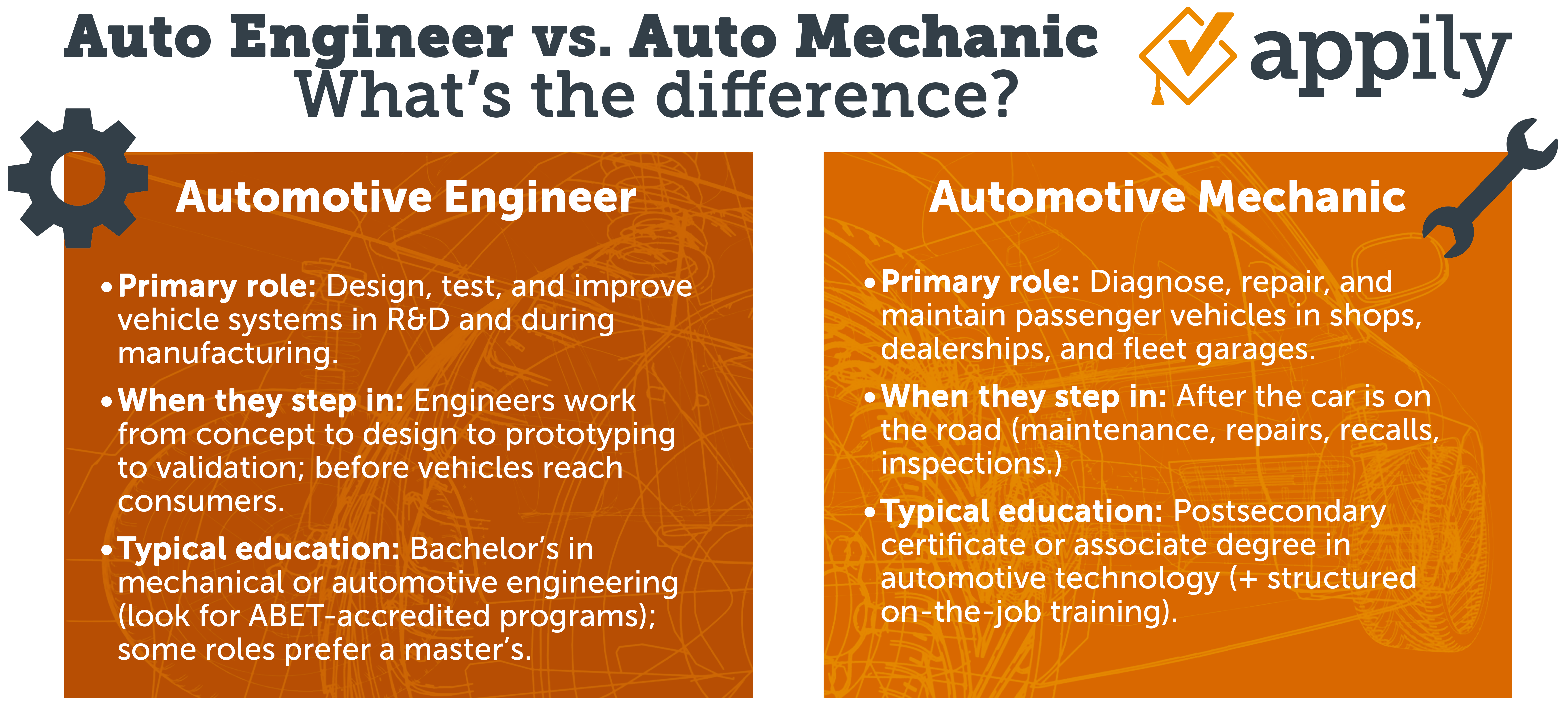
Next step: Write down two or three automotive jobs that sound interesting to you, then check which degree employers typically request for those roles.
2. Check the exact degree name and required courses
Do not assume programs with similar names teach the same material.
Automotive engineering, automotive engineering technology, and automotive technology are distinct academic paths.
Engineering generally emphasizes engineering science, mathematics, analysis, and conceptual design.
Engineering technology generally emphasizes the application and implementation of engineering principles.
Automotive technology generally focuses more directly on vehicle operation, diagnostics, service, repair, testing, and technical support.
Then look beyond the title. Compare the required courses.
If you are interested in EV engineering, for example, look for subjects such as:
- Battery systems
- Power electronics
- Electric motors
- Thermal management
- Controls
- Embedded systems
- Vehicle electronics
- Charging systems
- Manufacturing
- Vehicle testing
3. Check accreditation for the exact program
Accreditation applies to individual programs, not simply to the university as a whole.
ABET's Engineering Accreditation Commission accredits engineering programs, while its Engineering Technology Accreditation Commission accredits engineering technology programs.
ABET also notes an important curriculum distinction: engineering programs tend to emphasize theory and conceptual design, while engineering technology programs generally emphasize application and implementation.
Do not assume that one ABET-accredited program at a university means every engineering-related degree there has the same accreditation.
Status can also change as new programs move through the accreditation process. Clemson, for example, currently states that its new B.S. in Automotive Engineering is in the process of applying for ABET accreditation, while Purdue identifies its Motorsports Engineering program as ABET accredited.
4. Look for hands-on vehicle work
Strong automotive preparation should give you ways to apply what you learn, not just take automotive-themed classes.
Depending on your degree path, look for:
- Formula SAE, Baja SAE, motorsports, or other vehicle-design teams
- Vehicle laboratories
- Dynamometers or test cells
- Automotive shops
- Co-ops or internships
- Required industry experience
- Senior design or capstone projects connected to vehicles
- EV, battery, controls, autonomy, electronics, or manufacturing research
- Manufacturer training
- Opportunities to build, test, diagnose, or repair real vehicle systems
5. Ask about co-ops, internships, and industry connections
Automotive experience before graduation can help you understand the industry and build professional skills.
The structure varies significantly by college.
Kettering builds paid co-op experience into its educational model. RIT requires mechanical engineering students to complete four co-op blocks totaling 48 weeks. Purdue's motorsports program operates in Indianapolis near major racing organizations. Other programs connect students with manufacturers, suppliers, research centers, race teams, dealerships, or regional automotive employers.
When researching a program, ask:
- Is a co-op or internship required?
- Which companies hire students from this program?
- When do students typically complete internships?
- Are opportunities near campus, or will I need to relocate?
- Do students work with manufacturers, suppliers, racing organizations, dealerships, or research partners?
- What types of jobs do recent graduates enter?
6. Compare the complete path to graduation
Not every bachelor's program is structured as four years of continuous study after high school.
For example, some programs use a 2+2 structure that requires an associate degree before the bachelor's portion. RIT's required co-op schedule extends its mechanical engineering plan across five years.
That can be valuable, but it affects your timeline and potentially your costs.
Ask:
- Can I enter this bachelor's program directly from high school?
- Is an associate degree required first?
- How long do students typically take to graduate?
- Does co-op add semesters or years?
- Are summer terms required?
- Could changing majors delay graduation?
7. Compare cost, admissions fit, and location
A strong automotive program still has to work for you financially and academically.
Once you identify the right type of degree, compare:
- Estimated net price
- Scholarships and financial aid
- Admissions fit
- Distance from home
- Housing and transportation costs
- Program-specific admission requirements
- Whether you can change majors if your interests shift
- Whether co-ops or internships may require transportation or relocation
- Campus environment
- Support services
- Clubs and activities outside your major
A specialized program is not automatically the right choice if another school gives you a stronger overall financial, academic, or personal fit.
Final takeaway
Start with the job you want, then compare the degree.
If you want to design vehicles, EV systems, powertrains, controls, or other automotive systems, begin with automotive engineering and mechanical engineering programs.
If you are specifically interested in racing, compare motorsports engineering programs and mechanical engineering schools with substantial motorsports coursework, laboratories, design teams, and industry opportunities.
If your interests are more applied, such as vehicle testing, manufacturing, advanced diagnostics, technical support, or service operations, compare automotive engineering technology and automotive technology programs carefully.
Then narrow your list using the factors that can change both your college experience and your career preparation: the exact curriculum, program accreditation, laboratories and design teams, internships or co-ops, total time to graduation, cost, admissions fit, and location.
Once you have a few programs that match your career goal, use Appily to compare colleges, explore estimated costs, search for scholarships, and save the schools that fit your plans.
FAQ: Automotive engineering schools and degrees
What colleges offer automotive engineering degrees?
Clemson University and Minnesota State University, Mankato offer dedicated bachelor's programs in Automotive Engineering.
Other colleges offer different undergraduate routes into automotive engineering. Arizona State University offers engineering with an Automotive Systems concentration, while schools such as Kettering, Ohio Northern, RIT, Virginia Tech, and Tennessee Tech offer automotive-focused study through mechanical engineering.
Purdue University in Indianapolis offers a dedicated B.S. in Motorsports Engineering.
Because degree names and structures differ, compare the exact credential and curriculum rather than searching only for programs called “Automotive Engineering.”
Is automotive engineering a common major?
No. Dedicated undergraduate automotive engineering majors are less common than mechanical engineering programs.
Many students who want automotive engineering careers earn a mechanical engineering degree and build automotive experience through electives, vehicle-design teams, research, internships, co-ops, or graduate study.
That can also give you more flexibility if your career interests change.
Is mechanical engineering good for automotive engineering?
Yes. Mechanical engineering is a common route into automotive engineering.
Vehicle development involves subjects at the core of mechanical engineering, including mechanics, thermodynamics, materials, manufacturing, dynamics, fluids, and controls.
If you choose mechanical engineering, compare colleges based on automotive coursework, Formula SAE or other design teams, internships, co-ops, automotive research, and laboratories.
What is the difference between automotive engineering and automotive engineering technology?
Automotive engineering generally emphasizes engineering theory, mathematics, analysis, and conceptual design, while automotive engineering technology places more emphasis on applying and implementing engineering principles.
ABET treats engineering and engineering technology as separate accreditation categories and describes a similar difference in curricular focus.
Neither program name tells you everything about a specific college, so compare the required mathematics, science, design, testing, laboratory, and technical coursework.
What is the difference between automotive engineering and automotive technology?
Automotive engineering focuses primarily on designing, developing, analyzing, manufacturing, and testing vehicles or vehicle systems. Automotive technology generally focuses more directly on vehicle operation, diagnostics, service, repair, and technical support.
There can be overlap, especially in testing and advanced vehicle systems, but the academic preparation is different.
Check the required courses and the types of jobs the program is designed to prepare graduates for.
What is a good degree for EV engineering?
Several engineering majors can lead to electric-vehicle careers, depending on which part of an EV you want to work on.
Mechanical engineering can connect to thermal management, structures, vehicle dynamics, manufacturing, and mechanical systems.
Electrical engineering can connect to motors, power electronics, batteries, charging, and electrical systems.
Computer and computer engineering can connect to embedded systems, controls, software, connectivity, and vehicle computing.
Automotive engineering can combine several of those subjects in a vehicle-focused curriculum.
Look for programs with coursework, laboratories, and projects involving battery systems, power electronics, electric motors, thermal management, controls, embedded systems, vehicle electronics, charging, manufacturing, or vehicle testing.
Which colleges offer undergraduate motorsports engineering?
Purdue University in Indianapolis offers a dedicated B.S. in Motorsports Engineering and identifies it as the only ABET-accredited undergraduate motorsports engineering program in the United States.
UNC Charlotte offers a Motorsports Engineering concentration within mechanical engineering.
Students can also compare mechanical and automotive engineering programs with Formula SAE teams, vehicle dynamics and aerodynamics courses, data acquisition, motorsports laboratories, and racing-related internships.
Should I choose automotive engineering or mechanical engineering?
Choose automotive engineering if you are confident that you want your undergraduate coursework centered on vehicles and mobility systems. Choose mechanical engineering if you want an automotive career while preserving more flexibility across other engineering industries.
Do not make the decision based on the degree title alone.
Compare:
- Required courses
- Automotive electives
- Laboratories
- Design teams
- Internships and co-ops
- Research
