What Is a Forward-Deployed Engineer? The Fast-Growing AI Career

A forward-deployed engineer is a software engineer who works closely with customers to turn technology into a system people can actually use. In AI, that can mean figuring out which problem is worth solving, connecting a model to company data and tools, writing production code, testing the system, setting security controls, and helping employees work with it.
Sure, the title is a mouthful. But the job itself is easier to understand: forward-deployed engineers help promising technology survive contact with the real world.
This role is suddenly in high demand. Job-posting data show sharp growth for this role recently. Major technology companies are investing billions in deployment teams, and some employers are recruiting both new graduates and experienced engineers.
For students who like coding but also want to work with people and enjoy solving problems without an answer key, forward-deployed engineering is a career worth knowing about.
TL;DR: What is a forward-deployed engineer?
- A forward-deployed engineer (FDE) is a customer-facing software engineer who helps an organization figure out what problem to solve, builds the technical solution, launches it, and makes sure people can actually use it.
- FDEs do more than code. The role combines software engineering, AI and systems knowledge, communication, business judgment, and problem-solving, often in situations where the requirements are still ngineers is growing as companies look for people who can turn powerful AI tools into reliable systems that work with real data, workflows, security requirements, and business goals.
- There’s no single path into the field. Majors like computer science, software engineering, computer engineering, data science, information technology, math, and related technical fields can all provide useful preparation—especially when paired with hands-on projects and knowledge of a specific industry.
- You don’t need “forward-deployed engineer” to be your first job title. Experience in software engineering, data engineering, cloud engineering, solutions engineering, implementation, or technical consulting can help you build many of the same skills.
- The bigger takeaway? Don’t chase the title. Build the skill set. Companies need people who can understand a messy real-world problem, build a dependable solution, explain the tradeoffs, and improve it once real people start using it.
What is a Forward-Deployed Engineer?
A forward-deployed engineer, often shortened to FDE, is a customer-facing software engineer who helps design, build, and launch technical solutions for a specific organization.
The word “forward” means the engineer works close to the environment where the technology will be used. That might be a hospital, bank, factory, airline, government agency, retailer, or another business with its own data, software, rules, and ways of working.
An FDE is not simply installing a finished product. The job often begins before anyone knows exactly what should be built.
OpenAI describes its FDE role as owning the full deployment process, from discovery and technical scoping through system design, development, and production rollout. The company measures success by adoption, impact on customer workflows, and feedback to improve products and models.
In plain English, an FDE may need to:
- Talk with employees and understand how work gets done
- Find the real problem behind a customer’s initial request
- Decide whether AI is a useful part of the solution
- Design the system and write the code
- Connect company data, APIs, software, and cloud services
- Test accuracy, reliability, privacy, and security
- Launch the system and help people use it
- Measure whether it saved time, reduced errors, increased revenue, or created another meaningful result
- Bring lessons from the customer back to product and research teams
That is why the role overlaps with traditional software engineering, product management, systems architecture, and technical consulting. Coding matters, but it is only one part of the work.
What does a Forward-Deployed Engineer do?
Every project is different, but the work usually moves through five stages.
Find the real problem
An FDE may start with interviews, observations, and a lot of questions.
Suppose a hospital asks for an AI chatbot. After talking with nurses and administrators, the engineer might discover that a chatbot is not the priority. The larger problem could be that staff members spend hours searching several disconnected data systems for the same patient information.
The first job is to understand the outcome people need and what is getting in their way.
Choose a useful workflow
Not every frustrating task needs AI. An FDE has to decide where the technology could create enough value to justify the cost and risk.
That means asking practical questions: Does the necessary data exist? Is it accurate enough? Which mistakes would be unacceptable? When should a human make the final decision? How will the team know whether the system worked?
OpenAI says a typical deployment company engagement starts by learning how a business works and where AI could help the most. Then, OpenAI and the customer choose a few important tasks to focus on first.
Design and build the system
Once the problem is clear, the work becomes deeply technical. Depending on the project, an FDE might build a full-stack application, an AI agent, a data pipeline, an internal search tool, a user interface, or a set of integrations connecting several business systems.
The engineer may work in Python, JavaScript, TypeScript, Java, C++, or another language. They may also need experience with databases, APIs, cloud infrastructure, authentication, testing, monitoring, and AI evaluation.
Make it reliable enough for real use
A demo can look great with clean sample data and a friendly test question. But production is where things can get spicy.
Real systems have missing records, unusual requests, slow connections, conflicting permissions, security requirements, and users who do things nobody predicted. AI adds another challenge because model outputs can vary or be wrong.
An FDE may build evaluation tests, monitoring, fallback behavior, audit logs, permission controls, and human-review steps. In a high-stakes setting, knowing when the system should stop and ask for help can matter as much as knowing what it can automate.
Help people adopt it and improve it
A technically impressive system has little value if employees avoid it or cannot fit it into their work.
FDEs may train users, collect feedback, revise the interface, change the workflow, and measure results after launch. They also bring field lessons back to the company building the core product.
That feedback loop is part of the job.Palantir’s explanation of its engineering model says forward-deployed engineers sometimes contribute code back to the core product after learning what customers need.
How is an FDE different from a traditional software engineer?
Traditional product engineers usually build features meant to serve many customers. Forward-deployed engineers are more likely to combine several technologies to solve one customer’s problem.
Palantir, which popularized the role and calls its FDEs “Deltas,” puts the distinction neatly: a product engineer may focus on “one capability, many customers.” In contrast, an FDE focuses on “one customer, many capabilities.”
Imagine an airline wants to reduce flight delays. A product engineer might build a scheduling feature for every airline using a platform. An FDE might work with one airline to connect scheduling data, weather information, maintenance records, and staffing systems, then build an application around that airline’s specific operations.
FDEs also differ from many solutions engineers and consultants, although job titles are not consistent across companies.
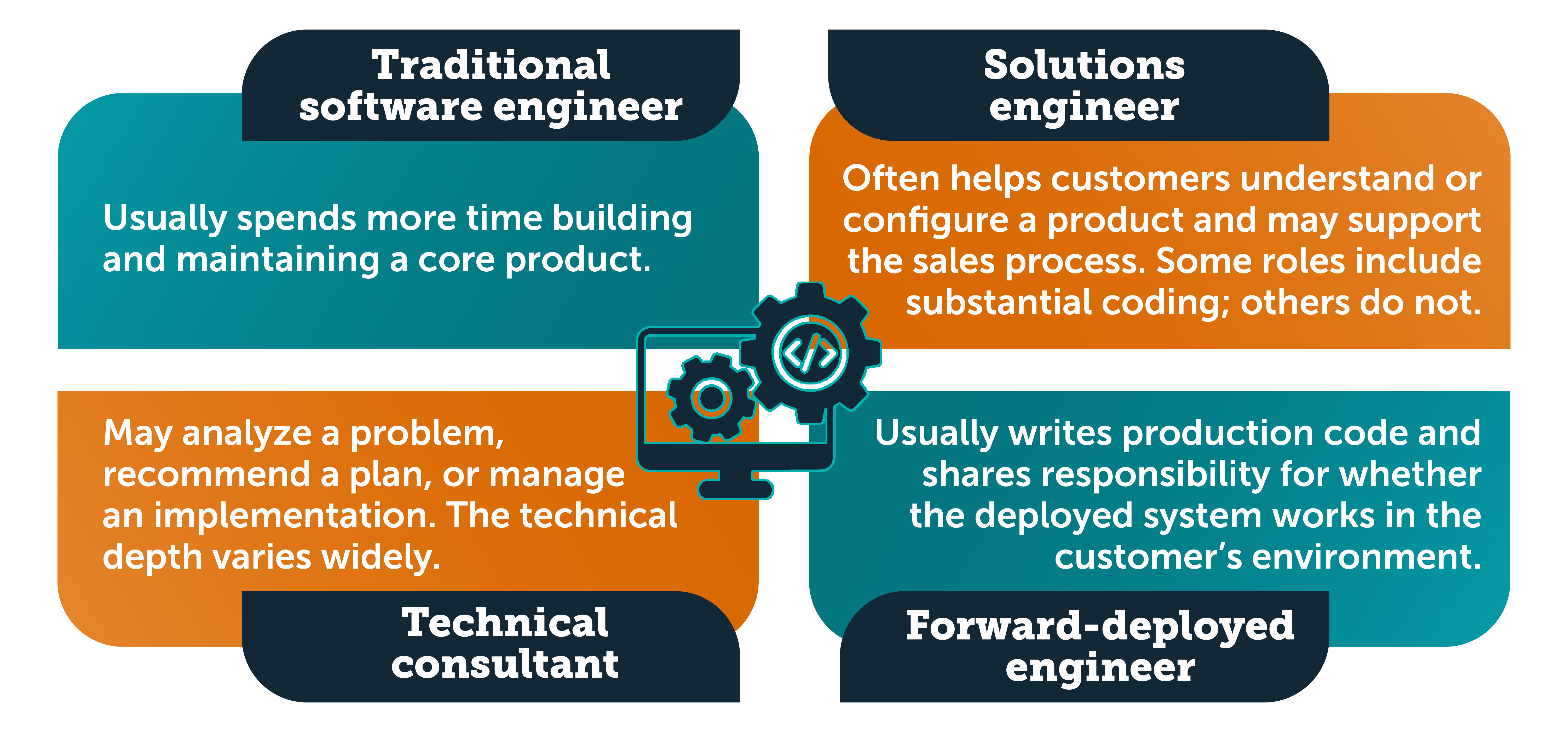
These categories overlap. The job description matters more than the label.
Why is demand for Forward-Deployed Engineers growing?
Companies have gained access to powerful AI models faster than they have learned to use those models across their organizations.
McKinsey’s 2025 State of AI survey reports that 88% of respondents said their organizations regularly used AI in at least one business function. Yet only about one-third said their organizations had begun scaling AI across the enterprise. Just 39% reported any enterprise-level effect on earnings before interest and taxes, and most of that group attributed less than 5% of EBIT to AI.
In other words, trying AI is common. Turning it into reliable, organization-wide value is still hard.
Employers appear to be hiring FDEs to close that gap. According to Indeed data reported by Business Insider, FDE postings in April 2025 were 543% above a January 2025 baseline. By April 2026, they were 5,230% above that baseline.
But those numbers need context. They are index values, not a count of individual openings, and a specialized job can post a huge percentage increase when it starts from a small base. The data shows momentum, not that FDEs have suddenly become one of the largest occupations in technology.
The investment trend is easier to see. In 2026, three technology companies announced more than $7.5 billion in combined investment in organizations focused on helping customers deploy AI.
- OpenAI launched the OpenAI Deployment Company with more than $4 billion in initial investment. Its planned acquisition of Tomoro is expected to bring about 150 experienced FDEs and deployment specialists to the new company, subject to closing conditions.
- Microsoft announced a $2.5 billion investment in Microsoft Frontier Company, with plans to embed 6,000 engineering and industry experts with customers.
- AWS announced a $1 billion investment in a dedicated FDE organization that will embed thousands of experts with customer teams.
That totals $7.5 billion and is simply the sum of investment from those three announcements. The message behind the spending is still clear: building a powerful model is not enough. Companies also need people who can connect that technology to real data, workflows, security controls, and business goals.
Where do Forward-Deployed Engineers work?
FDEs work at AI labs, cloud providers, enterprise-software companies, consulting firms, systems integrators, and startups. They are also needed in industries such as healthcare, finance, manufacturing, energy, transportation, cybersecurity, and government technology.
Many future FDEs will not work for the company that created the underlying AI model. Instead, partners will do much of the implementation work.
For example, Anthropic and DXC announced in June 2026 that DXC plans to train tens of thousands of Claude-certified FDEs for work with banks, airlines, insurers, manufacturers, and government agencies.
Interested students looking for opportunities should also look beyond a single title. Related roles may include:
Forward-deployed software engineer
Applied AI engineer
AI implementation engineer
Deployment engineer
Solutions engineer
AI solutions architect
Technical consultant
Implementation engineer
Then, when evaluating positions, read the responsibilities carefully. Some of these jobs involve heavy software development. Others lean more toward sales, configuration, project management, or support.
Is Forward-Deployed Engineering an entry-level career?
Sometimes it is, but not always. Many FDE positions are designed for experienced engineers because the job combines production software, customer communication, and independent decision-making.
OpenAI’s current New York posting, for example, asks for at least five years of engineering or technical deployment experience. Other companies recruit directly from college. Palantir’s current new-graduate FDE posting is open to students graduating in December 2026 or spring 2027. It asks for an engineering-related degree and proficiency in at least one programming language.
Students may also reach FDE work through a nearby first job, such as software engineering, data engineering, solutions engineering, cloud engineering, implementation, or technical consulting.
The practical takeaway: you do not need to land a job with “forward-deployed” in the title on day one. Build the combination of skills the work requires, then watch for several possible entry points.
How much do Forward-Deployed Engineers make?
FDE pay can be high, but there is no reliable national median for the title. It is still a small and loosely defined job category, and compensation changes with experience, location, employer, and equity.
Current postings provide useful examples:
- Palantir lists an estimated base salary of $135,000 to $145,000 for its New York new-graduate FDE role, with possible restricted stock units, a sign-on bonus, and other incentives.
- OpenAI lists compensation of $162,000 to $280,000, plus equity, for its New York FDE role, which requires at least 5 years of relevant experience.
Those are just examples, not promises or national averages. Both jobs are in New York, and one is an experienced-hire role.
For broader context, the U.S. Bureau of Labor Statistics reported a median annual wage of $133,080 for software developers in May 2024. BLS does not track forward-deployed engineers as a separate occupation.
What should you major in to become an FDE?
There is no single required major. Strong options include:
Palantir’s new graduate posting lists computer science, electrical and computer engineering, mathematics, software engineering, physics, and data science as preferred fields.
The best preparation often combines technical depth with knowledge of an industry or problem area. A student interested in health technology might pair computer science with public health courses.
Someone interested in financial systems could combine data science with economics or finance. Manufacturing, education, environmental science, supply-chain management, and cybersecurity can all provide useful domain knowledge.
You do not necessarily need a double major. A minor, concentration, internship, research project, student organization, or set of well-chosen electives can help you learn how another field works.
What skills does a Forward-Deployed Engineer need?
Strong FDEs are builders, translators, and problem-solvers. That combination is what makes the role interesting and demanding.
Software and systems skills
FDEs need a solid programming foundation. Depending on the role, that may include frontend and backend development, databases, APIs, data pipelines, cloud infrastructure, version control, testing, deployment, monitoring, and debugging.
For AI projects, it also helps to understand model evaluation, retrieval systems, prompt and context design, privacy and security, and when to review an AI-generated result.
Communication and discovery
An FDE has to ask useful questions, listen to people with diverse expertise, and explain technical choices without resorting to jargon.
Comfort with ambiguity
Customers do not always know what they need, requirements can change, and the first solution may fail. FDEs have to make decisions with incomplete information, test their assumptions, and adjust without treating every change as a five-alarm fire.
Business and domain judgment
The best technical solution is not automatically the most useful one. FDEs need to understand cost, risk, workflow, and the outcome the organization cares about. Knowledge of a specific field can help them notice constraints that a generalist might miss.
Ownership
An FDE is often responsible for more than completing assigned coding tasks. The role may involve defining the work, sequencing it, managing trade-offs, helping users adopt the system, and measuring outcomes after launch.
How can high school and college students prepare?
You do not need access to a frontier AI lab to practice the basic FDE mindset. Start smaller and build something real.
Build a project for an actual user
A personal project can show that you know how to code. But a project for another person shows that you can listen, test assumptions, and revise something.
You might help a teacher organize resources, build a simple tool for a student club, improve a process for a local nonprofit, or create a dashboard for a family business. The project does not have to be revolutionary. It has to be useful.
Try this process:
- Ask the user what is frustrating or taking too much time.
- Watch how they handle the task now.
- Define one small problem you can realistically improve.
- Build the simplest useful version.
- Let the user test it.
- Observe what breaks or confuses them.
- Improve it.
- Measure whether it helped.
That is very basic forward-deployed engineering.
Learn production fundamentals
A prototype is a great start. But knowing how to keep it working is even better.
Practice using Git, databases, APIs, authentication, automated tests, cloud deployment, logging, documentation, permissions, and basic security controls. You don’t need to master everything at once. You just need to try things, grow your skillset, and build one layer at a time.
Practice explaining your choices
Can you talk through a project with someone who does not code? You should be able to explain what problem it solves, what data it uses, where it can fail, how you protect users, and how you would measure success.
In an FDE role, good communication is just as essential as technical work.
Look for adjacent internships
Relevant experience may come from internships in software engineering, data engineering, cloud engineering, solutions engineering, implementation, consulting, product development, or IT. Appily’s guide toentry-level computer science jobs can help you explore several starting points.
Get comfortable with open-ended problems
Hackathons, robotics teams, research labs, entrepreneurship clubs, consulting clubs, capstone courses, and community technology projects can all help you get there. Choose experiences where you have to define part of the problem instead of following a complete set of instructions.
Who might enjoy this career?
Forward-deployed engineering may be a good fit if you:
- Enjoy coding but do not want to spend all day on isolated technical tasks
- Like talking with users and learning how organizations work
- Enjoy open-ended problems and changing requirements
- Want to learn about different industries
- Like seeing a project move from idea to real-world use
- Are comfortable balancing technical quality, speed, cost, and risk
- Do not mind travel or working at customer sites
That last point matters. Palantir’s new graduate role lists 25% to 50% travel, and OpenAI’s New York role requires up to 50% travel.
The career may be less appealing if you strongly prefer predictable requirements, long stretches of uninterrupted coding, minimal customer contact, a narrow technical specialty, or little travel. Those preferences are not flaws. They simply point toward different engineering roles.
Is Forward-Deployed Engineering just consulting with more code?
Well, sometimes there is a resemblance between the two. Both consultants and FDEs work closely with customers, learn how an organization operates, and try to improve results.
The strongest version of the FDE role goes further than advice. The engineer builds and deploys production software, then shares responsibility for whether people can use it successfully.
There is still a real tension in the model. Customers want technology adapted to their specific data and workflows. Software companies want products they can sell repeatedly without having to rebuild everything for each customer. Too much custom work can create expensive systems that are difficult to maintain. Too little can leave the customer with a polished demo that never becomes useful.
Companies are trying to manage that tension by turning successful deployment patterns into reusable tools, documentation, and product improvements. AWS says its FDE engagements are designed to leave customers with working systems, architectural documentation, runbooks, trained employees, and the ability to operate independently. OpenAI says its Deployment Company will look for effective patterns that can be generalized across organizations.
Whether every company can deliver on that promise is still an open question. Students should view the role as a serious engineering career, not a magic title that makes the hard parts of implementation disappear.
Is Forward-Deployed Engineering a lasting career?
The exact title may rise, fade, or split into several job families. The underlying problem is likely to stick around.
Organizations will continue to need people who can translate technical capability into reliable systems that fit real workflows. Some of that work may be called forward-deployed engineering. Some may move into applied AI, solutions architecture, systems integration, implementation, product engineering, or technical consulting.
AI tools will automate parts of the job, including code generation, testing, and documentation. That may push engineers toward harder-to-automate work such as system design, risk evaluation, user understanding, and organizational change.
The broader software field remains strong. BLS projects 15% growth from 2024 to 2034 for software developers, quality assurance analysts, and testers, with an average of about 129,200 openings per year. Those projections do not measure FDEs specifically, but they do show continued demand for people who can build and maintain software.
What should students take away from the FDE boom?
Do not chase a trendy title just because the salary screenshots look nice. Pay attention to the skill combination underneath it:
Technical depth + domain knowledge + communication + implementation experience
That could mean studying computer science while learning about healthcare. It could mean majoring in information systems and gaining supply-chain experience. It could mean studying data science, joining a consulting club, and building a useful tool for a nonprofit.
You do not have to become an expert in everything. Aim to become someone who can enter an unfamiliar environment, ask good questions, build a dependable solution, explain the tradeoffs, and improve it when the first version meets reality.
That is the bigger story behind the FDE boom. Companies already have access to increasingly capable AI. What many still need are people who can make it useful.
Turn this career interest into a college plan
You do not need to decide today whether “forward-deployed engineer” will appear on your future business card. Your interests may change, and the title may change too.
As you explore colleges, look for hands-on projects, internships, research, and ways to combine technology with another field. Appily’s guide to majors that can lead to six-figure careers offers more ideas, though salary should never be the only reason to choose a major.
Create your free Appily account to explore colleges, majors, and scholarships that can help you build your path. You can also take our Career Cluster quiz to uncover related career groups that fit your personality and interests. But remember...you do not need your whole future mapped out before you begin.
FAQs about forward-deployed engineers
What is a forward-deployed engineer?
A forward-deployed engineer, or FDE, is a customer-facing software engineer who designs, builds, and launches technical solutions for a specific organization. FDEs work closely with users to understand their problems, connect technology to existing data and systems, and turn a promising idea into something reliable enough for real-world use.
What does a forward-deployed engineer do?
A forward-deployed engineer usually works across the full lifecycle of a technical project. That can include identifying the real problem, deciding whether AI is useful, designing and coding the solution, connecting APIs and data systems, testing for reliability and security, launching the product, helping users adopt it, and measuring whether it delivered a meaningful result.
How is a forward-deployed engineer different from a software engineer?
Traditional product engineers often build features intended to work for many customers. Forward-deployed engineers are more likely to combine multiple technologies to solve the needs of one customer or organization. The roles overlap, but FDEs typically spend more time working directly with users, navigating changing requirements, and adapting technology to real-world workflows.
Is forward-deployed engineering an entry-level career?
It can be. Some companies hire forward-deployed engineers directly from college, while others look for engineers with several years of experience. Students can also enter the field through related jobs in software engineering, data engineering, cloud engineering, solutions engineering, implementation, or technical consulting before moving into an FDE role.
What should you major in to become a forward-deployed engineer?
There is no single required major for forward-deployed engineering. Common options include computer science, software engineering, computer engineering, electrical engineering, information technology, information systems, data science, mathematics, statistics, and physics. Pairing technical skills with knowledge of an industry such as healthcare, finance, manufacturing, cybersecurity, or another field can also be valuable.
What skills does a forward-deployed engineer need?
Forward-deployed engineers need both technical and people skills. Important technical skills can include programming, databases, APIs, cloud infrastructure, testing, deployment, monitoring, debugging, AI evaluation, privacy, and security. FDEs also need to communicate clearly, ask good questions, work through ambiguity, understand business needs, make tradeoffs, and take ownership of a project from idea through adoption.
How much do forward-deployed engineers make?
There is not yet a reliable national median salary specifically for forward-deployed engineers, and compensation varies by employer, experience, location, and equity. As of August 2026, the roles cited in this article include an estimated $135,000 to $145,000 base salary for a New York new-graduate FDE role at Palantir and $162,000 to $280,000 plus equity for an experienced New York FDE role at OpenAI. These are examples, not national averages or guaranteed salaries.
How can high school and college students prepare for forward-deployed engineering?
Start by building something useful for a real person or organization. Learn how to understand a user’s problem, create a simple solution, test it, collect feedback, and improve it. You can also build experience through internships, hackathons, research, robotics, consulting clubs, capstone projects, and courses that strengthen your programming, systems, communication, and problem-solving skills.
Is forward-deployed engineering just technical consulting?
Not quite. FDEs and technical consultants may both work closely with customers and learn how an organization operates, but a strong forward-deployed engineering role goes beyond recommending a solution. FDEs typically build and deploy production software and share responsibility for whether the system works successfully in the real world.
Is forward-deployed engineering a good career for students interested in AI?
It may be a strong fit if you like coding, enjoy working with people, and want to solve open-ended problems using AI and other technologies. The work can be especially appealing if you want to see a project move from an idea to something people actually use. If you prefer highly predictable requirements, minimal customer interaction, or a narrowly focused technical specialty, another engineering role may suit you better.
