How to Get Work Experience in High School

To get work experience in high school, start with an opportunity that lets you explore a career, practice a skill, contribute to an organization, or take on real responsibility.
That could mean getting a part-time job. But it could also mean completing an internship, volunteering, shadowing a professional, joining a career program, helping with a family business, or creating a project of your own.
In other words, you do not have to wait for someone to offer you the perfect job.
And you do not have to jump from “no experience” to “competitive internship” overnight.
You can start smaller.
Today, we’re breaking down how.
The TL;DR
- High school students can gain work experience through paid jobs, internships, apprenticeships, volunteering, job shadowing, school activities, family businesses, freelance work, and personal projects.
- Start by deciding what you need most: income, career exploration, a new skill, a professional connection, or something you can add to your resume.
- You do not need a job directly related to your future college major. Most first experiences build transferable skills that are useful in many careers.
- Ask teachers, counselors, coaches, family members, local organizations, and small businesses about opportunities.
- If an organization does not offer formal internships, ask whether you can help with one specific project.
- Track your responsibilities, accomplishments, hours, feedback, and work samples.
- Before accepting an opportunity, understand the schedule, pay, supervision, age requirements, safety expectations, and work you will actually perform.
What counts as work experience in high school?
Any type of structured or self-directed experience that helps you understand a workplace, practice career-ready skills, or take responsibility for completing the work can count as “work experience.”
That can include things like:
Part-time and summer jobs | Paid or unpaid internships |
Youth apprenticeships and pre-apprenticeships | Volunteer positions |
Job shadowing | Informational interviews |
School clubs and leadership roles | Career and technical education programs |
Freelance or self-employed work | Work for a family business |
Family responsibilities | Personal projects |
Virtual job simulations |
These experiences are not all identical.
For example, a paid job is formal employment. Job shadowing is mainly career exploration. Volunteering should normally be described as volunteer experience. An independent project may belong in the “Projects” section of your resume.
But each one can help you build skills, explore careers, and prepare for future opportunities.
Why is work experience important in high school?
Getting experience can help you prepare for jobs, internships, scholarships, college applications, and eventually a career. But the goal isn’t to simply to collect impressive titles. In high school, you have some unique opportunities:
You can explore careers before committing to one
A career may sound interesting until you see what the work looks like every day.
You might think you want to become a teacher and discover that you prefer working with students one-on-one. You may be interested in health care but realize that research, technology, or administration fits you better than direct patient care.
That is useful information.
You don’t have to have your entire future figured out in high school, but work experience gives you a way to test different possibilities before making bigger decisions about college, majors, and careers.
And you don't even have to have it all figured out by college. At many schools, co-op programs allow you to keep exploring the career paths you're interested in as part of your degree.
You can build transferable skills
Transferable skills can help you in almost any workplace, no matter what path you decide to take.
They can include skills like:
- Communication
- Reliability
- Teamwork
- Time management
- Organization
- Problem-solving
- Customer service
- Leadership
- Adaptability
It’s worth noting too that your first job doesn’t have to match your future major. Working in a grocery store may not connect directly to engineering, psychology, or journalism. But it can teach you how to communicate with customers, work with a team, follow procedures, solve unexpected problems, and manage your schedule. Those skills still count!
You can give better examples on applications
Applications often ask about your responsibilities, accomplishments, challenges, or goals.
Experience gives you something specific to discuss.
Instead of saying you are responsible, you can explain how you managed a weekly tutoring schedule. Instead of saying you work well with others, you can describe how your team prepared for a busy event.
The experience does not have to sound extraordinary. You simply need to explain what you did and why it mattered.
The work experience ladder
You do not have to begin with a formal job or internship.
Think of gaining experience as a series of possible steps:
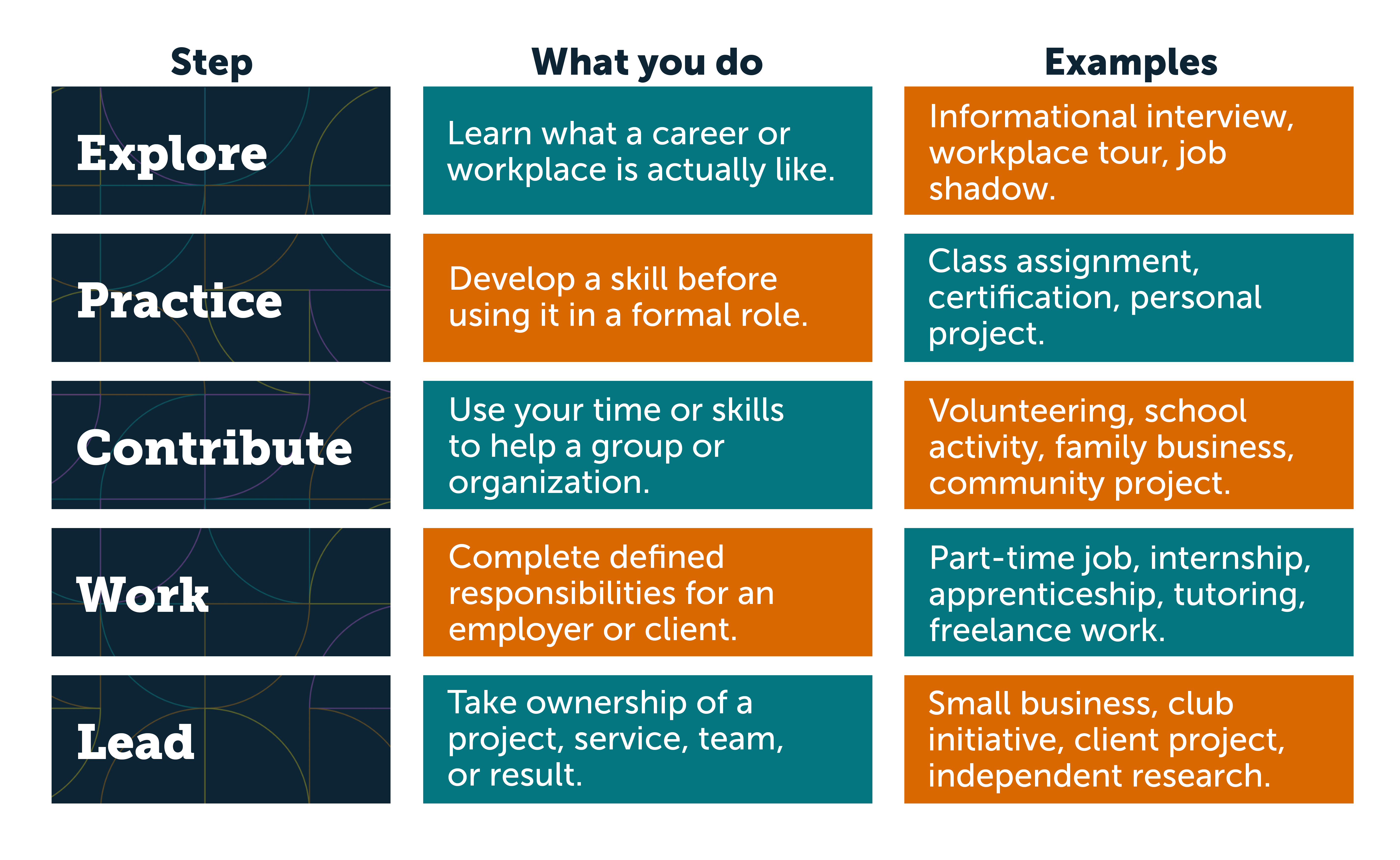
You don’t have to complete every step, or complete them in order.
The point is that there are ways to move forward before you qualify for a highly competitive position.
For example, you could:
- Interview a graphic designer about their work.
- Learn to use a design program.
- Create sample graphics.
- Volunteer to design a flyer for a school event.
- Use that work to apply for a paid design or communications role.
That is how experience starts building on itself.
Where should you start?
The best type of experience depends on what you need right now.
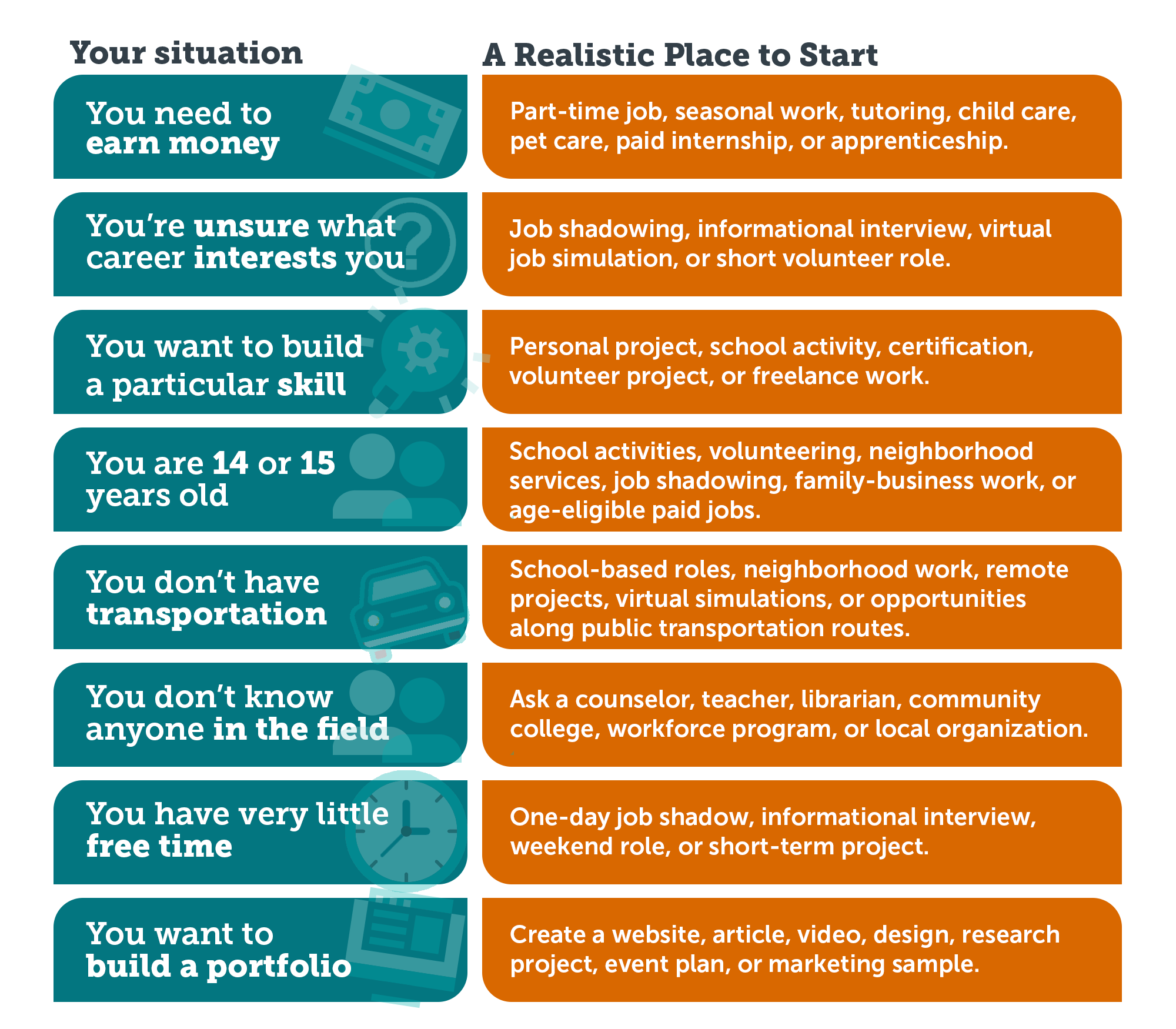
Start with the option that fits your actual circumstances, not the one you think will look most impressive.
Eight ways to get work experience in high school
There is no single best pathway. Your options will depend on your age, schedule, transportation, interests, financial needs, and what is available where you live.
1. Get a Part-Time or Summer Job
A traditional job is one of the most direct ways to gain experience (and earn some cash).
Some common high school jobs include:
- Retail or grocery store employee
- Restaurant host, cashier, or food-service worker
- Camp counselor
- Lifeguard
- Tutor
- Babysitter
- Pet sitter or dog walker
- Library assistant
- Recreation center employee
- Office assistant
- Social media or content assistant
Again, don’t worry if the job is unrelated to the career you think you want.
You don’t need to find a “future engineer job” or a “future lawyer job” at 16.
Look for a workplace where you can learn, contribute, and practice professional skills.
2. Apply for an Internship
An internship is a short-term opportunity to gain experience in a particular workplace or career field.
Internships may be available through:
- Businesses
- Nonprofit organizations
- Government offices
- Colleges and universities
- Museums
- Hospitals
- Research organizations
- Community programs
An internship may make sense if you already have a field you want to explore or a skill you want to practice.
Before accepting one, ask what you will actually do.
A useful internship should include clear responsibilities, supervision, feedback, and opportunities to learn. Be careful with positions that promise impressive “exposure” but cannot explain what your day-to-day work will involve.
If you’re already thinking about this path, check out Appily’s guide to getting an internship in high school.
3. Volunteer With an Organization
Volunteering can help you build experience while supporting an organization or cause.
Depending on the role, you might help with:
- Tutoring
- Event planning
- Fundraising
- Writing or editing
- Social media
- Animal care
- Food distribution
- Community outreach
- Office tasks
- Coaching or recreation
- Photography or video
- Basic technology support
Look for an opportunity where you will have a real responsibility.
Volunteering regularly with one organization may teach you more than completing a long list of unrelated service events.
You also don’t have to choose a cause just because it seems impressive. Pay attention to the work you will perform and whether the organization matters to you.
4. Try Job Shadowing or an Informational Interview
Maybe you’re not even sure where to start (and that’s totally okay and normal). Job shadowing lets you observe a professional for a few hours or a full day. An informational interview is a conversation where you ask someone about their work, education, career path, and advice.
An informational interview, on the other hand, is meant to help you learn about a career, not ask for a job offer. Its career-exploration guidance also recommends asking whether you can visit or shadow someone at work.
These options can be especially helpful if:
- You are too young for many formal positions
- You have limited time
- You want to explore a specialized career
- You are not sure whether a field interests you
- You want to make an initial professional connection
Questions you could ask include:
- What does a normal day look like?
- Which skills do you use most?
- What is your favorite part of the work?
- What is the most challenging part?
- What do people misunderstand about this career?
- What do you wish you had known in high school?
- How could a high school student learn more about this field?
Job shadowing is mainly observational, so it is not the same as completing ongoing work.
But it can help you decide what to do next.
If job shadowing sounds like the right next step, use our guide on how to ask for a job shadow in high school, including a request email template and follow-up examples
5. Gain Experience Through School
You may already have access to work-like responsibilities at school.
Consider getting involved with:
- The student newspaper or yearbook
- Student government
- Theater or technical crew
- Robotics or engineering teams
- Peer tutoring
- Morning announcements
- Video production
- Event planning
- Athletic team management
- A school store
- A club website or social media account
Simply joining an activity does not automatically create meaningful experience.
Look for ways to take ownership.
For example, “yearbook club member” does not tell an employer very much. Managing photography deadlines, designing pages, and coordinating with student groups demonstrate communication, organization, and project management skills.
6. Explore Career Programs and Apprenticeships
Your school may offer programs that combine classroom learning with career experience.
These may include:
- Career and technical education
- Cooperative education
- Work-study programs
- Pre-apprenticeships
- Youth apprenticeships
- Dual-enrollment career courses
- Industry credential programs
Registered youth apprenticeships can begin while students are still in high school and combine academic or technical instruction with workplace experience. Some connect to dual enrollment, college credit, or continued apprenticeship after graduation.
Ask your counselor:
“Does our school offer work-based learning, cooperative education, pre-apprenticeships, youth apprenticeships, or employer partnerships?”
Be specific. Your school may have opportunities that are not widely advertised.
You can also explore programs and openings through Apprenticeship.gov and its Apprenticeship Finder.
7. Create Your Own Work Experience
You do not always have to wait for an opening to appear.
You could:
- Tutor younger students
- Babysit
- Walk dogs or care for pets
- Complete yardwork
- Help people with basic technology
- Create photos or videos
- Design flyers or social media posts
- Repair bicycles or computers
- Start a newsletter, blog, podcast, or video channel
- Sell original artwork or handmade products
- Help an organization complete a project
Starting with one small project can be easier than asking for an ongoing role.
Instead of saying:
“I want marketing experience.”
Try:
“I noticed your summer event has not been posted on your social media pages. I’m interested in digital marketing and would be happy to draft a two-week posting calendar and five sample posts for your team to review.”
That tells the organization exactly how you could help.
Keep records of the work you complete, the people you help, and the results. Treat it professionally, even if you are working with a neighbor, family friend, or community group.
8. Complete a Personal Project or Virtual Job Simulation
A project can help you practice a skill before an employer hires you to use it.
Depending on your interests, you could:
- Build a basic website
- Create an app prototype
- Analyze a public dataset
- Produce a short documentary
- Design a mock marketing campaign
- Publish articles
- Develop tutoring materials
- Create a photography portfolio
- Complete an industry certification
- Conduct a research project
You can also try a virtual job simulation. These programs walk you through tasks modeled after work at a particular company or in a particular career.
A simulation is not the same as formal employment or an internship. But it can help you explore a field, learn a skill, and create work samples.
Learn more in Appily’s guide to choosing a major with virtual job simulations.
What if a job or internship is not realistic for you?
Not every student can spend the summer working in an office or completing an unpaid internship.
You may need to earn money. You might take care of siblings, help at home, share a car, live far from major employers, or already have a full academic schedule.
That does not mean you have nothing valuable to include on a resume or application.
Paid work, family responsibilities, school involvement, community projects, and informal work can all demonstrate skills such as:
- Reliability
- Organization
- Communication
- Problem-solving
- Leadership
- Time management
The title of the experience matters less than what you actually did.
A student who works a regular restaurant shift may develop more responsibility and workplace experience than a student who occasionally observes people at a prestigious organization.
Choose something that works with your circumstances. You do not have to compete with someone else’s opportunities.
How to find work experience as a high school student
Some positions are advertised online.
Many others are found through schools, community organizations, workforce programs, and direct conversations.
Start with your school
Talk to your school counselors, teachers, coaches, or librarians, and ask questions about whether your school has:
- Local employer partnerships
- Job or internship listings
- Career fairs
- Alumni mentors
- Service opportunities
- Career-shadowing days
- Career and technical education programs
- Prepare for a high school career fair
Look around your community
Potential organizations include:
- Libraries
- Museums
- Parks and recreation departments
- Community centers
- Local government offices
- Nonprofits
- Animal shelters
- Hospitals
- Small businesses
- Colleges and universities
- Child care centers
- Camps
- Cultural organizations
Check age and eligibility requirements before applying.
Look for local youth-employment programs
CareerOneStop’s Youth Program Finder helps people ages 14 to 24 locate free job, career, and training support.
Depending on the program, services may include help finding jobs, preparing applications, practicing for interviews, and learning about internships or apprenticeships.
Tell people what you are looking for
Let trusted adults know you are searching. Be specific.
“I need experience” is difficult to act on.
Instead, try something like:
“I’m interested in graphic design and communications. I’m looking for a job-shadowing opportunity, volunteer project, or beginner internship where I could help create digital content.”
That makes it easier for someone to think of a relevant person or organization.
Use your online network carefully
A professional online profile can help you research organizations, learn about careers, and find opportunities.
Appily’s guide to using LinkedIn in high school can help you create a profile and begin building your network.
Always verify that opportunities and recruiters are legitimate before sharing personal information.
Create a high school resume
You can make a resume even if you have never held a formal job.
Include:
- Your education
- Relevant classes
- Activities
- Volunteer experience
- Leadership
- Projects
- Skills
- Awards
- Informal work
- Family-business experience
Focus on what you did, not how impressive the title sounds.
Use Appily’s high school resume guide to build yours step by step.
Ask for a project, not just an internship
A small organization may not have the staff, time, or budget to create an internship for you. It may still need help with one specific problem.
So instead of asking:
“Do you have any internships?”
You could say something like:
“I’m a high school student interested in communications. I noticed your organization is preparing for its fall fundraiser. Would it be helpful if I drafted several social media posts or created a simple event flyer for your team to review?”
A strong project request explains:
- The problem you noticed
- What you can create or complete
- When you can finish it
- Who will review your work
- Whether you may save an appropriate work sample
Keep the first project manageable.
You are more likely to receive a yes when the organization understands exactly what you are offering.
Here’s an example of what an email to a part-time employer could look like:
“Hello [Name],
My name is Paige N. Terview, and I’m a sophomore student at Appily High School. I’m interested in learning more about marketing, especially graphic design.
I’m reaching out to ask whether your organization offers any part-time, volunteer, internship, job-shadowing, or short-term project opportunities for high school students. I have experience with flyer design, and I would be especially interested in helping with your social media accounts.
I would be happy to send a resume or provide more information.
Thank you for your time.”
Personalize the message.
Show that you understand what the organization does and explain why you contacted it specifically.
If you do not receive an answer, one polite follow-up after about a week is reasonable.
Does this count as work experience?
Here is how common high school experiences may fit on a resume or application:
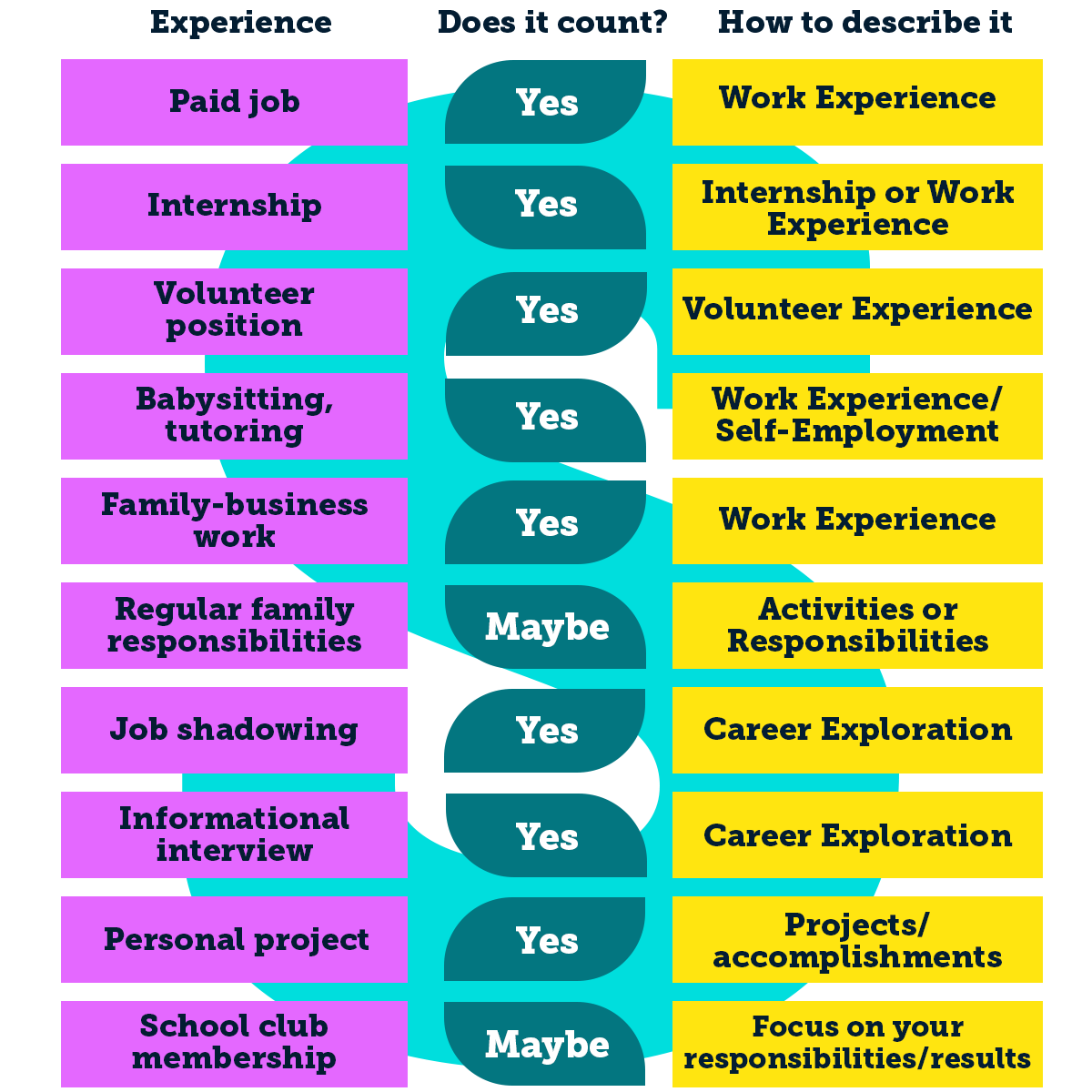
Describe the experience honestly.
You don’t need to call a project an internship or turn babysitting into “childhood development consulting” to make it matter.
Is this opportunity worth your time?
A useful experience should answer “yes” to most of these questions:
- Will I have a clear responsibility?
- Will someone train, guide, or give me feedback?
- Will I practice a useful skill?
- Will I create, improve, organize, or contribute something?
- Will I be able to explain what I learned afterward?
A recognizable company name does not automatically make an opportunity valuable.
A small project where you take real ownership may teach you more than an internship where no one knows what to do with you.
Be thoughtful about unpaid internships
Before accepting an unpaid position, make sure you understand:
- What you will learn
- What work you will complete
- How much time it requires
- Who will supervise you
- How the experience connects to your education
- Whether a similar paid option is available
Do you need work experience for college?
You do not need a prestigious internship or a certain number of work hours to build a meaningful college application.
Colleges want to understand how you spend your time, what responsibilities you carry, what you care about, and how you contribute.
That could include:
- A paid job
- Volunteer work
- An internship
- Family responsibilities
- Sports
- Clubs
- Hobbies
- Independent projects
The Common App allows students to report up to 10 activities, but it specifically says you do not need to fill every space. Its guidance encourages students to consider jobs, internships, volunteering, family responsibilities, hobbies, and sports, then focus on the experiences that best tell their story.
A job you took because you needed to earn money is not less meaningful than an unpaid internship related to a possible major.
They are different experiences. Each can reveal something important about you.
Learn more about what looks good on a college application.
How to make your experience count
Getting an opportunity is only the first step. It’s what you do with it that really matters.
Set a learning goal
Decide what you want to learn or improve.
For example:
- Become more confident speaking with customers
- Learn how an office operates
- Practice a software program
- Understand how a team manages projects
- Explore whether you enjoy working with children
A goal makes it easier to recognize your progress.
Ask questions
Pay attention to how people communicate, organize their work, solve problems, and make decisions.
You are there to contribute. But you are also there to learn.
Keep a record
Write down:
- Your responsibilities
- The skills you used
- Projects you completed
- Problems you helped solve
- Positive feedback
- Measurable results
- Dates and hours
- Names and contact information for possible references
Do this while the details are fresh.
Save work samples
You may be able to save:
- Writing
- Designs
- Presentations
- Photography
- Video
- Code
- Research
- Event materials
Always ask permission before saving or publishing work. Remove private or confidential information.
Ask for feedback
Ask your supervisor what you are doing well and what you could improve.
Learning how to receive and use feedback is a workplace skill of its own.
Reflect on the experience
Ask yourself:
- Which tasks did I enjoy?
- Which tasks did I dislike?
- Did I prefer working alone or with a team?
- Did I like a structured or flexible environment?
- Which skills do I want to keep developing?
- Do I want to explore this career further?
Discovering that you do not enjoy a field is not a failed experience.
It may help you avoid choosing a college major or career based on an inaccurate picture of the work.
How to put work experience on a high school resume
Focus on your actions, responsibilities, and results.
Instead of:
“Helped at summer camp.”
Try:
“Supervised 10 campers ages 6 to 8 and led daily games, crafts, and outdoor activities.”
Instead of:
“Tutored students”
Try:
“Provided weekly algebra tutoring to three middle school students and created practice materials based on their needs.”
A useful resume bullet often answers three questions:
- What did you do?
- Who or what did you help?
- What changed or resulted from your work?
Use numbers when they add useful context, but do not force them into every bullet.
And be accurate about whether the experience was a job, internship, volunteer role, project, or simulation.
Watch out for job scams
Scammers may advertise fake jobs through social media, job-search websites, text messages, and email.
The Federal Trade Commission warns that fake employers may use job offers to obtain money or personal information. Some scammers also impersonate recognizable companies or repost altered versions of real job listings.
Be careful if someone:
- Offers you a job without a real interview
- Cannot clearly explain the work
- Uses a personal email while claiming to represent a major company
- Asks you to pay for equipment or training
- Sends you a check and asks you to return part of the money
- Requests banking or identity information unusually early
- Pressures you to respond immediately
- Offers unusually high pay for vague tasks
Verify the position through the employer’s official website and contact information.
You don’t need the perfect internship, a famous company name, or a complete career plan to begin gaining experience.
Start with the next realistic step.
Apply for a part-time job. Ask someone about their career. Volunteer for a project. Help produce your school’s announcements. Tutor another student. Build something. Help an organization solve a small problem.
Then keep track of what you learn.
Each experience can help you understand the workplace, build useful skills, and learn more about yourself.
Still deciding which careers or college majors you want to explore? Take Appily’s free College Major Quiz to find options that may fit your interests, strengths, and goals.
FAQs about high school work experience
How can I get work experience in high school with no experience?
Start with an opportunity that does not require previous employment.
You could volunteer, job shadow, complete an informational interview, join a school activity, work on a personal project, help with a family business, offer a neighborhood service, or ask an organization about one small project.
Use that first experience to build skills and examples for your next application.
Can I get work experience without having a job?
Yes.
Volunteering, job shadowing, apprenticeships, school activities, family responsibilities, independent projects, and virtual job simulations can all help you gain relevant experience.
They may appear under different headings on your resume, but they can still demonstrate useful skills.
Does volunteering count as work experience?
Volunteer work is unpaid, so it should usually be labeled as volunteer experience rather than paid employment.
However, it can still show responsibility, skills, accomplishments, and experience related to future jobs or internships.
Does babysitting count as work experience?
Yes.
Babysitting, pet sitting, tutoring, lawn care, and similar services involve real responsibilities.
Include details such as how often you worked, what you handled, how many people or families you helped, and any special responsibilities.
Does job shadowing count as work experience?
Job shadowing is better described as career-exploration experience because you are mainly observing someone at work.
It may still be worth including on a resume or application when it is relevant, especially if you can explain what you learned and what you did next.
Can family responsibilities count as experience?
Yes.
Regular responsibilities such as caring for siblings or relatives, translating for family members, managing household tasks, or helping with a family business can demonstrate time management, reliability, communication, and leadership.
The Common App also gives students space to report responsibilities and circumstances that help colleges understand their daily lives.
Does my experience have to relate to my future major?
No.
Career-related experience can help you explore a major, but any responsible role can help you build transferable skills.
A college or employer can learn from experiences that show reliability, initiative, teamwork, leadership, service, or problem-solving.
How can a 14- or 15-year-old get work experience?
Options will depend on federal and state rules, but younger students can explore:
- Age-eligible paid jobs
- Volunteering
- Babysitting
- Pet care
- Tutoring
- School activities
- Family-business work
- Personal projects
- Informational interviews
- Job shadowing
Always check current age, hour, and task restrictions before accepting paid work.
How much work experience should a high school student have?
There is no required number of jobs, internships, or hours.
Look for an experience that fits your life and gives you a chance to learn, contribute, and take responsibility.
One sustained, meaningful experience may be more valuable than several short activities chosen only to fill a resume.
