How to Ask for a Job Shadow in High School

If you want to job shadow someone in high school, start with a short, specific request. Introduce yourself, explain which career you’re exploring, ask to observe for a few hours, and offer two or three possible dates.
You do not need to know the professional personally. You can start with teachers, counselors, family connections, local employers, and organizations with formal student programs.
This guide walks you through who to contact, what to say, when to follow up, and how to prepare if someone says yes.
The TL;DR
- Check for a formal process first. Search the employer’s website for “job shadow,” “student observer,” or “high school program” before contacting an employee directly.
- Send a short, personalized request. Introduce yourself, name the career you want to explore, explain why you chose that person or organization, and ask to observe for a few hours.
- Make it easy to say yes. Offer two or three possible dates, say you can adjust to their schedule, and be ready to follow any visitor, permission, or safety requirements.
- Follow up once if needed. If the organization has not given you a response timeline, send one polite follow-up about a week later. If you still do not hear back, move on to another contact.
- If they cannot host you, ask about an alternative. An informational interview, workplace tour, virtual conversation, or another student program can still help you learn what the career is really like.
What is job shadowing?
Job shadowing is a short career-exploration experience in which you observe a professional during part of their workday.
You might watch how someone completes regular tasks, tour a workplace, learn how equipment or technology is used, or ask employees about their jobs. What you are allowed to observe will depend on the workplace's privacy, safety, scheduling, and visitor rules.
Job shadowing is mainly about seeing what a career is actually like before you make bigger decisions about classes, college majors, training programs, or future work.
How do you ask for a job shadow in high school?
Start by choosing the career or job title you want to observe. Then find a professional who actually does that work and check whether their employer has rules for student visitors.
Here’s a simple approach to this:
- Choose one career or job title you want to explore.
- Check organizations in your area for formal job-shadow or student-observer programs.
- Identify three possible professionals or organizations.
- Send a short, personalized request with two or three possible dates.
- Follow up once, about one week later, if the organization has not provided a different response timeline.
For an informal request, asking to observe for two to four hours gives the professional a clear starting point without asking them to rearrange an entire workday. But treat this approach as a suggested request, not a universal rule. If an employer has a formal job-shadow program, follow the schedule and requirements it provides instead. Children's Wisconsin's high school job-shadow program, for example, says most of its job-shadow experiences last about four hours on a given day.
Job shadow request email template
A job-shadow request email should tell the recipient who you are, what career you want to explore, why you’re contacting them specifically, what you hope to observe, when you’re available, and that you’ll follow the organization’s visitor requirements. Keep the request short enough to understand at a glance.
Subject: High School Student Job Shadow Request
Hello [Full Name],
My name is [full name], and I'm a [grade] student at [high school]. I'm exploring careers in [field or job] because [one-sentence reason].
I learned about your work through [teacher, counselor, event, organization website, or mutual connection]. I was especially interested in [specific project, service, specialty, or part of the person's work].
Would you be open to letting me shadow you or another member of your team for a few hours? I hope to learn more about [learning goal one] and [learning goal two].
I'm available on [date], [date], or [date], and I can adjust to your schedule. I can provide any required school or parent/guardian permission forms and follow your organization's visitor requirements.
If an in-person visit is unavailable, I would also appreciate a short phone or video conversation.
Thank you for considering my request.
Sincerely,
[Full name]
[High school and grade]
[Professional email address]
[Phone number, optional]
Job shadow request email example
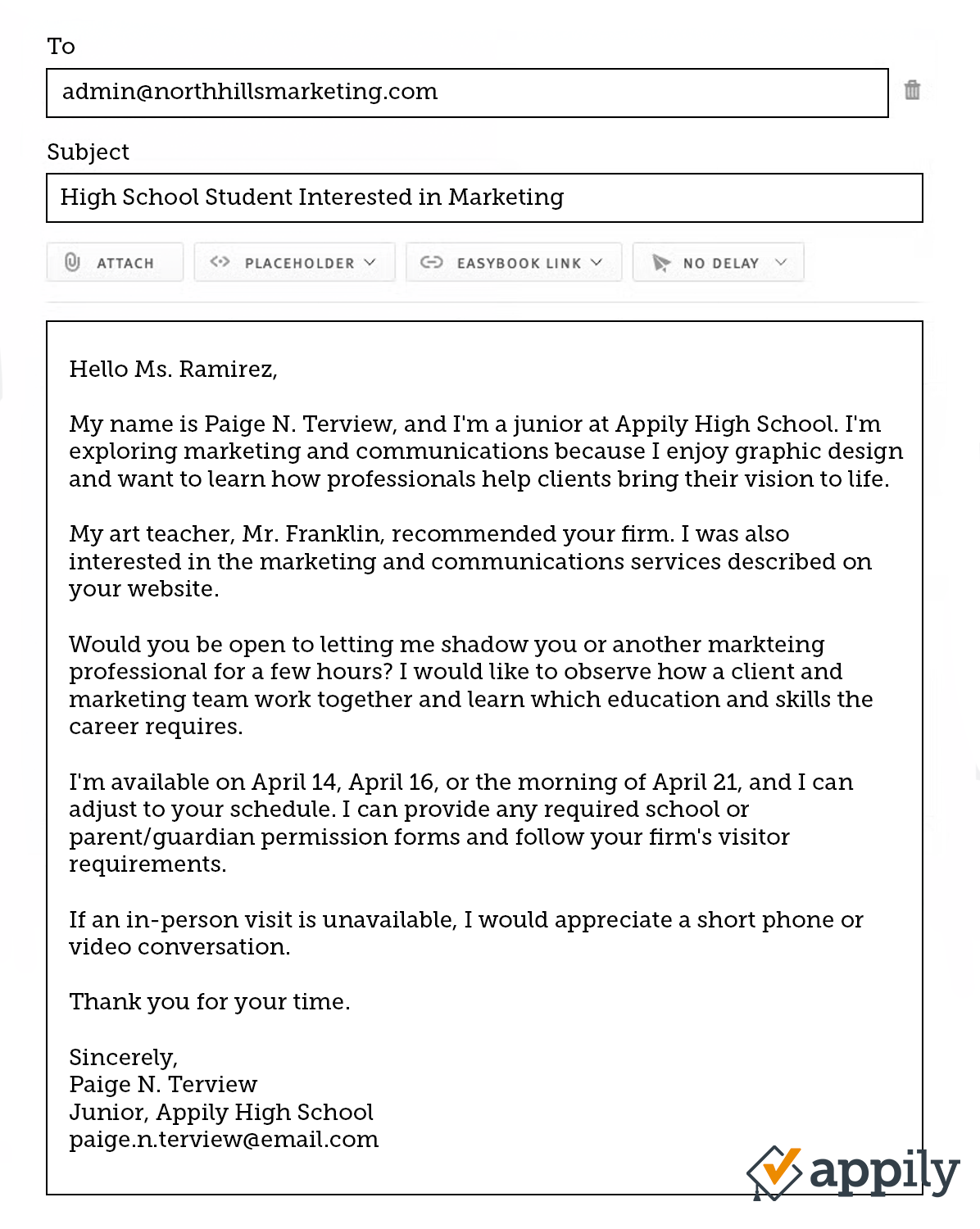
If you know the recipient uses a professional title such as Dr., you can use it. If you are unsure which title or honorific the person prefers, using "Hello [Full Name]" avoids guessing.
Is job shadowing the same as an internship?
No. Job shadowing focuses mainly on observing someone's work. An internship generally involves supervised responsibilities completed over a longer period.
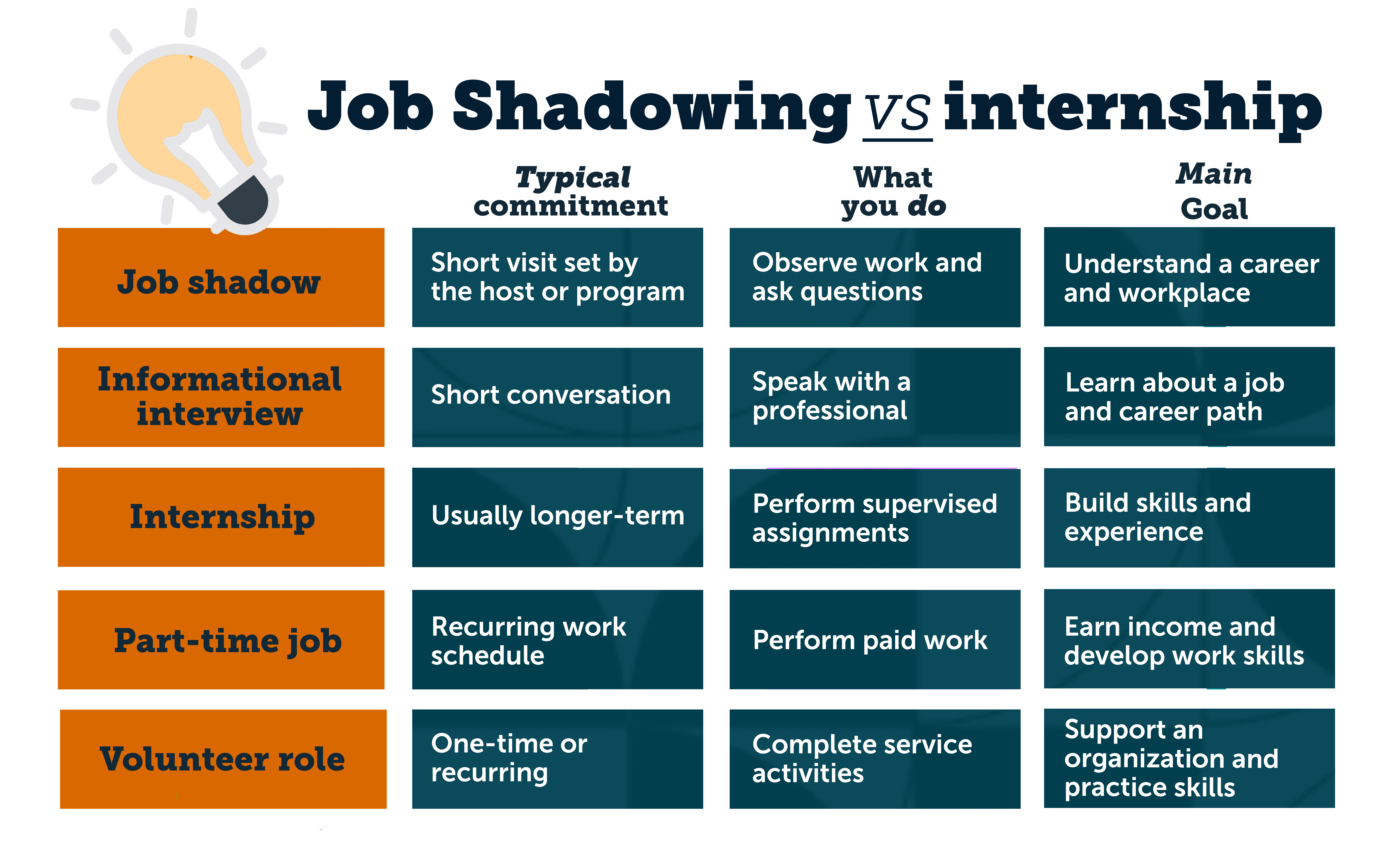
If you later include a short observation experience on your resume, label it Job Shadowing or Career Exploration, not an internship or job.
If you're looking for something more hands-on, use Appily's guide to getting work experience in high school to compare options such as internships, jobs, volunteering, apprenticeships, and projects.
How do you find the right person to ask for a job shadow?
Start with the organization's official process, then use your school and personal network if you need help finding a professional.
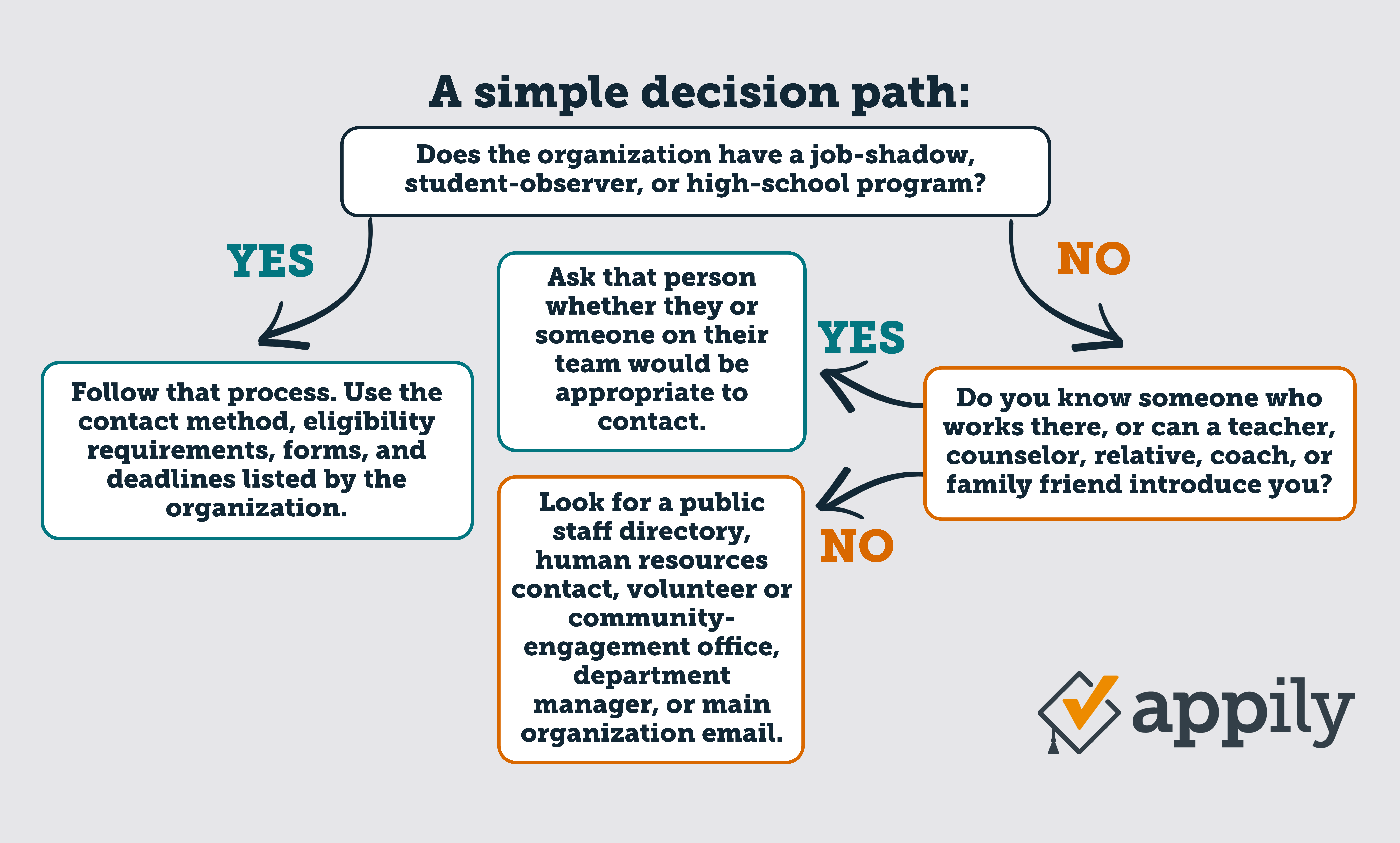
Good possible contacts include:
- A professional recommended by a teacher or counselor
- A relative, family friend, or neighbor
- A parent or guardian of a classmate
- A school alumnus
- Someone you met at a career fair or community event
- An employee listed on an organization's staff page
- A local business or nonprofit professional doing the work you want to explore
Choose someone whose daily work matches the career you want to observe. A company owner or hospital executive, for example, may spend most of the day managing people and budgets rather than doing the work that initially interested you.
If you want to observe physical therapy, look for a physical therapist. If you want to understand architectural work, look for an architect who works directly on projects.
What if you cannot find an individual employee?
Search the organization's website using terms such as:
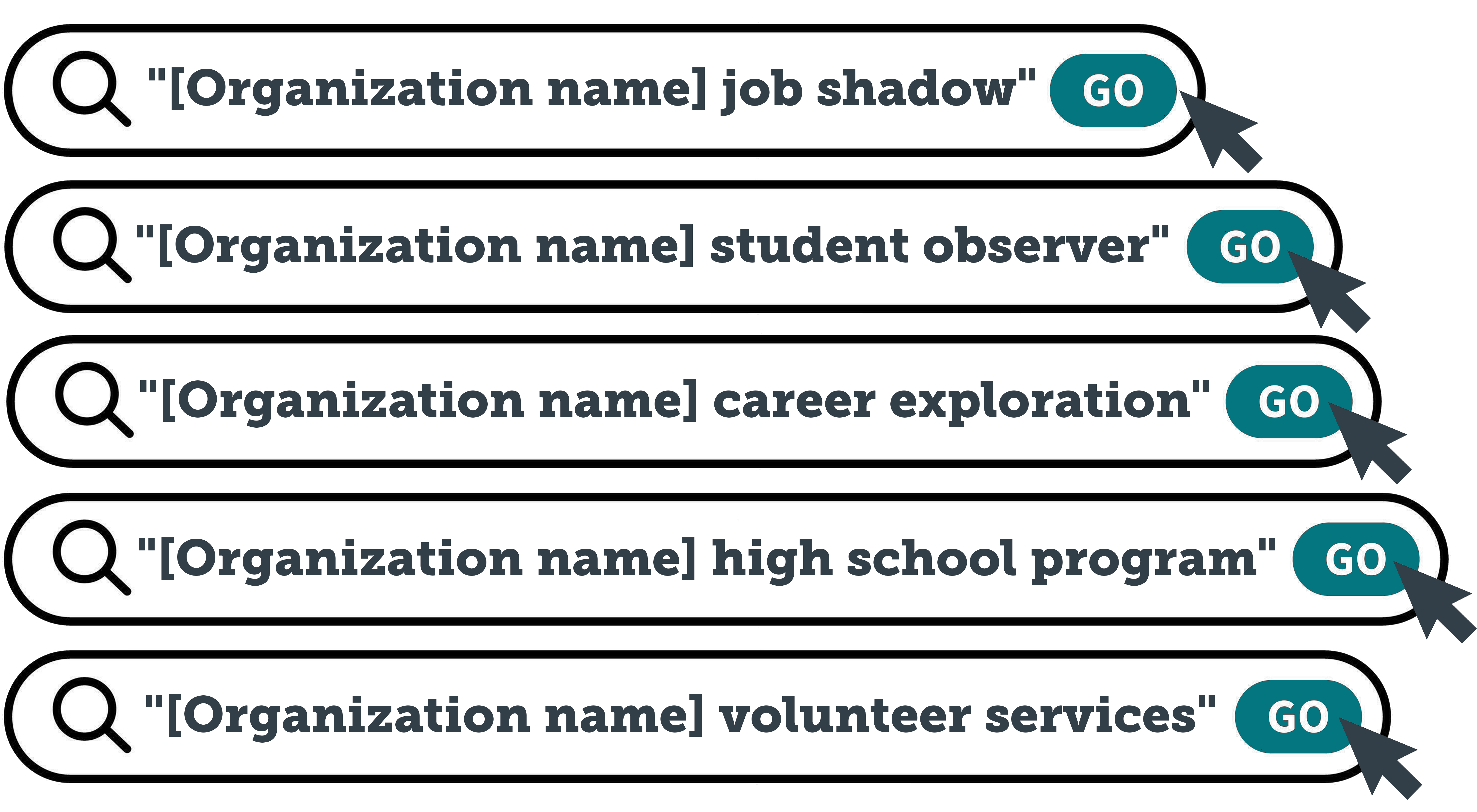
Some workplaces, including hospitals, government agencies, laboratories, schools, and large companies, may require requests to go through a central office instead of an individual employee.
If you cannot find instructions, ask:
Does your organization allow high school students to complete short job-shadow visits? If so, who manages those requests?
Use public professional contact information. Avoid personal phone numbers or private social media accounts you found through unrelated sources.
Your next step: Identify three possible contacts and record each person's name, job title, organization, and how you found them.
What should you research before asking?
Do a quick review of the professional, organization, and career before you write your email.
Confirm:
- The person's name and current job title
- What the organization does
- One project, service, specialty, or responsibility connected to your interests
- Whether the organization has a student program
- Whether the workplace is somewhere you can realistically travel
For career research, the U.S. Bureau of Labor Statistics' Occupational Outlook Handbook can help you review common job duties, work settings, education and training requirements, and related occupations.
Then use one specific detail in your message:
My biology teacher recommended your clinic, and I was interested in the sports rehabilitation program described on your website.
Avoid broad compliments such as "Your company looks amazing." A specific detail helps the recipient understand why you selected them.
How far in advance should you ask for a job shadow?
If the organization does not publish its own deadline, sending an informal request about two to four weeks before your preferred date gives you time to follow up and handle any required forms.
Formal programs may need more time for applications, permission forms, confidentiality agreements, health documentation, orientation, or department approval. Always use the organization's published deadline when it provides one.
For example, Children's Wisconsin recommends submitting required job-shadow documents at least three weeks before the observation.
If there is no formal timeline, use this as a flexible planning guide:
Timing
Action
A few weeks before
Identify contacts and check employer policies
Two to three weeks before
Send personalized requests
About one week later
Send one follow-up if you have not heard back
Before the visit
Confirm the schedule and submit required forms
A day or two before
Review the location, dress code, and questions
Soon after
Send a thank-you email
What should you include in a job shadow request email?
Keep your email short and make the request easy to spot.
Include:
- Your name, grade, and school
- The career you are exploring
- Why you selected that person or organization
- A clear request to observe for a short period
- What you hope to learn
- Two or three possible dates
- A note that you will follow any visitor or permission requirements
Here are a few tips for building that email out:
Use a clear subject line
Examples include:
- High School Student Job Shadow Request
- Student Job Shadow Inquiry: Physical Therapy
- Request to Observe a Civil Engineer
- High School Student Interested in Graphic Design
Avoid vague subject lines such as "Hello," "Question," or "Opportunity."
Introduce yourself and your career interest
My name is Paige N. Terview, and I'm a junior at Appily High School. I'm exploring physical therapy because I enjoy anatomy and want to learn how rehabilitation plans are developed.
Explain why you chose the recipient
My anatomy teacher recommended your clinic, and I was interested in the sports rehabilitation services listed on your website.
Make a specific request
Would you be open to letting me shadow you or another physical therapist for a few hours on Monday afternoon?
State what you want to learn
I would like to observe how physical therapists prepare for appointments and learn which education and skills the career requires.
Offer a few dates
I'm available on April 14, April 16, or the morning of April 21, and I can adjust to your schedule.
Specific dates make it easier for the recipient to decide whether the request could fit their calendar.
How do you ask for a job shadow over the phone?
Call when a small business does not publish an email address or lists phone calls as its preferred contact method.
Prepare a short script:
Hi, my name is [name], and I'm a [grade] student at [school]. I'm exploring careers in [field]. Does [organization] allow high school students to complete short job-shadow visits? If so, who should I contact about arranging one?
Write down the person's name, email address, and any application instructions.
If possible, send your request in writing afterward so the organization has your possible dates and contact information in one place.
Should a parent or counselor ask for you?
Send the main request yourself when the employer allows students to make direct contact.
A parent, guardian, counselor, teacher, or another trusted adult can still help you:
- Find an appropriate professional
- Review your email
- Verify the workplace
- Arrange transportation
- Understand school requirements
- Complete or submit forms when appropriate
A school coordinator should manage the request when your school or the employer requires it.
A trusted adult can also make an introduction:
One of my students is exploring careers in environmental science. May I connect you so they can ask about a short job shadow?
After the introduction, be sure to follow up promptly with your own message.
When should you follow up on a job shadow request?
If the organization has not provided its own response timeline, about one week, or roughly five business days, is a reasonable point to send one polite follow-up.
Use the same email thread so the recipient can see your original request.
Hello [Name],
I'm following up on the job-shadow request I sent on [date]. I'm still interested in learning about [career or role] and would appreciate the opportunity to observe for a few hours if your schedule allows.
I understand if your organization is unable to host a student. Thank you for considering my request.
Sincerely,[Name]
If you still do not receive a response after several more business days, move on to another contact.
Do not call repeatedly, message the person through several different platforms, or arrive without a confirmed appointment.
What should you do if the person says no?
Thank them and move to the next person on your list.
If it feels like an appropriate situation, you can also ask for one referral or alternative:
Thank you for letting me know. Do you know of another professional, workplace tour, or student program that could help me learn about this field?
A refusal can happen because of scheduling, visitor rules, privacy, safety, staffing, or other workplace restrictions. It does not tell you whether the career itself is a good fit for you.
If several personalized requests do not work, try another source, such as your counselor, teacher, a local professional association, or a formal student program.
Someone said yes. What should you do next?
Once someone says yes, get the logistics in writing: when and where to show up, what to wear, where to check in, and whether you need to bring any forms. Then spend a little time researching the career and writing down questions you want to ask.
Confirm the visit in writing
Ask for:
- The date, start time, and end time
- The address and check-in location
- The host's name and contact information
- The dress code
- Any required forms or identification
- Rules for phones, photos, notes, and social media
- Safety or footwear requirements
- Transportation or parking information
- Instructions for canceling or reporting a delay
Return required forms by the organization's deadline.
Keep the experience observational unless other activities are approved
A basic job shadow should focus on observing a professional's work unless your school and the organization have specifically approved other activities.
Tell a parent, guardian, counselor, teacher, or another trusted adult the host's name, workplace address, visit time, and transportation plan. Use verified workplace contact information.
Do not send sensitive information such as a Social Security number, banking information, or identification documents through regular email. If a school or employer legitimately requires sensitive information, ask how to submit it through its verified process.
If the experience begins to involve actual work rather than observation, different safety or youth-employment requirements may apply. Federal rules vary by age and task, and state laws may provide additional protections. Use the U.S. Department of Labor's YouthRules resources and state labor-law directory to check current requirements.
Prepare before you arrive
Review the career and organization before the visit. The Occupational Outlook Handbook can help you compare what you observe with common duties, work environments, education requirements, and related occupations.
Prepare several questions, such as:
- Which responsibilities take up most of your week?
- Which skills do you use most?
- What part of the job is hardest to understand without seeing it?
- Which education, training, license, or certification does this career require?
- What could I do during high school to explore this field further?
- What do students often misunderstand about this career?
- Is there a related career I should research?
- Does your organization offer other student programs?
Bring a notebook and pen along with any forms, identification, or safety equipment the workplace requested.
Follow workplace rules during the visit
During the job shadow:
- Arrive at the time your host requested.
- Introduce yourself to employees you meet.
- Keep your phone silenced unless you need it.
- Ask permission before joining a meeting or entering a restricted area.
- Wait for an appropriate break before asking questions.
- Do not photograph, record, or post about the workplace without permission.
- Do not copy private records, customer information, patient information, or internal documents.
- Stay with your assigned host.
- Follow clothing and safety requirements.
Take notes on responsibilities, skills, work setting, and education requirements rather than private information about individual customers, clients, or patients.
Send a thank-you email afterward
Send a short, specific thank-you message while the experience is still fresh.
Subject: Thank You for the Job Shadow Experience
Hello [Name],
Thank you for allowing me to shadow you on [date]. I appreciated learning how [specific task or process] works.
I was especially interested in [specific observation]. The visit helped me understand that the career requires [skill, education, or responsibility].
My next step is to [research a related major, take a course, speak with another professional, or apply for a student program].
Thank you again for your time and for answering my questions.
Sincerely,[Name]
What can you do if you cannot arrange a job shadow?
Choose another experience that helps you answer the same question: What is this career actually like, and do I want to explore it further?
Request an informational interview
Ask for a short phone, video, or in-person conversation instead of a workplace visit.
You can adapt the job-shadow template:
If an in-person job shadow isn't possible, would you be open to a short phone or video conversation about your work and career path?
Look for a workplace tour or career event
Ask your counselor about career fairs, employer panels, career camps, workplace visits, and career and technical education events.
You can also check local colleges, professional associations, unions, hospitals, community organizations, and employers for student events.
Try a virtual job simulation
A virtual job simulation can help you practice tasks modeled after work in a career field.
Keep track of what you completed, which skills the tasks used, what you learned about the career, and whether the experience made you more or less interested in exploring it further.
Describe the experience as a virtual job simulation, not an internship, unless the provider specifically defines it as one.
Ask your school about work-based learning
Try terms such as:
- Job shadowing
- Workplace tours
- Career mentorships
- Internships
- Employer projects
- Youth apprenticeships
- Career and technical education
Ask which office manages the program, who is eligible, and when students can apply.
If you want a longer or more hands-on option, use Appily's guide to getting work experience in high school to compare jobs, internships, volunteering, apprenticeships, projects, and other possibilities.
What should you do with what you learned?
If you loved your job shadowing experience, great! But even if you didn’t, it wasn’t necessarily a waste. That experience helps you make a better next decision.
Soon after the job shadow, ask yourself:
- Which part of the daily work interested me most?
- Which responsibility interested me least?
- Did I like the work setting and level of interaction with other people?
- What education or training would this career require?
- What surprised me?
- Which related career should I explore next?
If the experience is relevant to a future job, internship, scholarship, or program, you can also add it to your master resume under Job Shadowing, Career Exploration, or Additional Experience. Use Appily's high school resume guide for help formatting it accurately.
A simple entry might look like:
Marketing Job Shadow
North Valley Marketing Firm | Spring
- Observed a project kickoff and planning call during a three-hour project-exploration visit
- Spoke with two graphic designers about education requirements and workplace skills
Describe what you actually observed. Do not present a job shadow as clinical work, employment, or an internship.
Take the next step after your job shadow
A job shadow gives you a career clue. Your next step is figuring out what education could lead there.
Start with Appily's College Major Quiz to explore majors that may fit your interests, strengths, and goals.
Then use the majors and degrees directory to learn what those majors involve and explore related career paths. When you're ready, use Appily's college search to compare colleges offering programs you want to investigate.
You do not have to decide on a career after one job shadow. The goal is to leave with better information for choosing your next experience, class, major, or college.
FAQs about asking for a job shadow
Can high school students job shadow?
Yes, when the employer allows student observers and you meet its age, permission, safety, privacy, and visitor requirements.
Some organizations have formal high school job-shadow or student-observer programs. Others handle requests individually. Check the organization's website before contacting an employee so you do not accidentally bypass its required process.
Do I need a resume to ask for a job shadow?
Not necessarily.
For an informal request, you usually do not need to attach a resume unless the employer asks for one. Check the organization's instructions first.
It can still be useful to keep a one-page high school resume ready in case the employer uses a formal application process.
Can I ask someone I do not know?
Yes.
Use public professional contact information and explain how you found the person and why their work interests you.
Before arranging an in-person visit, share the host's name, workplace address, schedule, and transportation plan with a parent, guardian, teacher, counselor, or another trusted adult.
Can I shadow a doctor or another health care professional?
Only when the health care organization approves the visit.
Search the hospital or clinic's website for terms such as "job shadow," "student observer," "volunteer services," or "student placement." Follow any posted age, health, confidentiality, application, and supervision requirements.
Do not try to bypass a central approval process by arranging an informal clinical visit directly with an employee.
What should I wear to a job shadow?
Ask the host after your visit is confirmed.
An office might recommend business-casual clothing, while a clinic, laboratory, kitchen, farm, construction site, or manufacturing facility may have specific rules for footwear, hair, jewelry, clothing, or protective equipment.
Follow the workplace's instructions rather than relying on a general dress-code rule.
Can a job shadow be virtual?
Yes, if the host agrees.
You could ask for a virtual conversation that includes an overview of the person's workplace, typical responsibilities, career path, and time for your questions.
If a longer virtual visit is not practical, request a shorter informational interview instead.
Can I ask for an internship after the job shadow?
You can ask whether the organization offers internships, apprenticeships, volunteer opportunities, or other student programs and where the eligibility requirements are posted.
Do not expect your host to create a position for you. If a formal program exists, follow its application process.
Can I put job shadowing on my high school resume?
Yes, when it is relevant to the opportunity you are applying for.
Label the experience accurately as Job Shadowing, Career Exploration, or Additional Experience. Do not call it an internship or job if you only observed
What if I need to miss school for a job shadow?
Do not assume a job shadow automatically counts as an excused absence.
Ask your counselor, attendance office, career coordinator, or another appropriate school staff member what your school's policy requires before scheduling the visit during school hours. If possible, consider a teacher workday, school break, or another time that does not conflict with class.
