Colleges With Co-Op Programs and Built-In Work Experience

Some colleges make work experience part of earning a degree. In programs like that, students may alternate between classes and full-time employment, complete a required internship, or spend time in a clinical or field placement. The structure varies by college and major. So do the costs.
But there’s something to look out for. A school may promote “hands-on learning” even when placements are optional, unpaid, or limited to a few programs. Before choosing a college, find out what students actually do, how much support they receive, and whether the experience fits your budget and graduation plan.
The TL;DR:
- College co-op programs combine classroom learning with real-world work experience. Short for cooperative education, co-ops typically let you work in a job related to your major while you’re still earning your degree.
- Co-ops can give you a head start on your career. You can build your resume, develop professional skills, make industry connections, explore whether a career is actually right for you, and, in many programs, earn money while you work.
- A co-op is usually more structured than a typical internship. Co-op experiences are often built into a college’s academic program and may involve longer periods of full-time work or alternating between semesters of classes and employment.
- Co-op programs are not all designed the same way. Depending on the college and major, a co-op may be required or optional, available only to certain students, or affect your academic schedule and how long it takes to graduate.
- When comparing colleges with co-op programs, look beyond whether a school simply offers one. Find out which majors can participate, how students find placements, what employers work with the college, whether positions are typically paid, and how the experience fits into your degree plan.
- The best college with a co-op program is the one that fits your bigger goals. Consider hands-on career experience alongside your major, cost, admissions chances, location, campus experience, and the kind of support you want from a college.
What is a college co-op program?
A cooperative education program, usually called a co-op, connects academic study with paid or unpaid work related to a student’s major or career interests. Co-ops often include more than one work period. A student might alternate semesters of classes with full-time employment or complete several work terms before graduation.
The National Association of Colleges and Employers, or NACE, generally distinguishes co-ops from internships by their structure. Internships are usually one-time experiences. Co-ops commonly include multiple work periods connected to a student’s academic or career goals.
But colleges use these terms differently. So be sure to read the program requirements rather than relying on the name alone.
Does work experience in college help with employment?
NACE’s 2026 Internship & Co-op Survey included responses from more than 280 employer organizations about their 2024–25 internship and co-op programs. The survey found that employers offered full-time positions to about 72% of their interns, an increase of roughly 10 percentage points from the previous year.
Then, among interns who received an offer, 88.3% accepted it. Overall, 63.1% of interns at participating organizations accepted full-time positions and became employees.
NACE also reported that bachelor’s-level interns earned an average of $23.35 per hour during the 2024–25 internship cycle. But as you’d expect, pay varies by field, employer, region, and student experience, of course.
That connection between college and career also matters to families. In EAB and Appily’s 2026 parent survey, 29% of parents named postgraduation job prospects as a major concern, up from 16% in 2024.
When parents were asked what makes a college worth the cost, 39% selected internships, co-ops, and active learning, making up the highest-rated nonfinancial characteristic. Successful job placement after graduation followed at 38%, while 34% selected prospects for a fulfilling career and 30% selected prospects for a well-paying career. Name recognition was selected by 8% of parents, and a high ranking by 7%.
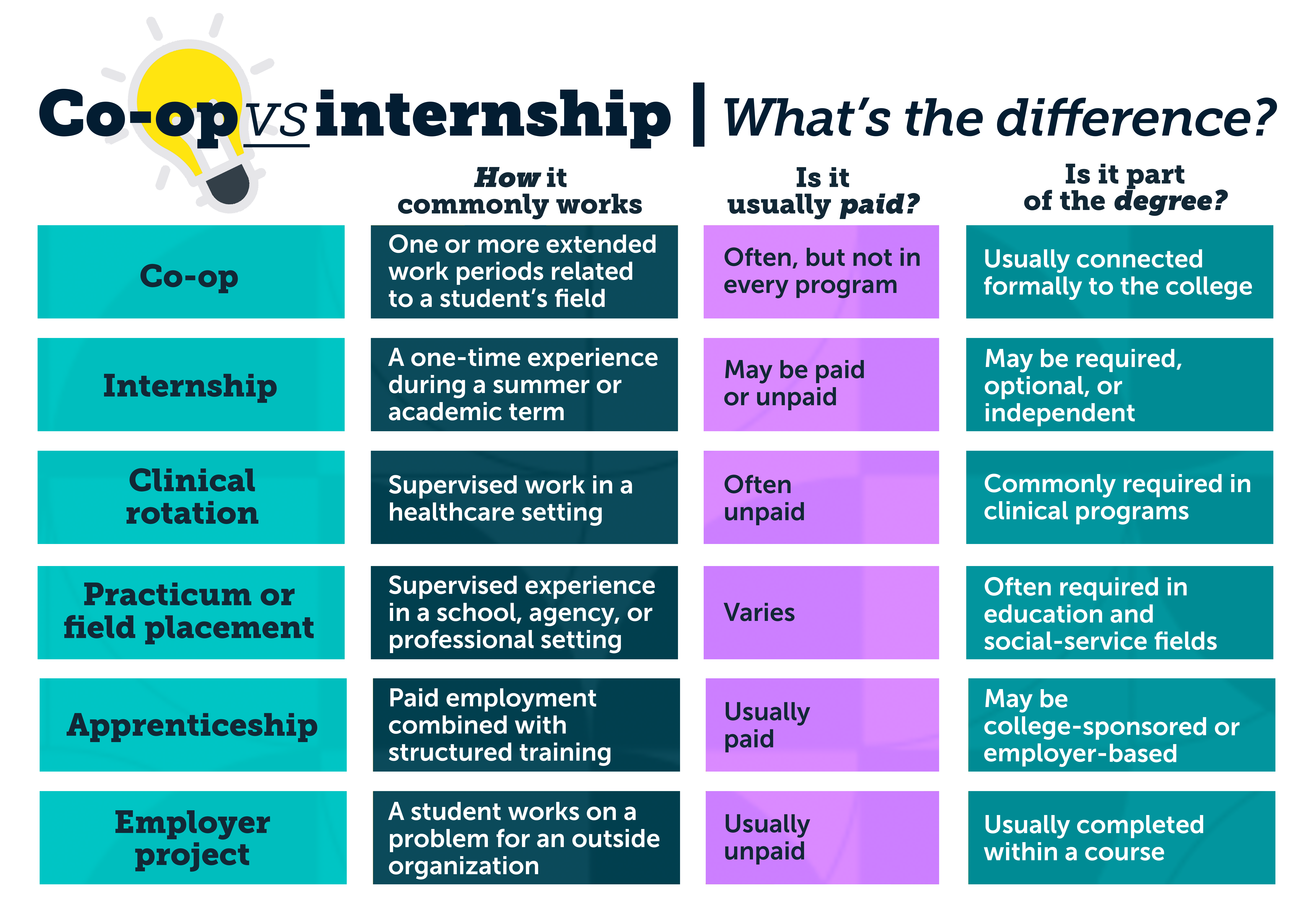
A built-in internship does not necessarily follow the same schedule as a co-op. It may last one summer, take place a few hours per week, or fulfill a graduation requirement during a single semester.
How do college co-op programs work?
There is no standard co-op schedule or format. Depending on the college, a student may:
- Complete one six-month placement
- Alternate academic and work terms/semesters
- Work for the same employer more than once
- Apply to several employers through a college system
- Graduate in four, four and a half, or five years
- Receive academic credit or maintain enrollment without earning course credit
Sometimes this type of experience is required for certain majors. Other times, it’s optional.
Georgia Tech, for example, describes its undergraduate engineering co-op as a five-year academic program that combines coursework with paid employment related to the student’s major. Participating students complete at least three work terms, generally with the same employer.
As you can see, that model differs from a single summer internship.
Examples of colleges with structured co-op programs
The following colleges show how much co-op structures can differ. We are sharing them as examples, not as a ranked or exhaustive list.
But remember, program requirements can change. Check the current academic catalog and the requirements for your intended major.
Drexel University
Drexel students may complete up to three six-month, full-time work experiences as part of their degree. The number of available co-ops depends on the academic program and whether the student chooses a four- or five-year path.
During the 2024–25 academic year, 5,272 Drexel students worked in co-op positions with 1,504 employers. The median gross salary for a paid six-month undergraduate co-op was more than $22,000. Drexel reports that 46% of co-op participants who were working full time after graduation had received an offer from a former co-op employer.
That last figure does not mean 46% of all co-op students received or accepted an offer. It applies to surveyed co-op participants who were working full time.
Drexel says students do not pay tuition during a co-op term, though university fees and living expenses may still apply.
Rochester Institute of Technology (RIT)
Co-op and internship experiences are built into many RIT programs and available to students across the university, although requirements vary by major.
And these hands-on learning opportunities make a difference. RIT reported that 92.8% of its Class of 2025 were employed or pursuing another next step within six months of graduation. This includes graduates who were employed full time, continuing their education, volunteering, or serving in the military.
In other words, the figure reflects the share of graduates who were working or pursuing another next step, not the percentage who received jobs through their co-ops. RIT’s Saunders College of Business separately reports a 95% undergraduate outcomes rate based on a four-year rolling average. Because that figure applies only to business graduates, it should not be used to describe outcomes across the entire university.
Students considering RIT should review information for their intended major, including whether a co-op is required, which employers typically hire students, average co-op pay, and what graduates do after completing the program.
Northeastern University
Northeastern’s co-op program places students in full-time professional work related to their academic or career interests. Experiences often last several months, but timing and participation vary by program.
The university reports that 97% of graduates were employed or enrolled in graduate school within nine months of graduation. This is an overall career-outcomes figure. It does not show that co-op caused each employment or graduate-school outcome.
Northeastern does not charge tuition when a student is enrolled only in co-op. Housing, meals, and tuition for any classes taken during the co-op term may still create costs.
Georgia Institute of Technology
Georgia Tech’s undergraduate co-op program is optional and available in all engineering majors. Students alternate academic terms with at least three semesters of full-time, paid work related to their major. The program normally extends the academic calendar to five years.
Georgia Tech reports that more than 1,200 employers hire its co-op students and interns each year. For all surveyed undergraduates in academic year 2024–25, 72.9% had received a job offer by graduation, and the average reported starting salary was $93,704. Those figures include the broader undergraduate population and should not be presented as co-op-only outcomes.
University of Cincinnati
The University of Cincinnati reported 8,395 co-op placements with 1,757 employers during the 2024–25 academic year. Students in paid co-ops reported earning a combined $94.2 million, averaging $11,220 per student per semester.
The earnings were self-reported and cover paid co-op experiences at one institution. They should not be treated as a typical national co-op wage.
UC’s programs also differ by college. Students should confirm how many work terms their major requires and whether those terms affect tuition, housing, and graduation timing.
Are college co-ops paid?
Many co-op positions are paid. Some are not.
Moreover, pay can differ by major, employer, location, work term, and previous experience. Clinical placements and student teaching are also less likely to be paid than engineering or technology co-ops.
Nationally, NACE reported an average wage of $23.35 per hour for bachelor’s-level interns in the 2024–25 cycle. That number is an employer-reported average, not a minimum wage or an amount every intern can expect.
Institutional averages may look different because of the majors offered, employers involved, and length of the work term. Drexel’s median paid undergraduate co-op salary was more than $22,000 for a six-month placement, while University of Cincinnati students in paid co-ops reported earning an average of $11,220 per semester.
Ask each college:
- What percentage of placements in my major are paid?
- What were the recent median earnings?
- Are unpaid placements required or permitted?
- Does the college offer grants for unpaid work?
A college-wide average may not reflect the experience of students in your field.
Do students pay tuition during a co-op?
Policies on this topic differ. Some colleges do not charge regular tuition during a full-time co-op term. Students may still owe fees or pay for housing, food, transportation, health insurance, and any courses they take while working.
Drexel reports that students are not billed for tuition during co-op terms, though fees and living expenses can continue. Northeastern also says students enrolled only in co-op are not charged tuition, but other costs may apply.
Before comparing programs, request a term-by-term cost estimate that includes:
- Tuition and mandatory fees
- Housing and transportation
- The total number of academic and work terms
- The effect on grants, loans, and scholarships
Expected co-op earnings should not be subtracted from college costs until you know the likely pay, number of hours, taxes, and expenses associated with the placement.
Can a co-op make college take longer?
Yes, it can. Some colleges fit work experience into four years, while other programs follow four-and-a-half- or five-year calendars.
Georgia Tech describes its engineering co-op as a five-year program. Drexel offers four- and five-year options, with the five-year model allowing more six-month co-op experiences.
More time in college may mean additional housing, food, fees, and transportation. Paid employment can offset part of that cost, but earnings vary. Students should compare the full cost and calendar of each program rather than focusing only on whether tuition is charged during the work term.
What are the potential benefits of co-ops?
A structured co-op or internship can give students time to test a career, develop professional skills, and build relationships with employers.
National employer data suggests internships can also lead directly to full-time hiring, which is an incredible leg up over other graduates. The 63.1% conversion rate in NACE’s 2026 employer survey shows that many participating organizations use internships as part of their hiring process.
However, the number does not tell you whether a particular college provides good placements. Program quality still depends on the available employers, the work students perform, and the support they receive.
What are the tradeoffs with co-ops?
A co-op program may change a student’s college experience, for better or worse.
Possible concerns include:
- A longer graduation timeline
- Relocation or commuting costs
- Competitive applications for placements
- Less flexibility for changing majors or studying abroad
- Unpaid work in some fields
- Housing complications during alternating terms
- Work schedules that conflict with caregiving or another job
Students who depend on regular part-time income should ask whether the co-op schedule creates gaps between paychecks or requires moving before the first paycheck arrives.
How to compare colleges with co-op programs
Ask questions like:
Is the program available for your major?
A college may promote co-op widely even when participation is required only in certain departments. So be sure to check the academic plan for your intended major. Ask how changing majors would affect your eligibility and graduation date.
Is placement guaranteed?
Career coaching and access to job postings do not guarantee an offer. Ask the college how many eligible students received placements during the most recent year. Find out what happens when a student applies but is not hired.
Drexel, for example, reports that 91% of its students secured a co-op position during the academic year. That means some students did not.
What employers hire students in your field?
A large employer count can sound impressive while telling you little about your own options. But you should request a list of recent employers and job titles for your major. Then ask how many placements were local, remote, or outside the region.
What will you earn and spend?
Compare expected pay with the cost of transportation, temporary housing, work clothes, and relocation deposits.
University of Cincinnati students collectively earned more than $94 million through paid co-ops in 2024–25, but individual earnings differed. The reported average was $11,220 per semester.
Who helps when something goes wrong?
Ask what happens if an employer cancels a position, the workplace is unsafe, or the job duties do not match the description. A strong program should have a clear contact person and a process for addressing problems during the work term.
Questions to ask if cost or transportation is a concern
Students may need money before a paid placement begins. Ask whether the college offers:
- Relocation or emergency grants
- Local or remote placements
- Short-term housing help
- Transportation assistance
- Funding for required clothing, equipment, or checks
- Alternatives to unpaid placements
Students with disabilities should ask how workplace accommodations are coordinated. International students should speak with the college’s international student office about employment authorization before applying or accepting a position.
Is a college co-op program worth it?
A co-op can be a strong option for students who want substantial work experience before graduation. Its value depends on the quality of the placements and the total cost of participating.
Before adding a college to your list, confirm:
- Whether co-op is available for your major
- Whether placements are paid and how students obtain them
- How the program affects costs and graduation time
- What support is available when a placement falls through
Compare the program that students actually complete, not the version described in a headline or admissions brochure.
Decide if a co-op college belongs on your list
A college co-op program can be worth it if it offers relevant placements, strong student support, and a realistic path to graduation at a cost that works for you. Look beyond whether a college offers co-op and consider how the full experience compares with your other options.
Co-op opportunities are only one factor in choosing a college. Create a free Appily account to compare colleges side by side and see how your options stack up based on what matters most to you.
FAQs about co-op programs
When do co-ops start?
The timing depends on the college and major. Some programs begin in the first year. Others require students to complete certain courses or maintain a minimum GPA before applying.
How long is a co-op?
A work term may last a semester or about six months. Students in alternating programs may complete several terms and graduate with a year or more of professional experience.
Is a co-op the same as an internship?
No standard definition applies at every college. Internships are commonly one-time experiences, while co-ops usually involve more than one work period or a longer alternating schedule.
Are co-ops always paid?
No. Many co-op positions are paid, especially in engineering, business, and technology. Pay is less consistent in education, the arts, healthcare training, and nonprofit work.
Does co-op count for academic credit?
Sometimes. A program may award credit, maintain full-time enrollment status, place the experience on a transcript, or require the co-op without counting it as a regular course.
Does the college find the co-op for you?
Colleges often provide job listings, employer connections, and interview preparation. Students may still have to apply and compete for positions.
Can a co-op lead to a full-time job?
It can. NACE reported a 63.1% intern-to-full-time conversion rate among participating employers for the 2024–25 internship cycle. Individual college results vary, and an offer is not guaranteed.
