Can You Use ChatGPT on College Applications? AI for Essays & Common App

You have essays to write, deadlines to track, activities to describe, and probably twelve tabs open right now. So it makes sense that you’re wondering whether AI tools like ChatGPT can help with college applications.
The answer is: sometimes. But you need to be careful.
AI may help you understand prompts, organize deadlines, brainstorm reflection questions, or catch grammar issues. But it should not write your essay, exaggerate your activities, or make your application sound like someone else wrote it.
The tricky part is that college AI policies are still hit-or-miss. Some colleges allow limited AI support. Some restrict it. Some have no clear public policy yet.
A 2025 Kaplan survey of more than 200 admissions officers found that only 2% of colleges said they officially allow applicants to use generative AI to write admissions essays. Another 30% said their institution bans it, while 68% said there is no official policy.
When it comes to brainstorming, colleges were more open to it. In the same survey, 27% said their college allows generative AI to help with ideas, 4% said it is not permitted, and 69% said there is no official policy.
That is a lot of gray area. Before you use AI on an essay or anything else you submit to a college, it is smart to understand what is okay, what is risky, and what crosses the line.
The TL;DR
- AI tools like ChatGPT can help with parts of the college application process, but they should support your thinking, not replace it.
- It’s usually safer to use AI for things like understanding prompts, organizing deadlines, brainstorming reflection questions, spotting vague wording, or catching basic grammar issues.
- Don’t use AI to write your personal statement, supplemental essays, scholarship essays, or activity descriptions for you.
- Your college essay should still sound like you. Admissions teams want your voice, your experiences, and your reflection, not a polished-but-generic version of your story.
- AI rules vary by college, so check each school’s policy before using AI on anything you submit.
- Be especially careful with the Common App, scholarship essays, and activity descriptions. Don’t misrepresent AI-generated content as your own work.
- Avoid pasting sensitive personal information into AI tools, especially when working on the Additional Information section.
- Keep drafts of your work so you can show your writing process if questions ever come up.
Bottom line: AI can help you get unstuck, but it shouldn’t complete your application. If you wouldn’t feel comfortable explaining exactly how you used AI, it’s probably doing too much.
Quick answer: Can students use AI on college applications?
Sometimes, but it depends on how you use it and what each college allows.
AI is usually lower-risk when it helps you think, plan, organize, or review your own work. It becomes risky when it creates the substance of your application, writes your essay, adds extra details, “improves” your extracurriculars, or changes your voice so much that the final result no longer sounds like you.
A good rule: AI can help you get unstuck, but it should not complete your application.
Remember, you don’t need to sound more polished than everyone else. That’s not what colleges want. They want your voice and unique personality to shine through.
Why AI rules for college applications are confusing
Most students apply to colleges using the Common App, so it makes sense to understand that policy first. Common App defines fraud as submitting essays that are not your own work and misrepresenting the content or output of an artificial intelligence platform, technology, or algorithm as your own.
But colleges can also set their own rules.
Yale says that submitting personal statements or other written responses composed using text-generating software may result in the loss of your admission offer or even expulsion. Yale also says using AI for grammar, spelling, general advice, or topic suggestions at the start of the writing process does not constitute application fraud.
Brown takes a stricter approach. Brown says the use of artificial intelligence by an applicant is not permitted under any circumstances in connection with application content, though basic spelling and grammar review is allowed.
The University of California gives students a more practical warning. UC says AI may help with structure and readability, but your submission should reflect your own experiences and be written in your own words. UC also says its personal insight questions help admissions readers get to know each student’s voice, which is exactly why submitting AI-generated writing is risky.
So, yes, it is confusing. And that is why you should check each college’s published policy instead of assuming the same rules apply everywhere.
What if a college does not have a clear AI policy?
If a college does not publish a clear AI policy, do not assume that AI-generated writing is allowed. Use the strictest reasonable standard:
- Do not submit AI-written paragraphs, essays, or activity descriptions.
- Keep your examples, ideas, and final wording your own.
- Use AI only for support tasks you could explain honestly.
- Save your drafts so you can show your writing process if questions come up.
- Ask your counselor or the admissions office if you are unsure.
The question to ask yourself is simple: Would I be comfortable being honest and telling an admissions officer exactly how I used AI? If the answer is no, AI is probably doing too much.
Lower-risk, risky, and avoid: How to think about AI use
AI is lower-risk when it supports your thinking. It is riskiest when it replaces your thinking.
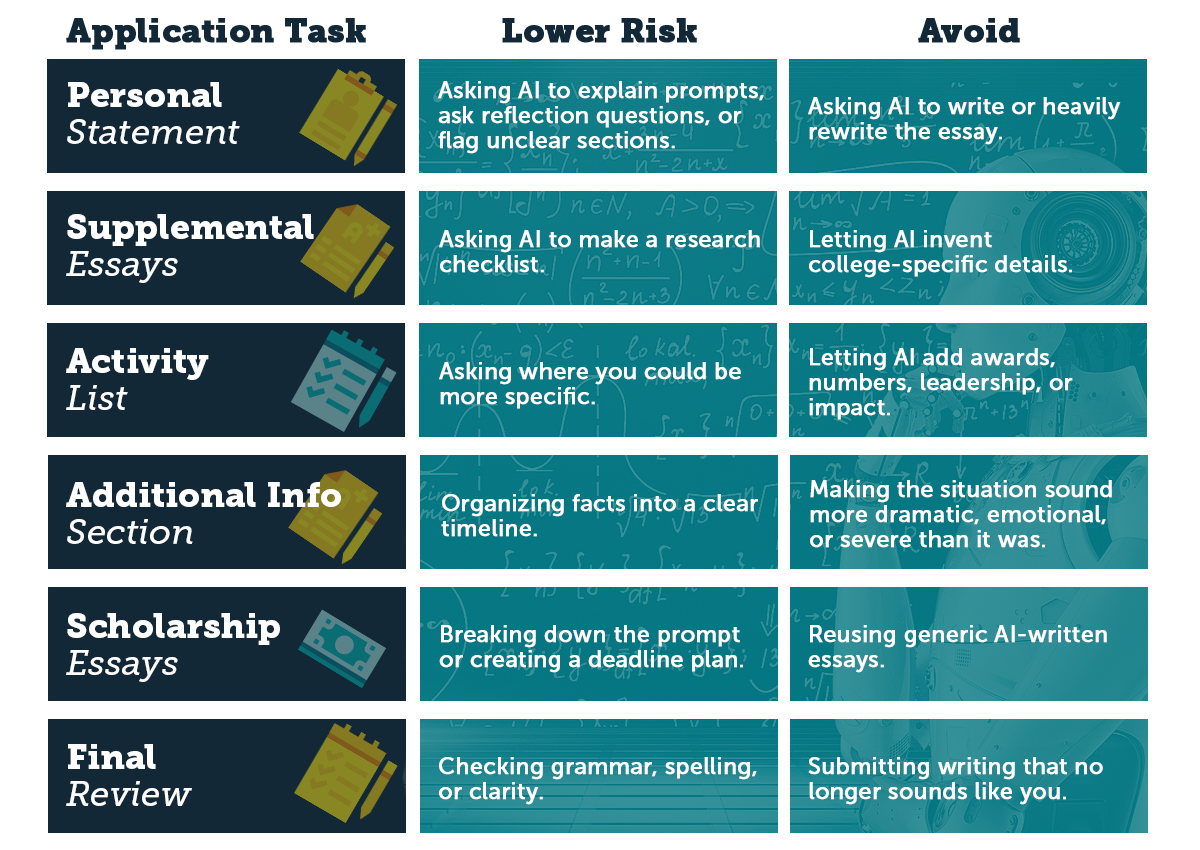
Can I use AI on the Common App?
You should be careful.
As mentioned above, the Common App considers it application fraud to submit essays that are not your own work and/or misrepresenting AI-generated output as your own. That does not mean every small use is automatically a problem. But it does mean your final application needs to be your own work, factually accurate, and honestly presented.
Use AI for support, not as a substitute.
It’s smart to use AI to:
- Understand a prompt
- Make a checklist
- Ask yourself better reflection questions
- Notice where your draft is vague
- Catch basic grammar issues
But you should not use AI to:
- Write your personal statement
- Write your supplemental essays
- Invent stories or accomplishments
- Rewrite your essay so heavily that it no longer sounds like you
- Create activity descriptions that overstate what you did
Can I use AI for my college essay?
No. Don’t ask an AI tool to write your college essay for you.
Your college essay needs to highlight your voice, experiences, values, and reflection. If you let AI write your essay, then it’s no longer serving its purpose.
Admissions readers want authenticity, personal reflection, specific details, and a clear sense of who you are. AI-written essays usually sound polished but empty. They feel generic, vague, emotionally flat, or inconsistent with the rest of an application.
Again, the goal is not to sound as impressive as possible. Essay readers want to connect with you, a real person who learned something, cared, struggled, changed, chose something, or began to understand themselves better. That will not happen if AI writes your piece.
Can I use AI for supplemental essays?
Be extra careful with supplemental essays.
Supplemental essays often ask why you want to attend a specific college, why a major fits your goals, or how you would contribute to a campus community. AI can make these answers sound polished, but also obviously generic.
Even worse, AI can invent details. It might name a program, club, professor, scholarship, major, lab, or campus tradition that does not exist or is outdated.
For supplemental essays, a smart way to use AI is to get help researching a school or program. Use a prompt like:
Help me make a checklist of things to research before writing a “Why this college?” essay. Do not write the essay. Do not invent any college-specific details.
You’ll get the best final piece by researching the college on its official website, taking notes in your own words, and then writing about the real connections between the school and your goals.
Can I use AI for activity descriptions?
Maybe, but do not let AI inflate your role.
Activity descriptions should accurately reflect what you did, how much time you spent, what role you had, and what impact you made. They are not supposed to sound like a corporate award bio, and if yours does, it will stand out as AI-written.
AI often adds language that sounds impressive but says very little. It may also add leadership, outcomes, numbers, or accomplishments that are not true.
Try this AI prompt instead:
Check these activity descriptions for clarity. Tell me where I could be more specific about my role or impact. Do not add accomplishments.
Can I use AI for the Additional Information section?
The Additional Information section is usually for context, not a second essay.
Students often use it to explain things like a scheduling conflict, a family responsibility, a health issue, a grading discrepancy, or an unusual circumstance. Because this section can involve private or sensitive information, be careful about pasting personal details into AI tools.
AI can help you organize facts in a clear order. But it should not make your situation sound more dramatic, emotional, or severe than it really was.
Can I use AI for scholarship essays?
Scholarship essays may have their own rules, so check before using AI.
Some scholarships care deeply about personal voice, financial need, identity, leadership, career goals, or community impact. If AI writes the essay, it may miss the details that make your story real.
AI can help you:
- Break down a scholarship prompt
- Make a list of experiences that might fit
- Create a deadline checklist
- Find vague parts of your draft
- Prepare questions for a counselor or mentor
AI should not:
- Write the essay for you
- Make your financial situation sound different from reality
- Invent service hours, awards, leadership roles, or obstacles
- Reuse the same generic essay across multiple scholarships
The same caution applies outside college applications. High school writing competitions have different AI policies, ranging from required disclosure to complete prohibition.
Can colleges tell if I use ChatGPT for my essay?
Maybe. But that is not the question to build your strategy around.
Some colleges may use AI or plagiarism detection tools. UC says it runs personal insight question responses through plagiarism-detection software and warns that copying from others or using AI-generated text that draws on online sources can be caught.
At the same time, AI detection tools are not perfect. OpenAI discontinued its own AI Text Classifier in 2023 due to low accuracy. So students should not assume AI detection is always reliable.
But the bigger issue is authenticity. Admissions readers have read a large volume of student-written pieces. So they usually notice when an essay sounds generic, overly polished, inconsistent with the rest of the application, or very different from a student’s short answers, activity descriptions, recommendation letters, or academic record.
In Kaplan’s 2025 survey, admissions officers said GenAI can strip essays of their personal touch and produce generic content that does not reflect a student’s authentic voice or unique experiences. That’s the last thing you want when applying to a college.
So, the truth is, a personally written essay will be better than an AI-written one. Sure, you’ll probably have to work through a few versions, editing and revising along the way. First drafts are usually a mess. But your real voice, personal details, and thoughtful reflection are the point.
Helpful ways to use AI for college applications
AI is most helpful when it acts like a coach, not a ghostwriter.
Use AI to understand essay prompts
You can paste in a prompt and ask AI to explain what the college is really asking.
Try:
Explain this college essay prompt in plain language. What is it asking me to show about myself? Do not write an essay.
Use AI to brainstorm
Instead of asking AI for essay topics, ask it for reflection questions.
Try:
Ask me 12 personal reflection questions that could help me choose a college essay topic. Focus on moments of growth, curiosity, responsibility, challenge, or change. Do not write the essay for me.
Use AI to organize deadlines
AI can help you create a timeline for applications, recommendation letters, financial aid, scholarships, and essays.
Try:
Help me create a college application checklist for the next eight weeks. Include essays, recommendations, financial aid, and scholarship tasks.
Use AI to review clarity
AI can point out confusing sections, vague claims, or missing details without rewriting your work.
Try:
Read this paragraph and tell me where it feels unclear, generic, or missing specific details. Do not rewrite it.
Use AI to check for generic language
Sometimes AI is useful for spotting places where your writing sounds too broad.
Try:
Tell me which sentences sound generic or unlike a high school student. Do not rewrite them. Explain why they might feel less personal.
Use AI to prepare questions
AI can help you create questions for counselors, teachers, admissions reps, or family conversations.
Try:
Based on this college application list, what questions should I ask my counselor before I submit?
Before using AI, ask yourself these questions
Before you paste a prompt, draft, or personal detail into an AI tool, pause to check the rules, purpose, and privacy risks.
Does this college allow AI use?
Check the college’s application instructions, admissions website, honor code, essay guidance, and application certification language.
Am I using AI to support my thinking or replace it?
Brainstorming questions are different from finished paragraphs.
Would I be comfortable telling an admissions officer how I used AI?
If the answer is no, rethink the use.
Does the final draft still sound like me?
Read it out loud. If it sounds like a motivational poster wearing a blazer, revise.
Are all details true?
Do not let AI invent achievements, hardships, leadership roles, conversations, emotions, or lessons.
Am I sharing sensitive information?
Avoid sharing things like:
- Social Security numbers
- FAFSA information
- Financial details
- Immigration details
- Medical or mental health information
- Disciplinary records
- Full names of other people
- Private family information
Can I explain every part of this application?
You should understand and stand behind every sentence you submit.
A simple AI-use checklist before you submit
Use this checklist before submitting any application material if you used AI.
- I checked the college’s AI policy.
- I checked the application platform’s rules.
- I wrote the final version myself.
- I can explain every sentence.
- All accomplishments, numbers, roles, and details are true.
- AI did not invent experiences, emotions, or lessons.
- The writing still sounds like me.
- I did not paste sensitive private information into an AI tool.
- I would be comfortable explaining how I used AI.
- I asked a counselor, teacher, or trusted adult for feedback when I was unsure.
If you cannot check these boxes, slow down before submitting.
What if I already used AI on my college essay?
First, do not panic. Most students are trying to figure this out in real time. The next step depends on what AI actually did.
Ask yourself:
- Did AI only explain the prompt?
- Did it ask reflection questions?
- Did it help with grammar?
- Did it suggest structure?
- Did it rewrite sentences?
- Did it write full paragraphs?
- Did it create the main story or message?
If AI only helped you brainstorm, organize, or proofread, you may be able to revise lightly and move forward, depending on the college’s policy.
If AI wrote or heavily rewrote your essay, take a deeper pass:
- Remove sentences that do not sound like you.
- Replace generic claims with real details.
- Check that every example actually happened.
- Rewrite important sections in your own words.
- Read the essay out loud.
- Ask someone who knows you whether it sounds like you.
- Check the college’s AI rules before submitting.
If a college or scholarship asks you to disclose AI use, answer honestly.
Bottom line: AI can help, but your application should still be yours
AI can make the college application process feel less overwhelming, especially when you use it to plan, brainstorm, and gain clarity. But what you submit should reflect your real experiences, goals, and voice.
As you work on applications, don’t forget to look for scholarships, too. Many scholarship essays ask for the same thing colleges do: a clear, honest sense of who you are and what you’re working toward.
Appily can help you find scholarship opportunities, stay organized, and build a college list around schools that fit your goals, budget, and interests.
FAQs: Using AI with your college essay and applications
Can I use ChatGPT to write my college essay?
No. You should not ask ChatGPT or another AI tool to write your college essay for you. Some colleges restrict or ban AI-generated writing, and the Common App says misrepresenting AI-generated output as your own work is fraud.
It is safer to use AI for brainstorming, outlining, understanding prompts, or asking revision questions, as shared above.
Is AI allowed on the Common App?
Common App says submitting essays that are not your own work and misrepresenting AI-generated output as your own is fraud. That means students should not submit AI-generated essays, activity descriptions, or written responses as their own work.
Read more about how to submit your Common App materials.
Can colleges detect ChatGPT?
Some colleges use AI detection or plagiarism detection tools. Colleges may also notice AI use if an essay sounds generic, inconsistent with the rest of the application, or unlike the student’s writing. You know AI slop when you see it. They do, too.
Is using AI on a college essay plagiarism?
It can be, depending on how AI is used and what the college’s policy says. Common App defines fraud as misrepresenting AI-generated output as your own work, and Yale says submitting written application responses composed by text-generating software may result in admission revocation or expulsion.
Using AI for basic grammar help or brainstorming questions is different from submitting AI-generated writing as your own.
Can I use AI to brainstorm college essay ideas?
In many cases, using AI to brainstorm or ask reflection questions is acceptable, but policies vary by college. Check each college’s application instructions and use AI as a support tool, not the source of your final essay.
Is it okay to use Grammarly or AI grammar tools on college essays?
Basic grammar and clarity tools may be acceptable in many situations, but be careful with tools that rewrite whole sentences or change your voice. Always check the college’s policy and make sure the final essay still sounds like you.
Can I use AI for supplemental essays?
AI can help you break down a supplemental essay prompt or create a research checklist, but it should not write the response for you. Supplemental essays should demonstrate genuine fit with the college, and AI can fabricate or misstate college-specific details.
Can I use AI for activity descriptions?
You can use AI to check for clarity, but do not let it add accomplishments, leadership roles, numbers, or awards that are not true. Activity descriptions should accurately reflect what you did.
Can I use AI for scholarship essays?
Maybe, but scholarship rules vary. Use AI to understand the prompt, organize your ideas, or find unclear sections. Do not use AI to write the essay, exaggerate need, invent service work, or create a generic essay you submit everywhere.
Should I disclose my use of AI on my college application?
Some colleges, scholarships, or programs may ask students to disclose their use of AI, while others may not. Follow each college’s instructions. When in doubt, use AI only in ways you would feel comfortable explaining honestly.
What should I do if I already used AI?
Figure out what AI actually did. If it only helped with brainstorming, grammar, or structure, review the college’s policy and make sure the final work is yours.
If AI wrote or heavily rewrote your essay, revise it in your own words, remove generic language, check every fact, and ask a trusted adult for feedback.
What information should I avoid putting into AI tools?
Avoid pasting personal information like Social Security numbers, financial details, FAFSA information, immigration details, medical or mental health information, disciplinary records, full names of other people, or private family information.
