22 Writing Competitions for High School Students: 2026-27 Deadlines and Eligibility

Writing competitions can help high school students earn publication, scholarships, professional feedback, mentorship, or formal recognition. The right competition for you depends on your grade, location, strongest type of writing, budget, and how much time you have before the deadline.
As of August 6, 2026, several competitions on this list are still accepting entries or have confirmed fall deadlines. Many 2027 contests, however, have not announced their next prompts or submission windows. When 2027 information is unavailable, this guide clearly labels details from the latest completed cycle so you can plan without mistaking an old deadline for a current one.
Entering a competition by itself will not automatically make your college application stand out. Winning an award, being named a finalist, publishing your work, or showing a sustained commitment to writing may give you a meaningful accomplishment or experience to discuss.
Important: Organizers may change deadlines, fees, prompts, prizes, eligibility rules, publication terms, and artificial intelligence policies. Open the official rules before you begin writing and check them again before submitting.
TL;DR: How to find the right high school writing competition
- Start by checking your grade, age, location, citizenship or residency status, and school type. These requirements can eliminate contests before you spend time on an entry.
- As of August 6, 2026, YoungArts, VFW Voice of Democracy, Nancy Thorp, and Harvard International Review have current submission opportunities or deadlines. Bennington opens September 1, and Scholastic opens October 1.
- Compare more than the prize. Check the entry fee, word or page limit, required sponsor, publication rights, simultaneous-submission policy, and AI rules.
- Treat details from a previous cycle as planning information only. Confirm the current prompt, deadline, fee, and eligibility requirements on the organizer’s official website.
- Give yourself two to four weeks to revise a shorter creative piece and six to eight weeks for a research essay, portfolio, play, recording, or interdisciplinary project.
- Winning, placing, or publishing your work may support a college application. Simply entering a contest usually carries less weight, but the finished piece can still become part of a portfolio or another submission.
Which high school writing competitions are open now?
As of August 6, 2026, YoungArts, the VFW Voice of Democracy contest, the Nancy Thorp Poetry Contest, and the Harvard International Review contest have current submission opportunities or deadlines. Bennington opens September 1, and the 2027 Scholastic Awards portal opens October 1.
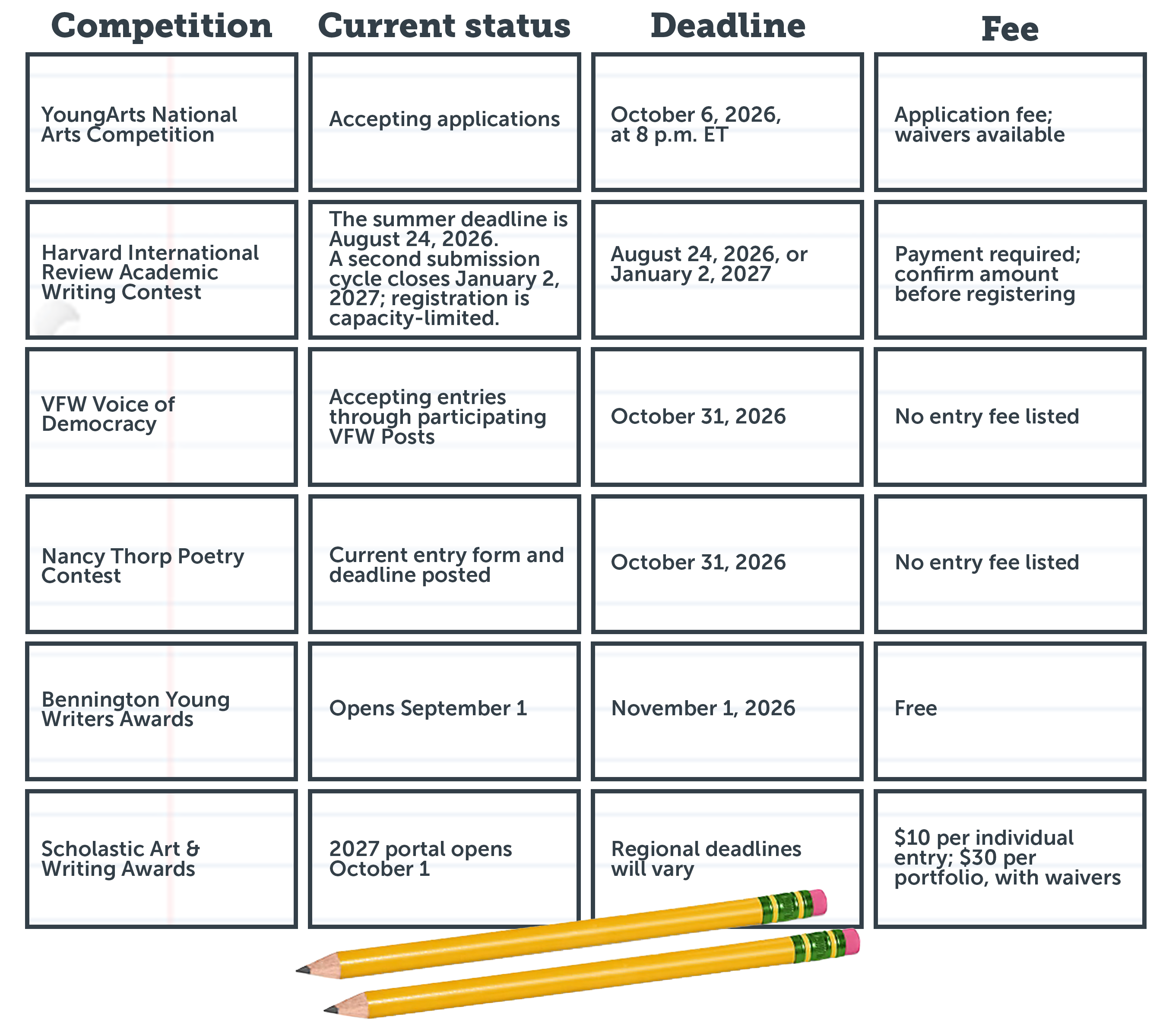
YoungArts lists an October 6 deadline and current eligibility requirements. The VFW is accepting 2026-27 entries through October 31, and Harvard International Review lists August and January submission cycles. Bennington opens September 1, while the Scholastic portal says the 2027 program opens October 1.
The Ayn Rand Institute’s contest dashboard is also live, but its current prompts and deadlines are still marked as coming soon. Do not begin an essay using an older prompt.
What should you check before entering a writing competition?
Before entering, confirm these six details on the organizer’s current rules page:
- Eligibility: Does the contest accept students in your grade, age group, country, state, citizenship category, or school type?
- Current status: Is the competition open, closed, or waiting to announce its next cycle?
- Exact deadline: What date, time, and time zone apply?
- Cost: Is there an entry fee? Can you request a fee waiver?
- Submission rules: What prompt, genre, word count, file format, and supporting materials are required?
- Originality and rights: Does the contest permit previously published work, simultaneous submissions, collaboration, or generative AI tools?
Keep the official rules open while you prepare the entry. A missed word limit, file requirement, permission form, sponsor requirement, or time zone can disqualify an otherwise strong submission.
Which type of writing competition should you choose?
Choose a competition that accepts your strongest type of writing and fits the time you have available. Start with these categories, then confirm your eligibility, fee, deadline, and submission requirements.
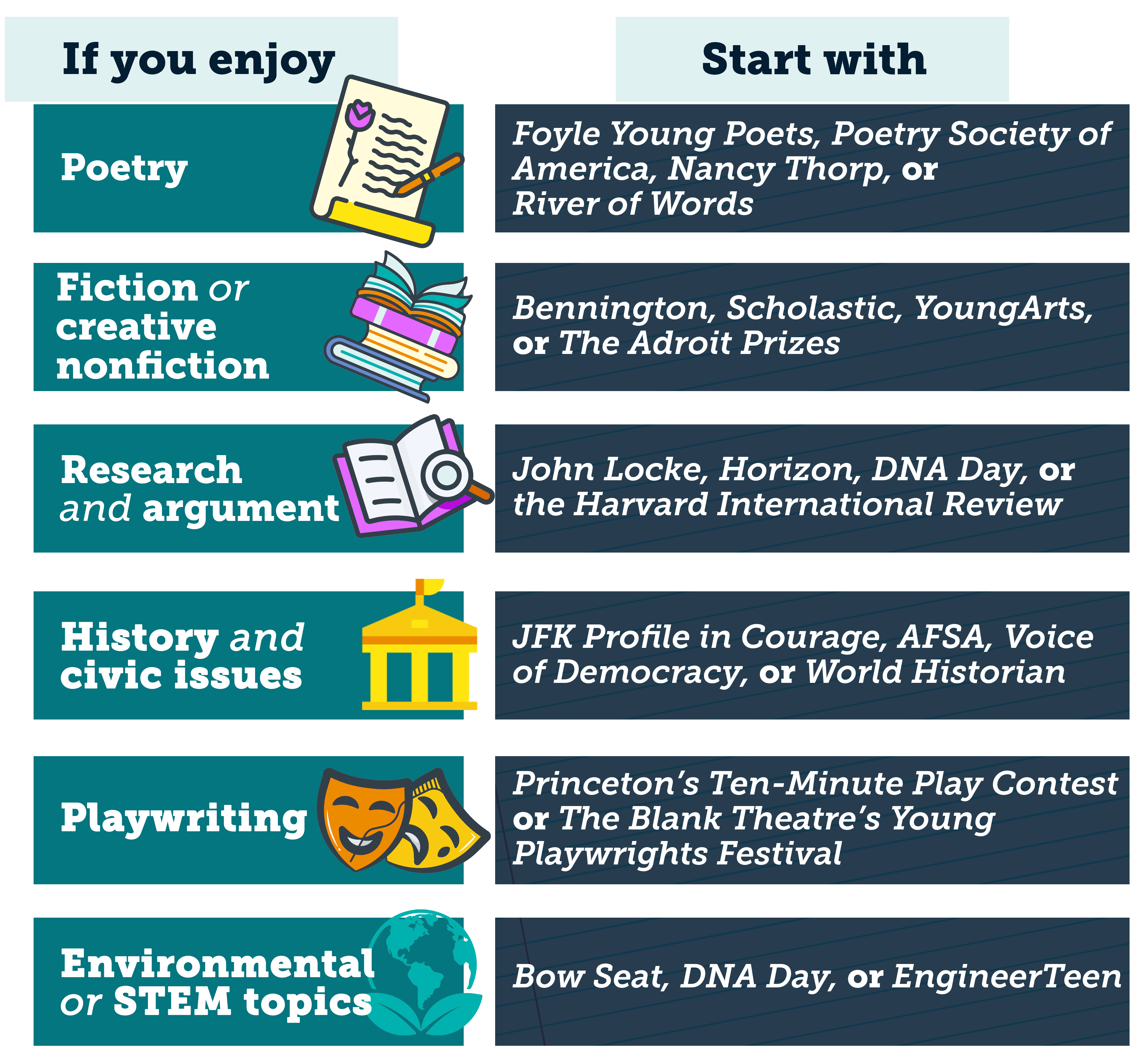
Poetry, fiction, and creative writing competitions
These contests accept poetry, fiction, creative nonfiction, or several forms of creative writing. Compare the genre, length limit, cost, publication terms, and simultaneous-submission rules before choosing one.
Bennington Young Writers Awards
Bennington Young Writers Awards
Best for: Students with a polished poem, short story, or work of creative nonfiction
2026 status: Opens September 1 and closes November 1, 2026
Eligibility: Students in grades 9-12 worldwide. A sponsoring teacher must review and approve the entry. Homeschooled students must use a non-parent mentor.
Fee: Free
What to submit: One entry in poetry, fiction, or nonfiction. Fiction and nonfiction entries must be no more than 1,500 words. Poetry entries may contain one to three poems within the combined word limit.
Awards: First place in each category receives $2,000, second place receives $1,000, and third place receives $500. Distinguished submissions receive $250. Winners, distinguished writers, and finalists who apply, are admitted, and enroll at Bennington may qualify for college-specific scholarships.
Important for seniors: Grade 12 students begin through the application process described by Bennington. The college says this process is nonbinding and does not require an application fee or supplemental essay for the Young Writers Awards.
Publication and submission rights: Bennington says simultaneous submissions are accepted and authors retain their copyrights, although winning work may be published by the college.
Appily planning tip: Ask your teacher or mentor to review the piece by October 15 so you have at least two weeks to revise before the November 1 deadline.
Scholastic Art & Writing Awards
Scholastic Art & Writing Awards
Best for: Students who want to choose from several writing categories and compete first at a regional level
2027 status: The entry portal opens October 1, 2026. Each region sets its own deadline. In the previous cycle, deadlines ranged from December 1 through January 6.
Eligibility: Students in grades 7-12 who are at least 13 and live in the United States, a U.S. territory or military base, or Canada.
Fee: $10 per individual entry and $30 per portfolio. Students may select a fee waiver when the cost is a barrier.
What to submit: Current writing categories include critical essay, flash fiction, journalism, novel, personal essay and memoir, poetry, screenplays and scripts, short story, speculative fiction, and a writing portfolio for graduating seniors. Requirements and word limits differ by category.
Awards: Entries compete first within their region. Gold Key work advances to national judging. Recognition may include regional or national awards, exhibitions, publication, and category-specific scholarships.
Rights: Students retain their intellectual property rights. The organizer’s terms describe the permission granted to display or publish entered work.
Appily planning tip: Create or update your account when the portal opens on October 1. Use the Region Locator that day to record your exact writing deadline instead of relying on the previous national range.
YoungArts National Arts Competition
YoungArts National Arts Competition
Best for: Experienced writers with a strong portfolio who want national recognition and long-term artistic development
2027 status: Applications are open. The deadline is October 6, 2026, at 8 p.m. ET.
Eligibility: Applicants must be in grades 10-12 or ages 15-18 as of December 1, 2026. They must be a U.S. citizen, permanent resident, or legally able to receive taxable income in the United States. A previous winner who attended National YoungArts Week may not apply again.
Fee: An application fee is required, but fee-waiver documentation is accepted. Confirm the current amount in the application portal before submitting.
What to submit: Writing categories include fiction, nonfiction, poetry, spoken word, and play or script writing. Each category has separate portfolio and formatting requirements.
Awards: YoungArts winners receive $250. Winners with distinction are invited to National YoungArts Week and may be considered for additional awards of up to $10,000. Winners also receive access to professional development and the YoungArts artist network.
Appily planning tip: Review the exact requirements for your category before selecting pieces. Aim to upload a complete draft by September 22 so fee-waiver documentation or technical problems do not delay your submission.
The Adroit Prizes for Poetry and Prose
The Adroit Prizes for Poetry and Prose
Best for: Secondary or undergraduate writers seeking publication in a literary journal
2027 status: Dates have not been announced.
Latest completed cycle: The 2026 submission window ran from April 1 through May 12, 2026, at 11:59 p.m. PT.
Eligibility in 2026: Secondary and undergraduate students worldwide
Fee in 2026: $15 per submission. Financial assistance was available.
What students could submit in 2026: Poetry entries could include up to five poems. Prose entries could include up to three works of fiction or creative nonfiction totaling no more than 3,500 words.
Awards in 2026: The poetry and prose winners each received $200 and publication in The Adroit Journal. Runners-up and finalists received a book from the contest judges.
Submission rights: The organizer accepted simultaneous submissions when disclosed. Review the next rules carefully for previously published work and publication-right requirements.
Appily planning tip: Set a reminder for mid-March 2027 to look for the next window. Keep a small portfolio within the previous limits, but do not assume the fee, dates, or page limits will remain the same.
Foyle Young Poets of the Year Award
Foyle Young Poets of the Year Award
Best for: Young poets with a strong, unpublished poem
2027 status: Dates have not been announced.
Latest completed cycle: The 2026 contest closed July 31, 2026, at midnight BST.
Eligibility in 2026: Writers ages 11-17 worldwide who met the age requirement on the deadline date
Fee: Free
What students could submit in 2026: Poems on any subject, with a maximum length of 40 lines. U.K. entrants could submit up to three poems; international entrants could submit one.
Recognition: The program traditionally selects 15 top winners and 85 commended poets and provides publication or writing-development opportunities.
Important restrictions in 2026: Generative AI was prohibited. The official rules also addressed prior publication and the number of entries permitted.
Appily planning tip: Keep one strong poem offline and unpublished while waiting for the 2027 rules. Check the organizer’s page in early April rather than assuming the previous deadline and international submission limit will repeat.
Poetry Society of America Student Poetry Award
Poetry Society of America Student Poetry Award
Best for: U.S. high school students with one polished, unpublished poem
Next-cycle status: Dates have not been posted.
Latest posted cycle: October 1 through December 15, 2025, at 11:59 p.m. ET
Eligibility in the latest cycle: U.S. students in grades 9-12
Fee in the latest cycle: $5 for an individual entry. Teachers or administrators could submit multiple student entries through a $20 group-entry option.
What to submit: One unpublished poem. Translations and poems with more than one author were not accepted under the latest posted rules.
Award in the latest posted cycle: $250
Appily planning tip: Check the award page in mid-September. Do not post the poem publicly while waiting if the next rules continue to require unpublished work.
River of Words Youth Art and Poetry Contest
River of Words Youth Art and Poetry Contest
Best for: Students who write about nature, ecology, watersheds, or a sense of place
Next-cycle status: Dates have not been posted.
Latest completed cycle: The 2026 contest opened October 15, 2025, and closed January 31, 2026, at 11:59 p.m. PST.
Eligibility in 2026: Students in pre-K through grade 12, ages 5-19, who were enrolled in school. A parent, guardian, educator, or facilitator had to submit the work unless the student was 18 or older.
Fee: Free
What to submit: Poetry exploring the student’s watershed, local environment, ecology, or sense of place. The program also accepts art in separate categories.
Location rule: Students in Arizona and Georgia must use their state River of Words programs. Their work is then entered in the international contest.
Appily planning tip: Check the official page in early October. Students in Arizona or Georgia should open their state program’s rules before preparing the entry form.
Nancy Thorp Poetry Contest
Nancy Thorp Poetry Contest
Best for: High school sophomores and juniors who identify as young women and want poetry recognition connected to a college writing program
Current status: The deadline is October 31, 2026.
Eligibility: Young women who are high school or preparatory school sophomores or juniors. Current program materials also reference homeschooled students, and recent results include entrants from outside the United States.
Fee: No entry fee is listed on the public contest page.
What to submit: One or two unpublished poems. Review the current entry form for simultaneous-submission restrictions and formatting requirements.
Awards: The first-place winner receives $350, publication in Cargoes, a renewable Hollins scholarship worth up to $5,000 per year if the student enrolls, and tuition and housing for the Hollinsummer creative writing program. Six second-place winners receive publication and smaller Hollins and Hollinsummer scholarships.
Appily planning tip: Confirm your grade eligibility before completing the form. Submit by October 24 so you have time to correct a missing file or form field.
After choosing a creative-writing contest, record whether the organizer allows simultaneous submissions. That rule determines whether you may send the same work to another competition or publication.
Playwriting competitions
Playwriting contests require a script rather than a standard essay or short story. Check page limits, estimated performance time, formatting, collaboration rules, and whether the organizer accepts musicals.
Princeton University Ten-Minute Play Contest
Princeton University Ten-Minute Play Contest
Best for: Eleventh-grade students with a short, complete play that can be performed in about 10 minutes
2027 status: Dates have not been announced.
Latest completed cycle: The submission form opened January 12, 2026. The contest closed March 31 at noon ET or when it reached 250 entries, whichever happened first.
Eligibility in the latest cycle: Students in 11th grade in the United States or the international equivalent. Homeschooled students working at the 11th-grade level could enter.
What to submit: One original play of no more than 10 pages. Princeton describes one page as approximately one minute of performance time.
Awards in the latest cycle: First place received $500, second place received $250, and third place received $100.
Important restriction: The 250-entry cap may close the contest before the listed deadline.
Appily planning tip: Check the page in early January 2027 and prepare to submit during the first week the form is available.
The Blank Theatre Young Playwrights Festival
The Blank Theatre Young Playwrights Festival
Best for: Young playwrights who want professional mentoring, direction, and performance
2027 status: Submissions open January 5 and close March 15, 2027.
Eligibility: Writers must be age 19 or younger on March 15, 2027, and live or attend school in the United States. Co-authored plays are accepted when every author meets the eligibility requirements.
Fee: Free
What to submit: Up to three original plays or musicals of any length or genre. Each work requires a separate submission form and must have a title page and numbered pages.
Award: Selected works receive professional mentoring, direction, and performance during the festival in July 2027.
AI policy: No part of the script may be written using generative AI.
Appily planning tip: Ask a drama teacher or experienced reader to review your stage directions and dialogue by February 15. Aim to submit by March 1.
Read your script aloud before entering either playwriting contest. A timed reading can reveal whether the play fits the intended length and whether the dialogue sounds natural.
Essay, history, civics, and research competitions
These contests typically require research, citations, or a response to a specific prompt. Review the required source types, citation format, sponsor requirements, and AI policy before selecting a topic.
John F. Kennedy Profile in Courage Essay Contest
John F. Kennedy Profile in Courage Essay Contest
Best for: U.S. high school students interested in politics, history, and primary-source research
2027 status: Dates and the current prompt have not been posted.
Latest completed cycle: The contest opened September 1, 2025, and closed January 12, 2026, at 11:59 p.m. ET.
Eligibility in the latest cycle: U.S. students in grades 9-12 attending public, private, parochial, or home schools. Certain students in correspondence or GED programs and U.S. citizens attending school overseas were also eligible.
What to submit: A 700- to 1,000-word essay analyzing one act of political courage by a U.S. elected official who served during or after 1917. The essay must use at least five sources and name a nominating teacher.
Awards in the latest completed cycle: First place receives $10,000, second place receives $3,000, three finalists receive $1,000 each, and 15 students receive honorable mentions.
Disqualification risks: Appointed officials do not qualify. John F. Kennedy, Robert F. Kennedy, Edward M. Kennedy, senators featured in Profiles in Courage, and some prior award subjects are restricted or disqualified. Essays with fewer than five sources are disqualified.
AI policy in the latest cycle: Essays were disqualified if AI was detected in the essay or bibliography.
Appily planning tip: Check for the 2027 page in late August. Before drafting, compare three possible local or state officials against the disqualified-subject lists and choose the one supported by the strongest primary sources.
AFSA National High School Essay Contest
AFSA National High School Essay Contest
Best for: Students interested in international relations, diplomacy, and U.S. foreign policy
Next-cycle status: The 2025-26 contest is closed. AFSA has not posted the next prompt or deadline.
Eligibility in the latest cycle: Students in grades 9-12 in the 50 states, District of Columbia, or U.S. territories. U.S. citizens attending high school overseas and homeschooled students could also enter. Previous first-place winners and certain relatives of partner staff were not eligible.
What students submitted in 2025-26: A 1,000- to 1,500-word essay responding to a prompt about U.S. diplomacy, soft power, and the Foreign Service.
Awards in the latest completed cycle: The winner receives $2,500, a trip to Washington, D.C., with their parents, and an educational Semester at Sea voyage. The winner’s school receives 10 copies of Inside a U.S. Embassy: Diplomacy at Work.
Appily planning tip: Check the official page in early December. Wait for the new prompt before selecting a topic because the diplomatic issue changes each cycle.
VFW Voice of Democracy Audio-Essay Contest
VFW Voice of Democracy Audio-Essay Contest
Best for: Students who are comfortable writing and recording a speech on a civic or patriotic theme
2026-27 status: Accepting entries. Submissions are due to a participating local VFW Post by October 31, 2026.
Eligibility: Students in grades 9-12 who meet the requirements on the current VFW entry form
Prompt: “What a Veteran Taught Me About America”
What to submit: A recorded audio essay and completed entry form. Entries are submitted through a participating local VFW Post rather than directly to a single national upload portal.
Award: The national first-place winner receives a $35,000 scholarship paid to an American college, university, or vocational or technical school. Additional national and state scholarships are available.
Appily planning tip: Use the VFW Post locator now and contact the Post before recording. Local instructions may require more than uploading an audio file.
Jane Austen Society of North America Essay Contest
Jane Austen Society of North America Essay Contest
Best for: Students who enjoy close reading, literary analysis, and Jane Austen’s novels
2027 status: The topic and rules are scheduled to be published in November 2026. Submissions are expected to open in February 2027.
Eligibility: High school, college, and graduate students worldwide compete in separate divisions. Homeschooled students at the high school level may enter the high school division.
Fee: JASNA membership is not required.
What to submit: An essay responding to the current annual topic. Word limits and formatting rules vary by division and should be checked when the 2027 rules are posted.
Awards under the latest posted program details: First place in each division receives $1,000, second place receives $500, and third place receives $250. First-place winners also receive registration and two nights of lodging for the JASNA Annual General Meeting. Transportation is not included.
Appily planning tip: Check the contest page in early November. Read the new prompt before deciding which novel, adaptation, character, or historical issue to analyze.
John Locke Institute Global Essay Prize
John Locke Institute Global Essay Prize
Best for: Students who enjoy academic argument in philosophy, politics, economics, history, psychology, law, theology, public policy, or science and technology
2027 status: Dates and questions have not been announced.
Latest completed cycle: Regular registration closed March 31, 2026. Submissions were due May 31 at 11:59 p.m. GMT. Paid late-registration and deadline-extension options were available.
Eligibility in 2026: Students from any country who were younger than 19 on May 31, 2026
Fee in 2026: Regular registration was free. Late registration cost $10.
What to submit: An essay of no more than 2,000 words responding directly to one official question. Students had to provide an academic referee and follow specific file-naming and anonymous-submission rules.
AI policy in 2026: The organizer allowed AI use but warned that overreliance could make an essay less original or compelling. Students should review the 2027 policy rather than assuming it will remain unchanged.
Appily planning tip: Set reminders for February 1 and March 1, 2027. Register before the regular deadline, then record the separate essay-submission deadline.
Horizon Academic Essay Prize
Horizon Academic Essay Prize
Best for: Students interested in research-based argument who would consider using an award toward a specific academic program
Next-cycle status: Dates have not been posted.
Latest completed cycle: The 2026 deadline was February 1 at 11:59 p.m. PST.
Eligibility in 2026: Current high school students from any country who met the organizer’s enrollment-date requirement
Fee: Free
What to submit: One essay responding directly to one of five questions under the annual theme. Joint entries were not permitted.
Awards: The 2026 awards were scholarships toward the Horizon Academic Research Program. They were not unrestricted cash awards or general college-tuition scholarships.
Appily planning tip: Review the full program price and scholarship conditions before treating the award as a financial-aid opportunity. A partial program scholarship may still leave a significant balance.
World Historian Student Essay Competition
World Historian Student Essay Competition
Best for: Students who want to connect a historical subject to broader world or global-history themes
2027 status: The World History Association’s awards page lists May 1 as the annual deadline, but students should confirm the 2027 prompt and submission instructions before beginning.
Eligibility: Students in kindergarten through grade 12
What to submit: An essay responding to the current World History Association prompt and following its citation and formatting requirements.
Appily planning tip: Open the official awards page in January 2027. Save a copy of the current prompt and rules before beginning research.
Ayn Rand Institute Essay Contests
Ayn Rand Institute Essay Contests
Best for: Students who want to write a literary or philosophical argument about Anthem, The Fountainhead, or Atlas Shrugged
Current status: The organizer’s dashboard is live, but current deadlines and essay prompts are marked as coming soon.
Eligibility: The Anthem and Fountainhead contests are open to middle and high school students worldwide who are at least 13. The Atlas Shrugged contest is open to high school, college, and graduate students worldwide. Entrants must be enrolled in school during the contest period.
What to submit: Students choose the contest that matches their eligibility, read the assigned novel, and respond to one current official prompt.
Awards: The organizer lists prizes of up to $25,000, depending on the contest and placement.
Appily planning tip: Choose the book that matches your eligibility, but do not draft from an old question. Check the dashboard regularly until the organizer posts the current prompt and deadline.
American Society of Human Genetics DNA Day Essay Contest
American Society of Human Genetics DNA Day Essay Contest
Best for: Students who enjoy genetics, medicine, bioethics, and evidence-based science writing
2027 status: The prompt and dates have not been posted.
Latest completed cycle: The 2026 submission deadline was extended to March 8 at 11:59 p.m. ET.
Eligibility: Students in grades 9-12 worldwide
What to submit: An English-language essay of no more than 750 words with at least one reference. A teacher or school administrator normally submits the essay. A parent may submit when an approved school adult is unavailable under the organizer’s rules.
Awards in 2026: First place received $1,000, second place received $600, and third place received $400. The contest received more than 1,200 essays from 56 countries and 35 U.S. states and territories.
AI policy in 2026: Students had to document the use of large language model tools in the citations section. An AI tool could not be credited as an author.
Appily planning tip: Check the official page in early January. Ask a science teacher before drafting because an approved adult must complete the submission.
Harvard International Review Academic Writing Contest
Harvard International Review Academic Writing Contest
Best for: Students interested in international affairs who are prepared to research, write, and defend an argument orally
Current status: The summer deadline is August 24, 2026. A fall and winter cycle closes January 2, 2027. Registration is handled on a rolling basis, and capacity is limited.
Eligibility: The senior division accepts students in grades 9-12 worldwide. Submissions must be written in English.
Fee: Registration and payment are required before submission. The public contest page does not clearly state the amount, so confirm the full price in the registration process before paying.
What to submit: An 800- to 1,200-word article responding to an approved international-affairs theme. Articles must use reliable sources, hyperlink citations, and current AP style. Finalists participate in a 15-minute virtual presentation and defense.
AI policy: ChatGPT and other AI writing tools are prohibited.
Appily planning tip: Students targeting August 24 should register immediately and complete a full draft by August 14. Students choosing the January cycle should select a topic by October 15 and finish most research before winter break.
For any research contest, create a source list before writing the introduction. Confirm that each factual claim has a reliable citation and that the organizer accepts your chosen citation format.
Environmental and interdisciplinary competitions
These contests combine writing with science, conservation, visual design, performance, or another discipline. Students must complete every required component, not only the written portion.
Bow Seat Ocean Awareness Contest
Bow Seat Ocean Awareness Contest
Best for: Students who want to connect creative writing or poetry with ocean, climate, and environmental issues
2027 status: The 2026 contest is closed. The organizer plans to announce the 2027 theme in September 2026.
Latest completed-cycle deadline: June 8, 2026, at 11:59 p.m. ET
Eligibility: Students ages 11-18 worldwide who are enrolled in middle or high school. College students are not eligible. Students enter the junior division at ages 11-14 or the senior division at ages 15-18.
Fee: Free
What to submit: Categories include creative writing, poetry and spoken word, film, visual art, performing arts, and interactive media. Every entry requires a 100- to 300-word reflection and contact information for an adult sponsor.
Writing limits in 2026: Creative-writing entries could be up to three pages in the junior division or five pages in the senior division. Poetry entries could be no more than one page.
AI policy: AI-generated writing or art is treated as plagiarism and results in disqualification.
Appily planning tip: Check the contest page after the 2027 theme is announced. Choose a category only after reviewing the new prompt, length limit, reflection questions, and file requirements.
EngineerTeen Writing and Design Competition
EngineerTeen Writing and Design Competition
Best for: Students who enjoy combining engineering, visual design, and written explanation
2027 status: The theme and deadline have not been announced.
Latest completed cycle: The 2026 contest closed February 1, 2026, at 11:59 p.m. ET.
Eligibility in 2026: The contest included separate categories for grades 3-5, 6-8, and 9-12. Review the next rules for international and homeschool grade-selection instructions.
What to submit in 2026: A two-dimensional visual design and written responses explaining how engineers create a better world and how the student used the engineering design process.
Awards in the latest high school category: First place received $1,000, second place received $750, and third place received $500.
AI policy: Participants could not use AI to create any part of the submitted artwork or written responses.
About the organizer: EngineerTeen is being developed with the National Academy of Engineering and builds on the EngineerGirl program.
Appily planning tip: Check the official page in early October. Wait for the new engineering prompt before creating the design or written statement.
Choose an interdisciplinary contest only when you have enough time to finish every component. A polished essay will not compensate for a missing reflection, recording, design, reference list, or sponsor form.
How should you choose a writing competition?
Choose a contest by checking eligibility first, then comparing the work required with the time, money, and support you have available.
Which contests can you eliminate immediately?
Remove any competition that does not accept your:
- Grade or age
- Country, state, residency, or citizenship status
- School type
- Writing genre
- Submission format
- Previously published work, when applicable
This prevents you from spending time on an entry that cannot be judged.
What result do you want?
Choose based on the outcome that would be most useful to you:
Publication: Prioritize literary journals and contests that publish winning or finalist work.
Scholarship money: Check whether the award is unrestricted cash, general college tuition, a scholarship to one specific college, or a discount on a private academic program.
Professional development: Look for mentoring, workshops, feedback, artist networks, or staged performances.
Practice: Choose a free contest with a manageable deadline and word count.
Write your main goal beside each contest you are considering. Remove opportunities that do not support that goal.
How much time will the entry require?
A practical planning estimate is:
- Two to four weeks for revising a poem or short personal essay
- Six to eight weeks for a research essay requiring several sources and citations
- Additional time for a portfolio, play, recording, visual design, sponsor form, or academic referee
Count backward from the official deadline and reserve at least three days for forms, uploads, payment or fee-waiver processing, and technical checks.
What will entering cost?
Add up:
- Entry fees
- Required books
- Program tuition connected to an award
- Optional travel
- Printing, art, or recording expenses
Use a fee waiver when one is available. For an award tied to a specific college or summer program, calculate the remaining cost before deciding how much financial value the prize offers.
How can you tell whether a writing contest is legitimate?
A credible writing contest clearly identifies its organizer, eligibility rules, deadline, prizes, judging process, and publication or usage rights.
Look for:
- An official rules page
- A named organization with working contact information
- Specific fees and prize terms
- Past winners or contest results
- An explanation of how submitted work may be published, displayed, licensed, or stored
- A clear originality, plagiarism, and AI policy
Be cautious when a contest guarantees that every entrant will win, pressures students to buy an anthology, requests payment without explaining the judging process, or does not identify who owns or may publish the submitted work.
Before paying, search for the organizer’s official rules, past winners, refund policy, and entry-rights terms. Use the organizer’s own website rather than relying only on a third-party roundup.
How should you plan your entry?
Begin four to eight weeks before the deadline, depending on the research and submission requirements.
Six to eight weeks before a research contest
Confirm the prompt and eligibility. Choose a topic, gather reliable sources, and contact the required teacher, sponsor, or academic referee.
Four weeks before a creative-writing contest
Select the piece you will enter. Compare it with the word, page, or line limit and complete a full revision.
Two weeks before any deadline
Ask a teacher, librarian, mentor, or trusted reader for focused feedback.
Useful questions include:
- Where did you become confused?
- Which section needs more evidence?
- Which details feel generic?
- What can I cut without losing meaning?
- Does the opening clearly answer the prompt?
Three days before the deadline
Check:
- Word, page, or line count
- File type and file name
- Citation format
- Required title page
- Anonymous-submission requirements
- Sponsor, referee, or permission forms
- Audio, image, or video requirements
- Entry fee or completed fee waiver
- Deadline time and time zone
Submit before the final evening whenever possible. Save the final file, official rules, and confirmation email in the same folder.
Can a writing competition help with college applications?
A formal award, finalist placement, or publication can support a college application when it demonstrates skill, achievement, or sustained involvement. Merely entering a competition usually provides less useful information.
The Common App allows students to share activities, responsibilities, and academic honors or achievements. A formal competition result may fit with academic honors, while writing competitions that are one part of a broader commitment may be better described with the activity itself.
Honors example:
National finalist, [Competition Name], poetry division
Activities example:
Wrote and revised short fiction; submitted work to youth publications and competitions; one story selected for publication
Include the award level and genre when space allows. Use selectivity numbers only when the organizer publishes them.
What should you do if you do not win?
Keep the final draft, submission confirmation, official rules, and any feedback you receive. Check the contest’s publication and simultaneous-submission policies before sending the work elsewhere.
A completed entry can become:
- A submission to a student magazine
- Part of a writing portfolio
- A school publication
- A revised entry for another eligible contest
- The foundation for a longer story, essay, play, or research project
Record the next eligible deadline and decide whether to revise the same piece or begin something new.
Finding the right writing competition is important, but the bigger picture shouldn't be lost: finding the right college.
You can use Appily's tools to:
- Search colleges by major, cost, admission rate, location, and campus setting
- Build and compare a college list
- Search scholarships by grade level and eligibility
- Take virtual tours before deciding which campuses to visit
- Check Appily Match for direct admission opportunities if you are in your final year of high school
Appily’s free College Match Quiz can help you discover colleges that fit your academic interests, goals, budget, location preferences, and ideal campus experience-including schools you may not have considered yet.
FAQs about writing competitions for high school students
Are any high school writing competitions open now?
Yes. As of August 6, 2026, YoungArts, VFW Voice of Democracy, the Nancy Thorp Poetry Contest, and the Harvard International Review Academic Writing Contest have current submission opportunities or deadlines. Bennington opens September 1, and the Scholastic Art & Writing Awards portal opens October 1.
Always confirm the current status on the organizer’s official website before beginning an entry.
Are there free writing competitions for high school students?
Yes. Several competitions on this list are free, including Bennington Young Writers Awards, River of Words, The Blank Theatre Young Playwrights Festival, Horizon Academic Essay Prize, and Bow Seat Ocean Awareness Contest.
Other competitions charge a fee but may provide waivers or financial assistance. Check whether a waiver is available before deciding that a contest is unaffordable.
Can I submit the same piece to more than one writing competition?
It depends on each organizer’s simultaneous-submission policy. Some competitions allow you to submit the same work elsewhere as long as you disclose it or withdraw the piece if it is accepted. Others prohibit simultaneous submissions.
Check the current rules for every competition before sending the same poem, story, essay, or script to multiple places.
Can I enter a writing competition if my work has already been published?
Some contests accept previously published work, but many require unpublished entries. A poem or story posted on a blog, social media account, school publication, or personal website may count as published under an organizer’s rules.
Read the contest’s definition of “published” before submitting.
Can high school students use AI for writing competitions?
AI rules vary by competition. Some organizers prohibit generative AI entirely. Others allow limited use but require students to disclose it. A few may not publish a specific policy.
Do not assume that using AI for brainstorming, revising, citations, or drafting is allowed. Review the current AI and originality rules before using any tool.
How early should I start a writing competition entry?
Start two to four weeks before the deadline for a poem, short essay, or other piece that mainly requires revision. Start six to eight weeks ahead for a research essay, portfolio, play, recording, or project that requires citations, a sponsor, a referee, or multiple components.
Reserve at least three days for forms, uploads, payment or fee-waiver processing, and technical checks.
Do writing competitions help with college applications?
Winning an award, becoming a finalist, publishing your work, or showing sustained involvement in writing may strengthen an application when it demonstrates skill or commitment. Merely entering a contest usually provides less useful information.
A formal award may fit in an application’s honors section. Competition participation may fit better in the activities section when it is part of a larger writing commitment, such as editing a literary magazine, building a portfolio, or submitting work regularly.
What should I do if the 2027 deadline has not been announced?
Use the latest completed cycle only to estimate the likely season, workload, and submission requirements. Do not assume that the old deadline, prompt, fee, prize, or eligibility rules will remain the same.
Set a reminder to check the organizer’s official website when the next cycle is expected to open.
What should I do if I do not win?
Keep the final draft, submission confirmation, official rules, and any feedback you receive. After checking the publication and simultaneous-submission policies, you may be able to revise the work for another contest, submit it to a student publication, add it to a portfolio, or expand it into a longer project.
