Colleges for a 3.9 GPA
A 3.9 high school grade point average (GPA) usually means mostly A grades on a common 4.0 scale. GPA rules vary by high school, so the cleanest number to use is the GPA listed on your transcript.
Use this page to explore colleges that have admitted students in the 3.9 to 4.0 GPA range, then compare acceptance rate, average financial aid, test scores, and application deadlines to build a smart list.
What is a 3.9 GPA?
A 3.9 GPA is a grade point average of 3.9 on a 4.0 scale. On this scale, an A typically equals 4.0, and your overall GPA reflects the average of your class grades.
A 3.9 often looks like “mostly As” with a small number of A- grades, depending on your school’s grading system.
Is a 3.9 GPA good?
Yes. National data from the 2019 NAEP High School Transcript Study show that the average GPA for 2019 graduates was 3.11, so a 3.9 sits well above that national average.
A 3.9 is a strong academic signal, especially when earned alongside challenging courses.
How Does a 3.9 GPA Affect College Admissions?
A 3.9 GPA is very strong. Admissions committees consider your GPA and your full application when making their decisions. In addition, they look at your test scores, extracurricular activities, recommendations, and essays.
A 3.9 GPA may make you a competitive candidate. But if you aren't sure, it's best to try improving your GPA, as we discussed above. You can also put additional effort into extracurricular activities, sports, and community service to make your application more competitive.
What colleges can you get into with a 3.9 GPA?
A 3.9 GPA can open doors at a wide range of schools, including selective colleges, depending on the rest of your application.
The college list on this page includes schools with a history of admitting students in the 3.9 to 4.0 range, but admission is never guaranteed.
How to use the college list below
Use the sort and filters to match what matters most:
- Cost, including average net price
- Selectivity, including acceptance rate
- Academic fit, including average GPA and test scores
- Timing, including application deadlines and early timelines
Then, sanity-check each school as a reach, match, or safety based on your full profile, not GPA alone.
Build a balanced college list (safety, match, reach)
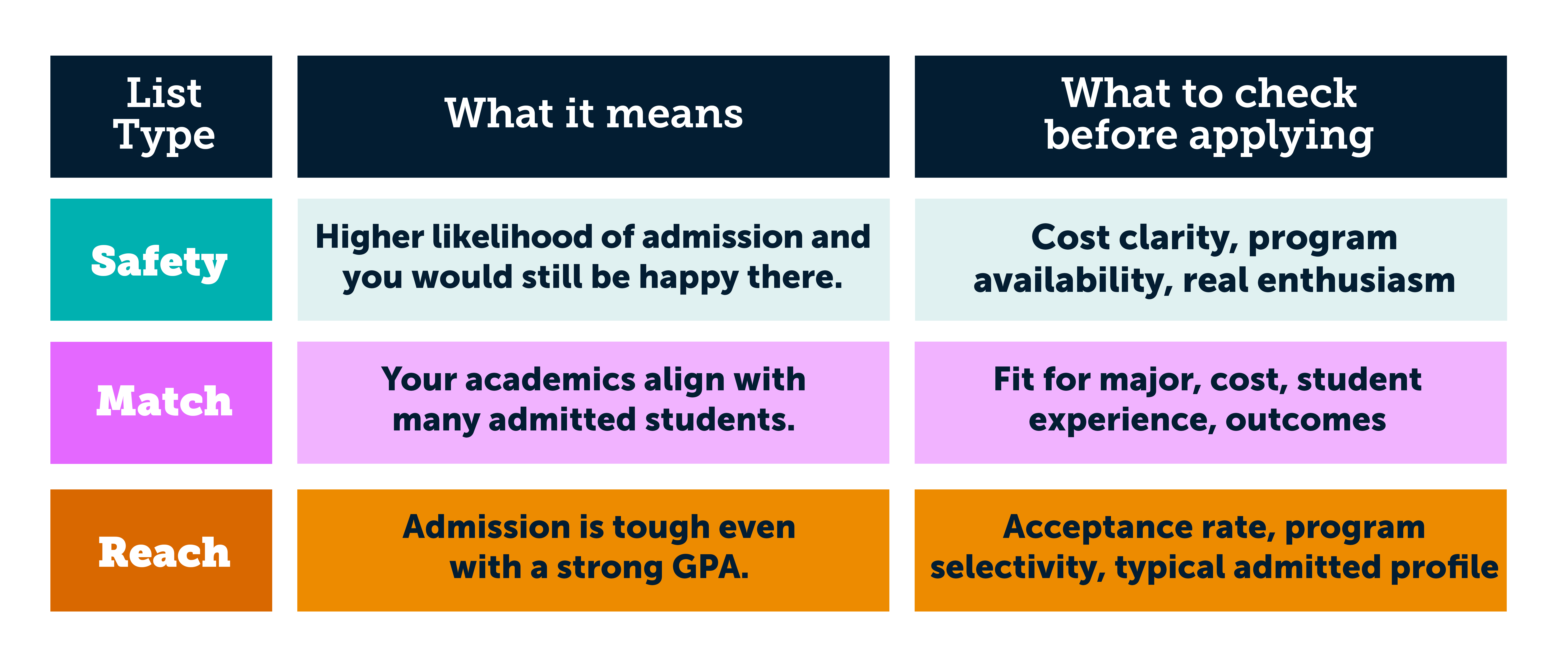
Use a reach, target, and likely framework to keep your list ambitious and realistic.
What Scholarships Can I Get With a 3.9 GPA?
You can apply to just about every scholarship requiring a minimum GPA. You may find a scant few that require a 4.0, but they'll be few and far between. Make sure to apply for as many scholarships as possible, regardless of the dollar amount, because even small amounts can help offset tuition costs.
What colleges look at besides a 3.9 GPA
Colleges consistently rate grades and curriculum strength as major factors. After that, these can matter a lot:
Activities and leadership | |
Recommendations |
Mini scenario
Student A has a 3.9 with mostly standard-level classes. Student B has a 3.7 with a heavy honors/AP load. Many selective colleges prefer Student B’s rigor, even with a slightly lower GPA.
A quick game plan by grade level
Freshmen and sophomores Keep the GPA strong and level up rigor when possible. Add one or two activities you can stick with long-term. |
Juniors Lock in the college list. If testing is part of the plan, prep and schedule it early. Use admission stats and deadlines to build a realistic calendar. |
Seniors Make the rest of the application match the GPA. Essays should show voice and direction, activities should show impact, and deadlines should be handled early. |
How Can I Improve My 3.9 GPA?
If you have a 3.9 GPA and would like to improve it, here are some tips:
| Identify areas of weakness: Identify the subjects or courses where you struggled or received lower grades. Work on improving your skills and understanding of these topics. |
| Take challenging courses: Challenge yourself by taking advanced or honors-level courses in your areas of strength. This will help you demonstrate your academic abilities and show that you are willing to push yourself. |
| Focus on time management: Create a schedule that balances academic work with other commitments, such as work or extracurricular activities. |
| Attend office hours and seek help: Attend office hours and seek help from professors or tutors. They can guide how to improve your grades and understanding of the material. |
| Study effectively: Develop effective study habits such as creating a study plan, taking notes, and reviewing material regularly. |
| Stay organized: Keep track of your assignments, deadlines, and exams. This will help you avoid procrastination and stay on top of your academic work. |
Remember, improving your GPA takes time and effort, so be patient and persistent.
What is a Weighted vs. Unweighted GPA?
A weighted GPA considers the difficulty of the classes you take. For example, honors, Advanced Placement (AP), and International Baccalaureate (IB) classes typically carry more weight, meaning a higher grade in these classes will result in a higher GPA. A weighted GPA is often used in college admissions to assess the academic rigor of a student's high school curriculum.
On the other hand, an unweighted GPA assigns a standard value to each letter grade regardless of the class's difficulty level. For example, an A in an honors class is assigned the same value as an A in a regular class. An unweighted GPA is often used in high school to give a general overview of a student's academic performance.
3.9 GPA FAQs
Is a 3.9 GPA enough for Ivy League schools?
It helps, but admission stays highly selective. Course rigor, essays, activities, and fit still matter a lot.
Can someone with a 3.9 GPA get rejected?
Yes. Many applicants have top grades, so colleges use the rest of the application to make decisions.
Should test scores be submitted with a 3.9 GPA?
Depends on the college and the score. Some colleges are test-optional, and policies vary by school.
Explore Colleges for Every GPA with Appily
Ready to explore colleges that accept a GPA like yours? We have a comprehensive database to help you find and research schools. There, you can see essential data points like acceptance rate, average financial aid award, average test scores, and application deadlines, including those for rolling admission, early decision, and early action schools.