What Is a Good SAT Score in 2026? Average Scores, Percentiles, and College Ranges

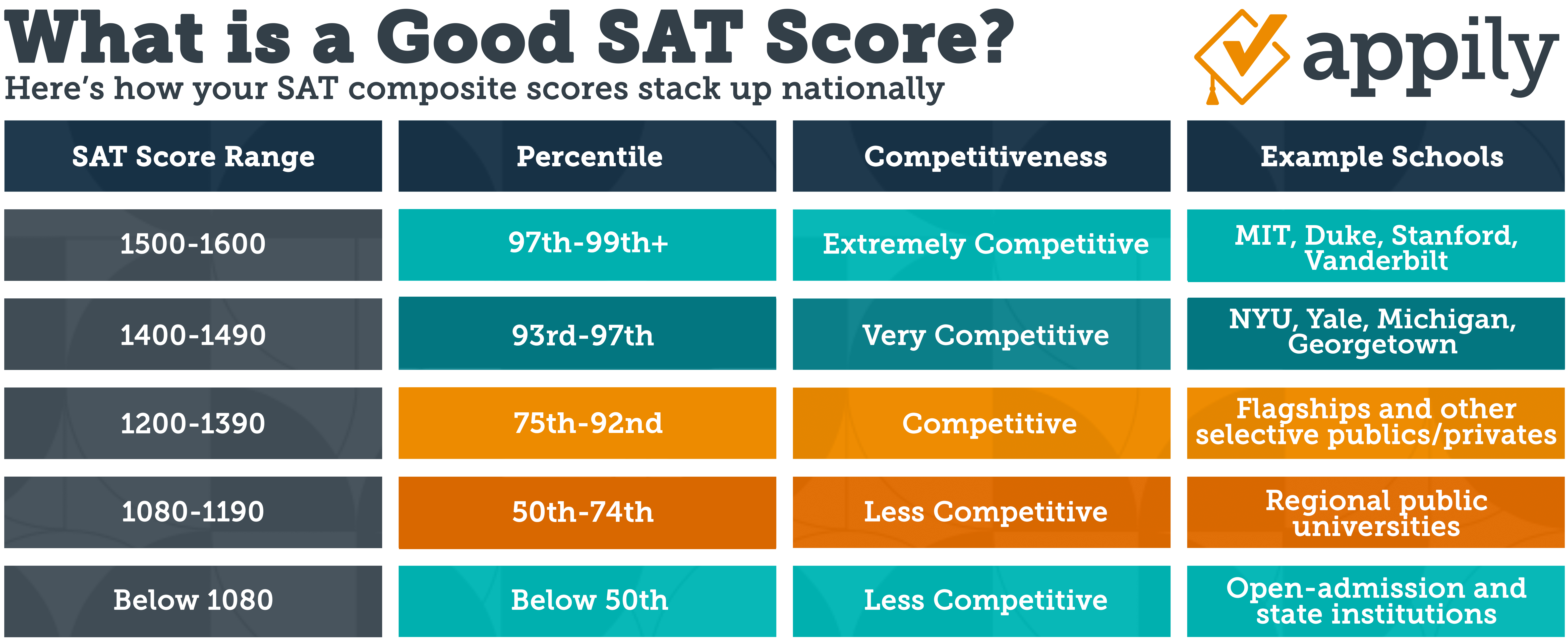
A good SAT score in 2026 is one that helps you reach a specific college, program, or scholarship goal. For national context, a 1200 is at the 75th percentile among recent SAT users, a 1400 is at the 93rd percentile, and a 1500 is at the 97th percentile, according to College Board’s SAT User Percentiles.
The latest available College Board SAT Suite Annual Report covers students in the high school class of 2025 who took the SAT. Their average total score was 1029.
Use those numbers to understand your score in a broader context. For college admissions, compare your score with each college’s current testing policy and most recent SAT range. Check whether the range describes admitted students or enrolled students, because colleges may publish data for different groups. Review program and scholarship requirements separately.
A score that is strong nationally may fall below the typical range at one college and above it at another. The same score can also affect scholarship or program eligibility differently.
Want the exact list of colleges where your score is competitive? Use Appily to browse colleges by SAT score to see which you should add to your list based on how you did on the test.
The TL;DR:
A good SAT score supports the college, program, or scholarship goals you have set.
- The latest available average among SAT test-takers is 1029 for the high school class of 2025.
- Among recent SAT users, 1200 is at the 75th percentile, 1400 is at the 93rd percentile, and 1500 is at the 97th percentile.
- National percentiles show how you compare with other SAT users. A college’s SAT range shows how your score compares with the group that college says the data describe. A Common Data Set typically reports enrolled first-year students, while a college class profile may describe admitted or enrolled students.
- Check the testing policy for each college on your list and review any separate requirements for programs or scholarships.
- Retaking the SAT is most useful when a higher score would improve a specific college, program, or scholarship option.
What is a good SAT score in 2026?
There is no single SAT score that is “good” for every college. Nationally, a 1200 is around the top quarter of recent SAT users, a 1400 is around the top 7%, and a 1500 is around the top 3%. For college admissions, the more useful benchmark is each school’s current testing policy and most recent SAT range.
For national context, College Board’s current SAT User Percentiles provide these benchmarks:
SAT score | SAT user percentile | What that means nationally |
1500 | 97th | Around the top 3% of recent SAT users |
1400 | 93rd | Around the top 7% |
1300 | 85th | Around the top 15% |
1200 | 75th | Around the top quarter |
1100 | 62nd | Above most recent SAT users |
1000 | 47th | Near the middle of the SAT-user distribution |
College Board defines the SAT user group using the actual SAT scores of students who graduated during the previous three school years.
These percentiles measure your score against other SAT users. College admissions decisions require a more specific comparison with each school’s reported score range and testing policy.
For example, a 1200 is at the 75th percentile among recent SAT users, so it is a strong score nationally. Whether it is a strong score for a particular college depends on that school’s current testing policy, recent score data, and the population represented by that data.
What is the average SAT score?
The latest available average SAT score is 1029 for students in the high school class of 2025 who took the test.
According to the 2025 SAT Suite Annual Report from College Board, the mean section scores were:
- Reading and Writing: 521
- Math: 508
Treat 1029 as a national benchmark for SAT test-takers. For admissions planning, compare your score with the most recent SAT range and testing policy for each college you are considering.
What SAT score should you aim for?
Set an SAT target based on the colleges, programs, and scholarships you want to pursue.
Use this process:
- Build a preliminary college list. Identify the schools you are seriously considering.
- Record each college’s testing policy. Use the policy for the application cycle when you plan to apply.
- Find the most recent SAT range. Check the college’s official first-year or class profile or its Common Data Set. Note whether the data describe admitted students or enrolled students.
- Review program and scholarship rules. Look for any documented minimum or qualifying test score.
- Set a target tied to one of those goals. A higher score might move you into a college’s reported range, meet a scholarship threshold, or improve a section score for a college that superscores.
Choose a target based on the result you want from another SAT attempt and the specific college, scholarship, or program option a higher score could improve.
Not sure what that range actually represents in the schools you're applying to? See how to interpret a college’s middle 50% and admissions profile.
What do SAT percentiles mean?
An SAT percentile shows how your score compares with a defined group of students.
College Board publishes SAT user and nationally representative percentiles:
- SAT user percentiles use the actual SAT scores of students who graduated during the previous three school years.
- Nationally representative percentiles use a research sample designed to represent U.S. 11th- and 12th-grade students, including students who do not take the SAT.
A score at the 75th SAT user percentile means about 75% of the SAT-user comparison group scored at or below your score.
College SAT ranges measure something different. A college’s 25th–75th percentile range describes scores for the population identified by the college or data source. For example, Section C9 of the Common Data Set reports scores for enrolled first-time, first-year students who submitted scores. A college’s own class profile may use a different population, so check how the school labels its data before comparing your score with the range.
How do you compare your SAT score with a college?
Compare your score with the college’s most recent SAT data and testing policy for your application cycle.
Start with the college’s official admissions website. Look for:
- The current SAT or ACT testing policy
- A recent first-year, admitted-class, or enrolled-class profile
- Program-specific testing requirements
- Scholarship rules that mention test scores
When you find an SAT range, check who the data describe. A college may publish statistics for admitted students, enrolled students, or another defined group. Those are not interchangeable.
If the college publishes a Common Data Set, Section C9 can provide additional context. The 2025–2026 Common Data Set asks colleges to report the number and percentage of enrolled first-time, first-year students who submitted SAT or ACT scores. It also asks for 25th-, 50th-, and 75th-percentile scores for students included in the data.
The percentage of students submitting scores can help you interpret the range. At a test-optional college, the published SAT data may represent only part of the enrolled class.
If a college reports a 25th–75th percentile SAT range:
Below the 25th percentile
Your score is below the lower end of the college’s reported middle-50% range. If testing is optional, review the school’s policy, the population represented by the data, and whether submitting the score would add useful information to your application.
Between the 25th and 75th percentiles
Your score falls within the college’s reported middle-50% range.
At or above the 75th percentile
Your score is at or above the upper end of the college’s reported middle-50% SAT range.
SAT ranges provide one piece of admissions context. Depending on the college, the admissions process may also consider grades, course rigor, essays, activities, recommendations, and other application information.
Example: What could a 1240 SAT score mean?
For a student with a 1240, the next step changes based on the school or scholarship:
Goal | What the 1240 means | Possible next step |
College A reports an SAT range of 1180–1320 | The score falls within the reported middle 50% | Review the testing policy and decide whether to submit |
College B reports an SAT range of 1320–1450 | The score falls below the reported middle-50% range | Check whether scores are optional and review the rest of the application |
A scholarship requires a 1250 | The score is 10 points below the documented threshold | Check the deadline and decide whether another test date is practical |
These numbers are hypothetical. They show how the same SAT score can lead to different decisions.
Should you retake the SAT?
Retake the SAT when a higher score could improve a specific option, and you have enough time to prepare before your deadlines.
Your situation | What to consider |
Your score falls below the ranges at several colleges on your list | Another test may help if practice scores suggest you can improve |
You are close to a documented scholarship or program threshold | Check the required score, deadline, and available test dates |
One section is noticeably lower | A focused retake may help, especially if a college superscores |
Your score already supports your college and scholarship goals | Your time may be better spent on applications, schoolwork, financial aid, or scholarships |
Another test date falls too close to an application deadline | Confirm the college’s score-receipt deadline before registering |
Superscoring means a college may combine your highest section scores from different test dates. Policies differ by college, so use each school’s official admissions page to confirm how it handles multiple SAT scores.
A retake has a clearer purpose when you know the score you are trying to reach and what that score would change.
Should you take the SAT if colleges are test-optional?
Taking the SAT can still be useful when your college list includes test-optional schools.
Test-optional generally means you can choose whether to submit an SAT or ACT score for general admission. Programs and scholarships at the same institution may have separate testing rules.
College policies also differ. Depending on the school and application cycle, test scores may be required, optional, or excluded from the admissions process.
Before deciding whether to take the SAT:
- Check each college’s testing policy. Confirm the rule for your application cycle.
- Review program and scholarship requirements. Look for any separate testing criteria.
- Consider the rest of your college list. A score may be useful at another school even if one college makes testing optional.
How do you decide whether to submit your SAT score?
There is no universal SAT score or percentile at which every test-optional student should submit or withhold a score. Use the college’s own testing policy and score data to decide what the score adds to your application.
Start by confirming whether scores are required, optional, or not considered. If submission is optional, compare your score with the college’s recent range, check who that range describes, look at the percentage of enrolled students who submitted scores when that information is available, and review any guidance the college gives applicants. Check programs and scholarships separately.
Then consider these four questions:
1. Is a score optional for your application?
Read the admissions policy for your application cycle, then review your intended program and scholarships. Do not assume the college’s general admissions policy applies to every program or award.
2. Where does your score fall within the college’s recent range?
Use the college’s official class profile or Common Data Set to find its 25th–75th percentile SAT range. Check whether the source describes admitted students or enrolled students.
3. What percentage of enrolled students submitted SAT scores?
Section C9 of the Common Data Set can provide this figure when a college reports it. A lower submission rate means the published range represents a smaller share of the enrolled first-year class and should be interpreted in that context.
4. Does the score add useful academic information to your application?
Consider the college’s score range, testing policy, any instructions the college gives applicants, and the rest of your academic record together. Avoid relying on a universal internet rule such as “always submit above this percentile” because testing policies and applicant pools differ by college.
A published SAT range provides context. It does not predict whether an individual student will be admitted. Tracking the testing policy, SAT range, population represented by that range, and score-submission percentage for each school can make the decision easier to compare across your list.
Can your SAT score help you qualify for scholarships?
SAT or ACT scores are part of the eligibility rules for some college and private scholarships. Each scholarship sets its own criteria.
For any scholarship you are considering, review the current requirements for:
- Minimum SAT or ACT score, if one is listed
- GPA and other academic criteria
- Residency or enrollment rules
- Required application materials and deadline
Use the scholarship provider’s official page for the current requirements. A college’s general admissions rules may be different from its scholarship criteria.
Appily’s scholarship search can help you find awards that match your profile. Verify each scholarship’s current requirements before you apply.
What about National Merit?
The PSAT/NMSQT, not the SAT, is the qualifying test used to enter the National Merit Scholarship Program for U.S. high school students who meet the program’s other entry requirements.
For students testing in fall 2026, the National Merit Scholarship Corporation identifies the 2026 PSAT/NMSQT as the qualifying test for the 2028 National Merit Scholarship Program.
National Merit has additional entry requirements. Review the current requirements on the National Merit Scholarship Corporation website if you plan to enter the competition.
How SAT scoring affects how you interpret your score
Digital SAT scoring does not use a fixed formula that turns a certain number of missed questions into a specific score.
The SAT is scored from 400 to 1600. It has two section scores:
- Reading and Writing: 200–800
- Math: 200–800
The two section scores are added together for your total score.
The digital SAT uses an adaptive design. According to College Board’s explanation of SAT scoring, your scaled score depends on your performance and characteristics of the questions you answered. Two students can answer the same number of questions correctly and receive different section scores.
Wrong answers also do not trigger an extra point penalty, so it is generally better to answer a question than leave it blank.
Use your official scaled score and percentile to evaluate your results rather than estimating your score from the number of questions you missed.
How does the digital SAT work?
The current digital SAT has two sections, according to College Board’s SAT structure guide:
Section | Questions | Time |
Reading and Writing | 54 | 64 minutes |
Math | 44 | 70 minutes |
The full test includes 98 questions and 2 hours, 14 minutes of testing time. Each section has two modules. Your performance in the first module helps determine the mix of question difficulty in the second.
Students can use Bluebook’s built-in Desmos calculator throughout the Math section or bring an approved handheld calculator.
Under College Board’s current SAT calculator policy, calculators with computer algebra system, or CAS, functionality are not permitted. Because calculator guidelines can change, review the official policy again before your test date.
SAT vs. ACT: what’s the difference in 2026?
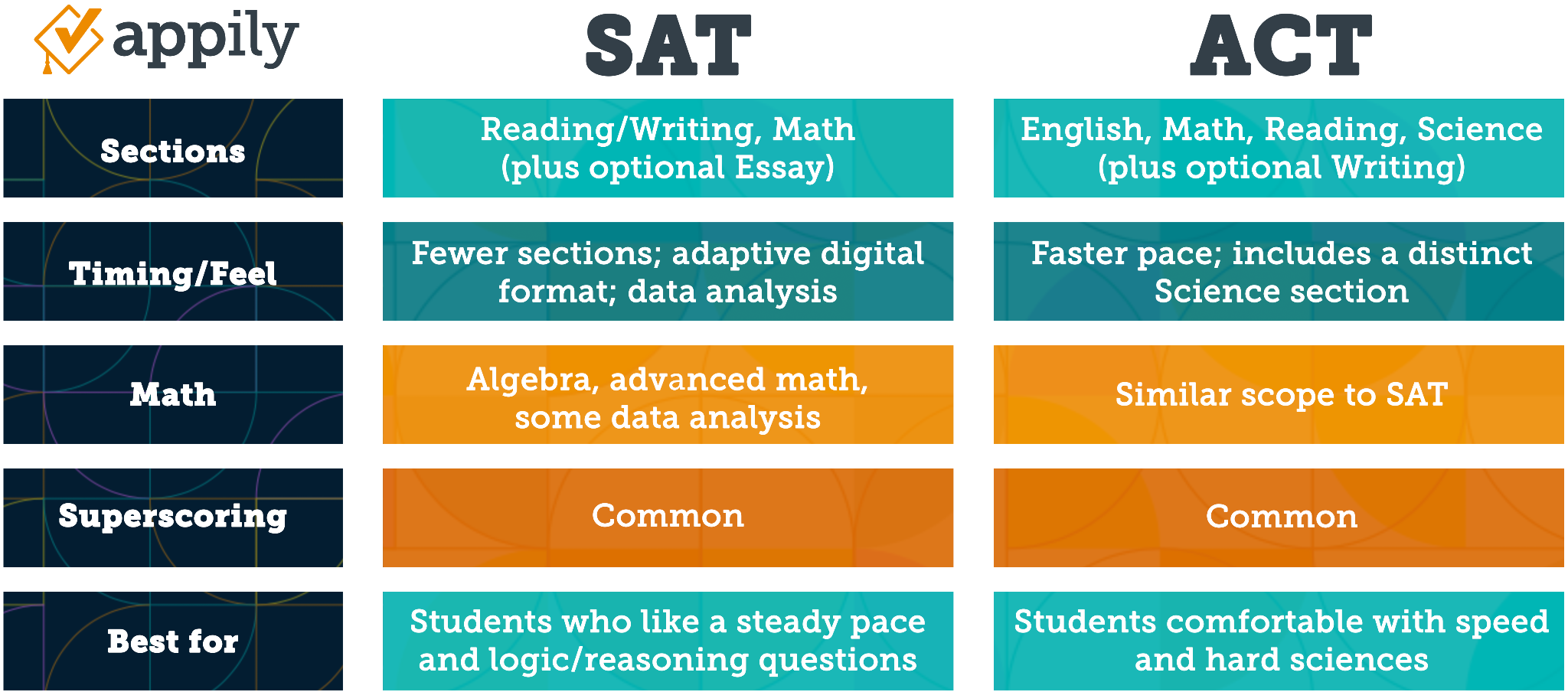
The SAT and ACT use different formats and scoring systems.
SAT | ACT | ||
Main score | 400–1600 | 1–36 Composite | |
Core sections | Reading and Writing, Math | English, Math, Reading | |
Adaptive | Yes, by module | No | |
Science | No separate Science section | Science is optional and is not part of the current Composite score | |
Writing | No standard SAT essay | Optional |
Under ACT’s current enhanced ACT guidance, the ACT Composite score is based on English, Math, and Reading. Students taking national ACT administrations can choose whether to add Science. For state and district testing, available sections may depend on the testing contract. Students who take ACT Science receive a separate Science score and a STEM score.
The better test for you depends on your practice-test results, pacing, and comfort with each format.
How can you prepare for the SAT?
Start with an official Bluebook practice test so your preparation matches the current digital SAT.
Take the test under realistic timing conditions, then review the questions you missed or guessed on. Use those results to identify the Reading and Writing or Math skills that need the most attention.
College Board’s official SAT practice resources include full-length Bluebook practice tests, free Official SAT Prep through Khan Academy, and the Student Question Bank.
A practical study cycle:
- Take an official Bluebook practice test.
- Review missed and guessed questions.
- Pick two skills to work on during your next study sessions.
- Practice with official questions and lessons.
- Take another timed practice test and compare your results.
A teacher, counselor, study group, or tutor can help if you want more structure.
What should you do with your SAT score now?
Use your SAT score to make the next decision on your college list.
1. Check your SAT user percentile. This gives you national context for your score.
2. Compare your score with each college. Review the current testing policy and most recent SAT range. Check whether the data describe admitted or enrolled students. When available, use the Common Data Set to see what percentage of enrolled first-year students submitted scores.
3. Review programs and scholarships. Check for requirements that differ from the college’s general admissions policy.
4. Decide whether to retake the SAT. Compare your score with a specific college range or scholarship requirement, then review upcoming test dates and deadlines.
5. Put your time into the next application task. Once you have decided how to use your SAT score, continue with your applications, financial aid planning, scholarship search, or college list.
Ready to see how your SAT score stacks up? Create a free Appily account to discover schools where you’ll shine. With the right preparation, you can open the door to incredible opportunities.
Frequently asked questions about SAT scores
Is 1200 a good SAT score?
Nationally, yes. A 1200 is at the 75th percentile among recent SAT users, according to College Board’s SAT User Percentiles. That means about 75% of the SAT-user comparison group scored at or below 1200, placing it around the top quarter of recent SAT users.
For college admissions, compare a 1200 with the school’s current testing policy and recent SAT range. Check whether that range describes admitted or enrolled students.
Is 1400 a good SAT score?
Nationally, yes. A 1400 is at the 93rd percentile among recent SAT users, placing it around the top 7% of that comparison group.
For a specific college, program, or scholarship, compare the score with the current requirements and most recent data before deciding how to use it.
Is 1500 a good SAT score?
Nationally, yes. A 1500 is at the 97th percentile among recent SAT users, placing it around the top 3% of that comparison group.
College-specific testing policies and score ranges still determine how the score fits into an application.
What is the highest SAT score?
The highest possible SAT score is 1600.
Set your own target using the colleges, programs, and scholarships you plan to pursue.
What is the average SAT score?
The latest available College Board annual SAT data show a mean total score of 1029 for students in the high school class of 2025 who took the SAT.
The mean Reading and Writing score was 521. The mean Math score was 508.
Do SAT percentiles matter?
Yes. SAT percentiles show how your score compares with a specific group of students.
SAT user percentiles and a college’s middle-50% SAT range use different comparison groups, so check which measure you are using and who the college says its data describe.
Are SAT scores required for college admission?
Testing requirements depend on the college and application cycle.
Colleges may require SAT or ACT scores, make them optional, or exclude them from the admissions process. Check the college’s official admissions page for your application cycle, then review any separate program and scholarship requirements.
How should you evaluate your SAT score for highly selective colleges?
Compare your score with each college’s current testing policy and most recent SAT data rather than relying on a single score that is supposed to be “good” for every highly selective school.
Look for the school’s 25th–75th percentile SAT range, confirm whether it describes admitted or enrolled students, and, when available, check the percentage of enrolled first-year students who submitted scores. Use that information as one part of your application planning.
Where can you find a college’s SAT score range?
Start with the college’s official admissions website or most recent first-year class profile. Check whether the profile describes admitted students or enrolled students before comparing your score with the range.
If the college publishes a Common Data Set, Section C9 of the 2025–2026 CDS template shows the type of information to look for, including the percentage of enrolled first-time, first-year students who submitted SAT or ACT scores and their 25th-, 50th-, and 75th-percentile scores.
Make sure you use the most recent data published by the college.
