Colleges for a 3.3 GPA
Is a 3.3 GPA good for college applications?
A 3.3 GPA can make you a credible applicant across a substantial portion of the four-year college landscape. At this point, the most useful distinctions come from course rigor, grade trend, institutional selectivity, and how your academic record compares with a specific college, not from whether 3.3 clears a generic benchmark. A 3.3 can also begin to create meaningful financial leverage at institutions where your academic profile is stronger than that of many other applicants.
How do colleges interpret a 3.3 GPA?
A 3.3 GPA does not have one universal interpretation because high schools calculate GPA differently. A weighted 3.3 and an unweighted 3.3 are not directly interchangeable. Honors, AP, IB, dual-enrollment, plus/minus grades, and local policies can all affect the number. Some colleges may recalculate GPA using their own criteria. They may also consider course rigor and whether grades are trending upward, holding steady, or declining. At 3.3, successful work in increasingly challenging courses can add important context to the GPA. Compare your full academic profile with each college’s current published admissions information.
What colleges may be a good fit with a 3.3 GPA?
A wide range of regional public universities and private colleges may be strong possibilities. Some selective institutions may also be reasonable reaches. At this level, where your grades came from matters. A 3.3 earned with successful progression into demanding academic courses tells a different story from the number alone. Your intended major may also change how competitive the record is.
How do you build a safety, match, and reach list with a 3.3 GPA?
Build your list conservatively and use more than GPA to decide whether a college is a safety, match, or reach.
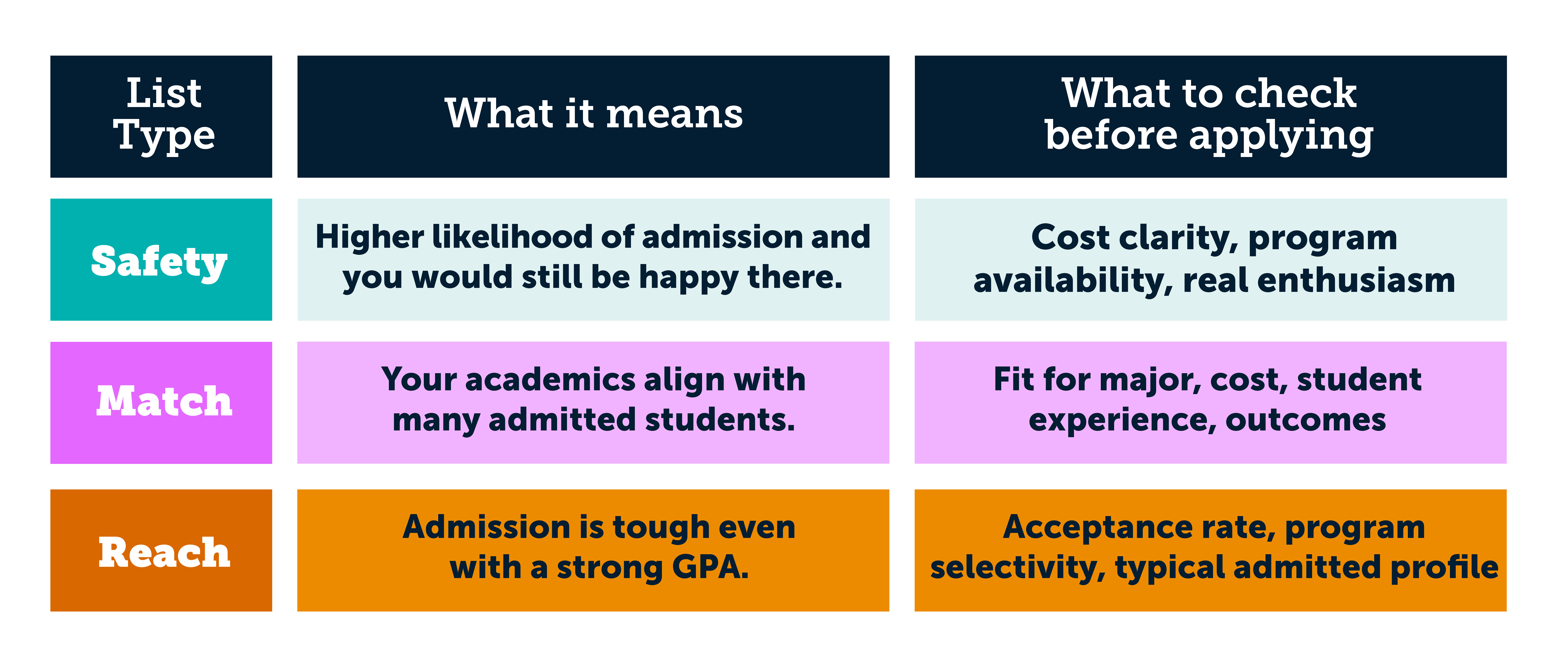
Use colleges in the low-to-mid 3s as discovery candidates rather than automatic matches. Your list should still include schools where your academic record sits comfortably within the institution’s profile. A college where your GPA appears statistically typical can still be a reach if overall admission is highly competitive.
How can you improve a 3.3 GPA?
Freshmen and sophomores
Moving toward the mid-3s through stronger grades can create additional admissions and scholarship possibilities. Do not try to raise the GPA by avoiding appropriate academic challenge.
Juniors
A strong junior year combined with sensible rigor can strengthen the academic story even if the cumulative number changes only moderately.
Seniors
Maintain your academic strength while shifting more attention toward applications, affordability, and college fit.
What should you prioritize with a 3.3 GPA?
Begin thinking about both admission fit and financial leverage. At one college, a 3.3 may place you near the middle of the academic profile. At another, it may make you a comparatively strong applicant. That difference can affect not only admission strategy but also merit-aid opportunities.
Most useful next step: Compare colleges on both admission fit and where your academic record may give you greater financial advantage.
Can you get merit scholarships with a 3.3 GPA?
A 3.3 can make academic merit opportunities increasingly relevant, particularly at institutions where your record sits toward the stronger end of the applicant pool. Do not assume merit is automatic. Verify published criteria and compare your final net cost across schools.
Is a 3.3 better with AP, IB, honors, or dual-enrollment courses?
Successful advanced coursework can add useful context to a 3.3, but colleges evaluate rigor relative to what your high school offers. More advanced courses are not automatically better if they cause your grades to decline significantly.
Should you submit a strong SAT or ACT score with a 3.3 GPA?
If a college considers scores and yours compare favorably with its current student data, submitting may add another academic strength. A test score should not be framed as cancelling out your GPA or as carrying equal weight at every college.
What colleges look at besides your GPA
GPA is just one aspect colleges review when looking through your college application. Make sure to include as many aspects of your high school career as possible, including any (or all) of the following:
How to use the college list
The colleges below are included because their average GPA falls within 3.2–3.4. The range helps surface colleges for comparison. It does not mean those institutions require a 3.3 or will admit every student near that number. A reported average is not a minimum, and colleges may recalculate GPA differently from your high school. Current policies, program requirements, and student profiles can change. Use the list to find colleges worth researching, then compare your full academic profile with each school’s current published information.
Explore colleges for every GPA with Appily
Ready to explore colleges that accept a GPA like yours? We have a comprehensive database to help you find and research schools. There, you can see essential data points like acceptance rate, average financial aid award, average test scores, and application deadlines, including those for rolling admission, early decision, and early action schools.