Colleges for a 2.9 GPA
Is a 2.9 GPA good for college applications?
A 2.9 GPA can support a broad search among many regional and less-selective four-year colleges. It is also close to 3.0, but colleges do not treat 3.0 as a universal national admissions cutoff. The practical importance of moving from 2.9 to 3.0 depends on whether a particular college, major, scholarship, or program actually uses 3.0 as a published threshold. Do not postpone your college search while waiting for the decimal to change. Build your list from the academic record you have now.
How do colleges interpret a 2.9 GPA?
A 2.9 GPA needs context because high schools use different grading scales and weighting systems. A weighted 2.9 and an unweighted 2.9 are not directly interchangeable. Honors, AP, IB, dual-enrollment, plus/minus grades, and other local policies can affect the GPA on your transcript. Some colleges may recalculate GPA using their own criteria. They may also consider your course rigor and whether your grades are improving, holding steady, or declining. Do not assume a college will round a 2.9 to a 3.0. Use the GPA your school actually reports unless an institution states how it calculates GPA. Compare your complete academic profile with each college’s current published information.
What colleges may be a good fit with a 2.9 GPA?
A broad group of regional public and private institutions may be realistic, depending on the rest of your transcript and the college’s current requirements. More-selective schools may remain reaches, particularly where typical students present substantially stronger grades and rigorous coursework. Program-specific requirements can also matter, so check your intended major before deciding a college is a fit.
How do you build a safety, match, and reach list with a 2.9 GPA?
Build your list conservatively and use more than GPA to decide whether a college is a safety, match, or reach.
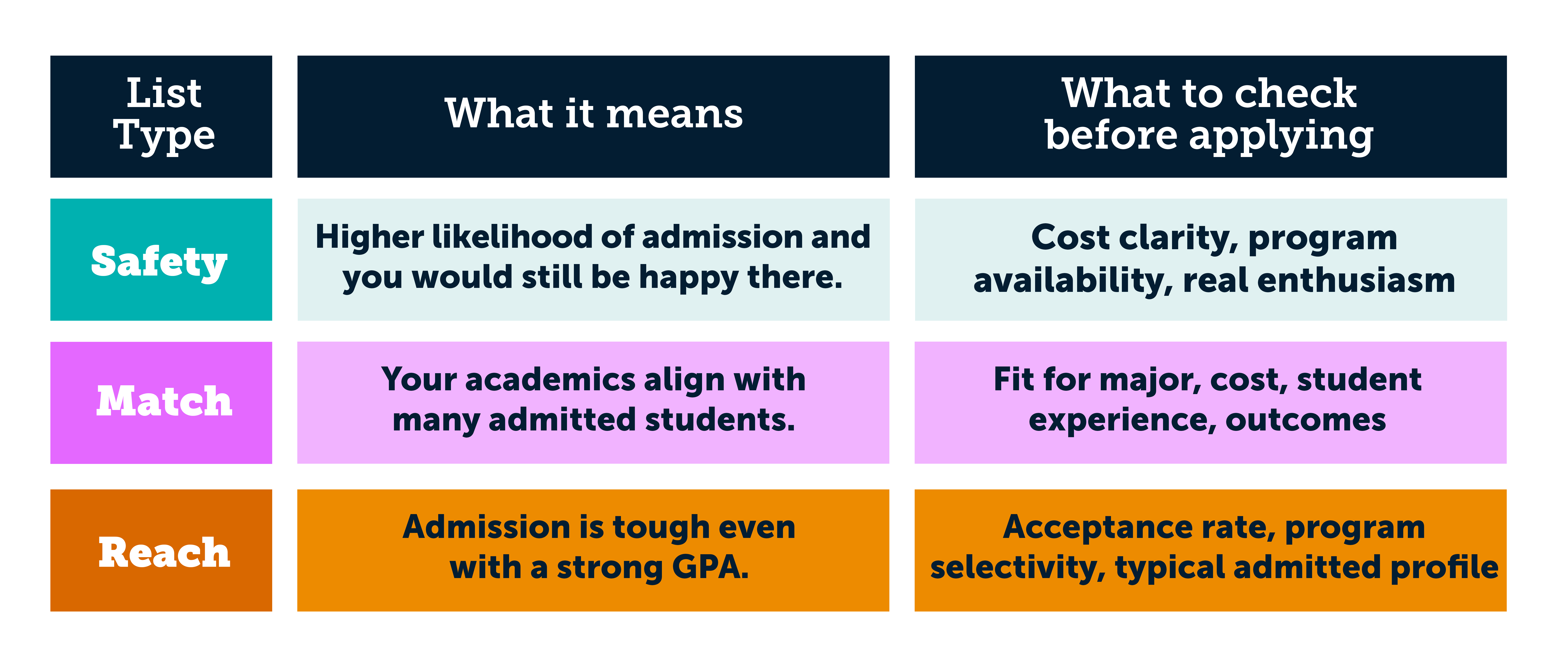
Use the high 2s and low 3s as a discovery zone, not as an automatic match range. At this GPA, it can be tempting to assume every school with an average near 3.0 is a match. That is too simple. Admission selectivity, required coursework, major requirements, grade trends, rigor, and other application components can all change the classification.
How can you improve a 2.9 GPA?
Freshmen and sophomores
Several strong semesters can move a 2.9 further into the 3s. Treat a higher GPA as the result of stronger academic performance, not the goal by itself.
Juniors
Crossing 3.0 may be realistic for some students and not others, depending on completed credits and the high school’s GPA system. A positive grade trend matters whether or not you reach exactly 3.0.
Seniors
Do not assume colleges will round a 2.9 upward. Apply based on the GPA your school reports and continue finishing as strongly as possible.
Why does 3.0 matter sometimes?
Fixed thresholds deserve particular attention when you are at 2.9. A small improvement can matter if an actual admission, scholarship, or program rule uses 3.0. If no relevant opportunity uses that threshold, there is nothing magical about crossing the number.
Most useful next step: Audit your priority colleges, programs, and scholarships for genuine 3.0 requirements. If none exist, focus on stronger grades and better-fit applications rather than chasing the decimal for its own sake.
Can you get merit scholarships with a 2.9 GPA?
A 2.9 may sit just below some published academic requirements and above others. Check thresholds early so you know whether a realistic GPA increase could have direct financial value. Continue looking at scholarships that use other eligibility criteria as well.
Does a 2.9 GPA round up to 3.0 for college admission?
Do not assume so. Colleges may use the GPA exactly as reported or calculate it using their own methodology. If a program requires a 3.0, verify how that institution determines whether you meet the requirement.
Should you wait until your GPA reaches 3.0 to build a college list?
No. Build your list from your current record and revise it if your academic profile changes. Waiting can cost you valuable research time without guaranteeing that the GPA will cross the threshold.
What colleges look at besides your GPA
GPA is just one aspect colleges review when looking through your college application. Make sure to include as many aspects of your high school career as possible, including any (or all) of the following:
How to use the college list
The colleges below are included because their average GPA falls within 2.8–3.0. This range is for college discovery. It does not mean a 2.9 meets a school’s admissions requirements. A reported average GPA is not a minimum, cutoff, or guarantee, and colleges may recalculate GPA differently from your high school. Admission policies, major requirements, and student academic profiles can change. Verify current information with each institution and compare your full academic record before labeling a college a safety, match, or reach.
Explore colleges for every GPA with Appily
Ready to explore colleges that accept a GPA like yours? We have a comprehensive database to help you find and research schools. There, you can see essential data points like acceptance rate, average financial aid award, average test scores, and application deadlines, including those for rolling admission, early decision, and early action schools.