Colleges for a 2.8 GPA
Is a 2.8 GPA good for college applications?
A 2.8 GPA does not take four-year college off the table. It can be workable at many institutions, particularly when your recent grades are improving or your core academic record is stronger than the cumulative GPA suggests. Highly selective institutions are a different category and should generally remain reaches. At 2.8, you have enough realistic four-year possibilities that community college should be evaluated for reasons such as cost, academic support, or a strong transfer pathway, not because the GPA automatically requires it.
How do colleges interpret a 2.8 GPA?
A 2.8 GPA can mean different things depending on how your high school calculates it. A weighted 2.8 and an unweighted 2.8 are not directly interchangeable. Honors, AP, IB, dual-enrollment, plus/minus grades, and local weighting practices all affect GPA. Some colleges may recalculate GPA using their own rules. They may also consider course rigor and whether grades are improving, stable, or declining. At 2.8, an upward trend and stronger performance in college-preparatory courses can help distinguish your recent work from the cumulative number alone. Compare your full academic profile with each college’s current published admissions information.
What colleges may be a good fit with a 2.8 GPA?
Many less-selective and regionally focused public and private colleges are reasonable areas to investigate. Depending on the institution, you may also want to compare:
- Traditional first-year admission
- Alternative or conditional admission programs
- Two-year transfer pathways
- Major-specific requirements
Do not assume there is only one route into a four-year degree.
How do you build a safety, match, and reach list with a 2.8 GPA?
Build your list conservatively and use more than GPA to decide whether a college is a safety, match, or reach.
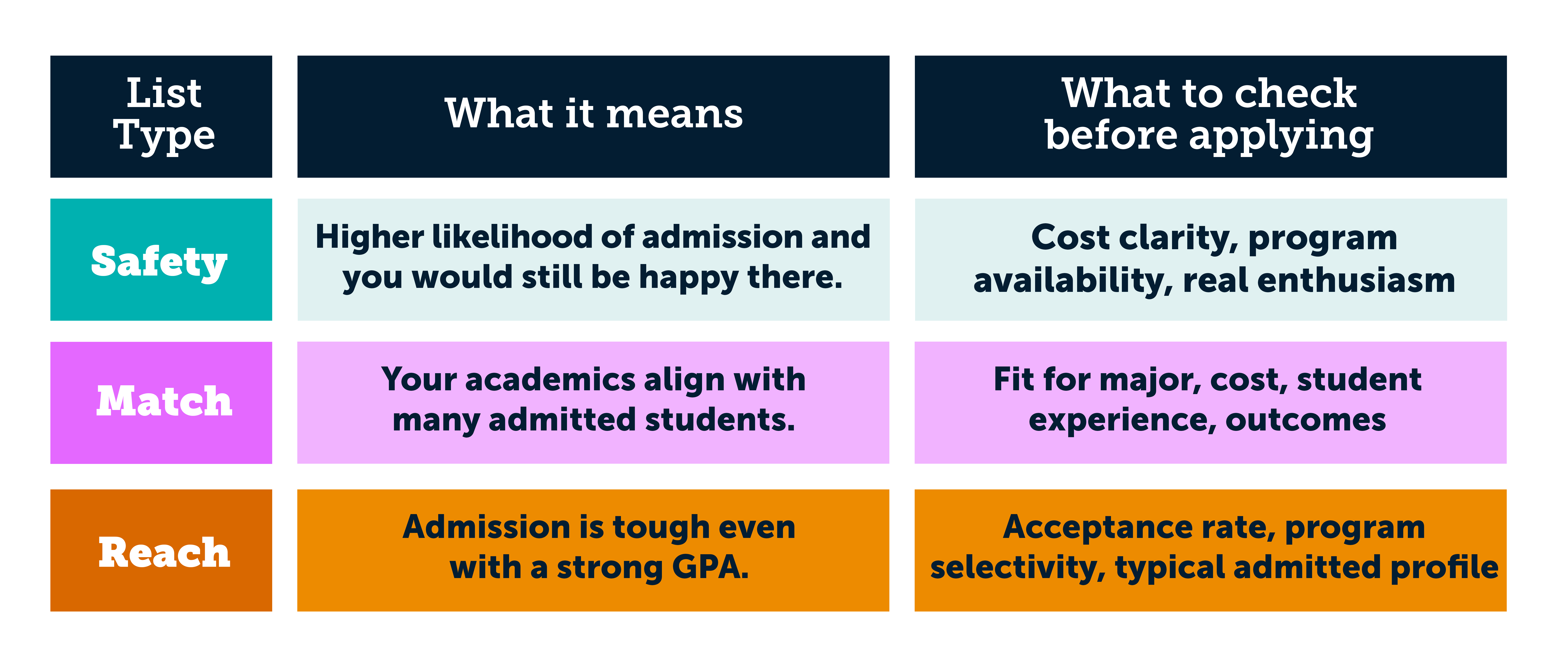
Do not define those categories by GPA alone. A college with a reported average near 2.8 could still have program requirements, coursework expectations, or admission patterns that make it more or less competitive for you.
How can you improve a 2.8 GPA?
Freshmen and sophomores
There is meaningful time to raise your cumulative GPA through several stronger semesters. Focus on the subjects where improvement is both achievable and sustainable.
Juniors
The numerical increase may be smaller, but better grades now can create a visible upward trend. Start comparing your current profile with college information rather than waiting for senior year.
Seniors
Do not delay list-building while hoping to reach 3.0. Finish strongly and apply using the academic record you actually have.
Should you try to reach a 3.0?
It can be worthwhile if your remaining coursework makes 3.0 realistic and a college or scholarship you care about publishes that threshold. The goal should come from an actual opportunity, not simply because 3.0 sounds better than 2.8.
Most useful next step: Build a balanced four-year list now, then identify whether reaching a specific GPA threshold would add meaningful options before your application deadlines.
Can you get merit scholarships with a 2.8 GPA?
A 2.8 may meet the requirements for some merit programs and fall below others. Check the actual scholarship criteria instead of relying on generic GPA advice. Also compare need-based aid and scholarships tied to service, activities, talents, work, intended field, or other qualifications.
Is community college still worth considering with a 2.8 GPA?
Yes. It can be an excellent option for cost, location, academic support, or transfer reasons. But a 2.8 student should also investigate four-year options rather than assuming community college is the only realistic route.
What colleges look at besides your GPA
GPA is just one aspect colleges review when looking through your college application. Make sure to include as many aspects of your high school career as possible, including any (or all) of the following:
How to use the college list
The colleges below are included because their average GPA falls within 2.7–2.9. That range is intended to help you discover schools. It is not an admissions cutoff. A reported average GPA is not a minimum or guarantee of admission, and a college may evaluate GPA differently from your high school. Current admission policies, program requirements, and student academic profiles can also change. Use the list as a starting point, then verify each college’s current information and compare your entire academic profile before deciding whether it belongs on your safety, match, or reach list.
Explore colleges for every GPA with Appily
Ready to explore colleges that accept a GPA like yours? We have a comprehensive database to help you find and research schools. There, you can see essential data points like acceptance rate, average financial aid award, average test scores, and application deadlines, including those for rolling admission, early decision, and early action schools.