Colleges for a 2.5 GPA
A Grade Point Average (GPA) is a number that summarizes academic performance by averaging each of your classes’ final grades throughout your high school career. A 2.5 GPA corresponds to a C average, making it a common starting GPA for many colleges and universities, even some more competitive institutions — though acceptance at that level would be a long shot.
Is a 2.5 GPA good for college applications?
A 2.5 GPA can make a number of four-year colleges realistic, although it will generally be less competitive at selective institutions with stronger academic profiles.
At 2.5, the college conversation should shift from “Can I go to college?” to “Which pathway gives me the best combination of admission fit, affordability, support, and long-term opportunity?”
Four-year colleges, community-college transfer pathways, and other admission routes can all be worth comparing. Community college is not automatically required at a 2.5, but it may be strategically attractive for cost, transfer, or academic reasons.
How do colleges interpret a 2.5 GPA?
A 2.5 GPA needs context because GPA systems differ across high schools. A weighted 2.5 and an unweighted 2.5 are not directly interchangeable.
Honors, AP, IB, dual-enrollment, plus/minus grades, and other local rules can affect how the number is calculated. Some colleges may also recalculate GPA using their own criteria.
Colleges may consider course rigor and whether your grades are improving, remaining steady, or declining. At 2.5, a clear upward trend can make the same cumulative GPA look different from a flat or declining record.
Compare your full academic profile with each institution’s current published admissions information.
What colleges may be a good fit with a 2.5 GPA?
Regional public universities, private colleges with broader admission, and transfer-friendly institutions can all belong on your research list.
Before deciding a school is realistic, check:
- Published admission requirements
- Required high school coursework
- Major-specific criteria
- Recently reported student academic information
- Cost and financial aid
- Academic support and retention resources
A 2.5 should open a genuine four-year search, but the list still needs to be built carefully.
How do you build a safety, match, and reach list with a 2.5 GPA?
Build your list conservatively and use more than GPA to decide whether a college is a safety, match, or reach.
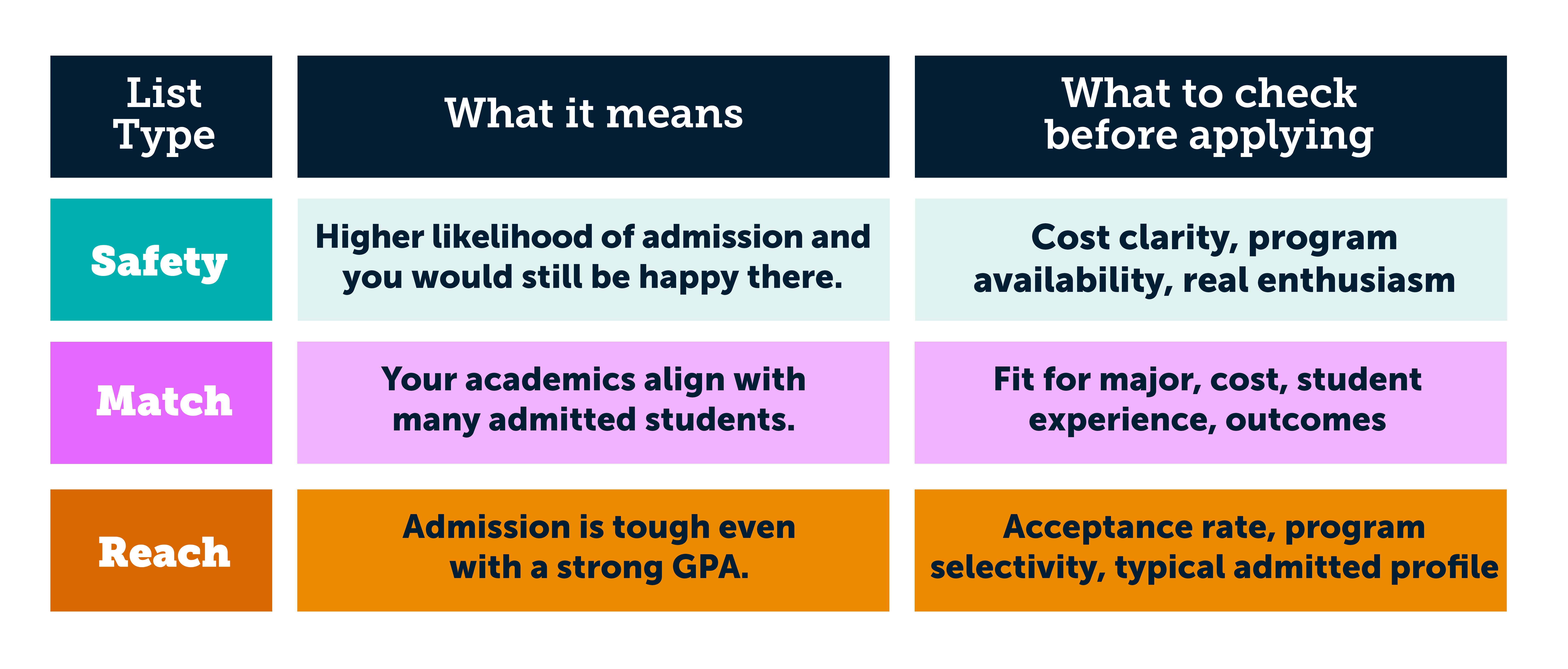
Matches may include schools whose student academic profiles resemble yours, but similar GPA data alone is not enough. Consider admission selectivity, coursework, grade trend, and program requirements.
More-selective colleges can be reaches, but do not let reaches dominate the list.
How can you improve a 2.5 GPA?
Freshmen and sophomores
Enough coursework remains for sustained stronger grades to create meaningful cumulative improvement.
Moving into the upper 2s may broaden some options, but focus on the academic habits and grades required to get there rather than the decimal itself.
Juniors
The cumulative GPA responds more slowly now, so both current performance and the direction of your grades matter.
Choose rigor carefully. Success in an appropriate course load is preferable to overextending yourself.
Seniors
Concentrate on finishing well and building applications that make sense with your current transcript.
Do not postpone realistic college planning while waiting for a major GPA change.
What should you prioritize with a 2.5 GPA?
Build more than one viable path. Compare a balanced four-year list with at least one strong transfer or alternate option.
Then evaluate them on cost, academic fit, student support, and long-term goals.
Most useful next step: Create those two pathways now instead of treating the alternate option as an emergency backup.
Tips for your college search and planning with a 2.5 GPA
|
|
|
|
|
|
Can you get merit scholarships with a 2.5 GPA?
Some merit programs may be available, while others use higher GPA requirements.
Keep your scholarship search broad. Look for institutional, local, need-based, service, talent, employment, and major-specific opportunities rather than assuming academic merit will be the main source of aid.
Can a strong SAT or ACT score help with a 2.5 GPA?
At a college that considers test scores, a strong result can provide another piece of academic evidence. It does not erase or “cancel out” the transcript.
Check the college’s current testing policy before deciding whether to submit a score, and compare your result with the information that institution publishes.
Do not assume GPA and testing are weighted equally.
Should you write your main essay about your grades?
Only if your academic record connects naturally to a meaningful story you genuinely want to tell.
If you simply need to explain circumstances that affected your grades, another appropriate application space may be more direct. Your personal essay does not need to become a defense of your GPA.
What colleges look at besides your GPA
GPA is just one aspect colleges review when looking through your college application. Make sure to include as many aspects of your high school career as possible, including as any (or all) of the following:
How to use the college list
The colleges below are included because their average GPA falls within 2.4–2.6.
This range is for discovery and comparison. It does not mean 2.5 is the college’s minimum GPA or that a student with a 2.5 is guaranteed admission.
Reported averages can also reflect GPA calculations that differ from your high school’s system. Admissions policies, program requirements, and student academic profiles can change.
Verify current information with each college and compare your complete academic profile, including rigor, grade trend, and any other required application materials, before categorizing a school.
Explore colleges for every GPA with Appily
Ready to explore colleges that accept a GPA like yours? We have a comprehensive database to help you find and research schools. There, you can see essential data points like acceptance rate, average financial aid award, average test scores, and application deadlines, including those for rolling admission, early decision, and early action schools.