Colleges for a 2.3 GPA
Is a 2.3 GPA good for college applications?
A 2.3 GPA can lead to four-year college options, but careful school selection matters. At this level, highly selective colleges should not drive your list, and your current academic performance deserves more attention than trying to compensate with application extras.
If your grades are improving, that upward trend can make the transcript more encouraging than the cumulative number alone. If your grades are flat or declining, academic improvement should be the immediate priority.
Two-year colleges and transfer pathways are also worth understanding now, even if you plan to apply directly to four-year schools.
How do colleges interpret a 2.3 GPA?
A 2.3 GPA needs context because high schools use different grading scales and weighting systems. A weighted 2.3 and an unweighted 2.3 are not directly interchangeable.
Honors, AP, IB, dual-enrollment, plus/minus grades, and other school policies can change the reported GPA. Some colleges may also recalculate GPA using their own methods.
Colleges may consider your course rigor and whether grades are improving, holding steady, or declining. At 2.3, stronger recent grades in core academic courses can help show greater readiness than the cumulative number alone suggests.
Use the GPA as one part of your academic record, then compare your full profile with each college’s current published admissions information.
What colleges may be a good fit with a 2.3 GPA?
Broad-access four-year colleges, regional institutions, and two-year colleges with strong transfer opportunities can all belong on your research list.
Check the intended major as well as the university. Some programs may have separate or higher academic requirements than the institution overall.
Before adding a college, ask whether you meet:
- Published GPA requirements, if any
- Required high school coursework
- Major-specific criteria
- Any additional admissions conditions
How do you build a safety, match, and reach list with a 2.3 GPA?
Build your list conservatively and use more than GPA to decide whether a college is a safety, match, or reach.
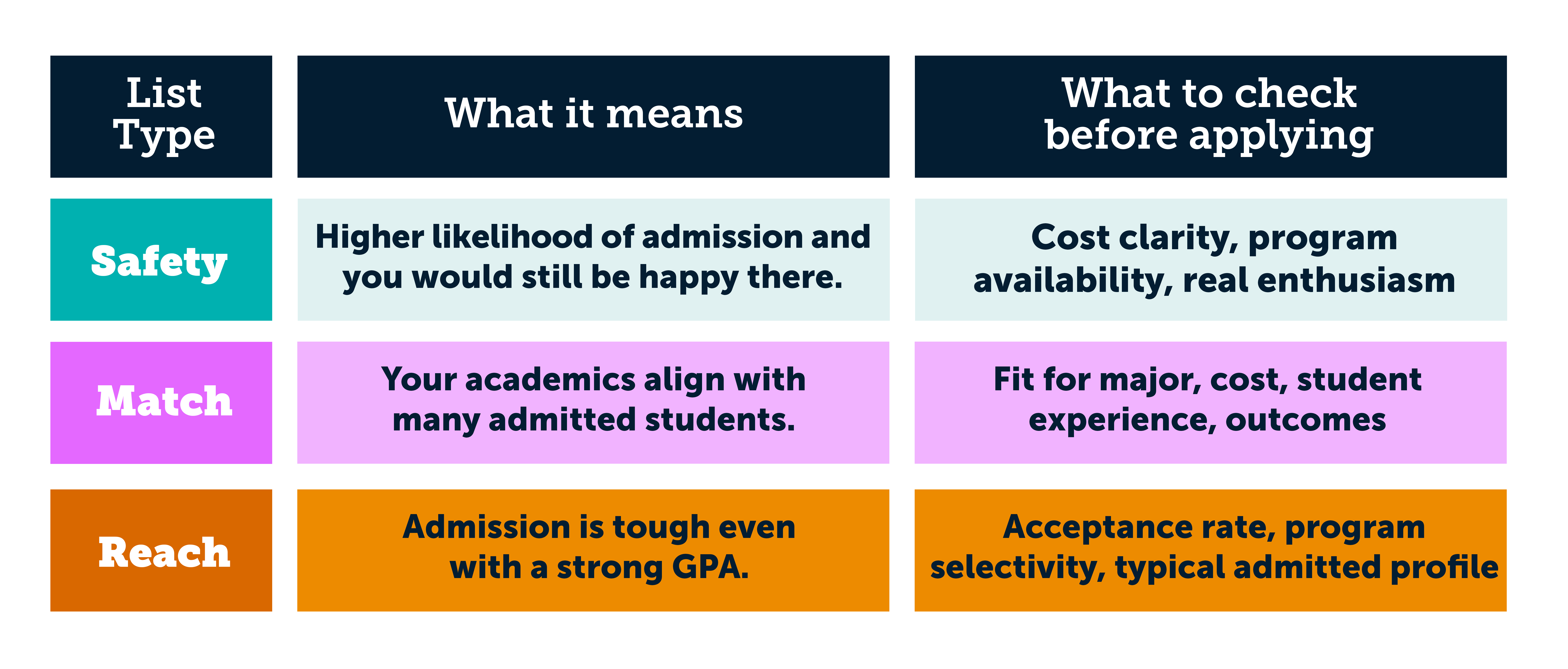
Several safeties should be colleges where you comfortably meet current academic requirements. Matches may include schools where your overall record is reasonably aligned with current students.
Choose reaches because there is a meaningful reason to apply, not because you found an example of one student with a similar GPA being admitted.
One student’s result does not predict yours.
How can you improve a 2.3 GPA?
Freshmen and sophomores
Multiple strong semesters can still reshape your cumulative record.
Aim for consistency rather than occasional excellent grades surrounded by weaker ones.
Juniors
There is less numerical runway, so a useful goal is to establish a sustained upward pattern and complete core college-preparatory courses successfully.
Start researching colleges now rather than waiting for a final GPA.
Seniors
Major GPA movement may be limited. Put equal energy into strong current grades and building a list with enough realistic choices.
What should you prioritize with a 2.3 GPA?
Better classroom performance will usually help more than accumulating additional low-commitment extracurriculars purely for admissions.
Extracurriculars can add value to an application, but they should not be treated as a substitute for academic preparation.
Most useful next step: Build an initial list with several broad-access four-year or transfer-friendly options. Add reaches only after the realistic foundation of the list is secure.
Tips for your college search and planning with a 2.3 GPA
|
|
|
|
|
|
Can you get merit scholarships with a 2.3 GPA?
GPA-specific merit opportunities may be narrower at this level, so keep the scholarship search broad.
Look at need-based aid, local scholarships, service awards, talent-based opportunities, employer or community scholarships, and programs connected to your intended field.
A college’s need-based aid may also matter more to your actual cost than a small merit award. Compare net price, not just advertised scholarship amounts.
Will extracurriculars compensate for a 2.3 GPA?
They can strengthen an application, but they do not erase the academic record.
If you still have time to improve your grades, academic progress should usually take priority over adding activities solely for admissions purposes.
Should I consider transferring from the beginning?
Yes, it can be useful to understand transfer options even while applying to four-year colleges.
Knowing which two-year colleges have strong transfer relationships, what credits transfer, and what future institutions require can give you a practical backup or alternative pathway.
What colleges look at besides a 2.3 GPA
Colleges consistently rate grades and curriculum strength as major factors. After that, these can matter a lot:
Recommendations | ||
How to use the college list
The colleges below are included because their average GPA falls within 2.2–2.4.
That range helps surface schools for comparison. It does not mean a 2.3 is an admissions requirement or that students with a 2.3 are guaranteed consideration or admission.
A reported average GPA is not a minimum or cutoff, and colleges may calculate GPA differently from your high school. Policies, program requirements, and admitted-student profiles can also change.
Verify each college’s current information and compare your full academic profile, including course rigor and grade trend, before deciding whether it belongs on your safety, match, or reach list.
Explore colleges for every GPA with Appily
Ready to explore colleges that accept a GPA like yours? We have a comprehensive database to help you find and research schools. There, you can see essential data points like acceptance rate, average financial aid award, average test scores, and application deadlines, including those for rolling admission, early decision, and early action schools.