A Rural Student’s Guide to Finding and Paying for College

Where you grow up can shape which colleges you hear about, how far you must travel, and how much college advising is available at your school. It does not determine which colleges you can consider or where you can succeed.
If you are from a rural or small-town area, you can broaden your options by researching beyond familiar schools, comparing net price instead of sticker price, including travel and technology in your budget, and using virtual events, college fairs, fly-in programs, and free advising resources.
Appily collaborated with the Small Town and Rural Students (STARS) College Network, a network of 32 colleges and universities aiming to increase college readiness, access, and success for students from rural and small-town communities, to create a guide to help you take those steps and build a college list that fits your goals, finances, family responsibilities, and preferred distance from home.
The TL;DR
Growing up in a rural or small-town community can affect which colleges you hear about, how easily you can visit them, and what resources are available during the application process. It should not limit the choices you consider.
This guide helps you:
- Identify colleges that fit your academic goals, preferred environment, budget, support needs, and desired distance from home.
- Look beyond familiar or nearby schools without assuming that distant, private, or selective colleges will be unaffordable.
- Compare what colleges may actually cost after grants and scholarships, including travel, technology, health insurance, and break expenses.
- Use virtual events, college fairs, fly-in programs, financial-aid resources, and trusted mentors to access opportunities that may not reach your school.
- Ask colleges the right questions about affordability, transportation, housing, rural and first-generation support, and life after enrollment.
- Present work, caregiving, family, farming, and community responsibilities as meaningful application context when they help explain your experience.
- Make a college decision based on a clear understanding of your options, not only the schools you already know or the prices displayed on their websites.
Start by deciding what you want from college
Growing up in a rural or small-town community may give you a strong sense of what you value in a place - whether that’s close relationships, access to nature, community involvement, independence, or something completely different! Think about which parts of your current environment you want to carry with you and which new experience you’d like college to offer.
Before searching by college name, identify the features that would make a college a good fit for your life.
Opening a search tool and scrolling through thousands of schools can quickly become overwhelming. A short list of priorities gives you a more useful starting point than “a good college.”
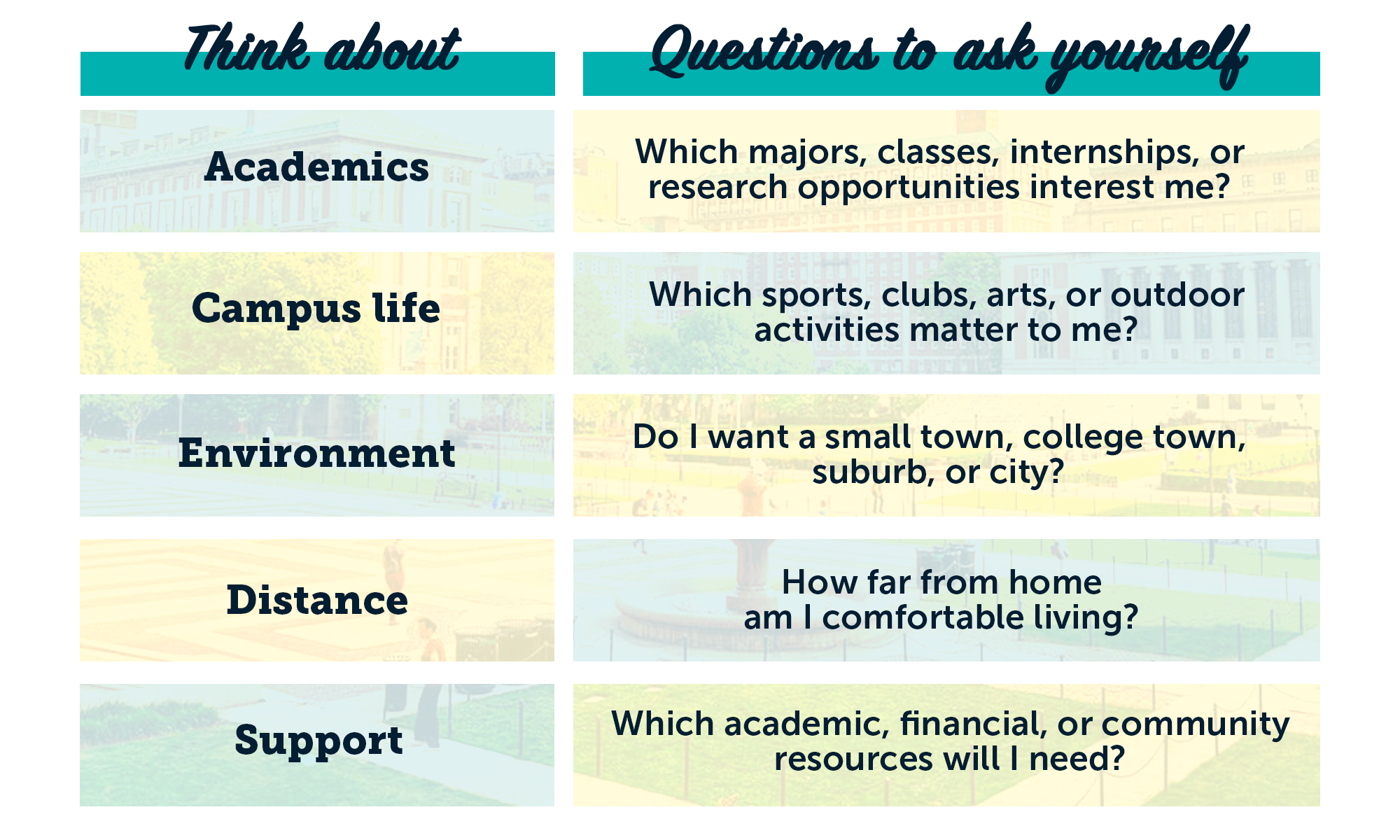
Start with academics. Which subjects interest you? Do you want undergraduate research, hands-on learning, internships, study abroad, or a specific major?
Then think about how you want to spend your time outside class. You might want major college sports, hiking trails, music groups, agricultural organizations, a dance studio, community service, or a club similar to one you joined in high school.
Campus environment matters, too. Would you prefer another close-knit community, or are you excited to experience a city? Do you want a college where most students live on campus? How important are access to nature, public transportation, or a nearby airport?
You don’t need to know exactly what you want. The goal here is to create a starting point you can revise as you learn more.
Look beyond the colleges you already know
The colleges closest to home may be excellent options, but they shouldn’t automatically be your only options.
Depending on where you live, fewer colleges may visit your high school or region, so the schools you hear about most often aren’t always the ones that could be your best fit. You may hear most often about a nearby community college, technical college, regional university, or state flagship. Those schools may deserve a place on your list. But you may also find private colleges, out-of-state public universities, and other institutions that fit your goals and provide substantial financial aid.
As you think about expanding your list out, consider researching:
- A nearby community or technical college
- In-state public universities
- Regional colleges
- Private colleges that provide need-based financial aid
- Colleges farther from home that closely fit your academic and personal goals
- Schools offering specialized programs unavailable in your area
You want to build a balanced list that includes colleges with different admission possibilities and price estimates. Don’t treat a college as affordable, likely, or out of reach until you’ve researched it a bit deeper.
You’re not committing to attend a college by researching, visiting, or even applying to it. You’re giving yourself more choices when admission and financial-aid decisions arrive.
Explore colleges without traveling to every campus
A campus visit can be helpful, but you don’t need to physically visit every college before deciding whether to apply. If the colleges you’re considering are several hours away, visiting every campus may not be practical, or even necessary.
Most colleges offer virtual information sessions, campus tours, financial-aid presentations, or student panels. Some admissions offices will also schedule individual virtual appointments.
A virtual tour won’t necessarily tell you everything about a campus, but it can still give you a feel for the campus environment and even the overall vibe of the school, which you can use to narrow your list before spending money on travel.
During a virtual event, pay attention to details beyond the most impressive buildings. Look at residence halls, dining options, classrooms, transportation, the surrounding community, and the places where students spend an ordinary weekday.
You can also attend regional college fairs. Ask your counselor whether several colleges are scheduled to visit your school or another school nearby. The National Association for College Admission Counseling also hosts college fairs in different regions.
The STARS College Network holds events for rural and small-town students, including a virtual college fair. If you don’t attend a high school served by a STARS College Advisor Program, you can also register for Rising STARS, which provides free virtual college advising.
Apply to college fly-in programs
A fly-in program can be one of the best ways to visit a distant college at little or no cost.
Colleges typically invite selected high school students to spend several days on campus. Depending on the program, the college may pay for transportation, housing, meals, and activities.
Students may be able to:
- Stay in a residence hall
- Attend sample classes
- Meet current students and professors
- Learn about financial aid
- Work with admissions counselors
- Explore the campus and surrounding area
Fly-in programs can be especially useful if you cannot otherwise afford a long-distance college visit. They offer a more complete sense of campus life than a short tour and may give you a chance to ask detailed questions before applying.
These programs can be competitive, and deadlines may arrive before regular college application deadlines. Begin searching during the spring or summer before senior year, and check each college’s admissions website carefully.
Even if you’re not selected, researching and applying to a fly-in program can help you learn more about the college. Not being selected for a fly-in is not the same as being denied admission.
Do not rule out a college because of its sticker price
Don’t eliminate a college based only on its published price, or sticker price. The number that matters most is its estimated net price: the total cost of attendance minus grants and scholarships.
A private college with a published cost of $80,000 can look less affordable than an in-state university charging $25,000. For example:

Some private colleges provide enough need-based grant aid to cost less than a public college with a lower sticker price. That will not be true for every student or every college, so run the net price calculator for each serious option before comparing affordability.
Colleges that participate in federal student-aid programs and enroll full-time, first-time undergraduate students are generally required to provide a net price calculator. You will enter information about your household finances, and the tool will estimate the grants and scholarships you may receive.
A calculator cannot guarantee your final aid offer, but it can give you a much more useful estimate than the sticker price. The more accurate the information is that you input, the more accurate your estimate will be.
Run the calculator for each college you are seriously considering. Save the results, note what information you entered, and compare the estimates with your family.
How can rural students build a college funding plan?
Start by completing the FAFSA and every financial-aid form required by your colleges. Then separate grants, scholarships, work-study, and loans so you can see what each college may actually require your family to pay, earn, or borrow.
Complete the FAFSA before your earliest deadline
The Free Application for Federal Student Aid, or FAFSA, is the application for federal grants, work-study, and federal student loans. States, colleges, and some private aid providers also use FAFSA information when awarding aid.
The federal government, your state, and each college may have different deadlines. College or state priority deadlines may arrive before the federal deadline, and some funding is limited. Complete the FAFSA each year and aim for the earliest deadline that applies to you.
Check each college’s financial-aid website to see whether it requires another form or additional documentation. Do not assume that submitting the FAFSA completes every financial-aid requirement.
Understand what each type of aid means
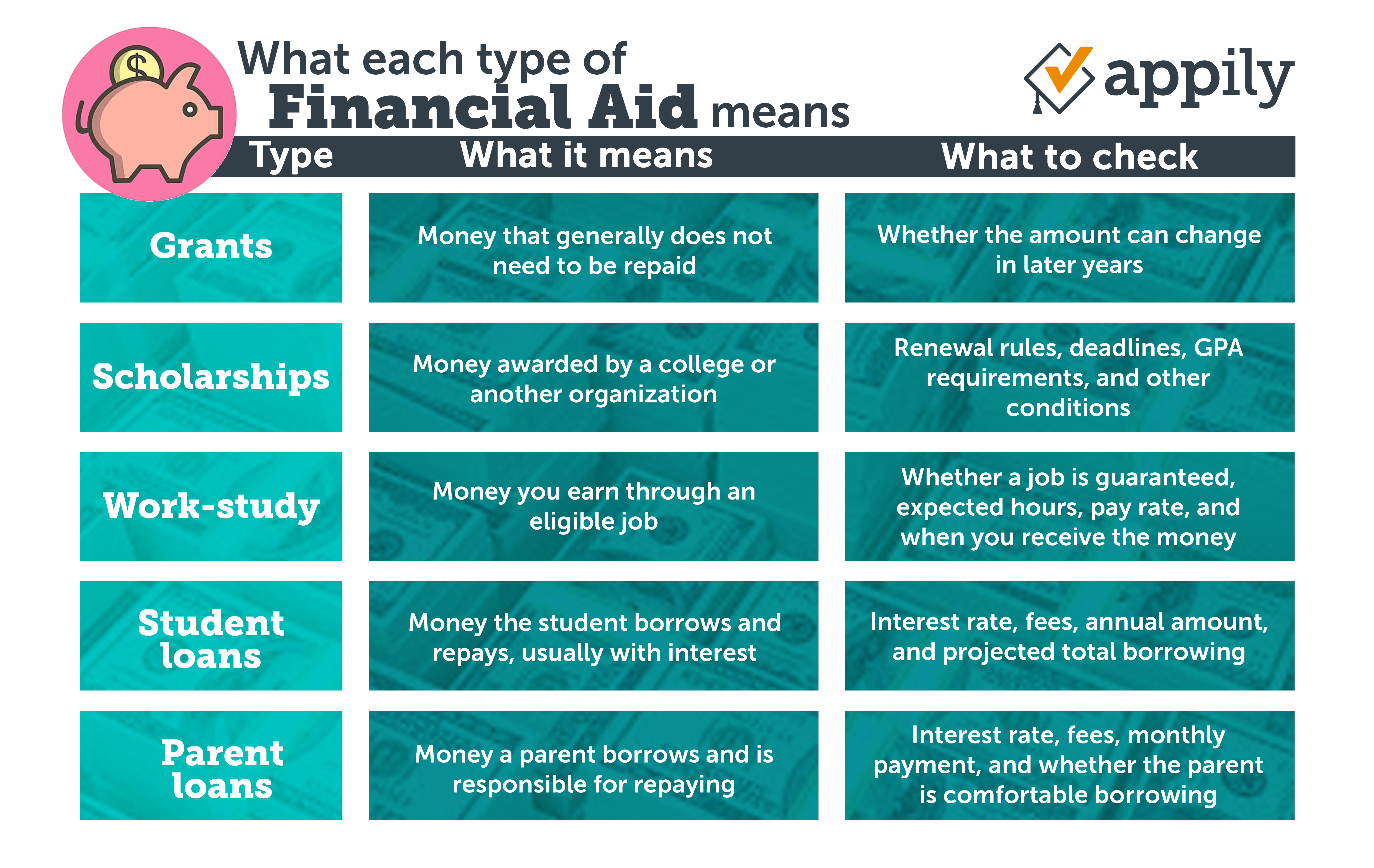
A work-study amount is not an automatic discount on your bill. You’ll generally need to find a qualifying job, work the required hours, and receive the money through paychecks. Work-study funding and jobs may not be guaranteed from year to year.
Search for scholarships from several sources
Scholarships can come from:
- Colleges and universities
- Community foundations
- Local businesses and employers
- Professional associations
- Civic, cultural, faith, and service organizations
- State agencies
- National scholarship providers
- Organizations connected to your intended major, identity, activities, or location
Ask your counselor, librarian, employer, family members, and local organizations about opportunities that may not appear in a national search.
Do not ignore smaller awards. A scholarship that helps cover a laptop, books, winter clothing, or travel home can still make a meaningful difference.
Appily’s scholarship database lets you search and filter opportunities, including scholarships based on location, financial need, first-generation status, enrollment level, and other eligibility factors.
Check for application fee waivers
The college application process itself can add an extra sticker price to your bill, but there are many ways that you can help reduce or even eliminate those costs. After all, application fees should not prevent you from considering a college.
The Common App offers a fee-waiver process for eligible students, and some colleges have their own fee waivers or do not charge an application fee. Review each college’s instructions and ask your counselor or admissions representative when you need help.
Ask for a financial-aid review when circumstances change
The financial information required on the FAFSA may not reflect what your family can currently afford.
A job loss, pay cut, major uninsured medical expense, or other significant financial change may qualify as a special financial circumstance. Submit the FAFSA as instructed, then contact the college’s financial-aid office to request an aid adjustment. The college may ask for documentation and will make the final decision under its policy.
Calculate the costs beyond tuition
For a rural student, the difference between “affordable” and “realistically affordable” may be transportation, technology, or the cost of remaining on campus during breaks.
A college’s cost of attendance usually includes estimates for expenses such as tuition, fees, housing, food, books, supplies, transportation, and personal costs. Those estimates may not match what you will actually spend.
For example, the college’s transportation allowance may not cover several flights home, a long-distance drive, airport transportation, or emergency travel. Your financial-aid offer may also leave part of the total cost uncovered.
When comparing colleges, estimate:
- Travel to campus at the beginning of the year
- Trips home during holidays and breaks
- Emergency travel
- Gas, maintenance, insurance, and parking
- Airport, bus, or train transportation
- Local transportation for students without cars
- Textbooks and course materials
- A laptop, internet access, and program-specific technology
- Health insurance
- Clothing for a different climate
- Groceries and personal expenses
- Moving and storage
- Fees for labs, studios, clinical work, or other programs
- Unpaid internships, research, or career experiences
Ask whether the college offers technology grants, laptop loans, emergency aid, travel assistance, paid research, or funding for otherwise unpaid internships.
Also find out whether residence halls close during Thanksgiving, winter, spring, or summer breaks. Ask whether you can remain on campus, where you would live, whether meals are available, and whether staying costs extra.
Ask admissions counselors direct questions
You don’t have to wait for an admissions representative to visit your high school before reaching out. If a college interests you, find the admissions counselor assigned to your state or region and introduce yourself. Many counselors are happy to answer questions by email or meet virtually.
An admissions counselor’s job is not only to evaluate applications. Counselors can also help prospective students understand the college, its application process, and its resources.
Useful questions include:
- What resources or student organizations support rural students?
- What percentage of demonstrated financial need does the college meet?
- What costs should families expect beyond tuition, housing, and meals?
- Are work-study jobs available to first-year students?
- Does the college offer travel grants or assistance with campus visits?
- Can students remain in housing during academic breaks?
- Is emergency travel funding available?
- What transportation options are available for students without cars?
- What support is available for first-generation or lower-income students?
- Where should I explain family, work, or community responsibilities in my application?
That last question can be especially important.
You may spend every afternoon caring for siblings, working in a family business, contributing to household income, tending animals, or helping relatives with transportation. Those responsibilities may not appear on your transcript, but they still show how you use your time and what you contribute.
An admissions counselor can explain whether that context belongs in the activities section, an essay, or the additional-information section of your application.
Look for signs that a college will support you after enrollment
Getting admitted is only one part of finding the right college. You also need to know what happens after you arrive.
Search the college’s website for terms such as “rural students,” “first-generation students,” and “student support.” Look for:
- A stated commitment to enrolling rural and small-town students
- A rural student organization or mentoring program
- First-generation student services
- Financial support for lower-income students
- Academic tutoring and advising
- Emergency grants
- Career programs connected to rural communities
- Courses, research, or community partnerships related to rural issues
You can also ask to speak with a current student from a rural community. Ask what surprised them, which resources helped, and how they adjusted to campus.
A college does not need a rural-student office to be supportive. But it should be able to explain how students find community, receive academic help, manage emergencies, and afford the full experience.
Think honestly about distance from home
There is no correct number of miles to travel for college.
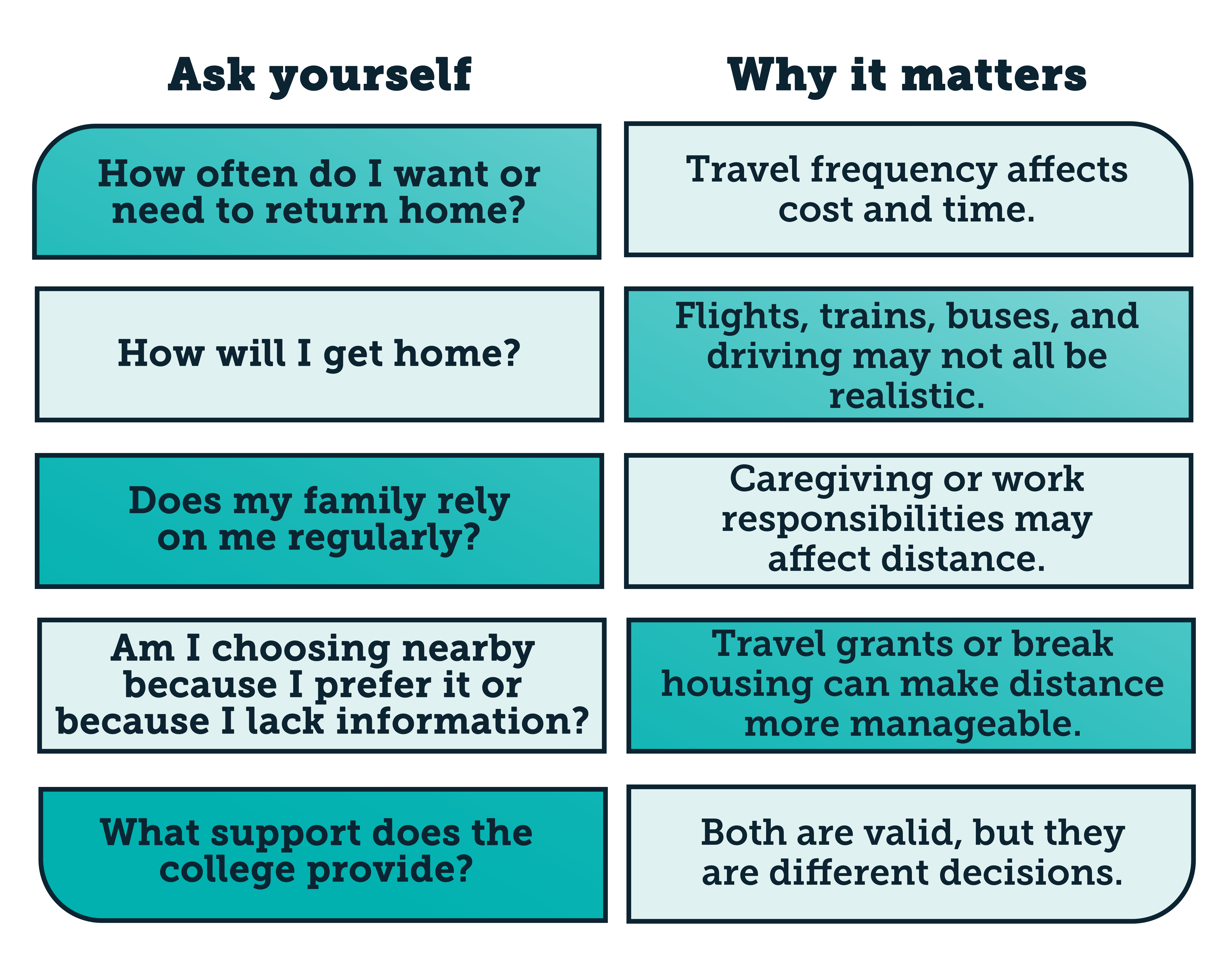
You may want to remain close because of family responsibilities, finances, a job, health needs, or simply because you like where you live. You may also be ready to experience somewhere completely different.
Have an early conversation with your family about distance. Talk about how often you hope to come home, how you would travel, what it would cost, and whether your family needs you nearby.
But do not reject a distant college before learning what it would actually cost or what support it offers.
A college farther away may provide more financial aid, pay for a visit, offer transportation support, or connect you with opportunities unavailable closer to home.
Applying preserves the option. You can make the final decision after seeing your admission and financial-aid offers.
Treat your rural background as useful application context
Your application should show what you accomplished within the opportunities, responsibilities, and circumstances available to you.
You are not expected to take a class your school does not offer. A high school’s school profile can provide colleges with context about its curriculum, grading system, student population, and other characteristics. Common App counselors also submit school information and transcripts, although each college determines how it reviews applications.
Your responsibilities outside school may also help an admissions reader understand how you use your time.
That could include:
- Working significant hours
- Caring for siblings or relatives
- Helping operate a farm or family business
- Providing transportation for family members
- Translating or completing paperwork
- Managing household responsibilities
- Creating an activity your school did not offer
- Traveling long distances for classes or extracurricular activities
- Organizing an event for your school or community
- Exploring an academic interest independently
Don’t force your rural identity into an essay if it doesn’t answer the prompt or reflect what you want to say. But at the same time, don’t hide an important experience simply because it feels ordinary to you.
Be specific about what you did, how often you did it, and what responsibility you held.
Instead of:
Helped on my family’s farm.
Try:
Cared for livestock before school five mornings a week, maintained equipment records, and managed weekend feeding when family members were working off-site.
Instead of:
Took care of my siblings.
Try:
Supervised two younger siblings after school, prepared dinner, and helped with homework four days a week while my parent worked an evening shift.
The goal is not to make your life sound dramatic. It is to give the reader enough information to understand your time, contribution, and skills.
Check the current instructions for each application. Depending on the platform and college, relevant context may belong in an activities section, essay, short-answer response, recommendation, or additional-information section.
Find at least one mentor
College applications involve a lot of unfamiliar language, deadlines, and decisions. You do not need to figure out all of it alone.
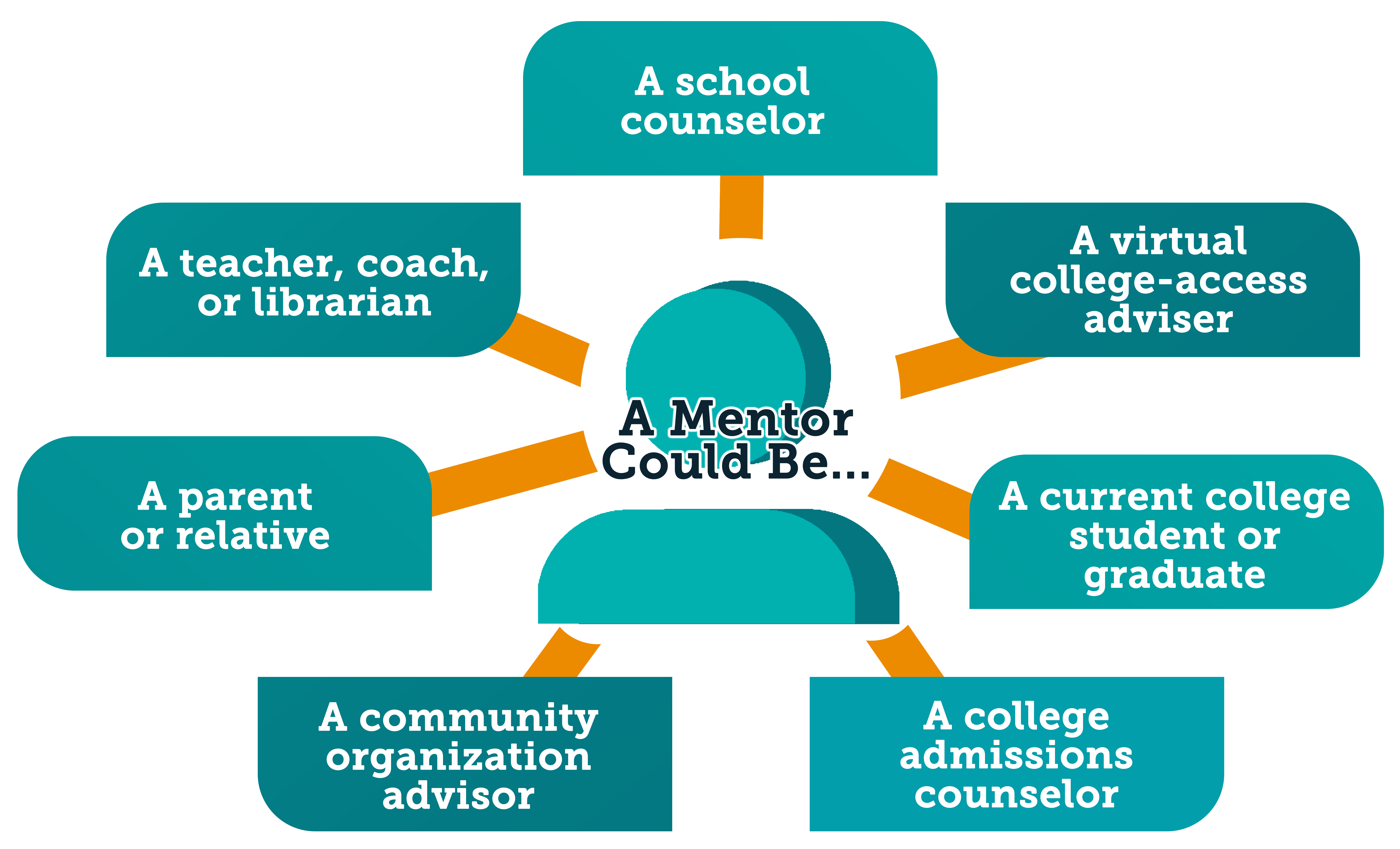
Your school counselor can be an important part of your college-search team, but they don’t have to be the only person you turn to. If your counselor supports many students or handles responsibilities beyond college advising, consider building a broader network of people who can help.
Different mentors can help with different parts of the process. A teacher may review an essay. A counselor may review your transcript. An admissions representative may answer questions about aid. A current student may explain what campus life actually feels like.
For rural students in particular, having one or more trusted people who can help explain the college process may make a meaningful difference. Mentors can help you identify unfamiliar options, stay on top of deadlines, understand financial aid, and adjust to college after enrolling.
Asking for help is not evidence that you are unprepared for college. Knowing how to seek information and build a support system is part of becoming prepared.
Your location should inform your college search, not limit it
Growing up in a rural community can affect which colleges you encounter, how far you must travel, and which resources are available at your high school.
It does not determine where you can apply or what you can accomplish.
Start with what matters to you. Research beyond the colleges you already know. Compare net prices rather than sticker prices. Use virtual events, college fairs, fly-in programs, and free advising. Ask direct questions about costs and student support.
Most importantly, give yourself permission to explore.
You may ultimately choose a college close to home, a campus across the country, a community college, a technical program, or another path entirely. The goal is not to travel the farthest or attend the most selective school.
It is to make that choice with a clear view of your options.
Find colleges that fit you
Your college options do not have to stop with the schools closest to home or the ones that visit your high school.
Appily’s free College Match Quiz can help you discover colleges that fit your academic interests, goals, budget, location preferences, and ideal campus experience-including schools you may not have considered yet.
FAQs from rural students applying to college
Are colleges interested in students from rural and small-town communities?
Yes. Some colleges have specific recruitment, access, or support initiatives for rural and small-town students. Others may not have a dedicated rural program but still value geographic diversity and the experiences students bring from different communities.
Look for rural recruitment initiatives, fly-in programs, mentoring, first-generation support, student organizations, and partnerships such as the STARS College Network. A college should also be able to explain how students receive academic, financial, and personal support after enrolling.
Will colleges understand that my high school offers few AP or advanced classes?
Many colleges review your academic record in the context of what your high school offers. You are not expected to take an AP, International Baccalaureate, dual-enrollment, or advanced course that was not available to you.
Take appropriately challenging classes within your school’s options. Your counselor’s school report or school profile may help colleges understand the curriculum, grading system, and opportunities available at your high school.
If an important limitation may not be clear from those materials, ask your counselor whether it should be explained elsewhere in your application.
Can an expensive private college cost less than a public college?
Yes, it can. Some private colleges provide enough grant or scholarship aid to have a lower net price than a public college with a lower published price.
Do not compare colleges using sticker price alone. Use each college’s official net price calculator, then compare your final financial-aid offers after admission.
Pay particular attention to:
- Grants and scholarships
- Student and parent loans
- Work-study
- Travel costs
- Housing and meals during breaks
- Technology and textbook expenses
- The amount your family would still need to pay
What is the difference between sticker price and net price?
Sticker price is the college’s published cost before financial aid. It may include tuition, fees, housing, meals, books, transportation, and estimated personal expenses.
Net price is the amount left after grants and scholarships are subtracted. Because grants and scholarships generally do not need to be repaid, net price gives you a more useful starting point for comparing affordability.
Loans should not be treated as a reduction in the price. They help cover the cost now but must be repaid later.
How can I visit a college if I cannot afford the trip?
Begin with virtual tours, online information sessions, student panels, and financial-aid presentations. You can also attend regional college fairs or ask whether admissions representatives will be visiting a nearby school or community.
Contact the college and ask about:
- Travel grants
- Fly-in programs
- Regional admissions events
- Individual virtual appointments
- Transportation assistance
- Application or visit programs for rural students
Some fly-in programs cover most or all transportation, housing, meals, and scheduled activities for selected students.
When should I look for fly-in programs?
Begin searching during the spring or summer before senior year. Some fly-in deadlines arrive well before regular college application deadlines.
Check each college’s admissions website for current dates and requirements. Some programs allow students to apply directly, while others require a counselor, teacher, or adviser to nominate them.
Not being selected for a fly-in is not the same as being denied admission to the college.
What should I do if I do not have reliable internet access?
Create a backup plan before you need to submit an application or attend an important virtual event.
Possible locations include your school, public library, community center, workplace, nearby college, or a trusted relative’s home.
When you have a reliable connection:
- Download instructions and forms.
- Save copies of essays and activity descriptions.
- Submit materials before the final deadline.
- Take screenshots of confirmation pages.
- Check that uploaded documents open correctly.
- Save important contact information offline.
Tell your counselor or the college as soon as possible if an internet problem may cause you to miss a deadline.
Where can rural students find scholarships?
Start with your colleges, Appily’s scholarship database, community foundations, local businesses, employers, civic organizations, professional associations, and state agencies.
Ask your school counselor and public librarian about local scholarships that may not appear in large national databases. Smaller local awards can help cover expenses such as books, a laptop, travel, winter clothing, or required supplies.
Always check:
- Eligibility requirements
- The application deadline
- Whether the award is renewable
- GPA or enrollment requirements
- Whether the scholarship can be used for travel, technology, or other non-tuition expenses
How should I compare two financial-aid offers?
Compare grants and scholarships first because they generally do not need to be repaid. Then review work-study, student loans, parent loans, and the amount your family must still cover.
For each college, calculate:
Total estimated cost minus grants and scholarships = estimated net price
Then add personal expenses that may not be fully reflected in the college’s estimate, such as travel home, break housing, transportation, technology, or health insurance.
Also ask whether grants and scholarships are renewable and whether the amount could change after your first year.
Is work-study guaranteed money?
Not necessarily. A work-study amount usually represents an opportunity to earn money through an eligible job. It is not automatically applied to your college bill.
Ask the college:
- Whether a job is guaranteed
- How first-year students apply
- How many jobs are available
- How much students usually earn
- When students receive their pay
- Whether the opportunity is likely to continue in later years
You may need to use other funds to pay charges that are due before you begin receiving work-study earnings.
How can I explain family, work, or community responsibilities in my application?
Describe the responsibility clearly and specifically. Explain what you did, how often you did it, how much time it required, and what decisions or leadership were involved.
Relevant responsibilities might include:
- Caring for siblings or relatives
- Working to contribute to household income
- Helping operate a farm or family business
- Providing transportation
- Translating or completing paperwork
- Managing household tasks
- Organizing a community activity
- Traveling long distances for school or extracurricular opportunities
Depending on the application, this information may belong in the activities section, an essay, a short-answer response, a recommendation, or an additional-information section.
Should I write my college essay about being from a rural community?
Only if the topic helps answer the prompt and tells the reader something meaningful about you.
You do not need to make your hometown the focus of your application. You also should not leave out an important experience simply because it feels ordinary in your community.
Avoid broad statements such as “rural life made me hardworking.” Tell a specific story that shows what you did, how you responded, and what the experience meant to you.
Should I stay close to home for college?
That is a personal decision based on your goals, finances, responsibilities, transportation options, health needs, and comfort level.
Compare both nearby and distant colleges before deciding. A college farther away may provide more financial aid, travel assistance, or break housing. A nearby college may offer the academic, personal, and financial fit you prefer.
Talk with your family early about:
- How often you would return home
- How you would travel
- What the trips would cost
- Whether your family relies on you regularly
- How you would handle emergencies
- What support the college provides
Choosing a college close to home is valid. The important thing is to make the choice after understanding your options.
What should I ask a college about staying on campus during breaks?
Ask whether residence halls and dining facilities remain open during Thanksgiving, winter, spring, and summer breaks.
You should also ask:
- Whether students must move to a different residence hall
- Whether staying costs extra
- Whether meals are available
- Whether financial assistance is offered
- Where international or long-distance students usually stay
- What happens during an emergency closure
This can be especially important when traveling home is expensive, time-consuming, or not possible.
How can I tell whether a college will support rural students after enrollment?
Look beyond recruitment language and ask what support students can actually use.
Search the college’s website for:
- Rural or small-town student programs
- First-generation services
- Peer or faculty mentoring
- Academic advising and tutoring
- Emergency grants
- Transportation assistance
- Break housing
- Career and internship funding
- Health and counseling services
- Student organizations and community-building programs
Ask to speak with a current student from a rural or small-town community. Find out what surprised them, which resources they used, and how easy it was to get help.
What if my family’s financial situation changes after I submit the FAFSA?
Submit the FAFSA using the required information, then contact each college’s financial-aid office.
Explain what changed and ask whether you can request a financial-aid review. Examples may include a job loss, reduction in income, major uninsured medical expenses, or another significant change in your family’s finances.
The college may ask for documentation. Each institution decides whether and how to adjust an aid offer under its policies.
Do I need to figure out the entire college process on my own?
No. Try to identify at least one trusted person who can help you understand deadlines, compare options, and ask questions.
A mentor might be a counselor, teacher, coach, librarian, relative, college-access adviser, admissions representative, current college student, or graduate.
Ask for specific help. For example:
“Could you review my college list and help me identify any missing deadlines?”
Or: “Could you help me compare the grants, scholarships, and loans in these two financial-aid offers?”
Different people can support different parts of the process. Building that support system is part of preparing for college.
