2026-27 Common App Guide: How to Apply Step by Step

The 2026-27 Common App officially opened on August 1, 2026, allowing first-year college students to enter their core application information once and apply to up to 20 schools (though each college can still set its own deadlines, essays, testing policies, fees, and recommendation requirements).
This guide explains what you need before you start, how the application is organized, what rolls over, where to find school-specific requirements, and what to check before submitting. You do not have to finish everything at once. Start with the sections you can complete accurately, then make a separate checklist for every college on your list.
And if you are feeling behind, you are not alone.
“It’s okay not to have everything figured out. Most seniors feel overwhelmed or uncertain at some point during the college application process,”
says Nicole Hank, Counselor at Mesa’s Westwood High School. Everyone’s in it together, and the Common App is a process, not a personality test.
Common App 2026–27: Quick answers
- The Common App platform is free, although individual colleges may charge application fees.
- First-year applicants can add up to 20 colleges in My Colleges.
- You reuse your core information, but you submit separately to each college.
- Answers in My Common Application roll over; college-specific questions, supplements, and portfolios generally do not.
- Each college sets its own deadlines, essays, testing, recommendation, fee, and Courses & Grades requirements.
- The personal essay may be required or optional depending on the college.
- FAFSA, state aid applications, and college-specific financial aid forms are completed separately.
- After submitting, check each college’s applicant portal for missing materials.
How to apply through Common App in seven steps
- Gather your information. Have your transcript, senior schedule, activities, honors, family information, and any test scores you may report nearby.
- Create your Common App account. Use an email address you check regularly and will still be able to access after high school.
- Add colleges to My Colleges. You can add up to 20 colleges, but you do not need to finalize your full list immediately.
- Check each college’s requirements. Review deadlines, fees, essays, testing policies, recommendations, and Courses & Grades requirements separately.
- Invite your counselor and any required recommenders. Ask your counselor how your school sends transcripts and recommendations before inviting anyone. If your school uses Naviance or another Common App integration partner, follow your school’s instructions for counselor and teacher materials instead of inviting them directly in Common App.
- Complete the application and writing. Finish My Common Application, then complete the questions and supplements required by each college.
- Preview and submit. Review the application for that college, resolve any missing requirements, pay the fee or use an approved waiver, and submit before the deadline.
What is the Common App?
The Common App is a not-for-profit online application platform that simplifies the college application process by letting students apply to more than 1,100 schools through one system. It is designed to help students save time and keep track of deadlines, school forms, recommenders, and college-specific tasks without starting from scratch for every application.
That does not mean every college application becomes identical. It just means the core information lives in one place, while each college can still ask for its own supplements, essays, deadlines, or other requirements.
One of the biggest misconceptions that many students hold is that once their Common App is submitted, they’re done and ready to go.
But as Nicole Hank explained,
“Many students think submitting the Common App means they're done. They often don’t realize that colleges may require supplemental essays, transcripts, test scores, recommendation letters, or application fees before the application is considered complete.”
When does the Common App open?
The Common App opens each year on August 1 for the new application season. Your answers in My Common Application, including your personal essay and activities, can roll over from year to year. College-specific questions, writing supplements, and portfolios may not, so wait until the correct application cycle before completing those sections.
That rollover detail matters more than people think. If you are a rising senior, you do not have to wait until the official launch to get organized. You can gather your materials, think through your activities, and start outlining essays before the rush hits.
What do you need before starting the Common App?
Before you begin, it helps to have a few things ready:
- your current high school transcript or at least a copy for reference
- your current class schedule
- your list of activities, work, responsibilities, and interests
- any academic honors or achievements
- SAT, ACT, AP, or IB score information if you want to report scores
- parent or guardian information
- fee waiver information if you think you may qualify
It can be overwhelming if you aren’t sure what to put in each individual section, so it helps to gather everything first and sort it before typing it out.
Another common stress point is senior-year classes. Students often wait until the last minute to figure out how to report their courses, which makes the Education section feel bigger than it is. If you have your schedule and transcript nearby, it gets a lot easier.
What are the Common App sections?
The first-year Common App is built around seven main sections: Profile, Family, Education, Testing, Activities, Writing, and Courses & Grades. Common App’s application guide walks students through each step, starting with gathering materials and ending with submission.
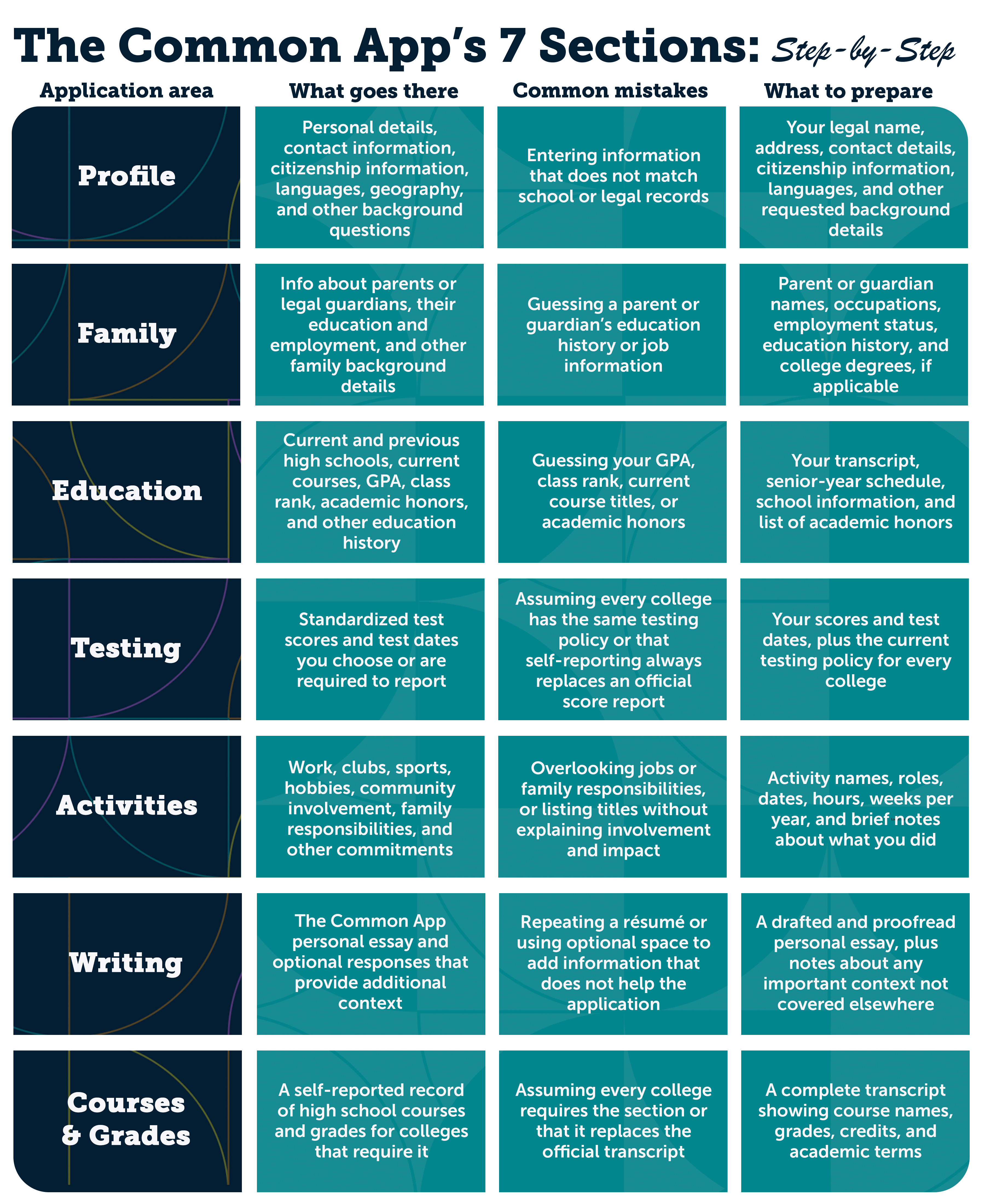
Profile, Family, and Education
This is where the basics live: your identity information, family background, school history, grades, and current coursework. Some colleges also ask students to self-report their transcript information. The Education section is also where students may report class rank and GPA if their school provides them.
Testing
The Testing section is where students can self-report standardized test scores if they choose to. Common App notes that every college has its own policy, and some are test-optional while others still want scores.
If you’re asking yourself, “Do I have to report my scores?” the answer is: maybe.
Be sure to check each college’s current testing policy. If scores are required, then follow that college’s submission instructions. If the college is test-optional, you can decide whether your scores strengthen your application.
Self-reporting scores in Common App may not replace an official score report when a college requires one.
Activities
This is where you show what you do outside class. Common App notes that activities can include work, hobbies, clubs, community engagement, and other responsibilities. In other words, this section is not only for the student body president or varsity captain. It is for real life, too.
Writing
The Writing section contains the main Common App personal essay, but not every college requires it. Common App shows whether each college requires or allows the essay. Colleges may also add short answers or separate writing supplements, including questions that appear only after you select a major, program, or application plan.
The 2026–27 prompts were announced in February 2026, and Common App continues to frame the essay as a chance for students to share something meaningful about themselves beyond grades and test scores.
Courses & Grades
Some colleges require students to self-report their high school coursework and grades in this section, while others do not. Check the requirements for every college in My Colleges before completing it. Completing Courses & Grades does not replace your official transcript. Your counselor will still submit your transcript as part of the school’s required materials.
The parts students tend to overcomplicate
Students often spend so much time trying to make every response “perfect” that they lose sight of what each section is asking for. One common sticking point is deciding what belongs in Activities, Honors, or an optional information section.
Kathryn Moody, Counselor at Lynnfield High in Massachusetts, has noticed that
“[Students] get jammed up on what to put in the honors section versus the activities section. They also feel like they need to answer every single question when they don’t necessarily need to; additional information, for example.”
That’s why it helps to slow down and think about the purpose of each section before you start filling things in.
The Common App is meant to simplify the repetitive parts of applying to college, not turn every blank space into a puzzle. If a section is optional and does not help explain your story, you do not have to force something into it just because the box is there.
What are Common App supplemental essays?
Common App supplemental essays are additional, college-specific responses that some schools require. They may ask why you want to attend, what you hope to study, how you have contributed to a community, or what you would bring to campus.
Now supplemental essays are where the Common App stops being generic and starts becoming school-specific, which is why they can feel more frustrating than the main application itself. Instead of answering one broad set of prompts, you have to switch gears from college to college and figure out what each school is really asking. One school may want a short response about why you are applying. Another may ask about your academic interests, your intended major, your community, or what you would bring to campus.
Some supplements are quick. Others are surprisingly specific. And because the questions can vary so much, it is easy to feel like you are starting over every time you open a new college tab.
That’s also why supplemental essays deserve a little more planning than students often give them. They aren’t just extra writing; they’re one more chance to show fit, interest, and thoughtfulness in a way that is tailored to the school. You don’t want to force the same answer into every prompt. Instead, slow down, read carefully, and answer the actual question in front of you. Once you get used to that rhythm, the supplemental essays can feel a lot less random and a lot more manageable.
How do Common App fee waivers work?
Common App fee waivers allow eligible students to submit applications without paying participating colleges’ application fees. A counselor must confirm the Common App fee waiver, and some colleges also provide separate school-specific waivers.
Application fee waivers can lower the cost of applying, but application fees are only one part of the larger college affordability picture. Nicole Hank notes that
“Families are more concerned about affordability than ever before. That is why the Common App should be treated as one part of the college process, not the whole affordability conversation.”
The Common App does not replace the FAFSA or other required financial aid applications. Students still need to complete financial aid forms separately if they want to be considered for aid.
When should you use additional information?
The Common App includes two optional places for context. Sometimes, things just happen or life gets in the way, and the Challenges and circumstances section is intended for experiences or conditions that affected your opportunities or achievements. Additional Information can be used for other important context that is not explained elsewhere in your application.
Neither response is required. Use one only when the information will help a college understand your experiences or application more accurately. These spaces should not become second personal essays or repeat information already covered in your activities or writing.
A lot of students feel pressure to answer every single prompt as if the application were a test. It is not. Some spaces are there for context, and some are there to help colleges understand your story more clearly.
What to do before you hit submit
Before submitting to a college, preview the application and confirm that its fee, essays, recommendations, testing requirements, and other school-specific tasks are complete. Submitting the core Common App does not automatically complete every requirement. And don’t forget, once you submit an application to a college, you cannot remove that college from your My Colleges list.
A few last-minute checks go a long way:
- make sure every college in My Colleges is still on your list
- confirm each school’s writing requirements
- check whether test scores are required or optional
- verify your fee waiver status if you need one
- make sure your recommenders and counselor have what they need
- submit early enough to avoid deadline-night chaos
What should you do after submitting the Common App?
After submitting, watch your email for instructions from each college. Create an applicant portal account if the college asks you to, confirm that required materials were received, and address any missing items. Continue completing the FAFSA, state aid applications, scholarships, and any college-specific financial aid forms by their separate deadlines.
The Common App can be a useful tool, but it is still just one part of the college search. Students do not need to know everything before they begin. They just need a clear place to start, a realistic timeline, and enough guidance to avoid the most common mistakes.
And maybe most importantly, they need to remember that there is no single “right” path after high school. As Nicole Hank reminds us all,
“There is no one ‘right’ path after high school. Success looks different for every student, and college, career training, military service, apprenticeships, and the workforce are all valuable options.”
Common App helps you submit your applications, but the work starts before you reach the submit button. Before adding schools to your application, make sure your list is balanced for admission chances, affordability, location, and fit. Appily can help you compare colleges, explore scholarships, and organize your options so you are not simply completing applications; you're applying to schools that make sense for your goals and budget.
FAQs: The Common App for 2026-27
What is the Common App?
The Common App is an online platform that lets students apply to multiple colleges through one application. In fact, more than 1,100 schools use the platform.
How many colleges can I add?
Up to 20 colleges in one application cycle.
When does the Common App open?
The Common App opens each year on August 1.
Do I need to send test scores?
Check each college’s current testing policy. Some colleges require scores, while others are test-optional. If you report scores in Common App, confirm whether the college also requires an official score report.
Is the Additional Information section required?
No. It is optional and should only be used for relevant information that is not already covered elsewhere.
Do I apply for financial aid through the Common App?
No. FAFSA and other aid forms are separate.
Can I save my progress and come back later?
Yes. You can save your work and return to it. Answers in My Common Application can also roll over to a future application cycle, but college-specific questions, writing supplements, and portfolios may not.
Do all colleges require Courses & Grades?
No. Each college decides whether students must complete Courses & Grades. Check the requirements for every school in My Colleges.
Does submitting Common App mean my application is complete?
Not necessarily. A college may still need recommendations, transcripts, test scores, fees, supplements, or financial aid forms before your file is complete.
