Colleges for a 4.0 GPA
Is a 4.0 GPA strong for college applications?
A 4.0 can represent the highest possible unweighted GPA at many high schools and is an exceptional academic record, but the number still needs context. Not every school uses the same grading scale. Some high schools weight honors, AP, IB, or dual-enrollment courses, and weighted GPAs may exceed 4.0. A weighted 4.0 is therefore not directly equivalent to an unweighted 4.0. That said, a 4.0 also does not guarantee admission anywhere. At highly selective colleges, many applicants have nearly flawless academic records, so GPA alone cannot distinguish every qualified student.
How do colleges interpret a 4.0 GPA?
Colleges need to understand what a 4.0 means within your high school’s grading system. A weighted 4.0 and an unweighted 4.0 are not directly interchangeable. Honors, AP, IB, dual-enrollment, plus/minus grades, and local weighting policies can all affect the GPA. Some colleges may recalculate GPA using their own criteria. They may also consider the rigor of your curriculum, grade trends, and the academic opportunities available at your school. At 4.0, this context is especially important. An unweighted 4.0 may represent the top of one school’s scale, while a weighted 4.0 may sit below another school’s maximum. Compare your entire transcript and academic profile with each institution’s current published admissions information.
What colleges may be a good fit with a 4.0 GPA?
From a grades standpoint, a 4.0 can make you academically competitive across a very broad range of institutions. That does not make every college equally realistic. At highly selective institutions, a 4.0 may be common among serious applicants. Admission can still depend on the full academic record, course rigor, institutional priorities, activities, essays, recommendations, testing where considered, and other parts of the application. At other strong colleges, a 4.0 may give you considerable admission and merit-aid leverage.
How do you build a safety, match, and reach list with a 4.0 GPA?
Build your list conservatively and use more than GPA to decide whether a college is a safety, match, or reach.A perfect or near-perfect transcript does not make an ultra-selective college a safety.
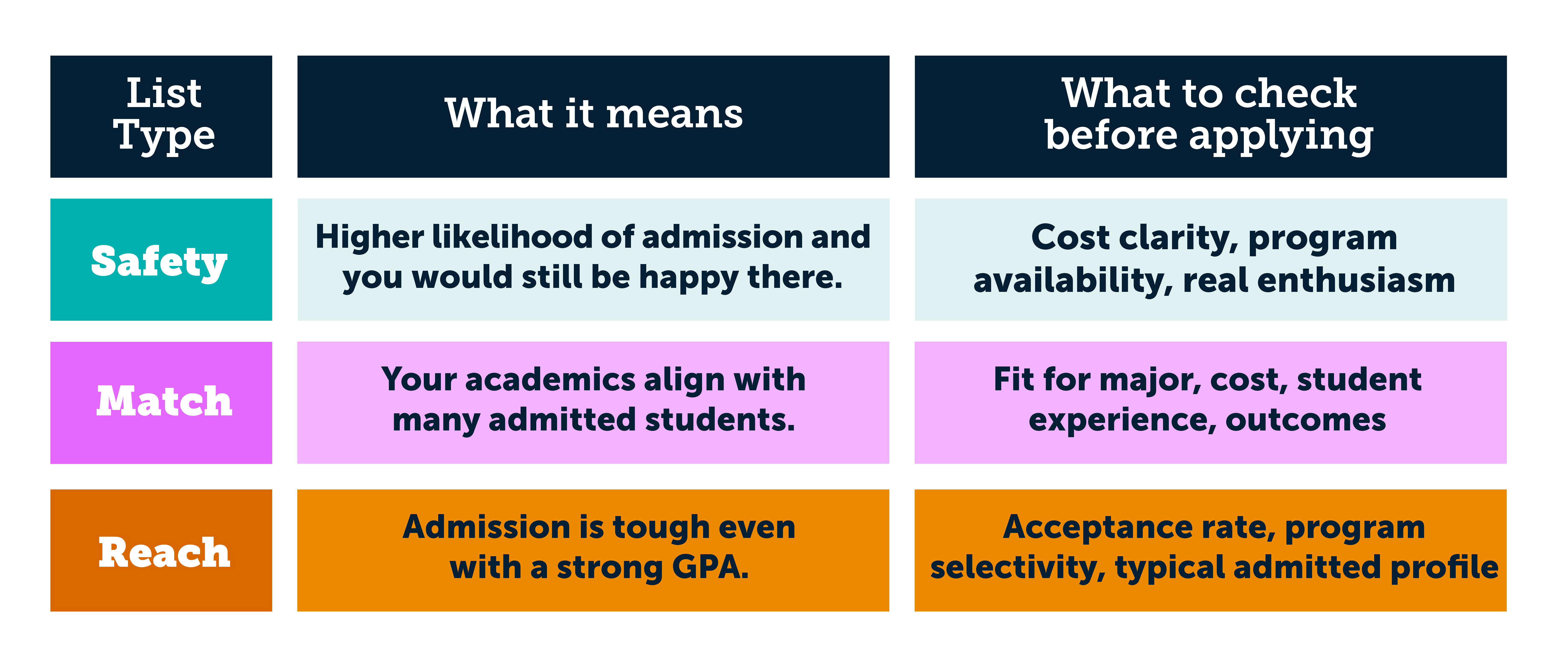
Use institutional selectivity as well as academic fit. Your list should include excellent schools where the overall admissions picture is favorable, not only institutions filled with other top academic applicants. A true safety should also work financially and offer programs and opportunities you would be willing to choose.
Can you improve a 4.0 GPA?
First determine whether the 4.0 is weighted or unweighted. At many schools, 4.0 is the maximum unweighted GPA. At schools using weighted GPA, 4.0 may not be the maximum at all.
Freshmen and sophomores
If 4.0 is the top of your unweighted scale, there is no numerical improvement to pursue. Your academic goal should be to maintain strong grades while taking appropriate opportunities for greater rigor.
Juniors
Concentrate on sustained performance and the quality of your curriculum. A perfect GPA in less-challenging courses should not automatically be assumed to be more competitive than a slightly lower GPA earned in a demanding program.
Seniors
Maintain the record, but shift more of your admissions effort toward college research, applications, affordability, and the parts of your application that distinguish you from other students with strong academics.
What should you prioritize with a 4.0 GPA?
Academic perfection is not admissions perfection. Highly selective colleges can deny applicants with flawless grades because GPA is only one part of the decision.
Most useful next step: Build a balanced list that includes reaches, matches, and genuine safety options, and use your academic strength to compare scholarship and affordability opportunities as seriously as prestige.
Can you get merit scholarships with a 4.0 GPA?
A 4.0 can make you a strong candidate for many academically based merit programs, but it does not guarantee an award. The strategic question is where your academic record creates the most value. At some highly selective institutions, many serious applicants have exceptional grades. At other colleges, your transcript may give you substantially more merit-aid leverage. Compare published scholarship criteria and actual net cost.
Do you have to earn an A in every class to have a 4.0?
Not necessarily. It depends on how your high school calculates GPA. Different grading systems can produce a 4.0 in different ways. That is one reason colleges look at the transcript and school context rather than the GPA number alone.
Can you get rejected with a 4.0 GPA?
Yes. A 4.0 is an outstanding academic credential, but not an admissions guarantee. This is especially important at highly selective institutions, where many applicants may have similarly strong academic records.
Does weighted versus unweighted GPA matter more at 4.0?
The distinction is especially important at 4.0. A 4.0 unweighted GPA may represent the top of one school’s scale, while a 4.0 weighted GPA may sit below another school’s maximum. Colleges need the transcript and high school grading context to interpret the number.
What colleges look at besides your GPA
GPA is just one aspect colleges review when looking through your college application. Make sure to include as many aspects of your high school career as possible, including any (or all) of the following:
How to use the college list
The colleges below are included because their average GPA falls within 3.9–4.0. This range is intended to surface colleges for comparison. It does not mean every listed college is a match for a student with a 4.0. A reported average GPA is not a minimum, cutoff, or guarantee of admission. Colleges may also recalculate GPA differently from your high school, and current admissions policies, program requirements, and student academic profiles can change. Use the list as a discovery tool, then verify each college’s current admissions information and compare your full academic profile, including rigor, course selection, grade pattern, intended program, and any other required application materials, before deciding whether a school is a safety, match, or reach.
Explore colleges for every GPA with Appily
Ready to explore colleges that accept a GPA like yours? We have a comprehensive database to help you find and research schools. There, you can see essential data points like acceptance rate, average financial aid award, average test scores, and application deadlines, including those for rolling admission, early decision, and early action schools.