Colleges for a 3.6 GPA
Is a 3.6 GPA good for college applications?
A 3.6 GPA is a very strong academic record for many colleges and can support a broad four-year list. At this level, the main challenge is usually not finding enough realistic colleges. It is building a list that is not unnecessarily top-heavy or expensive. Selective institutions may be realistic matches or reaches depending on the college, your course rigor, your high school context, your intended program, and the rest of your application.
How do colleges interpret a 3.6 GPA?
A 3.6 GPA needs context because high schools use different grading and weighting systems. A weighted 3.6 and an unweighted 3.6 are not directly interchangeable. Honors, AP, IB, dual-enrollment, plus/minus grades, and other policies can change the reported number. Some colleges may recalculate GPA using their own criteria. They may also consider course rigor and whether your grades are improving, stable, or declining. At 3.6, maintaining strong grades while continuing appropriate academic challenge may provide more useful context than trying to maximize the GPA through easier course choices. Compare your full academic profile with each college’s current published admissions information.
What colleges may be a good fit with a 3.6 GPA?
Many public universities, private colleges, and moderately selective institutions may be realistic options. More-selective colleges may also deserve consideration depending on your full transcript and application. Use the strength of a 3.6 to compare not only selectivity but also:
- Program quality
- Financial aid
- Merit opportunities
- Student support
- Outcomes
- Campus fit
How do you build a safety, match, and reach list with a 3.6 GPA?
Build your list conservatively and use more than GPA to decide whether a college is a safety, match, or reach.
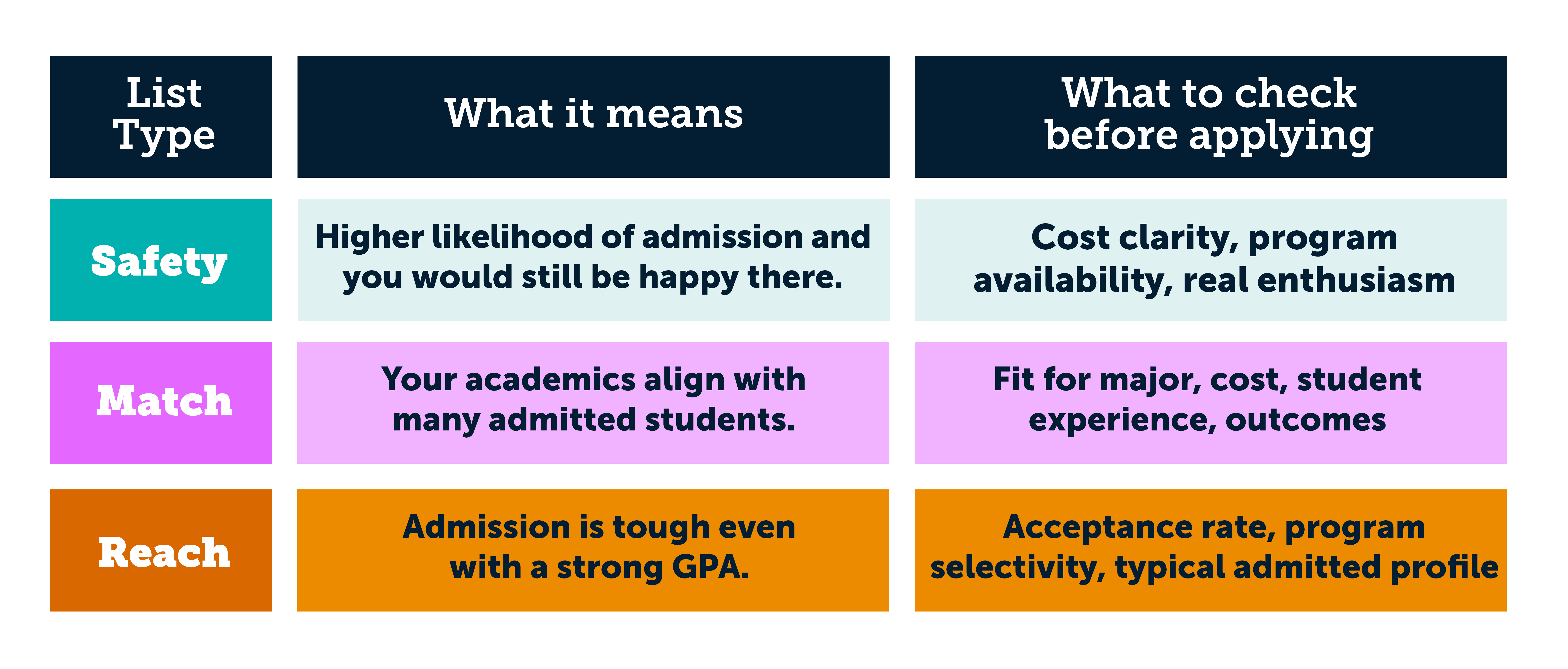
Use the advantage of a 3.6 to build attractive safety and match options rather than an unnecessarily ambitious list. A school can remain a reach even if 3.6 appears somewhere in its reported GPA data. Choose safeties you would genuinely be happy to attend and matches where your complete academic profile and the institution’s admission patterns align reasonably well.
How can you improve a 3.6 GPA?
Freshmen and sophomores
Further improvement is possible, but your goal should be continued strong performance in a suitably challenging curriculum. Do not maximize the number at the expense of meaningful academic challenge.
Juniors
Maintain or strengthen rigor while protecting your grades. A transcript that shows sustained challenge and success can provide more useful context than a tiny increase in GPA.
Seniors
Most of your academic record is established. Keep it strong while directing more energy toward college fit, applications, and cost.
What should you prioritize with a 3.6 GPA?
List quality matters more than chasing another decimal. You have enough academic strength to identify excellent colleges where you are in a favorable position, including schools that may offer merit aid.
Most useful next step: Identify strong safety and match colleges where your 3.6 creates clear academic leverage before adding ambitious reaches.
Can you get merit scholarships with a 3.6 GPA?
A 3.6 can create meaningful merit possibilities at colleges where it places you above much of the institution’s academic profile. Do not limit your search to the most-selective school that may admit you. A somewhat less-selective institution may offer a stronger financial package.
Is a 3.6 with strong rigor better than a higher GPA with easier courses?
There is no universal formula. Colleges may evaluate both grades and the academic opportunities you chose, which is why the transcript and school context are more informative than GPA alone.
Should you still try to improve a 3.6 GPA?
Yes, if improvement comes from stronger academic performance. But do not sacrifice meaningful activities, application quality, health, or appropriate academic challenge simply to chase a small decimal increase.
What colleges look at besides your GPA
GPA is just one aspect colleges review when looking through your college application. Make sure to include as many aspects of your high school career as possible, including any (or all) of the following:
How to use the college list
The colleges below are included because their average GPA falls within 3.5–3.7. That range is for discovery. It does not make those schools automatic matches. A college’s average GPA is not a minimum, cutoff, or guarantee, and the college may recalculate GPA differently from your high school. Current admission policies, program requirements, and academic profiles can also change. Verify each school’s current information and compare your full academic record before assigning a safety, match, or reach label.
Explore colleges for every GPA with Appily
Ready to explore colleges that accept a GPA like yours? We have a comprehensive database to help you find and research schools. There, you can see essential data points like acceptance rate, average financial aid award, average test scores, and application deadlines, including those for rolling admission, early decision, and early action schools.