Colleges for a 3.2 GPA
Is a 3.2 GPA good for college applications?
A 3.2 GPA is a solid starting point for a broad four-year college search. It can be competitive at many institutions while remaining below the typical academic profile at more-selective colleges. At this level, the number itself becomes less useful without transcript context. Two students with 3.2 GPAs may have taken very different courses, shown different grade trends, or performed differently in core academic subjects. Your college strategy should therefore combine GPA with rigor, program requirements, selectivity, affordability, and fit.
How do colleges interpret a 3.2 GPA?
A 3.2 GPA must be understood in the context of your high school’s grading system. A weighted 3.2 and an unweighted 3.2 are not directly interchangeable. Honors, AP, IB, dual-enrollment, plus/minus grades, and other policies can change the GPA reported on your transcript. Some colleges may recalculate GPA using their own criteria. They may also consider the rigor of your courses and whether your grades are improving, stable, or declining. At 3.2, course selection, core-subject performance, and grade trajectory can meaningfully distinguish one academic profile from another. Compare your full record with each college’s current published admissions information.
What colleges may be a good fit with a 3.2 GPA?
Regional public universities, private colleges with moderate selectivity, and a wide range of other four-year institutions may be reasonable possibilities. More-selective universities may still be reaches. If you are considering a competitive major, research that program separately. Admission expectations for nursing, engineering, business, or other programs may differ from the university overall.
How do you build a safety, match, and reach list with a 3.2 GPA?
Build your list conservatively and use more than GPA to decide whether a college is a safety, match, or reach.
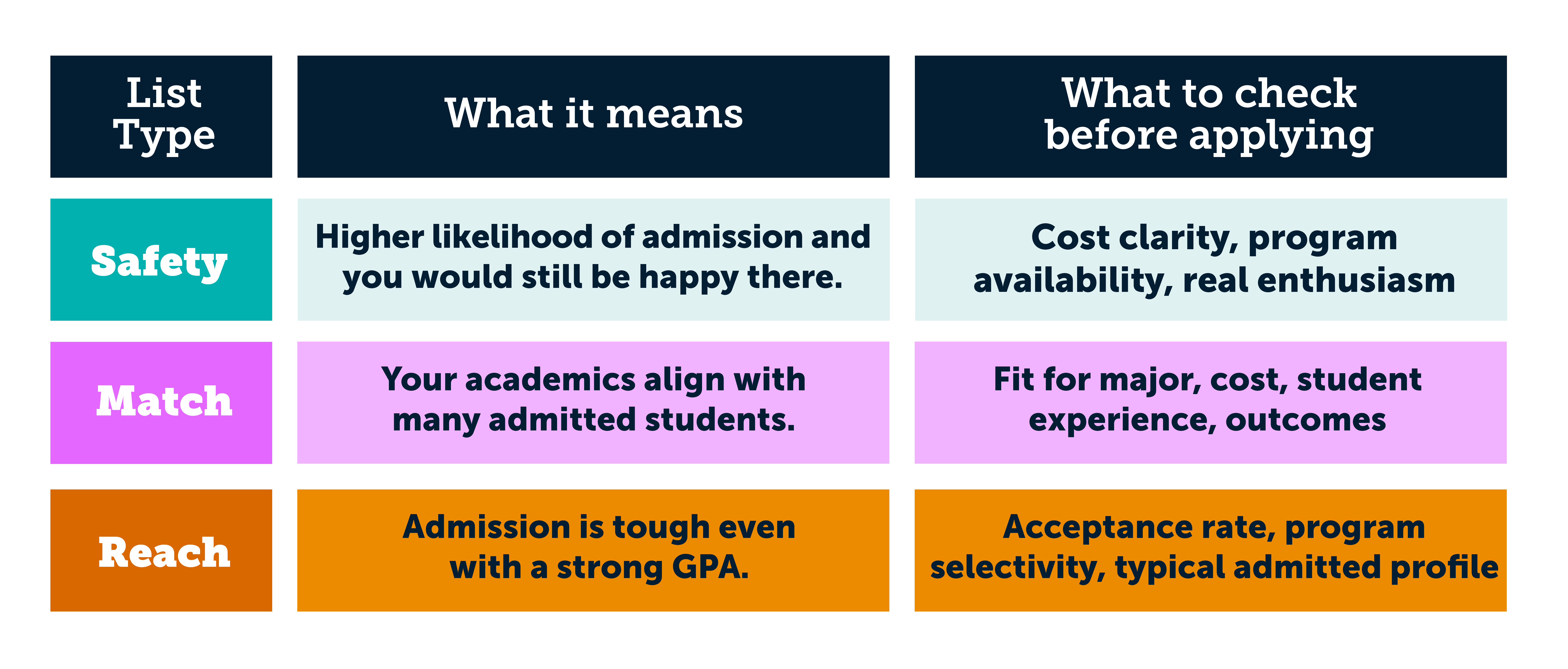
A 3.2 can support a healthy mix of safety, match, and reach schools. Safeties should be institutions where your complete academic record sits comfortably within expectations. Matches may include colleges where your overall profile is reasonably similar to current students. Schools where typical academic records are notably stronger should remain reaches.
How can you improve a 3.2 GPA?
Freshmen and sophomores
A continued upward trend can move you into a stronger academic position. Choose increasingly challenging coursework when you are prepared to succeed in it.
Juniors
Course rigor and grades now need to work together. A more challenging schedule can add context, but not if the added difficulty produces a significant academic decline.
Seniors
Focus on keeping the transcript stable and making strong college choices rather than attempting a last-minute academic reinvention.
What should you prioritize with a 3.2 GPA?
Look at the transcript behind the number. Where were your strongest grades? How challenging was your schedule? Are your grades improving? Are there weak core subjects that still need attention? Those answers can help you decide whether your next lever should be GPA improvement, greater rigor, application strategy, or college-list refinement.
Most useful next step: Compare several colleges where a 3.2 fits differently and see how course rigor, major requirements, and overall selectivity change your position.
Can you get merit scholarships with a 3.2 GPA?
Merit programs are increasingly worth researching at this range, but eligibility and award size remain college-specific. A 3.2 may position you strongly at one institution and fall below a scholarship threshold at another. Search broadly and compare total net cost.
Should you choose easier courses to protect a 3.2 GPA?
Not automatically. Colleges may consider academic challenge along with grades. Choose courses that are rigorous enough to challenge you while still giving you a realistic chance to succeed.
Is a 3.2 enough for a flagship state university?
There is no single answer. Public flagship universities range widely in selectivity, and some majors are more competitive than the institution overall. Check the university’s current admissions data and program requirements rather than relying on the “flagship” label.
What colleges look at besides your GPA
GPA is just one aspect colleges review when looking through your college application. Make sure to include as many aspects of your high school career as possible, including any (or all) of the following:
How to use the college list
The colleges below are included because their average GPA falls within 3.1–3.3. This range is a research tool, not an admission cutoff. A reported average GPA is not a minimum or guarantee. Colleges may recalculate GPA differently, and admissions policies, program requirements, and student profiles can change. Use the list to discover schools, then compare your complete academic record with each institution’s current published information before categorizing it as a safety, match, or reach.
Explore colleges for every GPA with Appily
Ready to explore colleges that accept a GPA like yours? We have a comprehensive database to help you find and research schools. There, you can see essential data points like acceptance rate, average financial aid award, average test scores, and application deadlines, including those for rolling admission, early decision, and early action schools.