Colleges for a 2.1 GPA
Is a 2.1 GPA good for college applications?
A 2.1 GPA can support admission at some colleges, but it will generally give you fewer four-year options than a stronger academic record. That makes recent performance and a realistic college list especially important. At this GPA, the most useful question is not whether 2.1 is “good” or “bad.” It is whether your transcript is stabilizing or improving and which colleges or pathways fit the record you have now. If you still have several semesters left, consistent improvement can meaningfully change both your cumulative GPA and the story your transcript tells.
How do colleges interpret a 2.1 GPA?
A 2.1 GPA does not mean exactly the same thing at every high school or college. GPA scales vary, and a weighted 2.1 and an unweighted 2.1 are not directly interchangeable. Honors, AP, IB, dual-enrollment, plus/minus grades, and local grading policies can all affect the GPA reported on your transcript. Some colleges may also recalculate GPA using their own rules or focus on particular academic subjects. They may consider course rigor, the classes available at your high school, and whether your grades are improving, stable, or declining. At 2.1, a sustained upward trend can be especially useful because stronger recent work may show that earlier grades are not the best reflection of your current academic habits. Compare your full academic profile with each college’s current published admissions information.
What colleges may be a good fit with a 2.1 GPA?
Broad-access public and private colleges, two-year colleges, and institutions with flexible or alternative admission pathways may all be worth researching. When comparing schools, ask:
- "Do I meet any published GPA or coursework requirements?"
- "Does my intended major have separate criteria?"
- "Does the college offer an alternative or transfer pathway?"
- "Does my recent academic record show stronger preparation than my cumulative GPA alone?"
Do not assume that a college reporting an average GPA near 2.1 has a 2.1 admission requirement. An average describes a group of students. It does not create a cutoff.
How do you build a safety, match, and reach list with a 2.1 GPA?
Build your list conservatively and use more than GPA to decide whether a college is a safety, match, or reach.
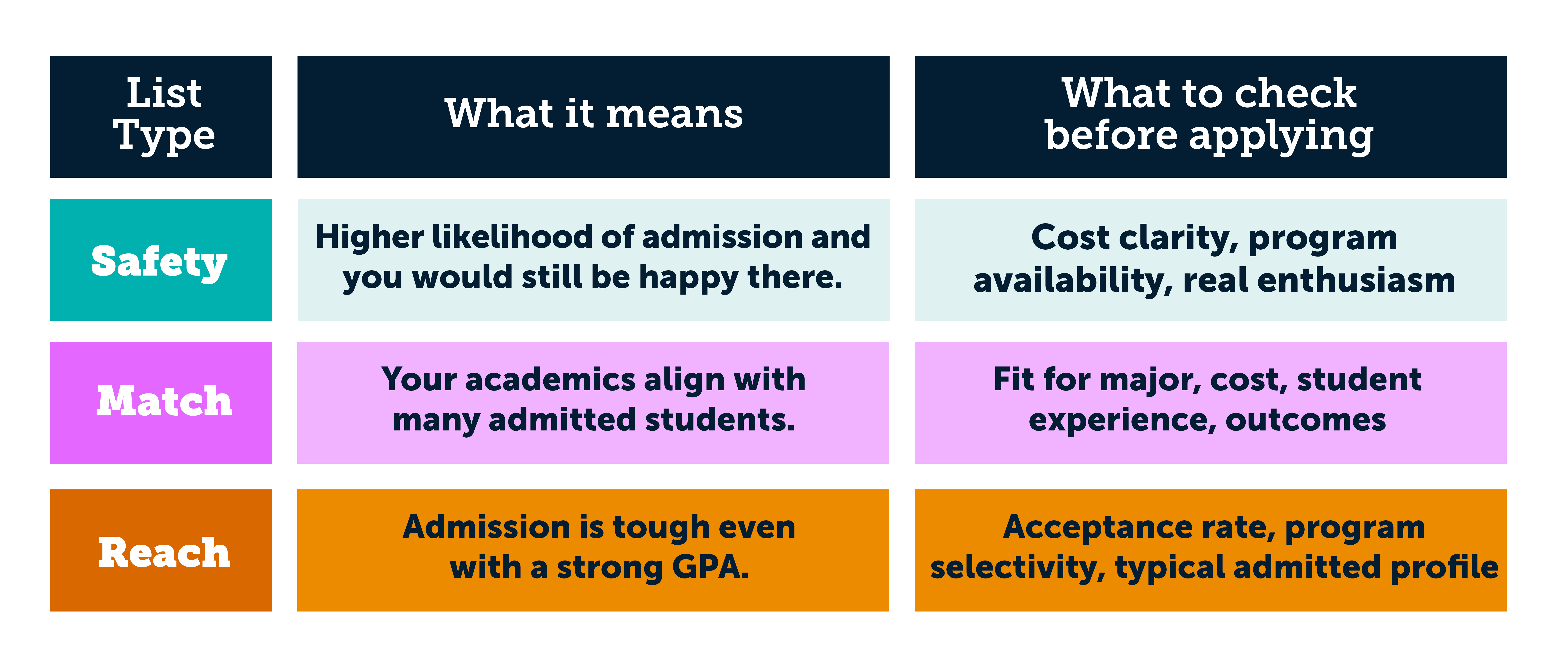
- Safeties should be colleges where your current academic record comfortably meets published requirements.
- Matches may include institutions where your grades, coursework, and overall academic profile are reasonably aligned with current students.
- Reaches include colleges with substantially stronger academic profiles or more competitive admission.
Do not rely on future GPA improvement when deciding which schools are safe today.
How can you improve a 2.1 GPA?
Freshmen and sophomores
You still have meaningful room for cumulative improvement. Focus first on turning recurring low or failing grades into steady passing grades, then work toward stronger performance. A consistent record is more useful than alternating between very strong and very weak semesters.
Juniors
The cumulative GPA may move more slowly, but a stronger junior-year record can still add important context. Identify the courses or habits creating the greatest drag on your transcript and address those before trying to improve every part of your application at once.
Seniors
Protect any progress you have made. A late academic decline can weaken the upward story you want your transcript to show. Finish graduation requirements successfully and apply to colleges that make sense for your current record.
What should you prioritize with a 2.1 GPA?
Stability comes first. A dependable recent academic record is more valuable than adding harder courses, test preparation, or extracurricular commitments that leave you unable to keep up with schoolwork.
Most useful next step: Identify the two or three classes or academic habits causing the most trouble and make a concrete plan with a teacher, counselor, tutor, or other support person.
Tips for your college search and planning with a 2.1 GPA
|
|
|
|
|
|
Can you get merit scholarships with a 2.1 GPA?
Some scholarships may be available, but GPA-based merit awards should not be the center of your affordability strategy.
Search across:
- Need-based aid
- Local scholarships
- Community and service awards
- Talent-based scholarships
- Employer- or organization-sponsored awards
- Scholarships connected to an intended major or career
Always check the published eligibility requirements.
Should I take harder classes with a 2.1 GPA?
Choose appropriate rigor, not difficulty for its own sake. Successfully completing a somewhat more challenging course can strengthen your record, but overloading yourself and lowering your grades further is unlikely to help. Academic stability should come first.
Can stronger junior-year grades change how a 2.1 is viewed?
They can provide meaningful context even if the cumulative GPA changes slowly. A sustained pattern of better grades may show academic growth and improved preparation. No college uses one universal formula, so continue comparing your full record with each institution’s current requirements.
What colleges look at besides your GPA
GPA is just one aspect colleges review when looking through your college application. Make sure to include as many aspects of your high school career as possible, including any (or all) of the following:
How to use the college list
The colleges below are included because their average GPA falls within 2.0–2.2. That range is intended to help you discover schools for further research. It is not an admissions cutoff or statement that students with a 2.1 are automatically eligible. A reported average GPA is not a minimum or admission guarantee, and a college may recalculate GPA differently from your high school. Admissions policies, program requirements, and student academic profiles can also change. Use the list to find possibilities, then verify each college’s current admissions information and compare your full academic profile, including coursework, course rigor, and grade trend, before deciding whether the school is a safety, match, or reach.
Explore colleges for every GPA with Appily
Ready to explore colleges that accept a GPA like yours? We have a comprehensive database to help you find and research schools. There, you can see essential data points like acceptance rate, average financial aid award, average test scores, and application deadlines, including those for rolling admission, early decision, and early action schools.