Colleges for a 2.0 GPA
Is a 2.0 GPA good for college applications?
A 2.0 GPA can make admission to some four-year colleges more challenging, but it does not mean college is off the table. On a common unweighted 4.0 scale, a 2.0 generally reflects a record with a substantial number of C-level grades. Your best options will depend on how your high school calculates GPA, your course history and grade trend, each college’s current admission requirements, and the pathways you are willing to consider. Broad-access four-year colleges, community colleges, and transfer pathways can all be worth exploring. The goal is not to find a college based on GPA alone. It is to build a realistic list of options where your full academic record fits the school’s current requirements and where you have a strong opportunity to succeed.
How do colleges interpret a 2.0 GPA?
Colleges do not necessarily interpret a 2.0 GPA exactly as your high school reports it. GPA scales and weighting rules vary by high school, so a weighted 2.0 and an unweighted 2.0 are not directly interchangeable. Honors, AP, IB, dual-enrollment, plus/minus grades, and other local policies can all affect the number on your transcript. Some colleges also recalculate GPA using their own criteria, such as particular academic subjects or their own approach to course weighting. Colleges may also consider:
- The academic courses you completed
- The rigor of the courses available to you
- Whether your grades are improving, holding steady, or declining
- Whether you meet required high school coursework or other published admission criteria
With a 2.0, an upward grade trend can provide especially useful context because the cumulative GPA may reflect earlier academic difficulty more strongly than your recent performance. Compare your full academic profile, not just the GPA number, with each college’s current published admissions information.
What colleges may be a good fit with a 2.0 GPA?
Students with a 2.0 GPA may find options at broad-access four-year colleges, community colleges, and institutions whose published admission requirements fit their academic record. Before adding a college to your list, check:
- Whether it publishes a minimum GPA or other academic requirements
- Whether you completed the required high school courses
- Whether your intended major has separate admission criteria
- What the college reports about recently admitted or enrolled students
- Whether there are transfer or alternative admission pathways
Community college can be a strategic option rather than simply a backup. Strong college performance gives future transfer institutions a college academic record to evaluate.
What to avoid: Do not apply to a school only because its reported average GPA looks similar to yours, and do not assume a school is automatically out of reach based on GPA alone.
How do you build a safety, match, and reach list with a 2.0 GPA?
Build your list conservatively and use more than GPA to decide whether a college is a safety, match, or reach.
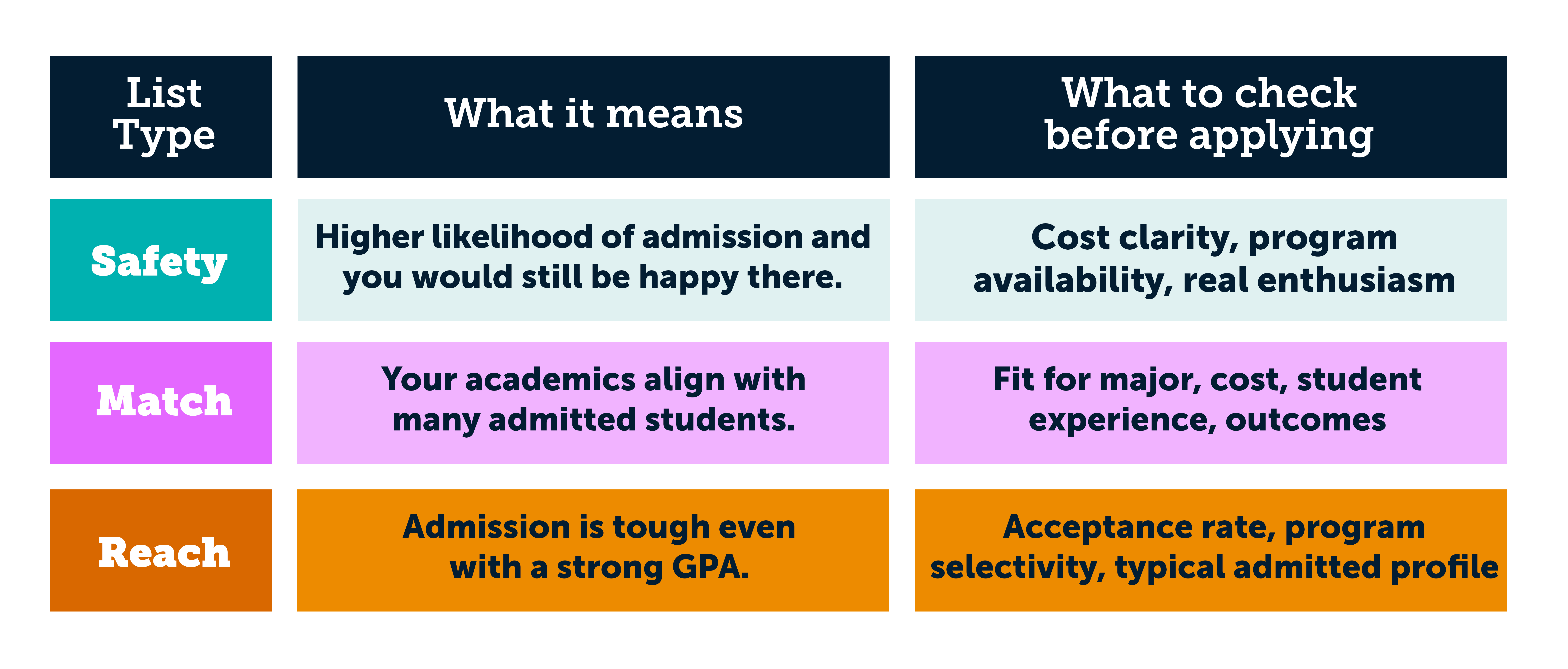
- Safety schools should have current academic requirements your full record comfortably meets. A similar average GPA alone does not make a school a safety.
- Match schools may include institutions where your academic profile reasonably resembles that of current students and you meet any published requirements.
- Reach schools include colleges where typical academic records are substantially stronger or other admission factors make acceptance less predictable.
A safety is not an admission guarantee. Check required coursework, program-specific criteria, GPA information, course rigor, grade trend, and any other application requirements.
How can you improve a 2.0 GPA?
What you can realistically change depends on how much high school you have left. Improving your grades can strengthen your transcript even when your cumulative GPA does not rise dramatically.
Freshmen and sophomores
You have the most academic runway. Several semesters of stronger grades can change your cumulative GPA and show that your current performance is different from your earlier record. Focus first on:
- Avoiding failed or incomplete courses
- Improving performance in core academic subjects
- Getting help early when you are struggling
- Building study and assignment habits you can maintain
Juniors
You have fewer completed credits left to influence the cumulative number, so do not build your plan around reaching one specific GPA. A sustained upward trend can still strengthen the transcript. Prioritize successful performance in graduation and college-preparatory requirements.
Seniors
A dramatic cumulative change is usually less realistic because most of your high school coursework is already complete. Finish as strongly as possible and build applications around colleges and pathways that fit the record you have now.
What should you prioritize with a 2.0 GPA?
Academic recovery should generally come before adding activities purely for admissions purposes. Improving classroom performance, completing required courses, and creating a realistic college plan are likely to be more useful than adding another activity just to make the application look busier.
Most useful next step: Meet with your school counselor to identify any academic or graduation requirements that still need attention. Then build a plan that includes at least one pathway you can pursue confidently with your current record.
Can you get scholarships with a 2.0 GPA?
A 2.0 GPA does not automatically rule you out of scholarships, but scholarships with higher academic requirements may not be a fit. Search for opportunities based on factors such as:
- Financial need
- Community service
- Employment or work experience
- Talents or extracurricular activities
- Intended major or career field
- Local residency
- Employer, organization, or community connections
Check every scholarship’s current eligibility rules because some still require a minimum GPA even when grades are not the primary selection factor. Use Appily’s scholarship tools to look for opportunities that match more than your GPA alone.
Should I explain a 2.0 GPA in my application?
Explain your GPA when there is meaningful context that helps an admissions reader understand your academic record. Illness, significant family responsibilities, school disruption, or another circumstance may be worth explaining if it materially affected your grades. Keep the explanation brief, factual, and focused on what happened and what changed. For example, if a health issue contributed to a semester-long decline and your grades improved afterward, that pattern may be useful context. You usually do not need to explain every low grade individually or turn the explanation into a defense of your transcript.
Is starting at a two-year college a bad outcome?
No. Starting at a two-year college can be a practical pathway to a bachelor’s degree, especially if you want another opportunity to demonstrate academic readiness. If transfer is your goal, research potential four-year colleges early so you understand current transfer requirements, credit policies, and any formal transfer agreements.
What colleges look at besides your GPA
GPA is just one aspect colleges review when looking through your college application. Make sure to include as many aspects of your high school career as possible, including any (or all) of the following:
How to use the college list
Use the colleges below as a starting point for research, not as a guaranteed-admission list. The schools shown on this page are included because their average GPA falls within 2.0–2.1. That range is intended to surface colleges for comparison. It is not an admissions eligibility rule. A reported average GPA is not a minimum, cutoff, or guarantee of admission. Students above or below that average may be admitted, and a college may calculate or evaluate GPA differently from your high school. Admissions policies, program requirements, and admitted-student academic profiles can change. Before adding a school to your list:
- Review its current admissions requirements.
- Check for major- or program-specific criteria.
- Compare your full academic profile, including coursework, rigor, and grade trend.
- Consider affordability, academic programs, and student support.
- Decide whether it belongs on your safety, match, or reach list using more than GPA alone.
Ready to explore your options? Use the colleges below to identify schools worth researching, then verify each college’s current requirements before adding it to your list.
Explore colleges for every GPA with Appily
Ready to explore colleges that accept a GPA like yours? We have a comprehensive database to help you find and research schools. There, you can see essential data points like acceptance rate, average financial aid award, average test scores, and application deadlines, including those for rolling admission, early decision, and early action schools.