How to Transfer Colleges

Thinking of transferring colleges?
First, know this: you're not alone. Every year, more than a million students transfer schools. Some are looking for a better academic fit. Others want lower costs, a new location, a change of scenery, or just a campus that feels more like home.
If you've been asking yourself "how do I transfer colleges?" or you're wondering how transferring colleges even works, the process is more straightforward than it might seem. It just takes planning and a little clarity about what you want next.
Let's walk through it.
Why do students transfer colleges?
Students transfer for all kinds of reasons, and most of them are completely valid. Sometimes it's academic. Maybe you discovered a new major your current school doesn't offer. Sometimes it's financial. Maybe another institution makes more sense long term. And sometimes it's about fit. You can like a school and still realize it isn't the right place for you.
Choosing a college at 17 or 18 doesn't lock you into that decision forever. People grow. Things change. Your priorities and what you want out of your college experience can shift. Transferring universities can simply be a part of finding where you belong.
How does transferring colleges actually work?
At its core, transferring colleges means completing some coursework at one institution and then enrolling at another. You'll apply as a transfer student rather than a first-year applicant, and the school will evaluate your college transcript instead of (or in addition to) your high school record.
The process usually looks something like this: you research new schools, confirm how your credits will transfer, submit a transfer application and transcripts, review your financial aid package, and then decide whether to enroll.
Each college has its own policies and deadlines, but the overall structure tends to follow that path.
So now the question is, how do you make it happen? Well, we've broken the whole process down to a few steps, starting right at the core of your decision to transfer in the first place.
Step One: Get Clear on Your "Why"
Before you start filling out applications, take a moment to reflect.
What isn’t working at your current college? Is it the academic environment? The social scene? The cost? Your answer matters, because transferring only helps if the next school solves the issue.
Being honest with yourself now will help you avoid repeating the same frustration somewhere new.
Step Two: Research Transfer-Friendly Colleges
Not all schools approach transfer students the same way. Some actively recruit transfer applicants and have strong support systems in place. Others are more selective or limit the number of credits they accept.
As you research, pay attention to transfer acceptance rates, minimum GPA requirements, and whether the school has clear information about how credits transfer. Keep an eye out for articulation agreements (or browse our course equivalency directory). These can make the transition much smoother.
Step Three: Understand How Credit Transfer Works
One of the biggest concerns students have is whether their credits will transfer, and well, that’s a smart question to ask.
In general, general education courses are more likely to transfer than specialized major courses. Classes where you earned below a C often won’t count. Even when credits transfer, they may not always apply directly toward your new major, which can affect your graduation timeline.
Before committing to a new school, ask for a credit evaluation. Find out exactly how many of your completed credits will apply and whether transferring will extend your time in college.
Step Four: Complete the Transfer Application
Transfer applications typically require your college transcripts, and sometimes your high school transcript as well. Many schools also ask for a personal statement explaining why you want to transfer. Some may request recommendation letters.
A growing number of colleges use the Common App’s transfer application, while others have their own systems. Deadlines can vary (for example, fall transfer deadlines often arrive earlier than students expect) so keep an eye on those dates.
Step Five: Review Financial Aid Carefully
Transferring colleges can change your financial situation in ways you might not anticipate.
Scholarships from your current school typically don’t transfer. However, many colleges offer scholarships specifically for transfer students. Before making a decision, compare the full cost of attendance (tuition, housing, fees, and aid), and remember to fill out your FAFSA to make sure the move makes financial sense.
When is the best time to transfer colleges?
Many students transfer after their first year, while others do so after completing two years, especially if they're moving from a community college to a four-year university.
Earlier transfers can sometimes make credit alignment easier, but there isn't a single "right" time. The best time to transfer is when you're confident the change will meaningfully improve your experience and help you achieve your goals.
Is transferring colleges a bad thing?
Not at all.
In fact, nearly one in three students transfers at least once during their college career. Admissions offices understand this, and employers rarely view it negatively. What matters most is how you frame your decision. It should always be a thoughtful step toward better alignment, not an impulsive reaction.
Transferring colleges isn't about starting over. It's about moving forward more intentionally.
The pros and cons of transferring universities
Like any big decision, transferring has trade-offs.
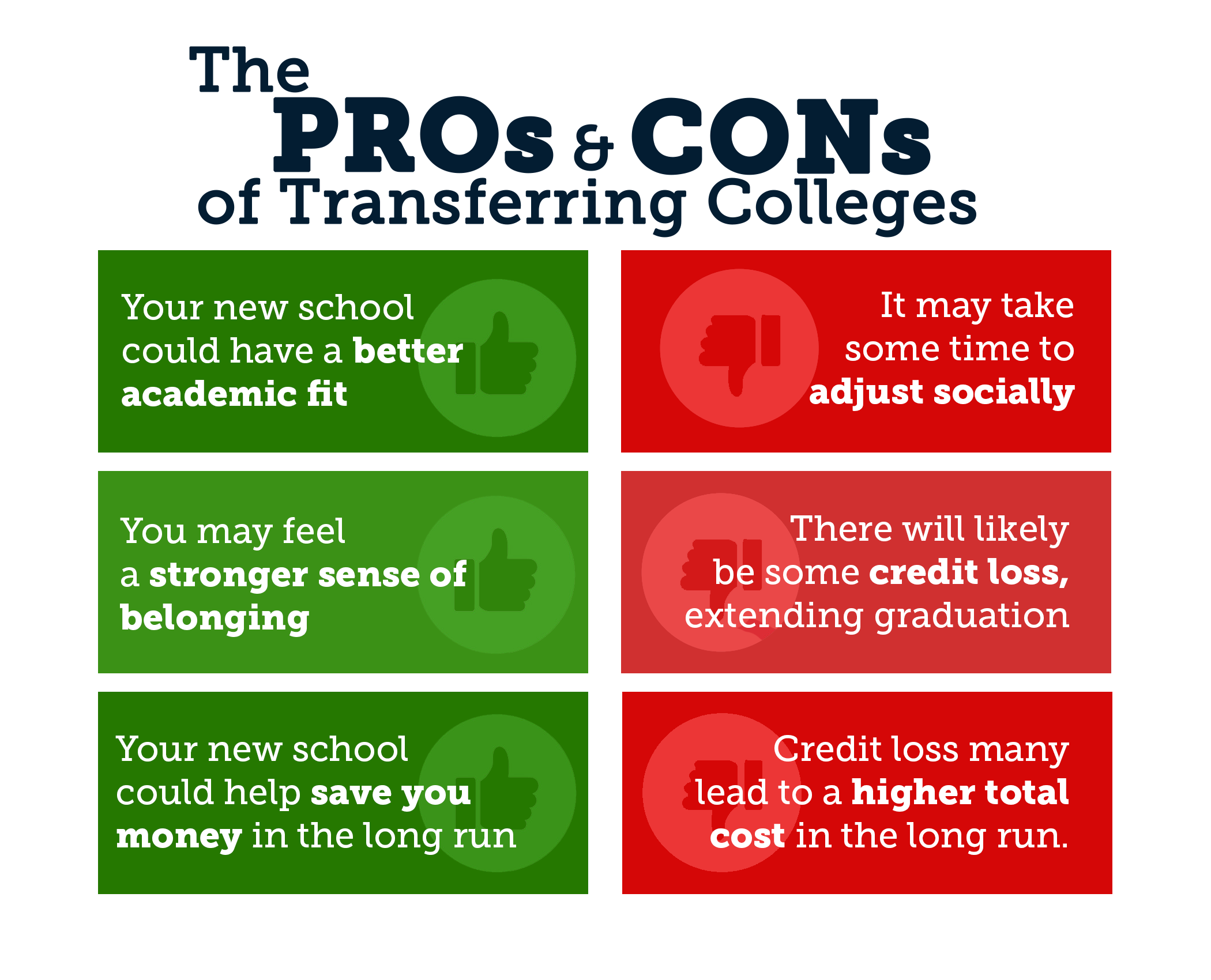
Some of the pros could be that it can mean a better academic fit, a stronger sense of belonging, or improved affordability.
On the flip side, it can also mean adjusting socially, navigating credit loss, or potentially extending your time to graduation. According to the National Center for Education Statistics, about one-third of first-year students transfer colleges, and have a 70% chance of losing some or all of their previously earned credit when transferring. So you'll want to keep that in the back of your mind.
If you're curious about whether your credits will transfer, check out our directory of transfer articulation agreements.
The key is weighing those factors honestly. If the benefits clearly outweigh the downsides, transferring may be the right call.
TL;DR: How to Transfer Colleges
If you’re thinking about transferring, start by clarifying why you want to move. Research schools carefully, confirm how your credits will transfer, understand application requirements and deadlines, and compare financial aid offers before committing. Transferring colleges is common and often a smart move when it leads to a better academic or personal fit.
Know which college is right for you
There are a ton of amazing schools out there, and you can be wildly happy and successful once you find the right fit. If you think it might be time to consider a different college, stay organized while searching for your perfect match with Appily.
When you create a profile and add schools in Appily, we’ll organize your list for you and even give you curated recommendations based on what you’re looking for in a college. You can search for scholarships and see your favorite school’s transfer acceptance rates. Appily makes it easy to find the college that’s right for you.
Click the link below to let us know your preferences, and we’ll show you your perfect college match!
FAQs about transferring colleges
How will transferring credits affect my GPA?
Transferring credits typically does not have a direct impact on your GPA. When you transfer credits from one institution to another, the grades earned in the transferred courses are usually not factored into your GPA at the new school.
How long will it take to transfer credits?
It can range from a few weeks to several months. The timeline is influenced by factors such as the responsiveness of the transferring and receiving institutions, the complexity of credit evaluation, and the availability of documentation. It is wise to start the credit transfer process as early as possible to allow ample time for the evaluation and processing of credits.
Can community college credits be transferred to 4-year colleges?
Yes, especially if the college has an articulation agreement with a 4-year college. Most students take general education courses in community college to assure the credits transfer.
Is transferring from online schools the same process?
As long as both colleges hold accreditation, transferring colleges involves the same process, whether moving between online schools or in-person institutions. Articulation agreements can provide smooth transfer between schools no matter their course delivery method.
Most online schools feature transfer-friendly policies since they often cater to working professionals and students who are returning to complete their degrees. Online programs may also be more accepting of transfer credits from alternative sources, including military training and professional experiences.
Visit our “College Transfer Center” for more frequently asked questions, expert advice, pertinent articles, and student transfer stories.
