Colleges for a 2.7 GPA
Is a 2.7 GPA good for college applications?
A 2.7 GPA can make a substantial group of four-year colleges worth exploring, although it will remain below the typical academic profile at many selective institutions. At this level, you should be building a real four-year college list now rather than waiting to see whether you can reach 3.0. If enough coursework remains, moving into the upper 2s or low 3s may be realistic. But the value of reaching 3.0 depends on whether an actual college, program, or scholarship you care about uses that threshold.
How do colleges interpret a 2.7 GPA?
A 2.7 GPA must be interpreted in the context of your high school’s grading system. Weighted and unweighted GPAs are not directly interchangeable, and high schools differ in how they treat honors, AP, IB, dual-enrollment, plus/minus grades, and other coursework. Some colleges may also recalculate GPA using their own criteria. They may consider course rigor and whether your grades are improving, holding steady, or declining. At 2.7, colleges may see a meaningful difference between a student who has remained at roughly the same level and one whose grades have steadily improved toward it. Compare your full academic profile with each institution’s current published information.
What colleges may be a good fit with a 2.7 GPA?
Regional public universities, moderately accessible private colleges, and institutions with broader admission can all be part of your search. Check your intended program separately. Nursing, engineering, business, and other competitive majors may have admission requirements that differ from the university overall. Also compare affordability and academic support, not just whether admission appears possible.
How do you build a safety, match, and reach list with a 2.7 GPA?
Build your list conservatively and use more than GPA to decide whether a college is a safety, match, or reach.
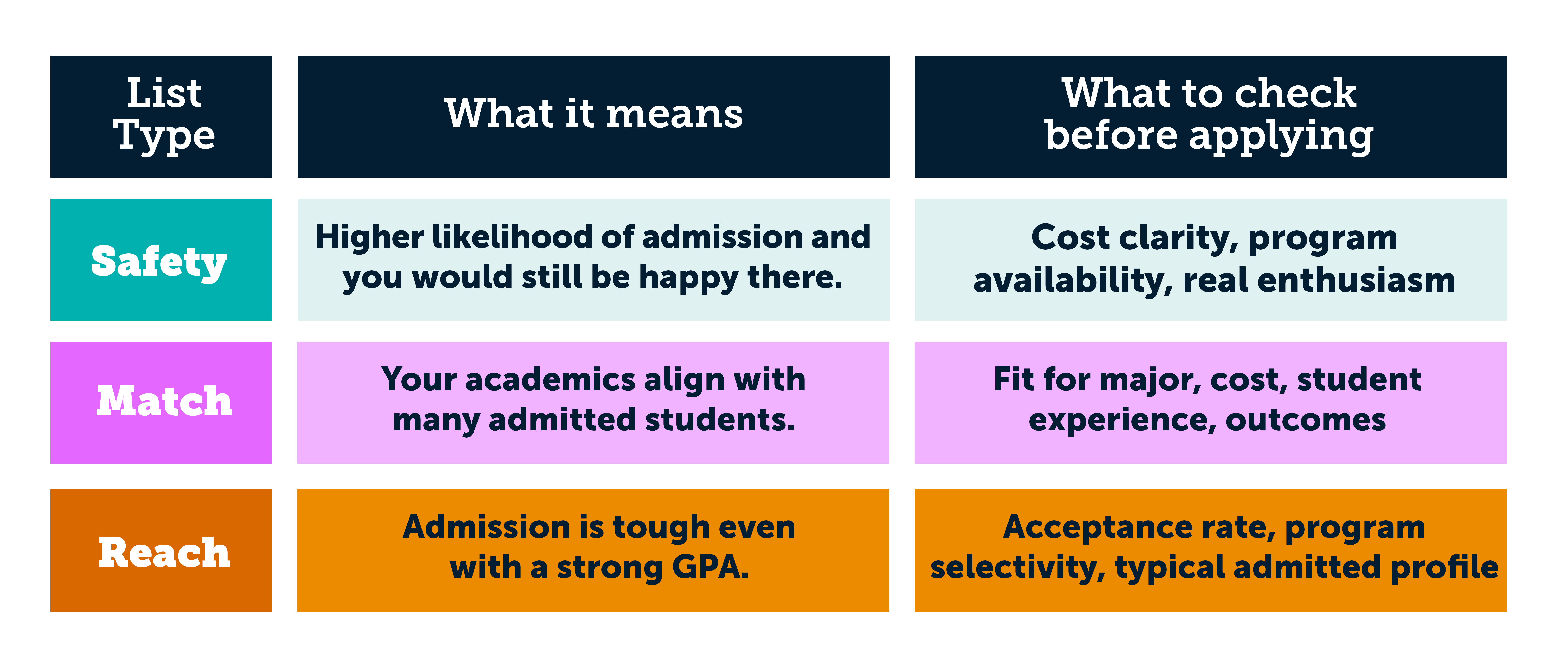
Matches may include colleges whose current student profiles broadly resemble yours and whose overall admissions process is realistic. More-selective institutions or schools where typical students have substantially stronger academic records should remain reaches.
How can you improve a 2.7 GPA?
Freshmen and sophomores
You have time for steady improvement to change your cumulative GPA significantly. Building consistent B-range performance where realistic may create more options later.
Juniors
A stronger junior year can improve both the GPA and the grade trend. Begin college research at the same time instead of waiting to see your final number.
Seniors
Focus on preserving academic momentum and applying to colleges that fit the record you have now. Do not delay applications while hoping to cross a particular decimal.
Should you aim for a 3.0?
Only after determining whether it is mathematically realistic and strategically useful. A 3.0 can matter when a college or scholarship uses it as an actual threshold. Otherwise, stronger grades themselves matter more than the appeal of a round number.
Most useful next step: Ask your counselor what cumulative GPA outcomes are realistic, then build your college list around your current record rather than a best-case future number.
Can you get merit scholarships with a 2.7 GPA?
Merit opportunities may be available, but do not assume a 2.7 meets an academic requirement. Verify each scholarship separately and compare the total net price of your college options, not just the amount of any individual award.
Should you use test-optional admission with a 2.7 GPA?
That depends on the college’s current testing policy and whether your score strengthens your application. If a college accepts test scores and your result compares favorably with the data it publishes, submitting may add useful academic evidence. A score should not be treated as a replacement for the transcript.
What colleges look at besides your GPA
GPA is just one aspect colleges review when looking through your college application. Make sure to include as many aspects of your high school career as possible, including any (or all) of the following:
How to use the college list
The colleges below are included because their average GPA falls within 2.6–2.8. This is a comparison range, not an admissions rule. A reported average is not a minimum GPA or guarantee that a student with a 2.7 will be admitted. Colleges may evaluate or recalculate GPA differently, and admission policies, program requirements, and academic profiles can change. Verify each school’s current information and compare your full academic record before categorizing it as a safety, match, or reach.
Explore colleges for every GPA with Appily
Ready to explore colleges that accept a GPA like yours? We have a comprehensive database to help you find and research schools. There, you can see essential data points like acceptance rate, average financial aid award, average test scores, and application deadlines, including those for rolling admission, early decision, and early action schools.