How to Make a College List with Safety, Match, and Reach Schools

It’s completely normal to feel stressed about building your college list, especially when you’re not sure how your chances stack up. The good news? There’s a smart way to plan your applications so you can dream big while also staying realistic. It all starts with understanding safety, match (target), and reach schools.
TLDR: List-making strategy recap
- Aim for 8–12 applications: balance reach, match, and safeties.
- Add “extreme reaches” with ultra-low admission rates, but pair them with solid safeties.
- Define financial safety: use each school’s net‑price calculator to estimate true affordability.
- Fight Undermatching: ensure you include and apply to aspirational but realistic schools.
- Check program competitiveness: even safeties may be selective in majors like engineering or nursing.
- Leverage data tools: use NPCs, Appily, College Board, and chancing engines to compare your stats to admitted students.
- Verify campus fit: take virtual and in-person tours, talk to students, explore resources, and tailor essays to each school's culture.
What are safety, match, and reach schools?
Safety, match, and reach schools are categories that help you organize your college list based on how likely you are to get in. The goal is to build a college list that includes all three, ensuring you have strong options regardless of the outcome. Here’s how we define the three:
Safety schools: You are highly likely to be admitted
A safety school (sometimes called a likely school) is one where your academic profile (GPA, test scores, and class rank) places you well above the average admitted student. If your numbers fall at or above the 75th percentile, and the school has an acceptance rate of over 70%, it's likely a safety school.
But don’t pick a safety school just because it’s “easy” to get into. Your safety schools should still offer programs, a campus culture, and affordability that make them a genuine fit. Try to include two to three safety schools you’d be truly happy to attend.
Match (target) schools: You are likely to be competitive
A match school (sometimes called a target school) is one where your academic stats align closely with those of admitted students, typically between the 25th and 75th percentiles. These schools have an acceptance rate around 40–70%, giving you a realistic, though not guaranteed, chance of admission.
You should apply to 3-4 match schools that reflect your academic goals, social preferences, and budget.
Reach schools: Admission is unlikely but possible
A reach school is one where your academic profile falls below the 25th percentile of admitted students, or the school has an extremely low acceptance rate, usually under 25%, and sometimes under 10%. These include highly selective institutions where many qualified students are still denied.
Apply to 2–3 reach schools that excite you. These should be ambitious choices, not impossible ones. Remember, a compelling essay, standout extracurriculars, or unique personal experiences can sometimes make a difference, even at your most competitive reach schools.
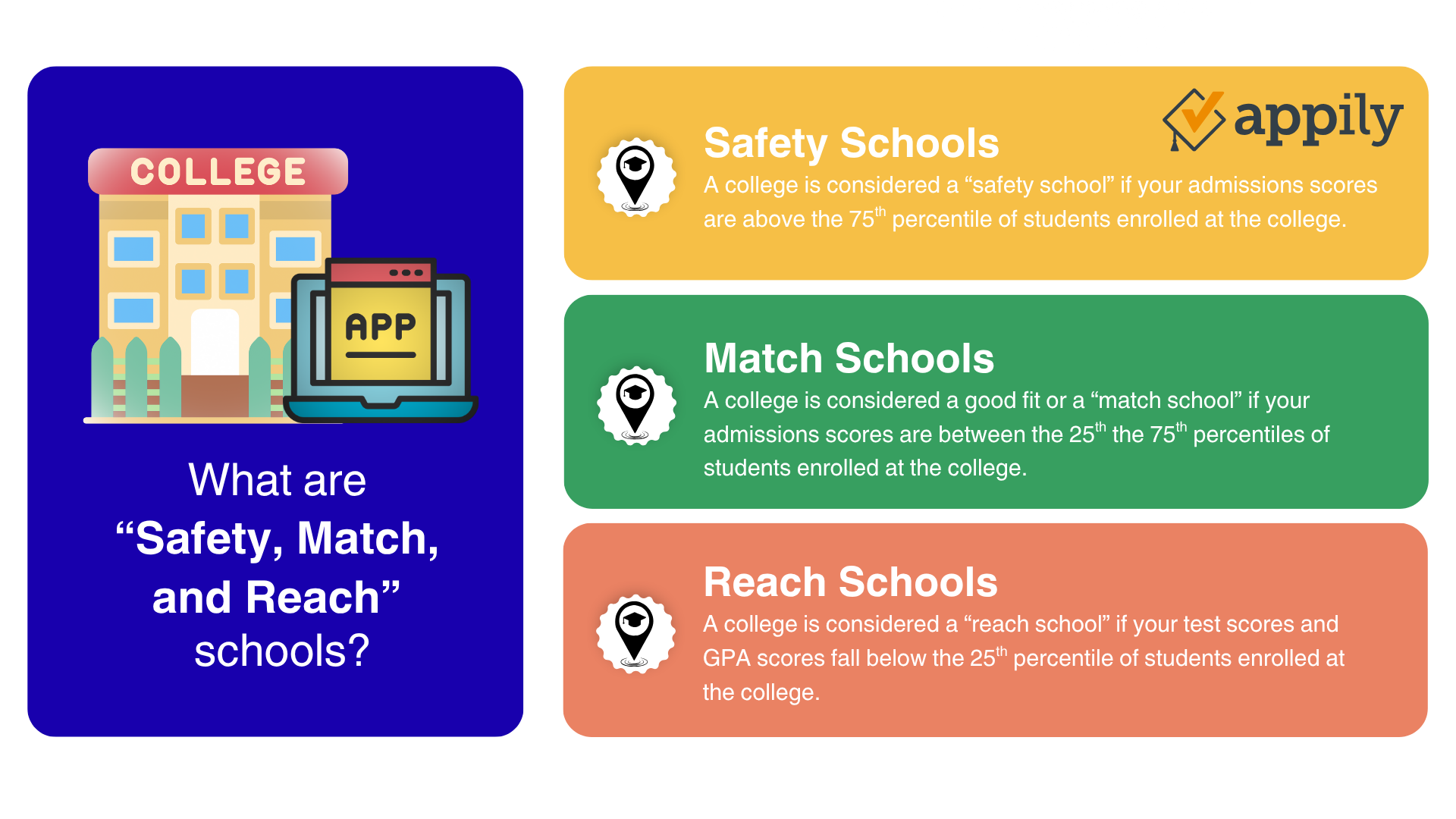
Tip: To determine where a college falls for you, compare your SAT or ACT scores and GPA to the school’s published admissions data. Use trusted college search platforms (like Appily.com) for accurate data.
Should you apply to extreme reach schools?
Yes. If you’re strategic. Some students choose to include “extreme reach” schools with extremely low admission rates (under 10%), such as Ivy League or top-tier private colleges. Keep in mind that you’ll want to ensure that you’re brushing up for those big standardized tests like the ACT and SAT. Many of the nation’s top schools are reinstituting these tests as an admissions requirement.
All in all, just make sure you balance your “extreme reach” schools with realistic options. A dream school is worth applying to, but it shouldn't be the only school you apply to.
How many colleges should you apply to?
Most experts recommend applying to 7–10 schools:
- 2–3 safety schools
- 3–4 match schools
- 2–3 reach schools
This range keeps your list manageable while giving you options across different levels of selectivity and financial aid possibilities.
Note: Some students apply to more than 10 schools, especially if they’re pursuing competitive majors or financial aid options. But applying to too many can stretch your time and resources. Quality over quantity.
What is a financial safety school?
A financial safety is a school you can afford to attend even with minimal aid. Sometimes this means an in-state public university. Other times, it’s a private college with generous merit scholarships or a community college. Use each college’s net price calculator to estimate your real costs, not just the sticker price.
Your final list should include at least one school that is both an admissions safety and a financial safety.
What is undermatching? (Why You Must Avoid it)
Some students, especially first-generation students or those from low-income or underrepresented backgrounds, don’t apply to competitive colleges, even when they’re well qualified. This is known as “undermatching,” and it limits opportunities, not just in terms of where you graduate from, but also in future earnings and career prospects.
So, including a few reach schools on your list isn’t just ambitious: it's also a smart move. Many selective schools offer generous financial aid packages, so these competitive colleges aren't guaranteed to be out of reach.
How to research and classify your college list
Use tools like Appily’s college profiles, acceptance rate data, and GPA/ACT/SAT percentiles to compare your stats to those of admitted students. A few smart tools to help incude:
- Net price calculators (NPCs) on college websites
- Appily's GPA, SAT & ACT-based college list pages
- Appily's college changes or acceptance calculators
- College Board's BigFuture
Appily's college list builder tool also eliminates a lot of the guesswork from the process, collecting the data points we discussed above and sharing a list of schools that meet your criteria.
College list-making mistakes (and how to avoid them)
| Pitfall | Why It Hurts | Smart Fix |
|---|---|---|
| Too many reach schools/ few safety schools | Leaves you vulnerable to rejection | Stick to 2–3 safety schools and 3–4 match schools |
| Safety schools you dislike | Lowers motivation and engagement | Only apply to safety schools you’d actually want to attend |
| Ignoring financial fit | High sticker could block decision | Always confirm net cost via NPCs |
| Assuming overall selectivity applies to all majors | Programs vary widely | Check major-specific admission stats |
Balance your applications between the reach, match, and safety schools on your list. So if you want to apply to 8 schools, weight your list like this:
- 3 likely schools
- 3 target schools
- 2 reach schools
Choosing the right schools for you
While admissions statistics are important when deciding whether to apply to certain schools, the most crucial factors come from you. Could you see yourself at that school? Would you like the campus and culture? What about the college's location and climate? Could you be happy there? You should ask yourself these big questions before adding them to your list.
Granted, some schools may need to fit certain quantifiable criteria (student body size, cost, majors offered) to meet your needs, but the central point is that those needs should come first. Don’t worry about whether you’ll get in until you’ve looked into the college as a good fit for you.
“Good fit” colleges can fall into all three categories covered in this guide: safety schools, reach schools, and match schools. What matters is that they have the academics, extracurriculars, location, and overall campus culture that you’re looking for.
All in all, you should be applying to roughly 7-10 schools. This will give you a good spread of all three school types to choose from without overwhelming you with too many options. You can apply for more. Just be sure you balance your time (and budget).
Find your right fit with Appily's college finder
If you’ve finished this article, you now know the difference between safety schools, reach schools, and match schools — and why applying to each is essential. Now that you know how to set up your college list, head over to your Appily profile and start looking for your safety, reach, and match schools.
At Appily, we’re here to help to make your college search and selection process as successful as possible. Use our platform to search for colleges and sign up for an account to calculate your chances at schools nationwide.
Just click the button below to get started.
FAQs about safety, match, and reach schools
What are safety, match (target), and reach schools?
Safety, match, and reach schools are categories used to organize a college list based on how likely you are to be accepted. A safety school is one where your academic profile is above the typical admitted range, giving you a high chance of acceptance. A match (target) school aligns closely with your academic profile, offering a realistic chance of admission. A reach school is more selective, where admission is less likely but still possible.
How do I know if a college is a safety school?
A safety school is one where your GPA, test scores, and other qualifications are stronger than the average admitted student’s (often above the 75th percentile), and the school has a higher acceptance rate. These institutions offer a strong likelihood of acceptance.
What defines a match (target) school in the college admissions process?
Match schools (also called target schools) are colleges where your academic stats are similar to the average range of admitted students, typically between the 25th and 75th percentiles. You have a good, though not guaranteed, chance of being admitted.
What makes a school a reach school?
Reach schools are more selective institutions where your academic profile falls below the average admitted student’s range, or where overall acceptance rates are low (often under ~25%). Admissions are unlikely but still possible with strong applications.
How many reach, match, and safety schools should I include on my college list?
Experts typically recommend applying to 7–10 colleges with a balanced mix: about 2–3 reach schools, 3–4 match (target) schools, and 2–3 safety schools. This strategy helps maximize acceptance chances while keeping your list manageable.
Should I be happy attending a safety school?
Yes, safety schools should be ones you’d genuinely consider attending, not just backups. They should fit your academic, financial, and campus life preferences so you’re excited about the option if it becomes your best choice.
What is a financial safety school vs. an admissions safety school?
A financial safety school is one you can afford even with minimal aid, whereas an admissions safety is a school where you are highly likely to be admitted. Ideally, your list includes at least one college that fits both criteria.
How do I classify a school using admission statistics?
You can use data like GPA and test score percentiles, acceptance rates, and historical admissions outcomes to compare your profile against a school’s averages. Tools like college profiles and chancing calculators help you sort schools into safety, match, or reach categories.
Can my extracurriculars or essays turn a reach into a match?
While academic metrics are key, strong essays, leadership roles, and unique experiences can strengthen applications and slightly improve chances at reach schools, though it doesn’t change the underlying selectivity.
Why is it important to build a balanced college list with safety, match, and reach schools?
A balanced list increases the odds that you’ll receive multiple acceptance offers, giving you options. It also reduces stress during application season and ensures you’re not relying solely on highly competitive schools or limiting yourself to only “safe” choices.
