What You Need to Know About Ivy League Schools

If you’re researching colleges, you’ve probably seen the term “Ivy League schools.” It shows up everywhere…rankings, college lists, social media, even movies. But what does an Ivy League university actually mean? And what makes a school Ivy League in the first place?
A lot of students assume the Ivy League refers to the “best” or “most prestigious” colleges in the country. Others think a university becomes Ivy League because of rankings, selectivity, or academic rigor.
The truth is simpler than most people expect. Here’s what the Ivy League really is, and why Ivy League schools have built such a powerful reputation.
What is the Ivy League?
The Ivy League consists of eight of the oldest and most prestigious universities in the United States, but believe it or not, the term originally referred to an athletic conference, not an academic ranking.
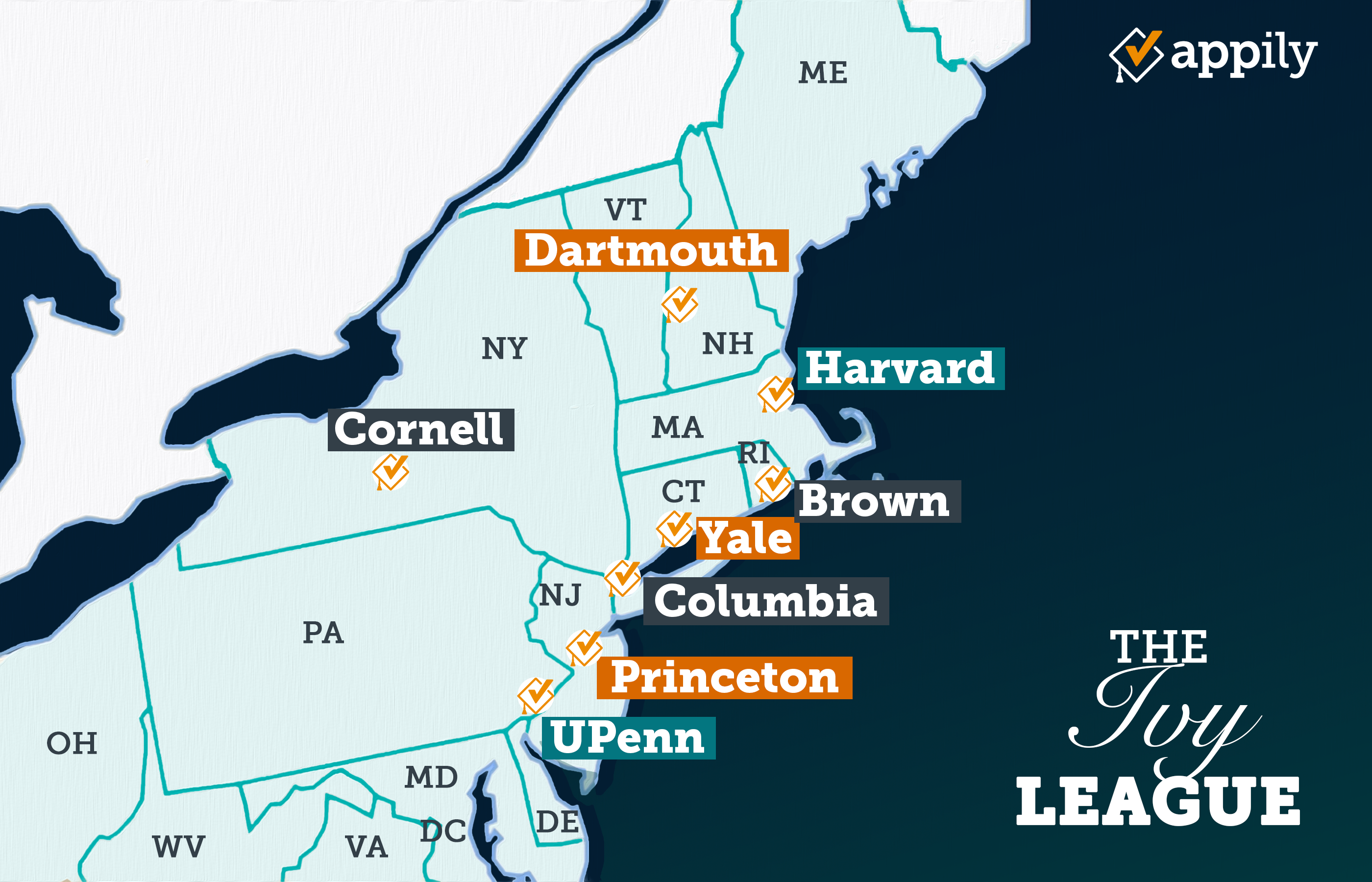
Ivy League Colleges
Brown University (founded 1764)
Columbia University (founded 1754)
Cornell University (founded 1865)
Dartmouth College (founded 1769)
Harvard University (founded 1636)
University of Pennsylvania (founded 1740)
Princeton University (founded 1746)
Yale University (founded 1701)
These schools compete together in NCAA Division I athletics under the official Ivy League conference. So technically, the “Ivy League” is an athletic designation, not a label awarded for academic performance.
What makes a school Ivy League?
One of the most common questions students ask is: What makes a school Ivy League?
The answer is simple:
A school is Ivy League because it is one of the eight universities that belong to the Ivy League athletic conference: nothing more, nothing less.
There is no application process to become an Ivy League school. There is no academic threshold that qualifies a university. No ranking system determines Ivy status. If a school is not one of those eight institutions, it is not Ivy League.
That’s what makes a university Ivy League: official membership in the Ivy League conference. But to be fair, when people ask, “What does an Ivy League university mean?” they’re often really asking about reputation.
While the official definition is athletic, the phrase “Ivy League university” has evolved to mean:
- Highly selective admissions
- Strong academic reputation
- Significant research funding
- Influential alumni networks
- Long institutional history
- National and global prestige
Over time, “Ivy League” became shorthand for elite higher education, even though many non-Ivy schools offer equally rigorous academics.
Why are Ivy League schools so prestigious?
If Ivy League status isn’t based on rankings, why do Ivy League schools have such strong reputations? Several factors contribute to their prestige:
Selective Admissions
While the average U.S. college acceptance rate is significantly higher, most Ivy League schools admit fewer than 10% of applicants.
What does this mean? Applications are high, and acceptances are low. The competition to get into an Ivy League school is fierce and, for most, almost impossible. Even if you’re a top candidate, admission to any of these schools is not guaranteed. They would be a reach for every student.
Having top grades, test scores, and interviewing well is only part of the battle. Because most other candidates are also high achievers, you must set yourself apart by demonstrating your unique talents and interests beyond the classroom. Extracurriculars, especially impressive and outside-the-box activities, are an important part of your profile. You need to demonstrate cohesion, focusing on a few interests as opposed to casting a wide net.
You can also show your unique qualities and characteristics in areas like your essay. This is also a good place to demonstrate your interest in and compatibility with the school. It’s not enough to want to attend any Ivy League institution: you need to really show why that institution in particular appeals to you.Family connections may also play a role at some highly selective colleges, including some Ivy League schools. This practice, known as legacy admission, gives consideration to applicants who are related to alumni. But policies vary by institution, and several colleges and states have moved away from legacy preferences.
Academic Resources
Ivy League schools manage some of the largest university endowments in the world. Harvard’s endowment exceeds $50 billion, while Yale and Princeton each manage more than $30 billion. These endowments fund research, financial aid, faculty recruitment, and campus infrastructure.
All Ivies also promise to meet 100% of demonstrated financial need, and many do not include loans in this aid. For low-income students, attending an Ivy League school could be cheaper than attending a state school, and you may even receive a full ride.
Harvard, for instance, grants full rides for students with families making under $65,000 per year. Not every Ivy is this generous, but in general, they offer some of the best aid in the country.
Attending an Ivy League institution also gives you access to research and study materials crafted by the most brilliant minds. Professors at Ivy League universities are well-educated and passionate about well-known topics and issues. These professors are encouraged and, most times, expected to perform research on these topics for the university. These colleges and universities attract some of the biggest names and most brilliant minds in their fields; as a student, you will have the opportunity to learn from them.
Alumni Influence
The Ivy League has graduates dating back to the 1700s. One of the Ivy League's most beneficial aspects is the alumni network's power. The alumni network consists of all graduates from a particular university and typically extends well beyond college friendships. Alumni connections often lead to your first post-graduation job. Each of these schools has graduated thousands of successful alumni. Many are eager to network with and help fellow alums. Before graduating, students can tap into this network for internships, leading to future employment opportunities. Attending an Ivy League school can provide you with the resources and contacts needed to get your foot in the door at world-renowned companies and agencies.
History and Cultural Reputation
Most Ivy League schools were founded in the 17th or 18th centuries. Their long histories contribute to tradition, influence, and legacy. Thanks to that history and legacy, “Ivy League” has become synonymous with academic excellence and social status in media and public perception.
Are Ivy League schools the best colleges?
Schools in the Ivy League are certainly among the best of the best, but they’re not alone.
Many schools outside the Ivy League are equally (or even more) competitive and academically rigorous.
For example, schools like:
- Stanford University
- MIT
- University of Chicago
- Duke University
- Northwestern University
- Johns Hopkins University
These schools are often grouped with Ivy League institutions in rankings, even though they are not part of the Ivy League conference. This is why students sometimes hear terms like “Ivy Plus,” “Little Ivies,” and “Public Ivies.” These labels are informal and not official designations. The biggest difference between these schools and the actual Ivy League is historical branding and conference membership, not necessarily academic superiority.
Do Ivy League schools offer better career outcomes?
An education from an Ivy League school can give you a head start in highly competitive fields like finance, law, and business. Top global companies seek the best and brightest students and understand that the Ivies can provide them. Here are just a few of their impressive job statistics:
- Of the 114 Supreme Court Justices, more than half attended an Ivy League University. Currently, all nine justices attended law school at either Yale or Harvard.
- In CNN’s top 100 startups list, 34 CEOs went to Harvard.
- UPenn is the top feeder school for companies like Goldman Sachs, Morgan Stanley, and Citigroup.
Attending an Ivy League school can also set you up for some pretty solid career earnings.
A study conducted by the US Department of Education revealed that graduates with a bachelor’s degree had an average income of $54,700, and those with a master’s degree or higher had an income of $65,000 per annum.
Although having a college degree increases your salary, statistically, attending a university in the Ivy League can improve it even more. Here are the numbers for the average early-career salary per year for an Ivy League graduate:

If you attend an Ivy League institution, you have the potential to secure an above-average early career salary.
- The Ivy League is a group of eight private universities in the Northeastern United States.
- A school is Ivy League because it belongs to the Ivy League athletic conference.
- The eight Ivy League schools are Harvard, Yale, Princeton, Columbia, Brown, Dartmouth, Cornell, and the University of Pennsylvania.
- “Ivy League university” originally referred to athletics, but today it’s associated with prestige, selective admissions, and academic excellence.
- Many non-Ivy League schools offer equally strong academics.
- The best college choice depends on fit, not just the Ivy League label.
Is the Ivy League right for you?
An Ivy League education is not the right fit for every student.
Before focusing solely on Ivy League schools, consider:
- Academic programs that match your goals
- Campus size and culture
- Geographic location
- Financial aid and affordability
- Mental health and support resources
- Overall student experience
A strong college fit often matters more than a school’s label.
Now that you know about Ivy League schools and how to balance a college's prestige against the things you are looking for in a school, you'll also want to know about Appily's college match quiz. You answer a few short questions, and you get a list of colleges that fit what you're looking for. It's always free and easy. Just click the button below to see your perfect match colleges.
FAQs about the Ivy League
What makes a school Ivy League?
A school is Ivy League if it is one of the eight universities that belong to the Ivy League athletic conference. Membership in this conference is the only official requirement. Academic ranking, acceptance rate, or prestige alone do not make a university Ivy League.
What makes a university Ivy League instead of just highly ranked?
The difference is official conference membership. Many highly ranked universities, such as Stanford, MIT, or Duke, are not Ivy League because they are not members of the Ivy League athletic conference. Rankings and selectivity do not determine Ivy League status.
What does “Ivy League university” mean today?
Originally, the term referred strictly to athletics. Today, “Ivy League university” is commonly used to describe institutions known for:
- Competitive admissions
- Academic rigor
- Influential alumni
- Strong research funding
- Institutional prestige
However, the official meaning still refers to athletic conference membership.
Why are Ivy League schools called “Ivy”?
The term “Ivy” is believed to reference the ivy plants traditionally growing on older campus buildings. By the mid-20th century, the phrase “Ivy League” became associated with the athletic conference formed in 1954.
Are Ivy League schools the best colleges in the U.S.?
Not automatically. While Ivy League schools are highly respected, many non-Ivy institutions offer comparable or stronger programs in specific fields. The “best” college depends on your academic goals, learning style, financial situation, and career plans.
Are there more than eight Ivy League schools?
No. There are only eight Ivy League schools. Sometimes people refer to “ivy leagues” informally, but officially, there is only one Ivy League conference with eight members.
Is Stanford or MIT an Ivy League school?
No. Stanford University and the Massachusetts Institute of Technology (MIT) are not Ivy League schools. They are private, highly selective universities, but they are not members of the Ivy League athletic conference.
What are the eight Ivy League schools?
The eight Ivy League schools are:
- Brown University
- Columbia University
- Cornell University
- Dartmouth College
- Harvard University
- Princeton University
- University of Pennsylvania
- Yale University
Why do students want to attend Ivy League schools?
Students are often drawn to Ivy League schools because of:
- Prestige and global recognition
- Competitive academic environments
- Strong alumni networks
- Research opportunities
- Financial aid policies (many meet full demonstrated need)
For some students, the Ivy League represents academic achievement and access to influential networks.
Do you have to attend an Ivy League school to be successful?
No. Students from a wide range of colleges and universities go on to successful careers. Outcomes are influenced more by academic performance, internships, networking, skills, and initiative than by institutional label alone.
