Does the Military Pay for College?

The rising cost of college has left many students and families wondering how they’ll afford higher education without taking on debt. One option is to join the military.
Indeed, a survey of 8,000 service members conducted by Syracuse University's Institute for Veterans and Military Families found that 53 percent of respondents cited educational benefits as a reason they joined the armed services.
But does the military pay for college? And if so, how much of college does it cover? Read on for answers to these questions and a detailed breakdown of different military programs.
Does the Military Pay for College?
Yes, the military helps pay for college. It offers multiple programs to assist prospective and current college students, active-duty service members, reservists, and veterans with funding their education.
For example, college students can leverage ROTC scholarships and programs. Active-duty members and reservists can take advantage of benefits like military tuition assistance and the Montgomery GI Bill Selected Reserve. Finally, veterans have options like the Montgomery GI Bill Active Duty and the Post-9/11 GI Bill.
These programs help cover tuition and fees, and some even provide housing allowances and book stipends.
Military College Benefits
The military provides college funding through various benefits and programs tailored to specific types of individuals.
Prospective and Current College Students
Military Academies|
Military or service academies are undergraduate colleges that train students to become commissioned officers of the U.S. Armed Forces. They offer free tuition in exchange for your commitment to serve. Before receiving free tuition, you must be accepted into your chosen military academy. Admission is highly competitive, with all five academies reporting an acceptance rate under 17 percent.
Reserve Officers' Training Corps (ROTC) Programs
The Army, Navy, Marine Force, Air Force, and Space Force all offer Reserve Officers' Training Corps (ROTC) programs, which provide college scholarships to eligible students. These scholarships pay the full or partial cost of your tuition, fees, and books for up to four years. They also provide monthly stipends. You can apply for ROTC scholarships in high school or college.
Active-Duty Service Members and Reservists
Military Tuition Assistance
The Military Tuition Assistance (TA) program pays up to 100 percent of tuition and course-specific fees for eligible active-duty, National Guard, and Reserve Component service members. You can use TA benefits for undergraduate, graduate, vocational, licensure, certificate, and language courses, or to complete your high school education.
Before receiving benefits you must apply and meet certain eligibility criteria, including maintaining a minimum GPA and incurring a service obligation. You must also ensure your program is eligible for TA funds.
If your college tuition is more than what the tuition assistance program covers, you can try the Tuition Assistance Top-Up Program.
The Montgomery GI Bill Selected Reserve (MGIB-SR)
The Department of Veterans Affairs (VA)’s Montgomery GI Bill Selected Reserve (MGIB-SR) program provides up to 36 months of education and training benefits. You may be eligible if you’re a member of the Army, Navy, Air Force, Marine Corps, or Coast Guard Reserve, Army National Guard, or Air National Guard. Visit VA’s website to learn more about the eligibility criteria for this program.
Benefits for Veterans and Their Families
The GI Bill helps qualifying veterans and their families with the costs of school or training. The GI Bill’s four main programs are:
- The Montgomery GI Bill Selected Reserve (MGIB-SR)
- The Montgomery GI Bill Active Duty (MGIB-AD)
- The Post-9/11 GI Bill
- Survivors’ and Dependents’ Educational Assistance (DEA)
We covered the first program above and will break down the remaining three below.
The Montgomery GI Bill Active Duty (MGIB-AD)
Veterans may be eligible to receive benefits through the Montgomery GI Bill Active Duty. This program helps you pay for education and training programs. Among other criteria listed on the VA website, you must be honorably discharged and must have served at least two years on active duty.
The Post-9/11 GI Bill
If you served on active duty after September 10, 2001, the Post-9/11 GI Bill (PGIB) program may give you money to pay for school or job training.
For those who meet at least one of the listed criteria on the program’s web page, VA will cover the costs of tuition and fees, housing, and books and supplies. You may also receive a one-time payment to help you move from a rural area to attend school.
Survivors’ and Dependents’ Educational Assistance (DEA)
The DEA program, also known as Chapter 35, provides a monthly payment to eligible dependents to cover the cost of school or expenses incurred during on-the-job training.
To be eligible, you must be the child or spouse of a veteran who:
has died,is captured or missing,or is permanently disabled due to a service-connected condition.
How Much of College Does the Military Cover?
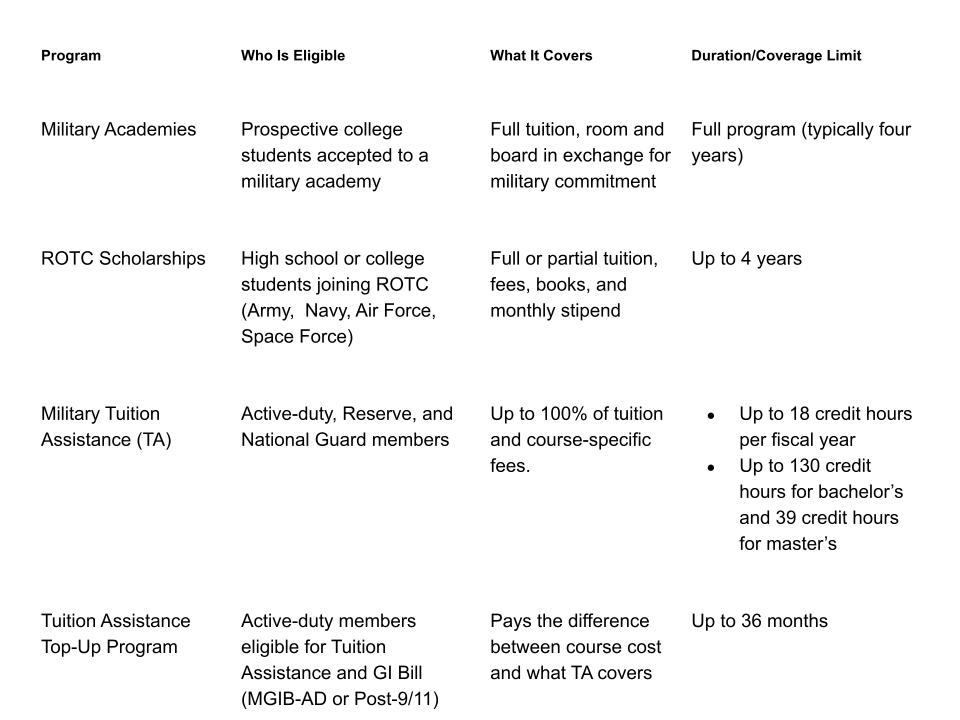
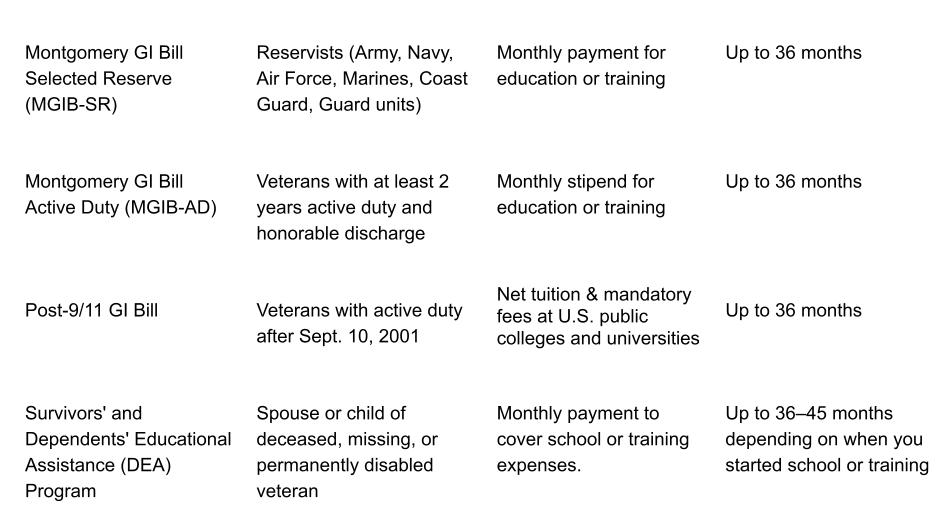
The military can cover the full or partial cost of your tuition, fees, books, supplies, and housing. The extent to which they cover these costs depends on the program and how much you’re qualified to receive. Here’s a table breaking down what each of the aforementioned military programs covers financially, among other details.
Note: VA rates are for the period October 1, 2024, to September 30, 2025
Military Tuition Benefits FAQs
How much does the military pay for college?
Military programs can pay the full or partial cost of college tuition, fees, books, supplies, and more. How much the military pays for these items depends on the program, how much you’re qualified to receive, and other factors.
A popular option is the Post-9/11 GI Bill, which covers tuition, fees, a monthly housing allowance, an annual book stipend, and a one-time relocation payment. ROTC scholarships also cover tuition and fees and provide a monthly stipend.
Does the military pay for 100% of college?
Some military programs cover 100 percent of college tuition and specific fees, or up to 100% of the total cost. These programs include the Post-9/11 GI Bill, the Military Tuition Assistance Program, and ROTC scholarships offered by the Army, Navy, Air Force, Marine Corps, and Space Force.
Find your military-friendly match with Appily
Now that you understand how each branch pays for college, you can decide whether or not you're interested in military service. The next step is creating a free Appily account. With it, you can explore different schools, including colleges that support military-affiliated students, and choose the best one for you.
Click the button below to sign up and find your military-friendly match.
