Can Pell Grants Pay for Certificate Programs? What Students Should Know About Workforce Pell

Not every student’s path after high school starts the same way. Some pursue a degree right away, while others look for shorter, career-focused training in fields like healthcare, IT, skilled trades, logistics, or technical training.
Workforce Pell is a new federal Pell Grant option for eligible short-term career-training programs. Beginning July 1, 2026, eligible students may be able to use Pell Grant funds for approved programs that are at least 8 weeks but less than 15 weeks long, meet instructional-hour requirements, receive state and federal approval, and satisfy outcomes standards.
That’s a big deal, but there’s a catch: not every certificate, bootcamp, or training program will qualify. Before you enroll, check whether the program is approved, what credential you’ll earn, what jobs it can lead to, and whether the cost makes sense.
Here’s what students should know before using Pell Grant money for a short-term program, whether it’s your first step after high school, a path into the workforce, or part of a longer education plan.
The TL;DR
Starting July 1, 2026, Workforce Pell may make it possible for eligible students to use federal Pell Grant money for certain short-term career-training programs.
This could help students pay for approved programs in fields like healthcare, IT, skilled trades, logistics, and technical training. But not every certificate, bootcamp, or training program will qualify.
Before enrolling, students should check:
- Whether the program is officially approved for Workforce Pell
- What credential they’ll earn
- Whether employers recognize the credential
- What jobs the program may lead to
- How much graduates typically earn
- Whether credits can transfer later
- What costs are not covered by aid
Bottom line: Workforce Pell could create more affordable pathways after high school, but students should still compare programs carefully. A shorter program can be a smart first step, part of a longer education plan, or one of several options to consider alongside community college or a four-year degree.
What is Workforce Pell?
A Pell Grant is federal financial aid that usually does not have to be repaid. Traditionally, Pell Grants have helped eligible undergraduate students with financial need pay for college programs, including associate and bachelor’s degrees.
The Workforce Pell expands Pell Grant eligibility to some shorter workforce-training programs. That means students who qualify for Pell may eventually be able to use those funds for certain approved programs designed to prepare them for specific jobs more quickly.
Think of it this way:
Traditional Pell mostly supports longer college pathways. Workforce Pell may support some shorter, job-focused pathways. But again, not every program will qualify.
What types of programs may qualify?
Workforce Pell is meant for short-term programs connected to real workforce needs.
Possible fields could include areas like:
- Healthcare support
- Advanced manufacturing
- Information technology
- Transportation
- Skilled trades
- Logistics
- Other state-approved workforce fields
The exact list will depend on which programs are approved by states and the U.S. Department of Education. That matters because a program can sound career-focused and still not qualify for Workforce Pell. Before assuming Pell will cover a program, students should ask the school directly and verify through official financial aid channels.
What makes a program eligible?
This is where the details matter. To qualify for Workforce Pell, a program must meet several requirements.
The Department of Education’s Workforce Pell guidance outlines the specific approval path:
1. The program has to meet the basic federal definition (a short-term workforce program that’s at least 8 weeks but under 15 weeks, with 150–599 clock hours or the credit-hour equivalent).
2. The program then needs state sign-off (the Governor, working with the state workforce board, has to agree it fits the state’s “high-skill, high-wage, in-demand” needs).
3. Then the program advances to federal sign-off (the U.S. Secretary of Education reviews it against federal requirements).
4. After that, programs still have to clear ongoing accountability, keeping up with outcome and reporting standards tied to completion, job placement, and earnings.
That’s a lot of fine print, but the student takeaway is simple: a program has to prove it leads somewhere.
Requirement
What It Means for Students
8 to under 15 weeks long
The program has to be short, but not too short.
150 to 599 clock hours
There are minimum and maximum instructional-time rules.
Approved institution
The program must be offered by an eligible institution.
State approval
The state governor must approve the program.
Federal approval
State approval alone is not enough; the U.S. Department of Education must also approve it.
Outcomes standards
Programs must meet completion, job-placement, and earnings-related standards.
Why Workforce Pell could matter for you
Workforce Pell could open up more options for students who want career training but can’t afford to pay out of pocket.
It may help students:
- Lower the upfront cost of short-term training
- Enter the workforce faster
- Build skills for in-demand jobs
- Explore career pathways without committing to a four-year degree right away
The Department of Education projected that about 184,000 students could use Workforce Pell in fiscal year 2027–28, with enrollment potentially rising to 191,000 by 2037–38 under low-end assumptions. The Department also estimated that as many as 28,000 existing undergraduate certificate programs could be eligible based on length, and that about 2,200 new programs could emerge because of the policy.
That could mean more choices for students. But more choices can also mean more confusion.
Why to be excited (but careful)
A short program can be a smart move if it leads to a recognized credential, a real job, and wages that make the cost worthwhile. But short-term does not automatically mean low-risk.
Students should slow down and ask questions because:
- Some credentials are more recognized than others
- Some programs may not transfer into future degrees
- Some programs may have extra costs that are not obvious upfront
- Some may sound career-focused but have weak outcomes
- Approval lists may take time to develop as states build their processes
New America has described Workforce Pell as heavily tied to state data and governance because states will have a major role in determining which programs qualify and how outcomes are measured. National Skills Coalition has also emphasized that implementation will depend on quality standards, student supports, data transparency, and clear signals that programs lead to real outcomes.
So yes, Workforce Pell could be helpful. But students should still compare programs carefully.
Why was the Workforce Pell Grant launched now?
Workforce Pell is part of a bigger shift.
More students are exploring shorter, more career-connected pathways after high school. The National Student Clearinghouse reported that fall 2025 postsecondary enrollment rose 2.0% overall, driven by a 2.4% increase in undergraduate enrollment, with community colleges and certificate programs helping fuel the growth.
Employers are also paying more attention to skills and credentials. SHRM reported that 78% of HR professionals in 2025 said skilled credentials were used sometimes, often, or almost always in hiring, up from 72% in 2021. That does not mean a certificate is always better than a degree. It means students have more pathways to compare. And that’s where the real work begins.
Questions to ask before enrolling in a Workforce Pell program
This is the most important part. Before enrolling in any short-term program, ask these questions.
“Is this program officially approved for Workforce Pell?”
Don’t rely only on marketing language.
Ask the school’s financial aid office:
- Is this program approved for Workforce Pell?
- Has it been approved by the state?
- Has it been approved by the U.S. Department of Education?
- When can students actually use Pell funds for this program?
If the answer is unclear, pause before enrolling.
“What credential will I earn?”
Ask exactly what you’ll receive when you finish.
It might be:
- A certificate
- A license
- An industry certification
- An apprenticeship-related credential
- A stackable credential that could lead to more training later
The name of the credential matters because employers may value some credentials more than others.
“Do employers actually recognize it?”
Ask which employers hire graduates from the program.
Also ask:
- Is this credential required for the job?
- Is it preferred, but not required?
- Does the school have employer partnerships?
- Do local employers know and trust the program?
A credential is most useful when it connects to real hiring demand.
“What are the completion and job-placement rates?”
Workforce Pell programs must meet outcomes standards, but students should still ask for program-level results.
Ask:
- What percentage of students finish?
- What percentage get jobs related to the program?
- How soon after finishing do graduates usually get hired?
This can help you separate strong programs from ones that only sound good.
“What do graduates earn?”
Ask for actual wage information, not just “jobs are available.”
Good questions include:
- What is the median wage for graduates?
- What do graduates typically earn in their first year?
- Are wages based on local data?
- Are students getting full-time jobs, part-time jobs, or contract work?
BLS data shows that healthcare occupations are projected to grow much faster than average from 2024 to 2034, with about 1.9 million openings projected each year on average. But not every healthcare-related program will qualify for Workforce Pell, and students should still check job outcomes for the specific program they’re considering.
“Will credits transfer later?”
This is a big one.
Some students may use a short-term program as a first step, then later decide they want an associate or bachelor’s degree.
Ask:
- Do credits transfer to a community college or four-year college?
- Is this program part of a larger pathway?
- Can it stack into another credential?
- Will I have to start over if I continue my education?
Lumina Foundation has noted that short-term credentials are expanding in fields like healthcare, advanced manufacturing, IT, and logistics, but many states still need stronger data and policy tools to make sure shorter programs deliver real economic value.
In other words: a short program can be useful, but students should understand what comes next.
“What costs are not covered?”
Even if Pell helps with tuition, students may still have costs.
Ask about:
- Tools
- Uniforms
- Transportation
- Exams
- Background checks
- Licensing fees
- Books and supplies
- Technology requirements
A program that looks affordable at first can become more expensive once extra costs are added.
“What happens if I don’t finish?”
No one starts a program planning to leave early, but life happens.
Ask:
- What is the refund policy?
- Will I owe money if I withdraw?
- Does the partial coursework have any value?
- Can I come back later?
- Will leaving affect future aid eligibility?
It’s better to understand those details before you start.
Workforce Pell vs. Traditional Pell
Here’s a simple way to compare the two.
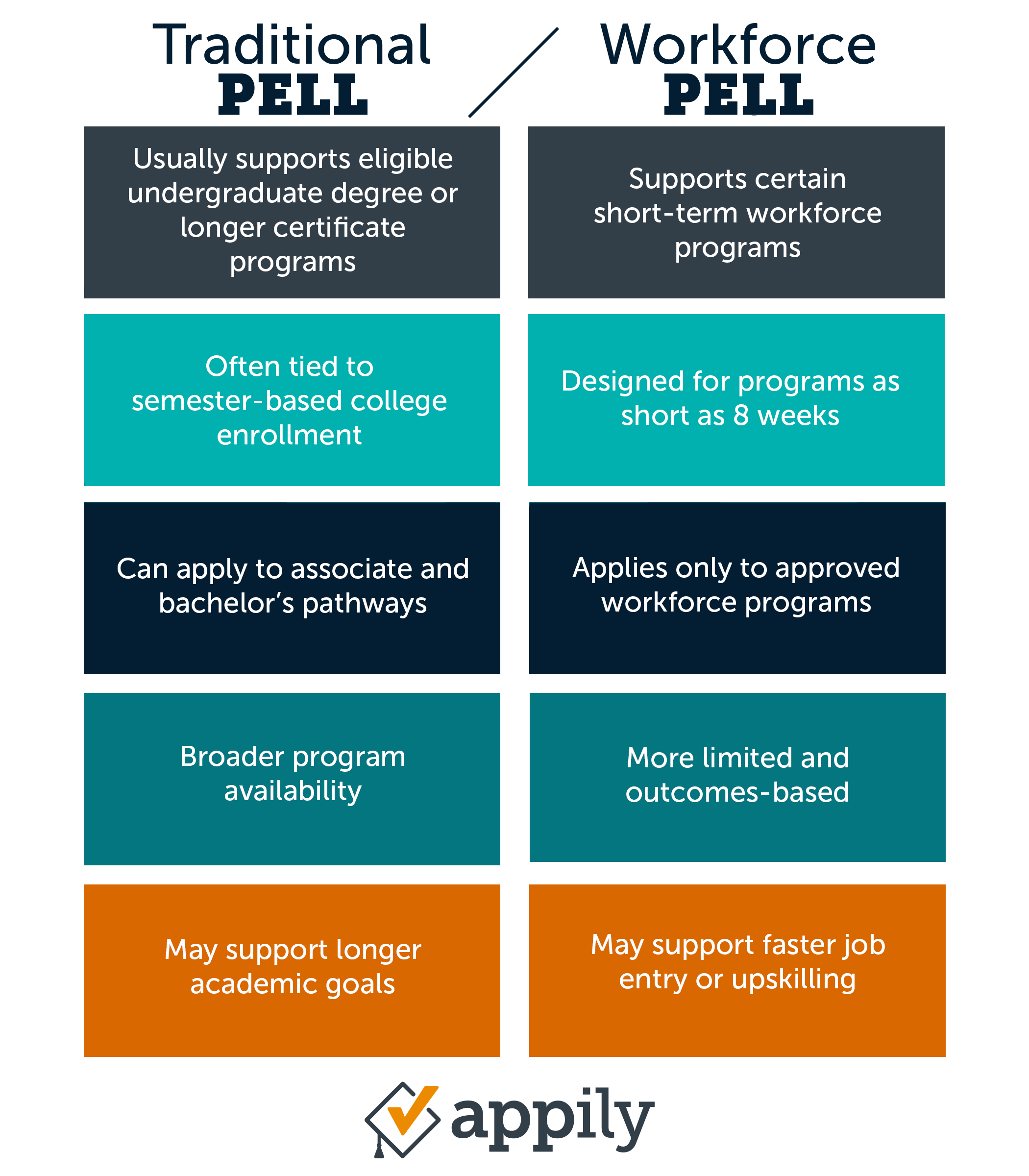
Both can help students pay for education.
The difference is the type of program the aid can support.
Is a short-term program better than college?
Not automatically.
A short-term program can be a good fit if:
- It leads to a recognized credential
- Employers value it
- Graduates get jobs
- Wages make the cost worthwhile
- You want a faster path into a specific career
A degree program may be a better fit if:
- Your career goal requires an associate, bachelor’s, or graduate degree
- You want a broader academic foundation
- You may transfer later
- You want more flexibility across career paths
Some students may use a certificate as a stepping stone. Others may go straight into a degree program. Others may work first and return to school later. There is not one right path. There is a path that fits your goals, budget, and timeline.
How to compare your options
When you’re comparing a Workforce Pell program to community college or a four-year college, look at the full picture.
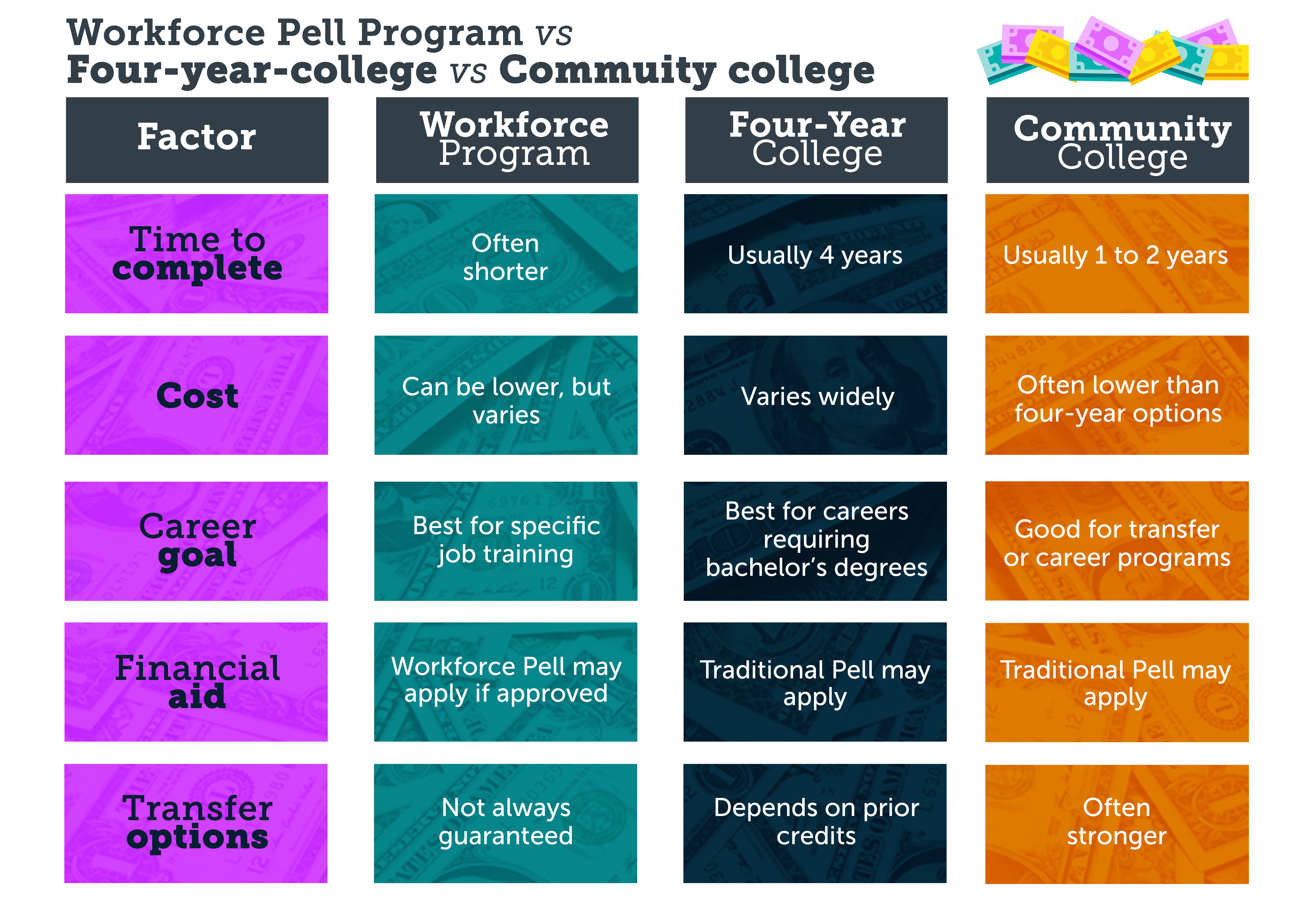
Before choosing, ask yourself:
- What job do I want?
- What credential do I need?
- What will this cost after aid?
- What will I earn after finishing?
- Can I keep going later if I want another credential or degree?
That’s how you move from “this sounds affordable” to “this actually makes sense for me.”
Military service after college
Military service can also be part of your post-college plan. Some students use college to prepare for an officer pathway through ROTC, while others explore Officer Candidate School (OCS) or Officer Training School after earning a bachelor’s degree. Certain professional fields may also have direct commission options, depending on the branch and role.
If you’re interested in serving after college, compare the requirements, service commitments, benefits, and career paths carefully. Like any education or training option, it’s worth asking: Does this path fit my goals, timeline, and long-term plans?
If the answer is "yes," we have the tools to help you get there.
How Appily can help
Workforce Pell may create more short-term training options, but students will still need help comparing pathways.
That’s where Appily comes in. You can use Appily to explore different options after high school, including:
- Colleges
- Community colleges
- Certificate programs
- Career pathways
- Financial aid and scholarship resources
The goal is not to push one path over another. It’s to help you compare your options clearly, understand what each path may cost, and decide what fits your goals.
FAQs on Workforce Pell and certificate programs
Can Pell Grants pay for certificate programs?
Sometimes. Traditional Pell Grants can already apply to some eligible certificate programs. Workforce Pell expands Pell eligibility to certain shorter workforce-training programs, but only if those programs meet federal and state requirements.
What is Workforce Pell?
Workforce Pell is a new expansion of the federal Pell Grant program that allows eligible students to use Pell funds for some approved short-term career-training programs.
When does Workforce Pell start?
Students may be able to use Workforce Pell for approved programs beginning July 1, 2026.
Does every certificate program qualify for Workforce Pell?
No. Programs must meet requirements related to length, instructional hours, state and federal approval, completion rates, job placement, and earnings outcomes.
How long does a Workforce Pell program have to be?
Eligible programs generally must be at least 8 weeks but less than 15 weeks long, with 150 to 599 clock hours or the credit-hour equivalent.
What fields could Workforce Pell programs cover?
Possible fields may include healthcare support, IT, advanced manufacturing, transportation, skilled trades, logistics, and other state-approved workforce areas. Exact eligibility will depend on state and federal approval.
Is Workforce Pell only for community colleges?
Not necessarily. The program must be offered by an eligible institution and meet approval standards. Students should verify eligibility directly with the school or training provider.
Is a short-term certificate better than a degree?
Not always. A certificate can be useful for specific jobs, especially if employers recognize it. A degree may be better for careers that require broader education or advanced credentials.
What should I ask before enrolling in a certificate program?
Ask whether the program is officially approved for Workforce Pell, what credential you’ll earn, what jobs it leads to, what graduates earn, whether credits transfer, and what costs are not covered.
Can Workforce Pell help me avoid student loans?
It may reduce out-of-pocket costs for some approved programs, but students should still compare total cost, financial aid, and expected earnings before enrolling.
