Differences Between College, Club, and Intramural Sports

Starting college comes with a lot of questions, including how you’re actually going to meet people, stay active, and find some balance once classes pick up.
For a lot of students, sports end up being part of that answer. The good news? You don’t even have to be a recruited athlete to get involved (although in theory, you can still play as an up-and-coming all-star on an NCAA Division 1 team or with some friends in an intramural league!) Intramural and club sports are both popular options on campus, but they offer very different experiences depending on what you’re looking for.
That’s a lot of terms to throw around–intramural, club sports, NCAA sports–many students feel confused over the different levels of college sports, so today, we’re breaking it down.
The TLDR;
- Intramural sports are the most casual option: no tryouts, low commitment, and all games happen on campus.
- Club sports are more competitive, often include tryouts and regular practices, and may involve traveling to play other colleges.
- The difference between club sports vs intramural sports mostly comes down to how competitive and structured you want your experience to be.
- Compared to NCAA teams (like D1), club sports are less intense and easier to balance with classes, but still offer real competition.
- Most schools offer both college intramural sports and college club sports, so you’ll usually have options no matter your experience level.
In short: intramurals are great if you want something flexible and social, while club sports are a better fit if you’re looking for a more competitive team experience.
The different levels of college sports
Colleges provide many opportunities for students to play sports while studying for a degree. The sports range from low-pressure intramural sports to super-competitive NCAA Division 1 sports. Here are the need-to-know differences between the three sporting options.
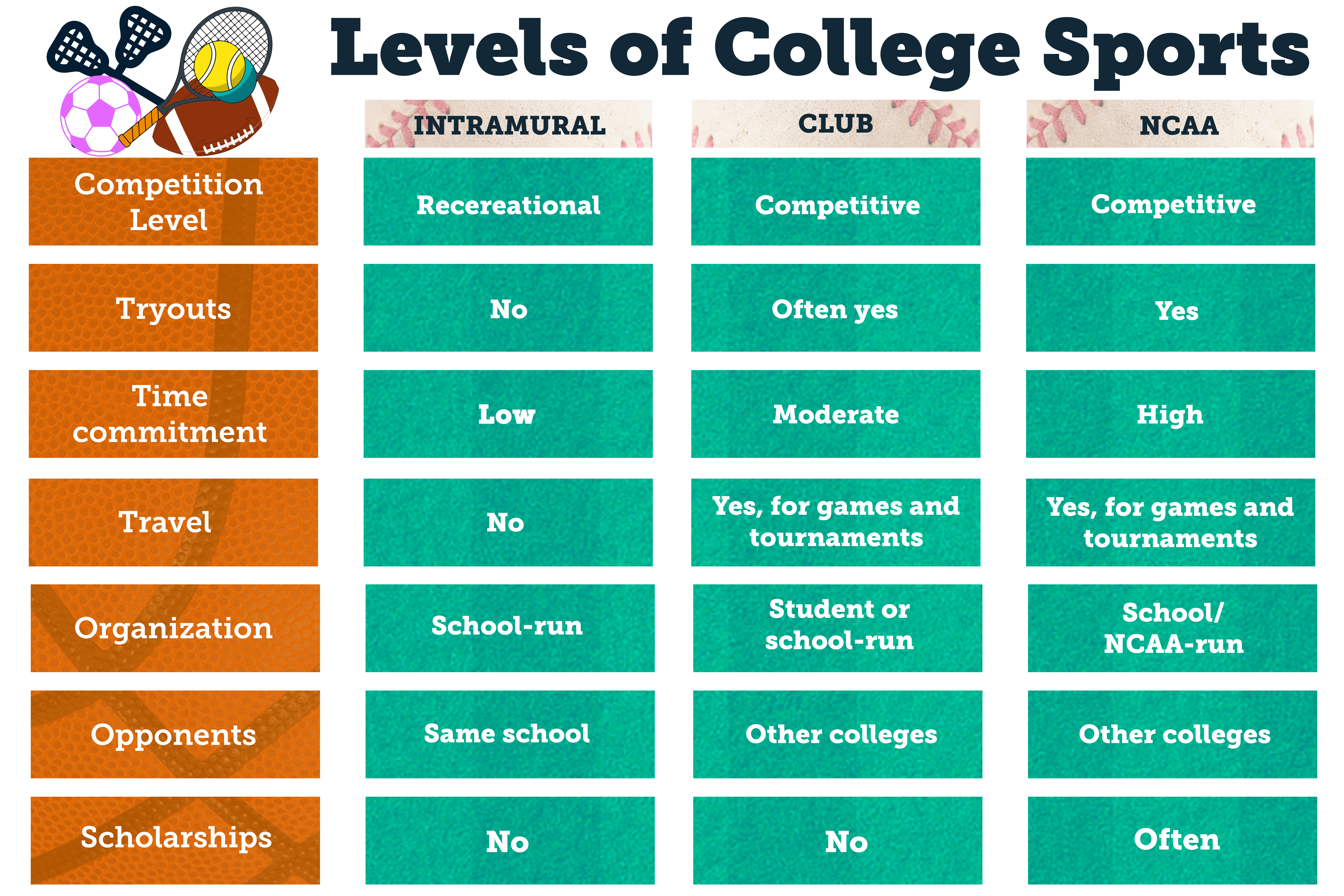
Intramural Sports
Intramural sports are the most laid-back version of college athletics. They’re organized by your school, and you play against other students at the same college. No travel, no recruiting, no pressure to be elite. If you’ve ever joined a rec league or played pickup sports, it’s pretty similar, just more organized.
Most colleges offer a ton of options, like:

Yes. Quidditch. If you’ve seen the movie “The Internship,” it’s exactly what you’re imagining.
College intramural sports are great for students with little free time, a small budget, or the goal of having fun while staying active-the best option if you just want an affordable way to join a group of friends for casual games. They don't require attendance at every game, and you won't have to travel for away games either. The highest out-of-pocket cost for students is usually a small fee to form a team.
The vibe is simple: show up, play, have fun.
Club Sports
Club sports are where things start to get more serious…but not too serious.
Suppose you want to continue your experience in organized sports after leaving high school, but you aren't competitive enough to play on a varsity team. In that case, university club sports are a solid choice. They’re still separate from NCAA athletics, but they’re competitive.
Unlike intramurals, club sports often have:
- Tryouts
- Scheduled practices
- Weekend games or tournaments
- Travel to other universities
And while they’re often student-run, they can still be pretty organized, sometimes even at the university-level.
Common club sports include things like rugby, lacrosse, soccer, ultimate frisbee, and tennis, but honestly, it depends on the school. Some campuses have dozens of options, including things like cornhole, disc golf, and rowing.
If intramurals are casual, club sports are the “middle ground” between playing for fun and playing at the varsity level.
Collegiate Sports
Collegiate varsity sports are the most rigorous of all undergraduate athletics. They are the most competitive and organized, plus the college or university funds them. They're also sanctioned by the National Collegiate Athletic Association (NCAA). Varsity sporting teams represent their schools in competition with other colleges and university teams and work to achieve national rank or recognition.
The NCAA recognizes collegiate athletes from three divisions: D1, D2, and D3. Division 1 teams feature the most skilled athletes. Their tournaments and games are broadcast on sports channels, and the best athletes often go into professional sports. These spots aren't just limited to the big ones, like football or basketball. There are even D1 esports athletes, programs, and competitions.
According to the NCAA, 500,000 college athletes across the three divisions compete for more than 1,000 schools throughout the U.S., (including the District of Columbia and Puerto Rico) and Canada. Each year, NCAA schools award nearly $3.5 billion in athletic scholarships. These schools also provide support to help student-athletes graduate at a rate higher than their peers.
How do intramurals and club sports compare?
There’s a clear difference between NCAA Athletics and the rest, so let’s tackle where most people get stuck on what they’re looking for: intramural sports vs. club sports.
When figuring out which one you’re leaning towards, think about how they feel:
- Intramural sports = show up with friends, play for fun
- Club sports = try out, practice regularly, compete against other schools
You don’t need experience for intramurals. For club teams, it definitely helps. You won’t travel for intramurals. For club sports, you probably will. And the time commitment? Way different. Intramurals are flexible. Club sports start to feel like a real team.
Questions to ask at the activities or clubs fair
If you’re exploring the idea of intramural sports or club sports, you aren’t alone. In fact, roughly 30% of college students participate in either club or intramural sports, according to a study from Michigan State University. Your college’s activities or clubs fair is one of the best places to get a feel for what each team is actually like. It’s also your chance to ask questions before committing your time.
Here are a few smart questions to ask, and why they can help you decide between club sports and intramural sports.
“Do you have tryouts, or can anyone join?”
Why ask: This is one of the biggest differences between club sports and intramural sports.
- Intramural sports are usually open to everyone
- Club sports often require tryouts
Knowing this upfront helps you understand how competitive the team is — and whether you’ll need to prepare.
“How often do you practice or play?”
Why ask: Time commitment can vary a lot.
- Intramural sports might meet once a week
- Club sports may practice multiple times per week
This question helps you figure out if the schedule fits with your classes, job, or commute.
“Do you travel for games or tournaments?”
Why ask: Travel is a key difference between college club sports and intramural sports.
- Intramurals stay on campus
- Club teams often compete against other colleges
If you’re balancing academics or want to stay local, this can be a deciding factor.
“What’s the overall vibe of the team?”
Why ask: Not every team has the same culture, even within the same sport.
Some are:
- Highly competitive
- Social and laid-back
- A mix of both
This question helps you figure out if you’ll actually enjoy being part of the group.
“What kind of experience do most players have?”
Why ask: This gives you a sense of whether the team is beginner-friendly.
- Intramural sports usually welcome all skill levels
- Some club teams expect prior experience
If you’re new to a sport, this can help you choose the right level.
“Are there any costs to join?”
Why ask: Costs can vary more than students expect.
- Intramural sports are often free or low-cost
- Club sports may have dues for travel, uniforms, or equipment
Knowing this early helps you plan ahead.
“How do I sign up or get involved?”
Why ask: Every school handles sign-ups a little differently.
Some teams:
- Use email lists
- Require registration through a portal
- Hold interest meetings before tryouts
This makes sure you don’t miss the next step.
Finding colleges & sports teams
So, we covered the different ways to play sports and answered the most common questions. Now, it's time to find your dream colleges.
To get a curated list of perfect-match schools based on what's most important to you —from budget to majors to sports, click the link below and create a free Appily account.
FAQs about playing sports in college
Now that you have a good idea of how to play your sport while in college, let's walk through and answer some of the common questions we hear.
Is it too time-consuming to join an intramural sport in college?
Most students say playing an intramural sport while still juggling their college classes is easy. You might have team practice a couple of times a week and a game a week. But, of course, it depends on the sport, your team's level of competitiveness, the season, and your course load. More competitive teams will require a more significant time investment.
Do you have to be recruited to play collegiate-level sports?
No. You don't. You can play collegiate sports without being recruited by "walking onto a team." That process usually occurs when you can perform at a high level at a walk-on tryout.
Of course, some walk-on players were recruited but didn't receive scholarship money to play. In their case, their position on the team is much more secure. You can read about the different types of walk-on offers on the NCAA's website.
If you're interested in walking on at your chosen school but were not recruited, it's recommended that you contact the coach early so you can discuss the possibility.
Is playing at the college club or at an intramural sports level better?
The answer depends on your goals and opportunities at your college. How much time can you devote to the sport? How serious are you about building or maintaining your athletic skills? You'll need to answer these questions for yourself. In the end, it's a personal decision. As discussed above, the time commitment difference is the biggest concern for most students.
Can I join a sports club at my college without being good at the sport?
Yes. Theoretically, you can work with an intramural sports team. But it's always a good idea to talk to some team members to gauge their level of competitiveness. It also helps to know the game and the team size to assess how much playing time you'll get.
If you join a big team that only requires a few players to engage at a time, you'll probably spend most of the season on the bench observing and/or in practice building your skills. And that's fine because your goal is probably to get out, meet people, and be active.
