
Anatomy of an Award Letter: The Complete Guide
When college acceptance letters arrive, financial aid award letters soon follow. These letters are meant to outline how a college will help cover the cost of attendance, but they often leave students and families with important questions.
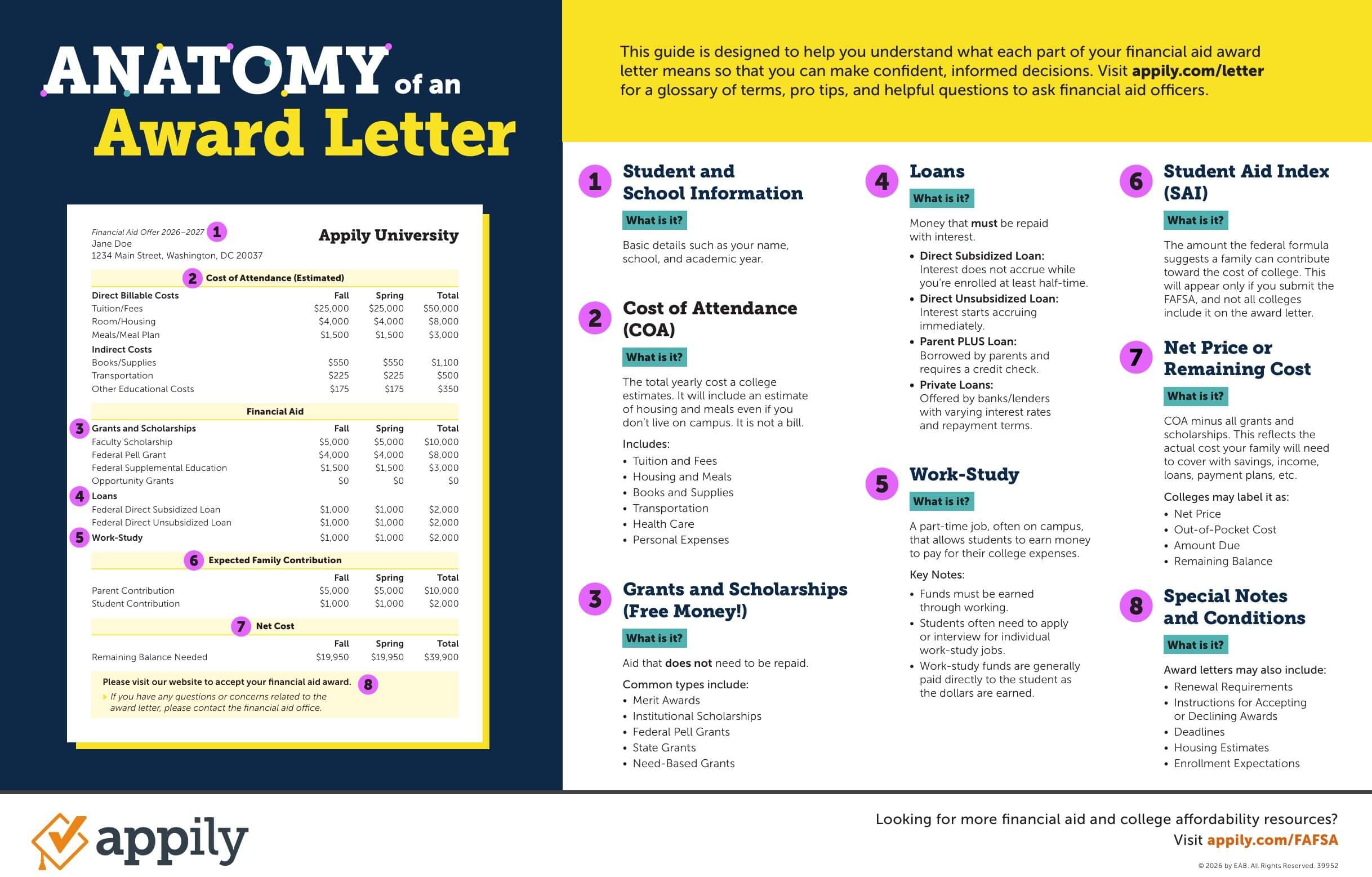
We created the Anatomy of an Award Letter infographic to provide students and families a clear, visual breakdown of the most important sections of the financial aid offer.
This companion guide expands on the infographic by providing additional explanation and practical guidance for each section of the award letter. It is designed to support conversations about affordability, help families compare offers and encourage thoughtful questions for financial aid offices.
Navigate Award Letters Like a Pro
Financial aid award letters can look different from school to school, but most include the same core components. Below, you will find a breakdown of the key sections you are likely to see, along with practical tips to help you review each part carefully, compare offers confidently and understand what it all means for your bottom line.
1. Student and School Information
- Pro Tip: Confirm that all details match the application information for each school. If anything looks off, contact the financial aid office right away.
2. Cost of Attendance (COA)
- Pro Tip: Compare the COA across all the colleges on your list. It helps you get a clearer picture of which options may be more affordable.
3. Student Aid Index (SAI)
- Pro Tip: Remember that SAI is not what you must pay; it simply helps the school determine aid eligibility. If your family’s financial situation has changed since you completed the FAFSA, you can ask the college about an appeal.
4. Grants and Scholarships (Free Money!)
- Pro Tip: Check whether grants or scholarships renew each year and whether they require students to maintain a certain GPA or number of credit hours.
5. Work Study
- Pro Tip: Apply early for work study jobs. Positions fill quickly, and applying early gives you more options. If you’re awarded work study and choose not to work or don’t earn the full amount of your work study, you’re responsible for the difference.
6. Loans
- Pro Tip: You do not have to accept all the loans offered. Only borrow what you truly need.
7. Net Price or Remaining Cost
- Pro Tip: Instead of comparing scholarship amounts, compare the net price across your schools. This helps you understand what you actually need to pay.
Questions to Ask the Financial Aid Office
1. Can you help me understand how much of this package is free money compared to loans?
2. Are any of these grants or scholarships renewable, and what do I need to do to keep them?
3. What is my net price after all grants and scholarships?
4. What is the process for appealing my financial aid if my family’s circumstances have changed?
5. How will our financial aid package change if we have additional children either entering or graduating from college?
6. What impact do outside scholarships have on my financial aid award?
7. What is the average amount of debt that students have from [insert college] upon graduation?
8. Will there be additional fees to utilize services such as laundry, printing, technology, library, fitness center etc.?
9. Is there an annual enrollment deposit?
Glossary of Key Terms
Cost of Attendance (COA): The college’s estimated total cost for one academic year before financial aid. It typically includes tuition, fees, housing, meals, books, supplies, transportation and personal expenses.
Direct Subsidized Loan: A federal loan for students with financial need. Interest does not accrue while the student is enrolled at least half time. Repayment usually begins six months after graduation or after dropping below half time.
Direct Unsubsidized Loan: A federal student loan available regardless of financial need. Interest begins accruing when the loan is disbursed. Repayment usually begins six months after graduation or after dropping below half time.
Disbursement: The process of releasing financial aid funds to the college. Funds are typically applied to tuition, fees and other charges first. Any remaining amount may be refunded to the student for other education-related expenses.
Fees: Required charges billed by the college beyond tuition, such as technology, lab or activity fees.
Free Application for Federal Student Aid (FAFSA): This form determines eligibility for federal, state and some college financial aid.
Gift Aid: Grants and scholarships that do not need to be repaid.
Institutional Scholarships: Financial aid awarded directly by a college or university, based on merit, financial need or other criteria.
Merit Awards: Scholarships based on academic achievement, talent, leadership or other accomplishments rather than financial need.
Need-Based Grants: Financial aid awarded based on a family’s financial situation as determined by financial aid applications.
Net Price: The amount students are responsible for paying after grants and scholarships are subtracted from the Cost of Attendance.
Parent PLUS Loan: A federal loan borrowed by a parent to help pay for a student’s education. It requires a credit check. Repayment generally begins after full disbursement, though parents may request a deferment while the student is enrolled.
Private Loans: Education loans offered by banks or private lenders. Interest rates and repayment terms vary and often depend on credit history.
Self Help Aid: Financial aid that must be earned or repaid, such as loans and work study.
State Grants: Financial aid provided by a state government, often based on financial need and residency.
Student Aid Index (SAI): A number calculated from the FAFSA that colleges use to determine eligibility for need-based aid.
Supplies: Required course materials such as textbooks, lab materials or specialized equipment.
Transportation: Estimated travel costs to and from campus and within the local area during the school year.
Questions? Contact us at [email protected], and we'll be happy to help!
