What is a Good ACT Score in 2026?

A good ACT score is one that is competitive for the colleges you want to attend. The easiest way to tell is to compare your score with each college's middle 50% ACT range. If your score falls within or above that range, it's generally considered a strong score for that school. If it's below the range, you may want to retake the ACT, apply test-optional where available, or strengthen other parts of your application.
So the real question isn’t just “What is a good ACT score?” It’s “Is my ACT score good for the colleges I’m applying to?”
Let’s break it down:
The TL;DR: What counts as a good ACT score?
- A good ACT score depends on your college list, not one universal number.
- The ACT is scored from 1 to 36.
- The national average ACT Composite score for the 2025 graduating class was 19.4.
- A 20 ACT score is slightly above average nationally, but may be low for selective colleges.
- A 24 ACT score is strong for many colleges and sits around the 80th percentile.
- A 30 ACT score is very strong and may help at selective schools or with some merit scholarships.
- The best way to judge your score is to compare it to each college’s middle 50% ACT range.
- If a school is test-optional, submit your ACT score if it strengthens your application.
- The fastest way to judge your score is to compare it with each college's middle 50% ACT range.
Bottom line: A good ACT score is one that supports your admissions, scholarship, and college-list goals.
What counts as a good ACT score?
A score above the national average is a helpful starting point, but it doesn’t tell the whole story.
A score that looks strong at one college may be below range at another. That’s why your target schools matter more than any single national number.
Here’s a simple way to think about it:
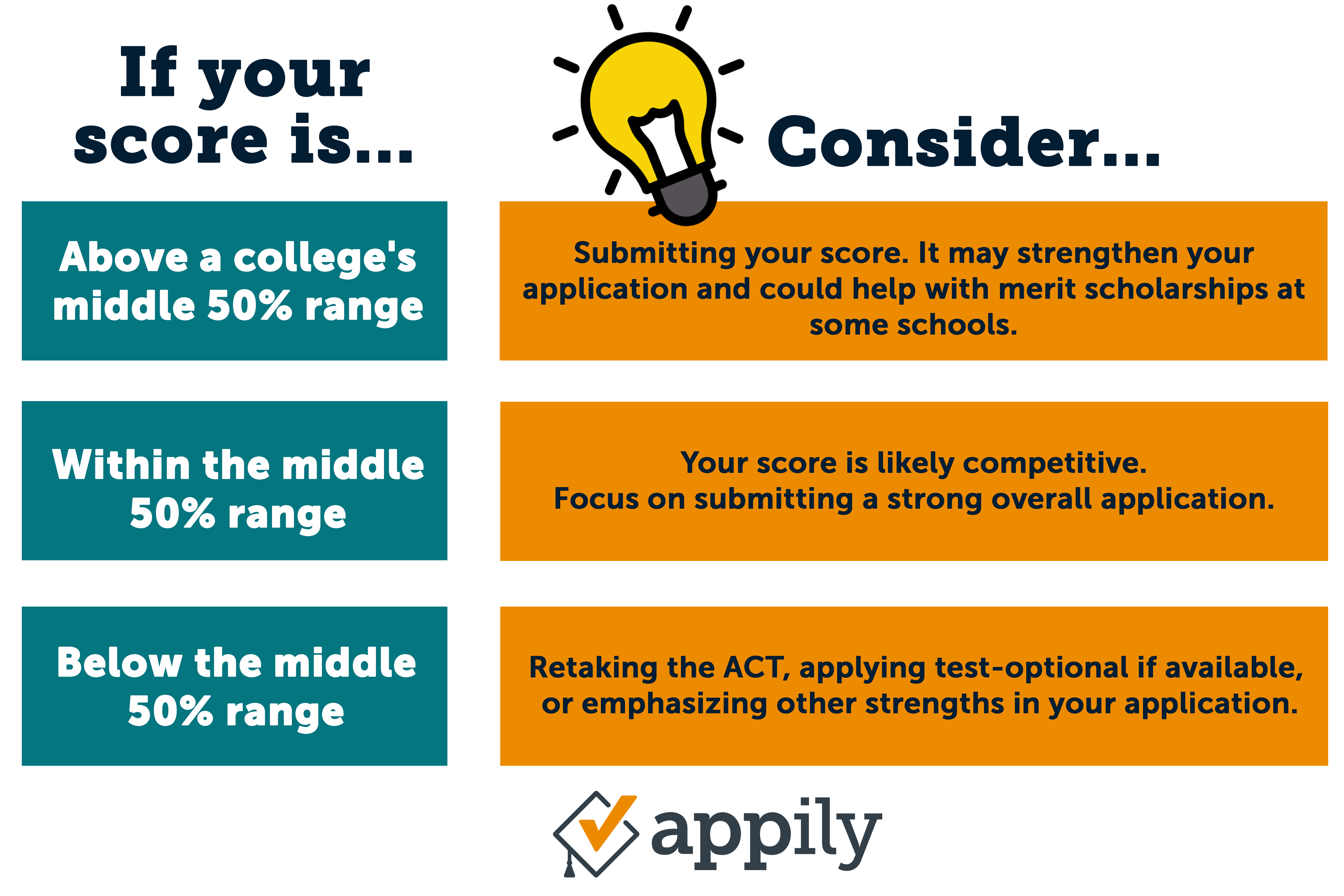
- Below the college’s middle 50% range: Consider retaking the ACT or applying test-optional if the school allows it.
- Within the college’s middle 50% range: Your score is likely competitive for that school.
- Above the college’s middle 50% range: Your score may strengthen your application and could help with merit aid at some colleges.
The middle 50% range shows where the middle half of admitted students scored. That range is one of the best tools for deciding whether your ACT score is “good” for a specific college.
Let’s look at an example:
Jordan earned a 25 ACT score. One college on his list has a middle 50% range of 22–27. Another has a range of 31–34. His 25 is competitive for the first school but below range for the second. He submits his score to one college and applies test-optional to the other.
ACT score ranges and what they may mean
Use this as a starting point, not a final rule.
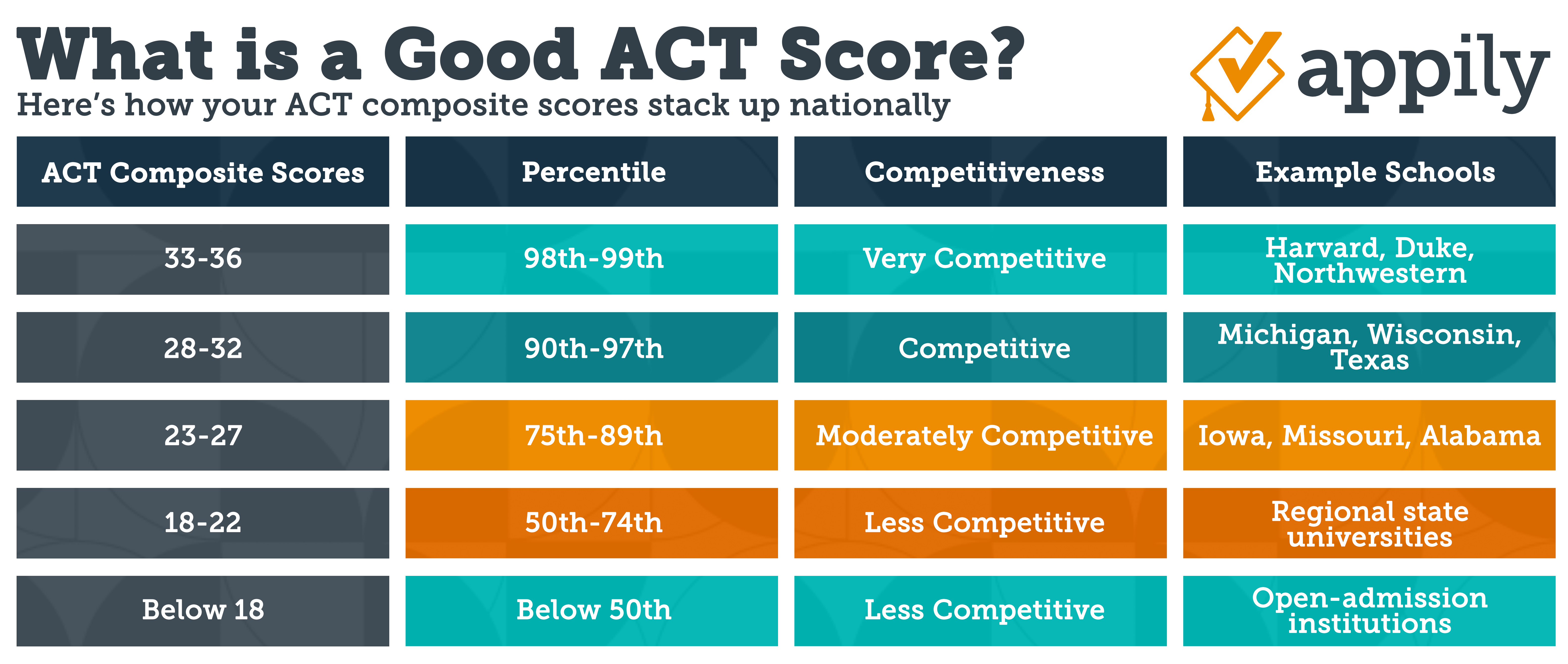
These score ranges are general guidelines. A 24 ACT score might be above average for one college but below average for another. Always compare your score with the colleges on your own list before deciding whether it's "good."
Percentiles can also help. ACT’s current national ranks place a 20 Composite around the 63rd percentile, a 24 Composite around the 80th percentile, and a 30 Composite around the 94th percentile.
Percentiles are helpful, but your college list matters most.
Is a 20 a good ACT score?
A 20 ACT score is slightly above the national average of 19.4 for the 2025 graduating class. It also falls around the 63rd percentile in ACT’s current national rank data.
Is it good? It depends on where you’re applying.
A 20 may be a reasonable score for some colleges, especially less selective schools or schools where your GPA, course rigor, essay, and activities are strong. But it may be below range for more selective colleges.
If your score is around 20, your next step is to compare it to the ACT ranges at the schools on your list.
You may want to retake the ACT if:
- Your target schools usually admit students with higher scores
- You have time to prep
- Your practice scores are improving
- You need a higher score for scholarships
If your target schools are test-optional and your score is below their range, you may choose not to submit it.
Is a 24 a good ACT score?
It depends on where you're applying, but for many students the answer is yes, a 24 ACT score is strong.
A 24 is above the national average and falls around the 80th percentile in ACT’s current national rank data.
That means it can be competitive at many colleges, especially if the rest of your application is strong. It may also help with some merit scholarship opportunities, depending on the school.
That said, a 24 may still be below range at more selective colleges.
Your next step:
- Compare your 24 to each college’s middle 50% ACT range.
- Submit it if it supports your application.
- Consider retaking if your target schools’ ranges are higher and you have time to prep.
Is a 30 a good ACT score?
Yes, a 30 ACT score is very strong.
A 30 falls around the 94th percentile in ACT’s current national rank data, which means it is higher than the scores of most ACT test takers.
A 30 can be competitive at many selective colleges and may strengthen your application, especially when paired with strong grades, rigorous courses, and meaningful activities.
For the most selective colleges, a 30 may still fall below the middle 50% range. That doesn’t make it a bad score. It just means you should check each school’s data before deciding whether to submit.
In general, a 30 is worth submitting if it lands within or above a college’s middle 50% range.
How to tell if your ACT score is good for your college list
Here’s the process.
Look up each college’s middle 50% ACT range
Start with the colleges on your list. Look for admitted-student ACT ranges on:
- The college’s admissions website
- The Common Data Set
- Appily college profiles
- College search and comparison tools
Compare your score to that range
Once you find the range, place your score into one of three categories:
| Your score | What it means |
| Below range | Retake, apply test-optional if available, or strengthen other parts of your application |
| Inside range | Your score is likely competitive for that school |
| Above range | Your score may be a strength in your application |
Look at your full application
ACT scores matter, but they are not the whole application.
Colleges may also consider:
- GPA
- Course rigor
- Essays
- Activities
- Letters of recommendation
- Demonstrated interest, where considered
- Portfolio, audition, or major-specific requirements
A strong ACT score can help. But it usually works best as part of a strong overall application.
Decide school by school
This is where students sometimes make mistakes.
A score you should submit to one college might not be worth submitting to another. A 25 could be strong for one school and below range at another.
Make the decision school by school. Not with one blanket rule for your whole list.
Should you retake the ACT?
Focus on retaking if...
Focus elsewhere if...
You're 1–3 points below target
You're already within range
Practice tests are improving
Your GPA needs attention
Scholarships depend on scores
Essays still need work
Retaking the ACT may make sense if your current score is below your goal and you still have time to prepare.
ACT reports that among 2025 graduates who tested two or more times, students improved their ACT Superscore by an average of 2.4 points. That doesn’t guarantee your score will go up, but it shows that retaking can be useful when you have a plan.
Consider retaking if:
- Your score is below the middle 50% range at your target schools
- Your score is close to a scholarship cutoff
- One section score is holding you back
- The colleges on your list superscore
- Your practice scores are trending higher
- You know what you need to improve
You may not need to retake if:
- Your score is already within or above range for your target schools
- You’re applying mostly test-optional and your score doesn’t help
- Retaking would take time away from grades, essays, applications, or other priorities
- You’ve already taken the test multiple times and your scores have leveled off
A retake is most useful when it has a purpose. Don’t retake just because you feel like you “should.”
Should you submit your ACT score to test-optional colleges?
If a college is test-optional, you get to choose whether to submit your ACT score.
That choice should depend on whether your score strengthens your application.
Consider submitting your score if:
- It falls within or above the college’s middle 50% range
- It supports your GPA and course rigor
- It may help with scholarships or honors programs
- It adds positive context to your application
Consider applying test-optional if:
- Your score is below the college’s range
- Your transcript is stronger than your test score
- Your score does not reflect your academic ability
- The school clearly says scores are optional
Testing policies are changing, so check each college’s current policy before you apply. Some colleges remain test-optional, some are test-free, and some require SAT or ACT scores again. Appily’s test-optional guide is a natural internal link here.
What ACT score can help with merit scholarships?
ACT scores can matter for scholarships, especially merit aid.
Some colleges use ACT scores when awarding merit scholarships, often alongside GPA or class rank. Other scholarships may not use test scores at all.
That’s why it’s worth checking scholarship requirements separately from admissions requirements.
A college may be test-optional for admission but still consider ACT scores for:
- Merit scholarships
- Honors programs
- Competitive majors
- Course placement
There is no universal scholarship score. At some public universities, merit aid may begin in the mid-20s. At more competitive schools, stronger scores may be expected. Always check the college’s current scholarship page.
If your ACT score is strong, it may be worth submitting even when it’s optional.
What if your ACT score is lower than you wanted?
First: don’t panic.
A lower ACT score does not mean your college options are gone.
You still have choices:
- Retake the ACT if you have time and a plan
- Try the SAT and see if that test fits you better
- Apply test-optional where available
- Focus on colleges where your score is in range
- Strengthen your essays, activities, and application strategy
- Look for schools where your GPA and course rigor carry more weight
A test score is one part of your application. It is not your entire story.
ACT vs. SAT: what if you’re not sure which test to take?
If you’re still deciding between the ACT and SAT, it may help to take one timed practice version of each.
The ACT and SAT are different tests, and some students feel more comfortable with one than the other.
In general:
- The ACT is scored from 1 to 36.
- The SAT is scored from 400 to 1600.
- Colleges typically accept either test unless they say otherwise.
- The better test is usually the one where your score is stronger and your prep feels more manageable.
This does not need to be the main focus of this article. For a deeper breakdown, check out our SAT vs. ACT guide.
Quick note on the enhanced ACT
In 2025, ACT began rolling out the enhanced ACT, which includes a shorter format and an optional Science section. ACT says that beginning in September 2025, all ACT tests use a Composite score based on English, Math, and Reading only; Science is optional and reported separately if taken.
That matters for test planning, but not for the main question here.
Whether your ACT score is “good” still depends on your college list, score ranges, and goals.
For more details about test format, link to Appily’s “what’s on the ACT” guide.
How to set a target ACT score
A target score gives your prep a clear goal.
Here’s how to set one:
- Make a list of colleges you’re interested in.
- Find each school’s middle 50% ACT range.
- Write down the upper end of each range.
- Choose a target score that puts you near the top range for most of your schools.
If your target colleges have very different score ranges, you may need more than one strategy. Your ACT score might be strong for some schools and below range for others.
That’s normal.
Your college list should include a healthy mix of safety, match, and reach schools.
If your colleges have different score ranges, set your target based on the most selective schools you're seriously considering, not the highest score you can find online.
Find colleges where your ACT score is competitive
Once you know your ACT score, use it as a tool, not a label.
Your score can help you:
- Find colleges where you may be a strong applicant
- Decide which schools are reach, target, or likely options
- Choose whether to retake
- Decide whether to submit scores at test-optional schools
- Explore scholarship opportunities
With Appily, you can browse colleges by ACT score, compare schools, and build a list that fits your goals, academic profile, and budget.
Your ACT score matters, but it’s only one part of your college search.
Use it to make smarter decisions, not to limit yourself too early.
See your chances of admission with your ACT score
Now that you know what's considered a good ACT score, it's time to use that information to decide where you'll apply to college.
Click the button below to create a free Appily account to see how competitive you'll be if you apply to the schools on your list. You can also search for additional schools using your ACT score, GPA, and other criteria to find your perfect match.
Just click the button below to get started!
FAQs: What is a good ACT score?
What is a good ACT score?
A good ACT score is one that is competitive for the colleges on your list. In general, a score within or above a school’s middle 50% ACT range is a strong sign that your score may support your application.
What is the average ACT score?
The national average ACT Composite score for the 2025 graduating class was 19.4, according to ACT data.
Is 20 a good ACT score?
A 20 is slightly above average nationally and falls around the 63rd percentile in ACT’s current national rank data. It can be useful at many colleges, but may be below range for selective schools.
Is 24 a good ACT score?
Yes. A 24 is above average and falls around the 80th percentile in ACT’s current national rank data. It can be competitive at many colleges.
Is 30 a good ACT score?
Yes. A 30 is a very strong ACT score and falls around the 94th percentile. It may help at many selective colleges, though you should still compare it to each school’s middle 50% ACT range.
Is 36 a good ACT score?
Yes. A 36 is a perfect ACT Composite score. It is impressive, but it is not required for admission at most colleges.
Should I retake the ACT?
Retake the ACT if your score is below your target schools’ ranges, you have time to prepare, or you’re close to a scholarship threshold. If your score is already in range, your time may be better spent on essays, grades, and applications.
Should I submit my ACT score to a test-optional college?
Submit your score if it strengthens your application. A good rule is to compare your score to the school’s middle 50% range. If your score is in or above range, submitting may help.
Do ACT scores matter for scholarships?
Sometimes. Some merit scholarships use ACT scores, while others do not. Check each college’s scholarship requirements separately from its admissions policy.
Is the ACT more important than GPA?
Usually, no. GPA and course rigor are often very important, but a strong ACT score can support your application and help show college readiness.
