Colleges That Offer Free Tuition for Low-Income Students

Not all “free tuition” programs work the same way.
If you’re looking for free tuition for low-income students, there are more options than you might expect. Many colleges now offer programs that:
- Cover full tuition
- Reduce costs based on family income
- Or replace loans with grants and scholarships
This list focuses on schools that make college more affordable, especially for students from lower-income backgrounds. As you read through, pay attention to:
Income thresholds (each school defines “low-income” differently) | What’s covered (tuition vs. full cost, including housing) | ||
Requirements (GPA, residency, application steps) | Whether aid replaces loans or adds to them |
The goal isn’t just to find a school with free tuition: it’s to find one that fits your situation.
Quick comparison: what these programs actually cover
Before you dive into the list, here’s a quick way to think about the differences:
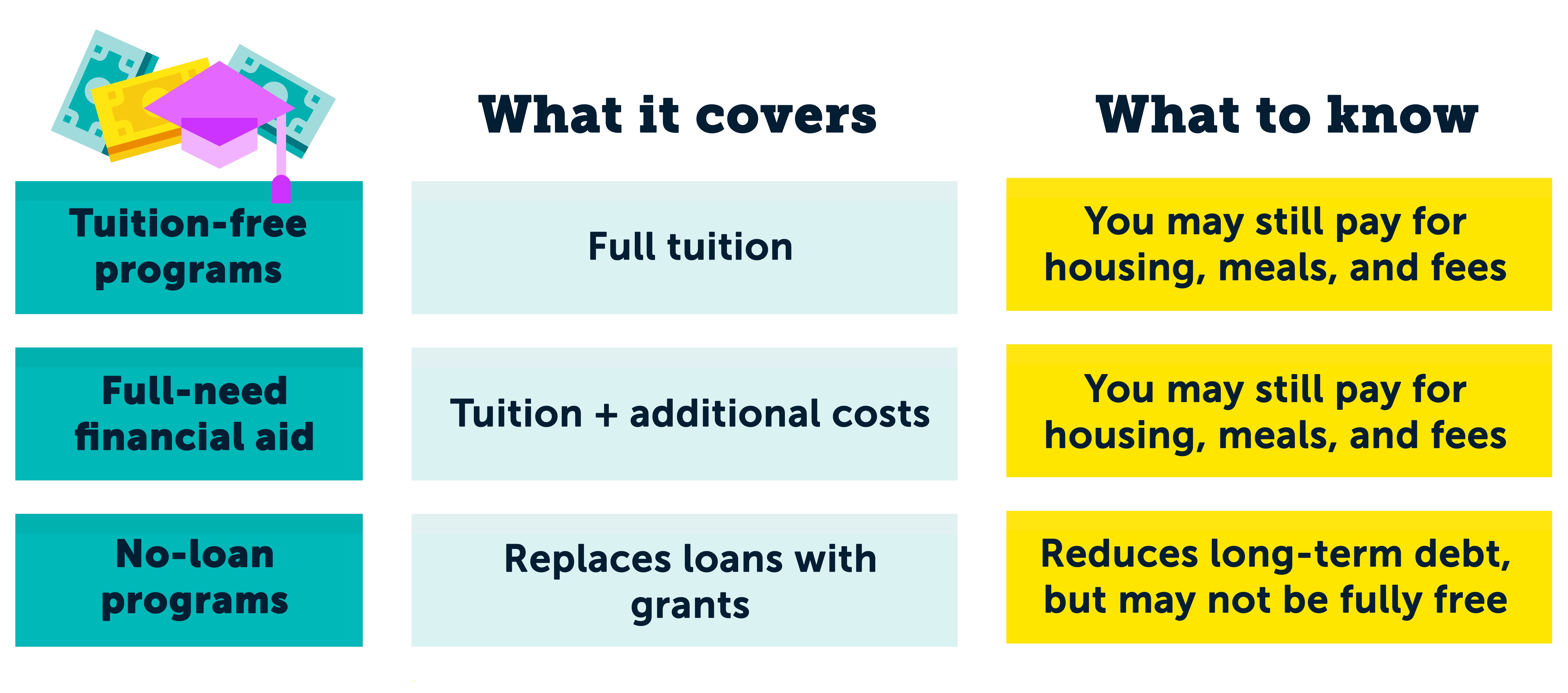
Two schools might both say “free tuition,” but your total cost could still be very different.
Types of free tuition programs
As you go through the list, you’ll notice a few common categories:
- Income-based tuition guarantees
- Full-need financial aid programs
- No-loan financial aid policies
- State-based free tuition programs
These categories are labeled below to help you compare.
Colleges that offer free tuition for low-income students
Income-Based Tuition Guarantee
Arkansas State University
A-State Promise Plus gives free tuition to many Arkansans whose households have an income under 70k.
Note: The A-State Promise Plus covers any remaining tuition costs after Pell Grants, Scholarships, and financial aid for up to 15 hours per semester.
Minnesota State University
North Star Promise Scholarship Program provides a pathway to free tuition and fees for eligible Minnesota residents at any of the 26 state colleges and seven state universities of the Minnesota State system.
To be eligible for the North Star Promise Scholarship:
- Be a Minnesota resident
- Have a family-adjusted gross income (AGI) as reported on the Free Application for Federal Student Aid (FAFSA) or Minnesota Dream Act Application below $80,000.
New York University
The NYU Promise guarantees that every undergraduate - domestic and international - who started as a first-year student admitted to our New York campus will not have to pay tuition if they have family income under $100,000 and hold typical assets.
University of Central Arkansas
University of Central Arkansas
The UCA Commitment is a groundbreaking, debt-free pathway for tuition and fees for incoming Arkansas freshmen with an annual household income of $100,000 or less.
University of Montana
With the Grizzly Promise, students from a family with an income of $50,000 or less, the University of Montana will cover your tuition and fees.
University of Nebraska - Lincoln
University of Nebraska – Lincoln
With the Nebraska Promise, students who meet academic qualifications and have a family income of $65,000 or less (Adjusted Gross Income/AGI) or are Pell Grant-eligible can attend tuition-free.
University of North Carolina at Asheville
University of North Carolina at Asheville
UNC Asheville offers Access Asheville, where Eligible NC residents with household AGI of $90K or less have tuition and fees covered with grants and scholarships.
But the program is soon to be expanding. First-year and transfer students from NC, GA, SC, TN, and VA currently applying to UNC Asheville for Fall 2025 and beyond are eligible if their household Adjusted Gross Income (AGI) is $90,000 or less.
Eligible North Carolina residents are guaranteed to have tuition and fees covered after all federal, state, and institutional grants and scholarships are applied, which is a minimum annual savings of $7,501 per student.
Beginning Fall 2025, eligible Georgia, South Carolina, Tennessee, and Virginia residents are guaranteed to have their tuition and fees reduced to $10,000 after all federal and institutional grants and scholarships are applied, which is a minimum annual savings of $14,849 per student.
University of North Texas
Beginning in the fall of 2026, UNT will cover full tuition and mandatory fees for incoming freshmen from Texas families earning $100,000 or less. This initiative is part of Texas universities’ growing promise programs, which aim to expand access to higher education by helping students limit debt to earn a degree. The program will cover tuition and fees for freshmen pursuing their first bachelor’s degree for up to four years. Eligible students must rank in the top 25% of their high school class or qualify for a federal Pell Grant.
University of Oklahoma
A student who is enrolled in OU’s Crimson Commitment will not have to pay tuition and, combining outside and OU resources, average student fees for four years.
To qualify for Crimson Commitment as an incoming freshman, one must-
- Qualify fully for Oklahoma’s promise. You must be:
- An Oklahoma resident
- Enrolled in the program during your eighth, ninth, or tenth year in an Oklahoma school
- A student whose parents earn $55,000 or less per year
University of Tennessee
This innovative scholarship will cover a student’s last dollar amount of tuition and mandatory fees after other financial aid is applied (such as Pell grants, HOPE Scholarship, or other institutional scholarships) to students who qualify for HOPE and whose household income is under $60,000 a year.
University of Texas System
The University of Texas System
The University of Texas System Board of Regents’ Academic Affairs Committee has given preliminary approval to a plan that will provide tuition-free education to UT undergraduates from families with an adjusted gross income (AGI) of $100,000 or less. This initiative is set to launch in the 2025-2026 academic year at all nine of the system's academic institutions.
University of Texas at Dallas
Eligible students with a family income of $65,000 or less will have their full tuition covered through a combination of the Comet Promise funding, scholarships, grants, and other tuition exemption programs.
University of Texas El Paso
The Paydirt Promise program covers tuition and mandatory fees for eligible students with a family-adjusted gross income of $80,000 or less.
Note: The Paydirt Promise is available to first-time freshmen, returning, and transfer students. The Paydirt Promise is not available to students who are receiving an exemption or waiver for tuition.
University of Vermont
Under the UVM Promise, admitted undergraduate students starting in the fall 2025 semester or later, whose parents' adjusted gross income (AGI) is $100,000 or less with typical assets will receive Federal, state, and institutional grants and scholarships to cover their tuition and comprehensive fee, as well as a waiver for the University acceptance fees.
Texas A&M University
AGGIE ASSURANCE PROGRAM: Aggie Assurance helps students with a family income of $60,000 or less by ensuring that eligible students have enough scholarships and grants to pay for tuition
Texas State University
Bobcat Promise. This program guarantees free tuition and mandatory fees for 15 credit hours per semester to new entering freshmen with a family-adjusted gross income that does not exceed $50,000.
In addition, the program will cover the cost of the required US1100 course. The amount awarded under this program equals the tuition and fees reflected in the Texas resident attendance cost; any award or combination of awards cannot exceed one's demonstrated need.
Weber State University
The Dream Weber program provides free tuition and general student fees to students enrolled in 12-semester credits who qualify for a Pell Grant and whose annual household income is $50,000 or less.
These schools typically use income thresholds to reduce or eliminate tuition, but may not cover full cost.
Full-Need Financial Aid (Highly Selective)
Brandeis University
Starting in the 2025-2026 academic year, Brandeis University will make undergraduate education more affordable through its new financial aid initiative, The Brandeis Commitment. For students entering in fall 2025 and beyond, the program offers generous scholarship packages based on family income:
- Families earning $75,000 or less will receive grants covering full tuition.
- Families earning between $75,001 and $200,000 will receive grants covering half tuition.
These awards are based on families with typical assets, as outlined in the program’s FAQ.
Brown University
Brown fully covers tuition for families earning $125,000 or less with typical assets. In addition, students of families making less than $60,000 a year with typical assets will receive scholarships that cover all expenses- tuition, room, board, and books- and additional scholarships to help support other expenses.
Colgate University
Students with annual family incomes below $80,000 attend tuition-free, while students with annual family incomes between $80,000 and $175,000 pay a percentage of annual income toward tuition.
Columbia University
Students from families with annual incomes less than $150,000 (and typical assets) can attend Columbia tuition-free.
Cornell University
Students with low-income status have little or no expected parent contribution as part of their financial aid package, are Pell Grant recipients, or have had their academic experience limited due to socioeconomic status. Note that they often intersect, first-generation and low-income are not synonymous.
For the 2025–26 academic year, most families with total annual income up to $75,000 and typical assets will receive aid offers, including grant aid and work-study only—no student loans. A typical aid offer will include:
- $0 expected student and parent contributions (maximizes grant/scholarship aid)
- $5,000 work-study award* (and abundant work-study job opportunities)
- $0 student loans*
Dartmouth College
Dartmouth’s Zero Parent Contribution Initiative ensures that students from low- to middle-income backgrounds can afford a Dartmouth undergraduate education. Those students whose families have a total annual income below $125,000 can expect to receive a financial aid package that includes no responsibility for a parent contribution and no loans, provided their assets are typical for this income range.
Duke University
Duke University is proud to offer full tuition grants to admitted undergraduate students from North Carolina and South Carolina whose families have a total income of $150,000 or less.
For students from families earning $65,000 or less, Duke goes even further, covering full tuition as well as providing financial assistance for housing, meals, course materials, and other campus expenses—all without requiring student loans.
Harvard University
As of fall 2025, you'll pay nothing to attend Harvard if your family’s income is $200,000 and below.
Haverford College
Students with family income below $60,000 per year will not have a loan expectation included in their financial aid package; loan expectations for incomes above this threshold remain low, ranging from $1,500 to $3,000 yearly.
Lafayette College
Families with total income of up to $200,000 and typical assets for families in this income group will have their financial needs met through grants and work-study programs, without any loans.
Lehigh University
Lehigh University’s Lehigh Commitment covers full tuition for undergraduate students from families earning under $75,000. Eligible students who apply for financial aid by the deadline pay no tuition, making a Lehigh education more accessible for low-income families.
Massachusetts Institute of Technology
Massachusetts Institute of Technology
As of the 2024-25 academic year, undergraduates from families earning less than $200,000 annually can attend MIT tuition-free, thanks to newly expanded financial aid. This income threshold includes 80 percent of American households. For families earning less than $100,000, parents will not be required to contribute anything toward the full cost of an MIT education, covering tuition, housing, dining, fees, and an allowance for books and personal expenses.
The $100,000 threshold marks an increase from this year’s $75,000, while the $200,000 threshold for tuition-free attendance will rise from the current $140,000.
Northwestern University
Northwestern University meets 100% of demonstrated financial need with loan-free aid. Most families earning less than $70,000 attend at no cost, and most families earning less than $150,000 pay no tuition. Students can estimate their net price in less than 20 minutes by using their Quick Cost Estimator.
Princeton University
Undergraduates from most families that earn up to $100,000 annually will not have to pay for tuition or room and board at the University.
Rice University
Rice University's Rice Investment offers the following support based on family income:
- Full Tuition, Fees, Room, and Board: Families earning less than $75,000 annually will receive grants covering all tuition, mandatory fees, and living expenses.
- Full-Tuition Scholarship: Families earning between $75,000 and $140,000 annually will receive at least a full-tuition scholarship.
- Half-Tuition Scholarship: Families earning between $140,000 and $200,000 annually will receive at least a half-tuition scholarship.
- Loan-Free Aid: Students qualifying for need-based aid will receive financial support without the requirement to take out student loans.
This initiative underscores Rice University's dedication to making a world-class education accessible to students from diverse economic backgrounds.
Tufts University
Students with an annual family income of less than $60,000 typically receive a financial aid package with no student loans.
University of Chicago
UChicago will guarantee free tuition for families with incomes under $125,000* per year (with typical assets). Families earning less than $60,000* per year (with typical assets) will have tuition, fees, and standard room and meals covered by financial aid.
University of Pennsylvania
The University of Pennsylvania's Quaker Commitment is a financial aid initiative aimed at supporting middle-income families with increasing aid packages and expanded full-tuition scholarships.
Starting in the 2025-2026 academic year, Penn will no longer include the value of a family’s primary home as an asset when determining financial aid eligibility. Additionally, the income threshold for families eligible to receive full-tuition scholarships will rise from $140,000 to $200,000 for those with typical assets.
This initiative highlights Penn’s dedication to making higher education more accessible and affordable for students from diverse economic backgrounds.
Vanderbilt University
“Opportunity Vanderbilt” is a new financial aid program that provides full-tuition scholarships without loans to all students with families making less than $150,000 annually. According to the Vanderbilt Hustler, the median aid awarded for the 2023-24 school year to first-year students with family incomes ranging from $125,000 to $150,000 was $70,359. This exceeds the $61,618 cost of tuition estimated by the Office of Student Financial Aid.
Washington University in St. Louis
Washington University in St. Louis
The WashU Pledge is a financial aid program that will provide a free undergraduate education to incoming, full-time Missouri and southern Illinois students who come from a family with $75,000 or less in annual income.
Wesleyan University
If your family income is less than $120,000 (with typical assets), Wesleyan University will ensure that there are no student loans in your Wesleyan financial aid package.
Effective fall 2024, Wesleyan University no longer includes loans in its financial aid packages.
Yale University
Families with annual income below $75,000 and typical assets qualify for a “zero parent share award”- Yale’s most generous financial aid package. These awards cover the full cost of tuition and fees, housing, food, and travel with a Yale Scholarship, and qualifying students receive a $2,000 grant for their first year and hospitalization insurance coverage.
These schools don’t usually advertise “free tuition,” but often providethe most generous overall aid.
No-Loan Financial Aid Programs
University of Richmond
For students who are Virginia residents with a total annual parental income of $60,000 or less, the University provides grant-based financial aid equal to full-time tuition, housing, and the Spider unlimited meal plan.
Washington & Lee University
Washington and Lee is need-blind in admission and meets 100% of demonstrated financial need without loans. Through the W&L Promise, admitted students from families with incomes below $150,000 and typical assets receive at least a full-tuition grant, while those with incomes below $75,000 receive grants covering tuition, room, and board. W&L also offers competitive merit scholarships, including the full-cost Johnson Scholarship and additional full-tuition awards.
These schools replace loans with grants, which can reduce long-term costs.
Strong Financial Aid (But Not Guaranteed Free Tuition)
Carnegie Mellon University
As of the 2024-2025 academic year, the CMU Pathway Program enables students from families earning less than $75,000 annually to attend Carnegie Mellon University tuition-free. Additionally, students from families earning less than $100,000 annually will have the opportunity to pursue their studies without relying on federal student loans. This program supports new and returning undergraduate students on CMU’s Pittsburgh campus who are U.S. citizens or permanent residents and whose families have typical assets for their income.
Florida State University - Panama City
Florida State University Panama City
The FSU Promise Scholarship provides free tuition and fees to students who are residents of NW Florida and whose combined family and student income is less than $60,000 or are Pell-eligible.
University of Illinois - Chicago
University of Illinois – Chicago
UIC's Aspire Program provides a 100% tuition-free education for Illinois residents with a family income of $75,000 or less. With the UIC Aspire program, you can earn a life-changing 4-year degree without the burden of tuition and fees. Focus on your future, not college debt, and discover where an exceptional UIC education can take you.
University of Illinois Urbana-Champaign
University of Illinois Urbana-Champaign
The University of Illinois Urbana-Champaign covers tuition and fees for up to four years for all qualified in-state students. To qualify, you must:
- You must be a U.S. citizen or eligible noncitizen
- You’re an Illinois resident (parents listed on the FAFSA are also Illinois residents)
- Your family income is $75,000 or less (effective fall 2025)
- Your family’s assets are $75,000 or less (effective fall 2025)
- You’re under the age of 24
- You’re admitted as a new freshman or transfer student
- You attended and graduated from an Illinois high school
- You must be enrolled in a baccalaureate degree program for at least 12 hours during fall or spring semesters
University of Michigan
All three U-M campuses offer the Go Blue Guarantee: free and reduced tuition for up to four years for qualified high-achieving, in-state, full-time undergraduate students.
Specifically, Michigan families with incomes $125,000 and under & assets below $125,000 will qualify for FREE TUITION beginning Fall 2025.
University of Maryland, Baltimore County
University of Maryland, Baltimore County
UMBC is proud to offer the UMBC Best of Baltimore Grant to undergraduate students from families earning less than $80,000 annually living in Baltimore City. The UMBC Best of Baltimore Grant is a last-dollar award to cover remaining direct costs (tuition, fees, housing, and meal plan) after all other federal, state, and institutional grants, scholarships, and federal subsidized student loans.
University of Wisconsin - Madison
University of Wisconsin – Madison
Bucky’s Tuition Promise is a commitment to Wisconsin resident students. The program guarantees scholarships and grants to pay for tuition and segregated fees for students whose household adjusted gross income (AGI) is $65,000 or less. Incoming first-year students will receive eight (8) consecutive semesters (4 years) of free tuition and segregated fees, and new transfer students will receive four (4) semesters (2 years).
Public University & State-Based Free Tuition Programs
Allegheny College
Through Allegheny’s Commitment to Access Program (CAP), Allegheny College will cover 100% of tuition for Pennsylvania and Ohio students from families earning $50,000 or less.
The State University of New York (SUNY)
The State University of New York
The Excelsior Scholarship provides tuition awards to eligible students attending New York State’s public colleges and universities (SUNY and CUNY). This scholarship, in combination with other student financial aid problems, allows students to attend a SUNY college tuition-free.
To meet the eligibility requirements, an applicant must
- Have a combined federal adjusted gross income of $125,000
- Be a resident of NYS and have resided in NYS for 12 continuous months prior to the beginning of the term
The University of California System
University of California- System
The nine schools of the University of California System—Berkeley, Davis, Irvine, Los Angeles (UCLA), Merced, Riverside, San Diego, Santa Barbara, and Santa Cruz—waive tuition and fees for most state residents with total family incomes less than $100,000 a year.
UC's Blue and Gold Opportunity Plan will ensure that you will not have to pay UC’s systemwide tuition and fees out of your own pocket if you are a California resident whose total family income is less than $100,000 a year and you qualify for financial aid — and that's just for starters.
The University of Texas System
The University of Texas System
The University of Texas System Board of Regents’ Academic Affairs Committee has given preliminary approval to a plan that will provide tuition-free education to UT undergraduates from families with an adjusted gross income (AGI) of $100,000 or less. This initiative is set to launch in the 2025-2026 academic year at all nine of the system's academic institutions.
University of Illinois - Chicago
University of Illinois – Chicago
UIC's Aspire Program provides a 100% tuition-free education for Illinois residents with a family income of $75,000 or less. With the UIC Aspire program, you can earn a life-changing 4-year degree without the burden of tuition and fees. Focus on your future, not college debt, and discover where an exceptional UIC education can take you.
University of Illinois Urbana-Champaign
University of Illinois Urbana-Champaign
The University of Illinois Urbana-Champaign covers tuition and fees for up to four years for all qualified in-state students. To qualify, you must:
- You must be a U.S. citizen or eligible noncitizen
- You’re an Illinois resident (parents listed on the FAFSA are also Illinois residents)
- Your family income is $75,000 or less (effective fall 2025)
- Your family’s assets are $75,000 or less (effective fall 2025)
- You’re under the age of 24
- You’re admitted as a new freshman or transfer student
- You attended and graduated from an Illinois high school
- You must be enrolled in a baccalaureate degree program for at least 12 hours during fall or spring semesters
University of North Carolina at Asheville
University of North Carolina at Asheville
UNC Asheville offers Access Asheville, where Eligible NC residents with household AGI of $90K or less have tuition and fees covered with grants and scholarships.
But the program is soon to be expanding. First-year and transfer students from NC, GA, SC, TN, and VA currently applying to UNC Asheville for Fall 2025 and beyond are eligible if their household Adjusted Gross Income (AGI) is $90,000 or less.
Eligible North Carolina residents are guaranteed to have tuition and fees covered after all federal, state, and institutional grants and scholarships are applied, which is a minimum annual savings of $7,501 per student.
Beginning Fall 2025, eligible Georgia, South Carolina, Tennessee, and Virginia residents are guaranteed to have their tuition and fees reduced to $10,000 after all federal and institutional grants and scholarships are applied, which is a minimum annual savings of $14,849 per student.
University of North Carolina at Chapel Hill
University of North Carolina at Chapel Hill
UNC-Chapel Hill will cover tuition and mandatory fees for in-state undergraduates whose family income is less than $80,000, effective fall 2024.
University of Virginia
UVA will cover the full cost of tuition and fees for in-state undergraduate students with a family income of less than $100,000. UVA will also cover the full cost of tuition, fees, room and board for Virginians from families with incomes of less than $50,000.
Universities of Wisconsin
The Wisconsin Tuition Promise provides up to four years of tuition and fee funding for undergraduate students coming from families earning less than $62,000 annually and enrolling at 12 public universities other than UW-Madison.
Note that these programs are often tied to residency and income requirements.
Full Tuition for All Students (Unique Model)
Berea College
Berea has not charged tuition since 1892. We’ve built our “No Tuition Promise” into an all-inclusive “Whole You” package that no other college can offer. Berea works with your FAFSA to cover all possible housing, food, and fees costs—plus provides unparalleled support: a free laptop, fully-funded internship, comprehensive health care, free professional clothing, and much more.
If you're not able to qualify for free college tuition, check out this list of the best value colleges. Students report an excellent ROI for the schools on our list.
QuestBridge programs
QuestBridge is a nationally recognized nonprofit organization that ensures high-achieving students from low-income backgrounds can reach their full potential at the nation’s best colleges.
The QuestBridge path to college begins with the College Prep Scholars Program, which helps high school juniors become strong applicants to top colleges. In their senior year, students can apply to the National College Match, an admissions process that connects students with admission and full four-year scholarships or generous financial aid from college partners.
Students admitted to a college partner through the National College Match join the QuestBridge Scholars Network, which provides them with engagement opportunities and a supportive community on campus and nationwide.
After graduation, the QuestBridge Alumni Association provides additional opportunities to support students in succeeding in their careers and communities.
QuestBridge college partners are highly selective research universities and liberal arts colleges in the United States. College partners offer an outstanding education to their undergraduate students. These schools range in size from 900 to over 16,000 undergraduates.
The colleges and universities listed below are partnered with QuestBridge:
Applying to colleges with free tuition
When applying to colleges offering free tuition for low-income students, carefully reviewing the admissions requirements and application process is vital. Each college may have specific criteria and deadlines that must be met.
Admission requirements can include submitting transcripts, standardized test scores, letters of recommendation, and personal statements.
To set yourself up for success, we recommend gathering all necessary documents and preparing a compelling application that highlights your achievements, experiences, and future goals. Seek guidance from teachers, counselors, or mentors who can provide valuable insights and assistance throughout the application process.
By submitting a well-prepared and thoughtful application, you increase your chances of gaining admission to colleges with free tuition programs.
Additional resources for students
In addition to accessing free tuition or the benefits of Questbridge programs, students can take advantage of other programs that expand access and opportunities for success. It's also helpful to stay updated about changes to college application requirements and funding options.
Learn your chances of admission with Appily
As you navigate the college application process, you'll want to make confident decisions based on facts. You can use Appily's chances calculator to calculate your chances of getting into any college.
Simply input data points like your GPA and test scores if you have them, and you’ll be able to see how you stack up against your peers. It’s always free and easy. Click the button below to learn your chances.
Frequently asked questions about free college tuition
Do any colleges offer completely free tuition?
Yes. Some colleges offer full tuition coverage for students below certain income thresholds. However, not all programs cover housing or other costs.
What is considered low-income for these programs?
It depends on the school. Some define low-income as families earning under $65,000, while others use higher thresholds.
Do I still need to apply for financial aid?
Yes. Most programs require submitting the FAFSA and sometimes additional financial aid forms.
Are these programs only at private colleges?
No. Both public and private colleges offer free tuition or reduced-cost programs.
What's the difference between free tuition and full financial aid?
Free tuition covers tuition only. Full financial aid may also include housing, meals, and other expenses.
Can international students qualify?
In most cases, these programs are limited to U.S. students, but some private universities offer aid to international applicants.
