How to Appeal a Financial Aid or Merit Scholarship Award Offer

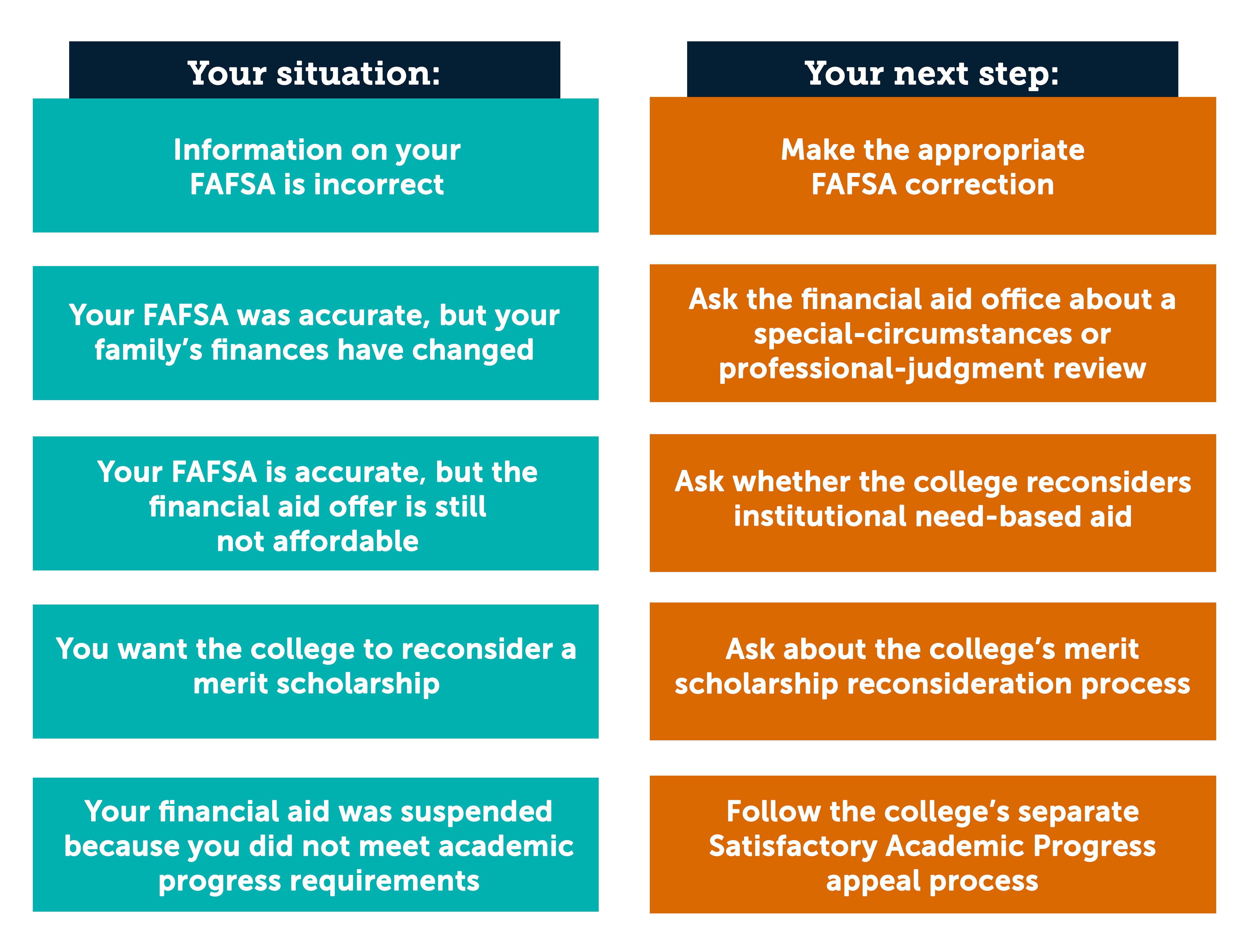
If your college financial aid offer is not enough, the right next step depends on why. If your FAFSA contains an error, correct the FAFSA. If your family’s financial circumstances have changed, ask the college about a special-circumstances or professional judgment review. If your FAFSA is accurate but you still want the college to reconsider its institutional need-based aid, ask whether the school has an aid reconsideration process. If you want more merit scholarship money, ask whether the college allows merit scholarship reconsideration.
Before sending a letter, contact the college and ask about its process, deadline, required forms, and documentation. Additional aid is never guaranteed, but a clear, well-supported request can make sure the school is reviewing the right information.
This guide covers requests to reconsider a financial aid offer. If your financial aid was suspended because you did not meet your college’s Satisfactory Academic Progress requirements, that is a different type of financial aid appeal. Schools that allow SAP appeals have separate policies and requirements.
The TL;DR
- If your FAFSA contains an error: Make a FAFSA correction or ask the college what can be corrected.
- If your FAFSA was accurate, but your financial circumstances have changed: Ask the financial aid office about a special-circumstances or professional judgment review.
- If your FAFSA is accurate and your circumstances have not changed, but the college is still unaffordable: Ask whether the school offers reconsideration of institutional need-based aid.
- If you want the college to reconsider a merit scholarship: Ask whether merit scholarship reconsideration is available and which office handles it.
- If your aid was suspended because of your academic progress: That is a Satisfactory Academic Progress, or SAP, issue and follows a different appeal process.If you are not sure which category applies, contact the financial aid office before changing your FAFSA or submitting an appeal.
What is a financial aid appeal?
A financial aid appeal is a request for a college to reconsider the financial aid it has offered you based on information the school is allowed to review.
For federal need-based aid, a financial aid administrator may use professional judgment to consider special financial circumstances on a case-by-case basis. Depending on the situation, the administrator may adjust certain FAFSA data used to determine your Student Aid Index or Pell Grant eligibility, or certain parts of your cost of attendance.
The U.S. Department of Education explains these rules in the 2026–27 Federal Student Aid Handbook section on special cases and professional judgment. A professional-judgment adjustment applies only at the school making the decision.
Professional judgment does not change the federal financial aid formula itself. It allows the college to review your individual circumstances and decide whether an allowable adjustment is appropriate.
A school may also have its own process for reconsidering institutional need-based aid, even when your FAFSA information and financial circumstances have not changed. Because institutional policies differ, ask whether this type of reconsideration is available and what information the college will consider.
Merit scholarship reconsideration follows a different process. Merit aid is based on criteria and policies set by the college, so ask whether the school allows merit scholarship reconsideration and which office handles those requests.
Is a FAFSA appeal the same as a financial aid appeal?
Not exactly. If information on your FAFSA is incorrect, you may need to make a FAFSA correction. If the FAFSA was accurate when you submitted it but your financial circumstances have changed, you generally contact the college’s financial aid office and ask about an aid adjustment or professional-judgment review.
A recent job loss, income reduction, or other financial change does not mean the earlier tax information on your FAFSA was wrong.
Federal Student Aid advises students with significant changes in income or other special financial circumstances to complete the FAFSA as instructed and then contact their college’s financial aid office about an adjustment. You can review the guidance in Federal Student Aid’s FAFSA checklist for students.
If you are unsure whether you need a FAFSA correction or financial aid review, contact the college before changing the form.
What are good reasons to appeal financial aid?
A significant change in your family’s finances or another circumstance that affects your ability to pay for college can be a reason to request a special-circumstances review.
Federal Student Aid identifies examples of special financial circumstances that a financial aid administrator may consider, including:
- A significant change in employment, income, or assets
- High medical, dental, or nursing home expenses not covered by insurance
- Child or dependent care expenses
- A change in housing circumstances
- Tuition expenses at an elementary or secondary school
- Additional family members enrolled in college
- A severe disability affecting the student or another household member
- Other significant changes that affect your costs or ability to pay for college
The federal list is not exhaustive, and decisions are made case by case. See Federal Student Aid’s professional-judgment guidance for special circumstances for the current federal examples.
A parent losing a job, a major reduction in family income, or another financial shift can mean the information on your FAFSA no longer reflects your family’s current situation.
FAFSA uses income and tax information from an earlier year. The 2026–27 FAFSA uses 2024 tax information, while the 2027–28 FAFSA uses 2025 tax information. Do not substitute a different tax year simply because your family’s finances have changed.
If your family’s current financial situation is substantially different from the tax information used on your FAFSA, complete and submit the FAFSA as instructed and then contact the college’s financial aid office. The college may ask for documentation before deciding whether an adjustment is appropriate. Federal Student Aid’s steps for students filling out the FAFSA explain this process.
An appeal does not guarantee more aid. But if your finances have changed substantially, asking the college what review process is available can still be worthwhile.
How to appeal your financial aid offer
A strong financial aid appeal follows the college’s instructions, explains why you are requesting a review, states the request clearly, and includes the supporting information the school asks you to provide.
Review your Student Aid Index and financial aid offer
Before appealing, make sure you understand what the college has offered and how much you would still need to cover.
Your FAFSA Submission Summary includes your Student Aid Index, or SAI. The SAI is an index number colleges use when determining financial aid eligibility and building financial aid offers.
The SAI is not:
- The amount of financial aid you will receive
- The amount you or your family is expected to pay
- Your final financial aid offer
Federal Student Aid’s Student Aid Index explainer provides more information about what the SAI means and how schools use it.
Your actual financial aid offer comes from the college and shows the specific types and amounts of aid the school is offering you. Your FAFSA Submission Summary includes estimates and your SAI, but the college makes the final determination about the aid it offers.
When reviewing an offer, separate:
- Grants and scholarships, which generally do not need to be repaid
- Work-study, which requires you to earn the money through eligible employment
- Student loans, which must be repaid
- The college’s total cost of attendance
- The amount you would still need to cover after grants and scholarships
If you have offers from several colleges, compare the remaining cost, not just the total dollar amount of each financial aid package.
Do not treat loans or work-study as discounts on the price of college. Federal Work-Study funds, for example, must be earned through eligible employment and are not guaranteed simply because an amount appears in an aid offer. Federal Student Aid’s guide to evaluating financial aid offers can help you compare the different types of aid.
Also look at which expenses the college bills directly and which estimated costs, such as books, transportation, or personal expenses, you may need to pay separately.
Contact the financial aid office
Before writing a letter, ask the college how its process works.
You can say:
Hi, I received my financial aid offer and would like to ask whether my current circumstances qualify for a financial aid review. Could you tell me the process, deadline, and documentation I would need to submit?
If your circumstances have not changed, adjust the wording:
Hi, I received my financial aid offer, and my FAFSA information is accurate. I’d like to ask whether the college has a process for reconsidering institutional need-based aid. Could you tell me whether reconsideration is available and what I would need to submit?
Write down the name of the person you speak with and any instructions they give you.
If the school directs you to a form or online portal instead of asking for a letter, follow that process.
Gather the documentation the college requests
Submit documentation that supports the situation the college is reviewing rather than sending every financial record you have.
The college may request items such as: 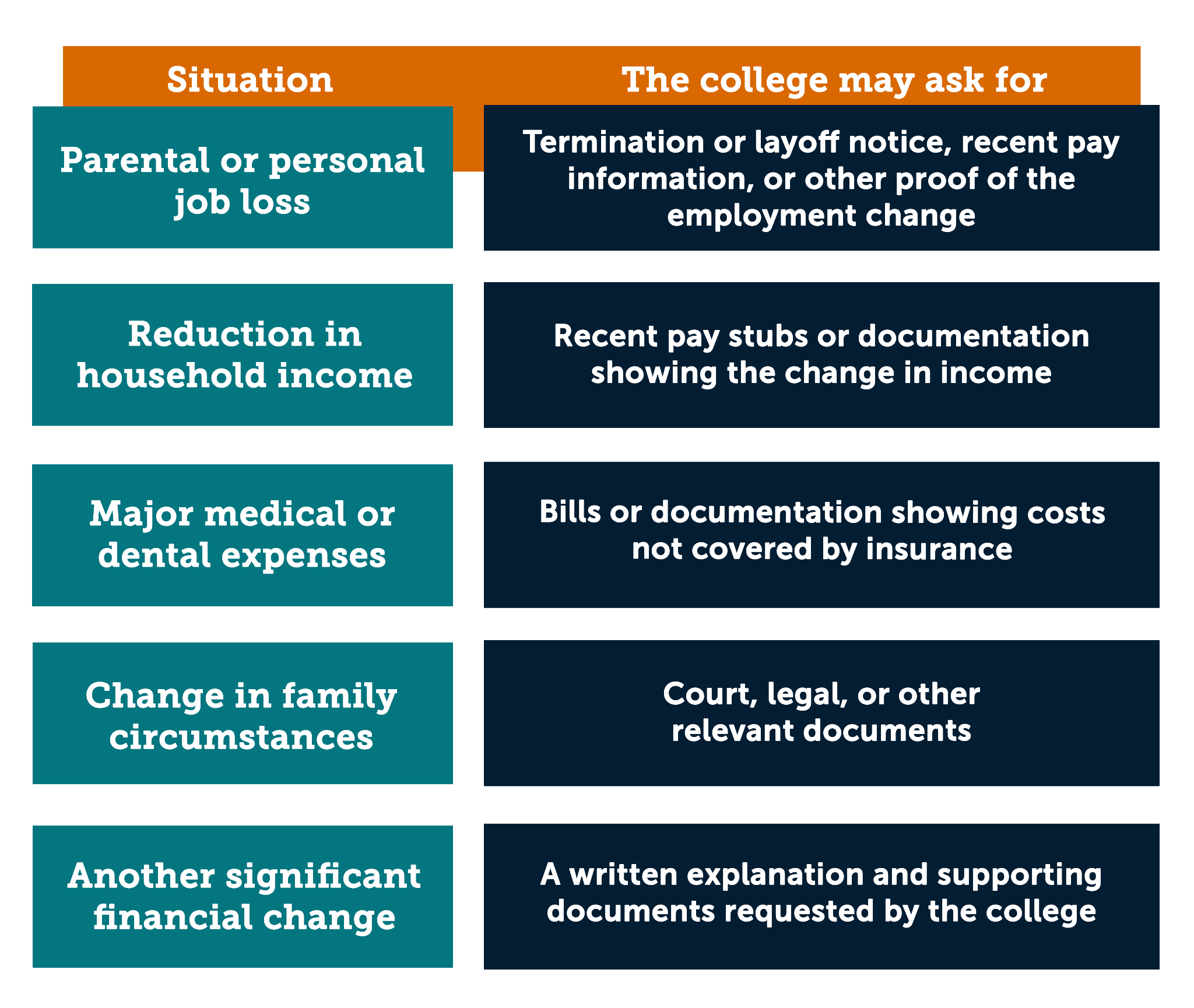
Federal Student Aid’s professional-judgment guidance explains that financial aid administrators must document their decisions and may use supporting information to substantiate the circumstances being reviewed.
Do not send sensitive financial or personal documents the college did not ask for. Follow the school’s instructions for securely submitting information.
Write and submit a concise financial aid appeal
Your letter should explain:
- What changed
- How the change affects your ability to pay
- What you are asking the college to review
- What documentation you are providing
Stick to the facts. You do not need a dramatic essay to make a strong request.
Submit the appeal using the method the college requires, whether that is an online portal, form, email, or another process.
Keep a copy of your request and the documents you submitted. If the college gives you an expected review timeline, record it so you know when a follow-up would be appropriate.
Special-circumstances financial aid review letter template
Use this template as a starting point, but follow the college’s instructions if it requires a particular form or format.
Subject: Request for Financial Aid Review for [Academic Year]
Dear [Financial Aid Administrator or Financial Aid Office],
My name is [Name], and I am an admitted/enrolled student at [College]. I am writing to request a review of my financial aid offer for the [academic year].
Since I submitted my FAFSA, [briefly explain the significant change in your financial circumstances]. This change has affected my family’s ability to contribute to my college costs because [brief explanation of the financial impact].
I have attached [list the documentation you are providing] to support my request.
I would be grateful if the financial aid office could review my circumstances and determine whether I may qualify for an adjustment to my financial aid. Please let me know if you need any additional forms or documentation from me.
Thank you for your time and consideration.
Sincerely,
[Your full name]
[Student ID, if applicable]
[Email address]
[Phone number, if requested]
Financial aid appeal submission checklist
Before submitting your request:
- Confirm the college’s appeal or reconsideration process
- Check the deadline
- Use the required form, portal, email address, or submission method
- Explain the specific reason you are requesting a review
- Include only the documentation the college requests
- Check that your contact and student information is correct
- Keep copies of what you submit
- Record the date you submitted the request
- Note any review timeline the financial aid office provides
- Watch your email and college portal for follow-up requests
Do you need to correct your FAFSA instead?
Correct your FAFSA when information on the form is wrong. If the information was accurate when you submitted it but your financial circumstances have changed since then, contact the college instead of replacing accurate FAFSA information with new numbers on your own.
After your FAFSA has been processed, certain corrections can be made online, including fixing some errors, updating certain information, and adding or removing schools.
Federal Student Aid’s guide to what to do after submitting the FAFSA explains which types of corrections students can make and when changes to financial information need to go through the school.
A recent job loss, income reduction, or similar change does not mean the earlier tax information on your FAFSA was incorrect. It means the FAFSA may no longer reflect your family’s current financial situation.
Federal Student Aid specifically advises families experiencing a significant change in income to complete the FAFSA as instructed and then contact the financial aid office about an adjustment rather than replacing the required tax information themselves. See the Federal Student Aid FAFSA checklist for current guidance.
If you are unsure whether your situation requires a FAFSA correction or a financial aid review, contact the college’s financial aid office before changing the form.
What if your FAFSA is accurate, but your financial aid offer is still not enough?
Ask whether the college has a process for reconsidering its institutional need-based aid.
Not every school offers this type of reconsideration, and the information a college will consider varies.
You can contact the financial aid office and say:
"Hi, I’ve reviewed my financial aid offer, and my FAFSA information is accurate. The remaining cost is still difficult for my family to afford. Does the college have a process for reconsidering institutional need-based aid, and is there any additional information I can submit for review?"
Ask whether the school:
- Has a formal reconsideration process
- Requires a form or written request
- Accepts information beyond the FAFSA
- Will consider another college’s financial aid offer
- Has a deadline for requesting reconsideration
Don’t describe changed financial circumstances if nothing has actually changed. State that you are asking whether the school has an institutional process that may apply to your situation.
Institutional need-based aid reconsideration email template
Subject: Request for Institutional Need-Based Aid Reconsideration
Dear [Financial Aid Administrator or Financial Aid Office],
My name is [Name], and I am an admitted student at [College]. Thank you for the financial aid offer I received for the [academic year].
I have reviewed my FAFSA information, and it is accurate. However, after grants and scholarships, my family would still need to cover approximately $[amount] toward my college costs.
I’m writing to ask whether [College] has a process for reconsidering institutional need-based aid and whether there is any additional information I can provide for review.
[Optional, if the school accepts competing offers: I have also received a financial aid offer from another college that leaves my family with a lower remaining cost, and I would be happy to provide that offer if it can be considered.]
Please let me know whether reconsideration is available, whether there is a form or deadline I should follow, and what information you would need from me.
Thank you for your time and consideration.
Sincerely,
[Your full name]
[Student ID, if applicable]
[Email address]
What should you say in a financial aid appeal?
Be specific enough for the financial aid office to understand what changed and why it affects your ability to pay.
Instead of saying "my family’s financial situation has become difficult," try "my parent lost their job in June, so our current household income is substantially lower than the income reflected in the tax information used for my FAFSA."
You don't need to include every personal detail of your family’s situation. Focus on the financial change the college is being asked to review and provide the documentation it requests.
If your circumstances have not changed, say that clearly and ask whether an institutional reconsideration process is available instead.
Can you appeal financial aid because another college offered more?
Possibly, but it depends on the college. A competing offer does not require one school to increase or match its aid.
If your financial circumstances have not changed, ask whether the college has an institutional financial aid reconsideration process and whether it considers offers from other colleges.
For merit scholarship reconsideration, ask whether competing merit awards are relevant under the school’s policy. If the college wants to see another offer, provide the actual documentation.
Compare the offers carefully. Focus on grants, scholarships, and the amount you would still need to cover, not just the headline value of one award.
For example, a $25,000 scholarship at a higher-priced college could still leave you with a larger remaining cost than a $15,000 scholarship at a less expensive school.
Do not assume the college will “match” another institution’s offer. Ask whether the information can be considered under the school’s policy.
Can you appeal a merit scholarship?
You can ask whether a college will reconsider a merit scholarship, but the process, eligibility rules, deadlines, and information the school considers vary.
Start by asking:
- Does the college allow merit scholarship reconsideration?
- Which office handles the request?
- Is there a deadline?
- Does the college require a specific form or written statement?
- Can you submit a scholarship or financial aid offer from another college for consideration?
If a competing offer is relevant, share it accurately. Focus on the grants and scholarships you received and your remaining cost at each school rather than simply saying another college “gave you more money.”
Avoid assuming that a school will match another institution’s award. Give the college useful information and ask whether reconsideration is available.
Do not make promises you do not intend to keep. For example, do not say you will definitely enroll if the college increases your scholarship unless that is your actual plan.
Merit scholarship reconsideration email template
Subject: Merit Scholarship Reconsideration Request
Dear [Admissions or Financial Aid Contact],
Thank you for my admission to [College] and for the [name or amount of scholarship] included in my offer. I am very interested in attending [College].
I’m writing to ask whether the college has a process for reconsidering merit scholarship awards.
[If applicable: I have received another scholarship offer that results in a lower remaining cost at another college, and I would be happy to provide a copy if that information can be considered.]
Could you let me know whether I am eligible to request a review and whether you need any additional information from me?
Thank you for your time and consideration.
Sincerely,
[Your full name]
[Student ID, if applicable]
How much should you ask for in a financial aid appeal?
For a special-circumstances review, do not choose an arbitrary dollar amount just to make your appeal sound stronger. Explain what changed financially and provide the documentation the college requests. The financial aid administrator will decide whether an allowable adjustment affects your eligibility.
If the school asks you to explain your affordability gap, be specific about what you are struggling to cover.
For example, you might explain that after grants and scholarships, your family would still need to cover $[amount] that it cannot reasonably afford under its current financial circumstances.
For an institutional or merit aid reconsideration request, you can explain your remaining cost or provide a competing offer if the college permits it. Ask whether additional grant or scholarship assistance is available rather than demanding that the school match a specific amount.
When should you appeal financial aid?
Contact the college as soon as you know you have information it should review or after you receive an aid offer you cannot afford and want the school to reconsider.
There is no single financial aid appeal deadline that applies to every college. A school may have its own deadlines, forms, documentation requirements, and review timeline.
You might request a review:
- After receiving a financial aid offer you cannot afford
- After a significant change in family income
- After a job loss
- After an unexpected major expense
- After another qualifying change in your financial circumstances
- During the school year if a significant financial change occurs after you enroll
Do not assume it is too late. Do not assume you have unlimited time, either.
Contact the financial aid office promptly and ask about the school’s current deadline, process, and documentation requirements.
Tips for talking to the financial aid office
Be clear, courteous, and specific about what you need. Remember, you're asking the college to review relevant information under its process, not trying to “win” a negotiation.
Ask questions when you do not understand your aid offer
Financial aid offers can include grants, scholarships, work-study, and several types of loans. Ask the financial aid office to explain anything you do not understand before deciding whether an appeal is necessary.
You want to know:
- Which aid reduces your cost without repayment
- Which money must be earned through work
- Which money would have to be repaid
- What your remaining cost would be
- Which costs are billed by the college and which are estimated expenses
Federal Student Aid’s guide to evaluating aid offers is also useful when comparing these categories across colleges
Be specific about what changed
“College is too expensive” does not tell the financial aid office what financial information it should review under a special-circumstances request.
Explain the concrete change. For example:
"My parent lost their job in June, so the income reflected in our FAFSA no longer represents our current household income."
Then ask what documentation the school needs. If nothing has changed, say that and ask whether an institutional reconsideration process is available.
Ask how institutional aid was calculated
For FAFSA purposes, your family’s principal place of residence is not reported as an investment.
Some colleges use the CSS Profile or other institutional financial aid information when awarding their own funds. The College Board’s CSS Profile overview explains that the CSS Profile is used by participating colleges and scholarship programs to award nonfederal institutional aid.
If you do not understand how a college calculated your institutional aid, ask.
You can also ask whether the school has a process for reviewing information or circumstances that may not be fully represented in its original calculation.
Share competing offers only when they are relevant
If a college allows reconsideration and wants to see other offers, provide the actual documentation.
Compare the remaining cost after grants and scholarships rather than focusing only on the headline amount of an award. A larger scholarship at a more expensive college may still leave you paying more.
What happens after you submit a financial aid appeal?
The college will review your request under its own process. It may approve the request, deny it, or ask for more information before making a decision.
Watch your email and college portal in case the financial aid office requests additional forms or documentation.
If you have not heard back within the timeframe the school gave you, follow up politely and ask about the status of your request.
For federal aid adjustments involving professional judgment, the school makes the case-by-case determination. Federal Student Aid states that the school’s decision is final and cannot be appealed to the U.S. Department of Education. You can find that rule in both the Federal Student Aid Handbook’s professional-judgment guidance and Federal Student Aid’s article on what to do when your financial aid is not enough.
Because professional-judgment decisions are made by individual schools, an adjustment made by one college does not automatically apply at another college.
What if your financial aid appeal is denied?
If the college cannot increase your aid enough, find out what other options are available and recalculate what attending that school would require you to pay or borrow.
Your next steps can include:
- Ask whether any other institutional grants or scholarships may be available.
- Confirm the final amounts of your grants, scholarships, work-study, and loans.
- Calculate how much you would still need to cover.
- Compare that amount with the remaining cost at your other colleges.
- Ask about available payment plans or student employment options if those would help your family.
- Continue looking for outside scholarships.
- Before accepting additional loans, make sure you understand how much you would need to borrow and repay.
Federal Student Aid recommends considering options such as scholarships, aid adjustments, additional need-based programs, work, and payment plans when an aid offer does not cover your college expenses. See 7 Options if You Didn’t Receive Enough Financial Aid for additional federal guidance.
If you receive an outside scholarship, do not assume it will reduce your remaining cost dollar for dollar. Ask the college how the scholarship would affect the rest of your financial aid package.
Compare your options before committing
Whether your appeal succeeds or not, the main question is how much each college will leave you to cover.
After the college gives you a final decision, compare your updated offers using the same categories at every school:
- Grants and scholarships
- Your remaining out-of-pocket cost
- The amount you would need to borrow
- Costs that may not appear on the bill, such as books and transportation
- Scholarship renewal requirements, if applicable
So now you know what's involved in appealing an aid award. But whether you choose to appeal an award or not, an appeal decision is only one part of choosing an affordable college, and you can almost always benefit from looking for supplemental scholarships. With Appily, finding scholarship money is easy. Create your free account, and you'll have access to our extensive and up-to-date database of scholarships and schools.
FAQs about financial aid appeals
Can I appeal financial aid at more than one college?
Yes. You can ask each college to review your financial aid under that school’s policies. If a college makes a professional-judgment adjustment based on your special financial circumstances, that decision applies only at that college. Another school would need to review your situation separately.
Do I need to write a financial aid appeal letter?
Not always. Some colleges require a specific form, online portal, or other submission process instead of a letter. Before writing anything, contact the financial aid office and ask about its process, deadline, required documentation, and submission method.
Can a financial aid appeal increase my Pell Grant eligibility?
Possibly. When special financial circumstances apply, a financial aid administrator may use professional judgment to adjust certain FAFSA information used to determine your Student Aid Index or Pell Grant eligibility. The college reviews these situations case by case, and an adjustment does not guarantee that you will receive more federal aid.
Does a financial aid appeal change my FAFSA?
A professional-judgment review is different from correcting an error on your FAFSA. If your FAFSA information was accurate but your financial circumstances later changed, contact the college instead of replacing accurate FAFSA information on your own. The financial aid administrator will determine whether an allowable adjustment is appropriate.
Can I ask a college to match another school’s financial aid offer?
You can ask whether the college considers competing financial aid or scholarship offers, but the school is not required to match another offer. If the college allows reconsideration, provide the actual offer if requested and compare the amount you would still need to pay after grants and scholarships, not just the total amount of aid offered.
What if my financial situation changes after I start college?
You can still contact your college’s financial aid office if you experience a significant financial change during the school year. Ask whether your circumstances qualify for a special-circumstances or professional-judgment review and what documentation the school requires.
What if the college asks for more information after I submit my appeal?
Respond promptly and follow the college’s instructions for submitting additional documentation. Financial aid offices may need more information before making a decision, so continue checking your college email and student portal while your request is under review.
Does a financial aid appeal guarantee more money?
No. A financial aid appeal or reconsideration request does not guarantee additional grants, scholarships, or other aid. The college will review your request under its policies and may approve it, deny it, or ask for more information before making a decision.
