How to Find Private Scholarships

Private scholarships are college funding opportunities offered by organizations outside your college or the federal government. The best way to find them is to start with your colleges, build profiles on trusted scholarship databases, search locally, and prioritize awards where you clearly meet the eligibility requirements.
It can all feel like a lot, especially when every search turns up hundreds of results.
The good news? You don’t need to apply to every scholarship you find. You need a system for finding the private scholarships that actually match your background, interests, goals, and timeline.
Private scholarships can come from companies, nonprofits, foundations, community groups, religious organizations, professional associations, and individuals.
Federal Student Aid also recommends checking schools, employers, community organizations, religious groups, and professional or social organizations when searching for scholarships.
Here’s how to search smarter, avoid dead ends, and build a private scholarship list that’s actually worth your time.
The TL;DR
- Start with your college financial aid offices, then expand to scholarship databases, local organizations, employers, and niche opportunities.
- Create a scholarship profile on trusted search tools so you can get matched with awards based on your background, interests, and goals.
- Prioritize scholarships where you are a strong fit, especially local, niche, renewable, or lower-competition awards.
- Keep a simple tracker with deadlines, requirements, award amounts, and submission status.
- Reuse essays and materials when you can, but always tailor your application to the scholarship.
- Watch for red flags. You should not have to pay to apply for a scholarship.
- Start with college scholarships, but remember that college-based scholarships are usually institutional aid, not private scholarships.
- Watch for scholarship scams. Legitimate scholarships should not require you to pay to apply.
- If you win an outside scholarship, check whether you need to report it to your college’s financial aid office.
What is a private scholarship?
A private scholarship is financial aid offered by an organization outside of the federal government or your college’s standard financial aid package.
Private scholarships may be funded by:
- Companies
- Nonprofits
- Foundations
- Community groups
- Religious organizations
- Professional associations
- Individuals
These scholarships can be based on different factors, including academic achievement, financial need, identity, location, intended major, career goals, hobbies, volunteer work, or personal experiences.
Some private scholarships are one-time awards. Others are renewable, which means you may receive funding for more than one year if you continue to meet the requirements.
How to find private scholarships: Step-by-step
The easiest way to find private scholarships is to treat the process like a search project, not a one-time task.
Step One: Start with the colleges on your list
Before looking everywhere else, check the financial aid pages for the colleges you’re applying to.
Some colleges automatically consider students for merit scholarships when they apply. Others require a separate scholarship application, additional essays, or earlier deadlines.
Look for:
- Merit scholarships
- Department scholarships
- Honors college scholarships
- Major-specific awards
- First-year student scholarships
- Separate scholarship application deadlines
This step matters because some school-based scholarships are easier to miss than national scholarships.
Quick note: College scholarships aren’t always “private scholarships”
College-based scholarships are still a smart first stop, but they’re not always considered private scholarships.
A private scholarship usually comes from an outside organization, like a company, nonprofit, foundation, community group, or professional association. A scholarship from the college itself is usually called institutional aid or a college-based scholarship.
Still, it makes sense to start with colleges because some school scholarships are automatic, while others require a separate application or earlier deadline. Once you’ve checked what each college offers, you can expand your search to outside private scholarships.
Step Two: Create profiles on trusted scholarship search tools
Scholarship search websites can save time, especially when they match you with awards based on your profile.
Many tools ask for details like your:
- Grade level
- Location
- GPA
- Intended major
- Background
- Activities
- Interests
- Career goals
Appily’s scholarship database, for example, lets students sort scholarships by criteria like academic year, location, gender, and ethnicity.
The key is to keep your profile updated. The more complete your information is, the better your matches can be.
Step Three: Search locally before going national
National scholarships can be worth applying for, but they often attract a huge applicant pool.
Local scholarships may have fewer applicants, which can make them a better use of your time. Federal Student Aid specifically points students toward community organizations, local businesses, community foundations, employers, and religious organizations as scholarship sources.
Check with:
- Your high school counseling office
- Local businesses
- Community foundations
- Rotary, Kiwanis, or Lions Clubs
- Religious organizations
- Local nonprofits
- Your employer or your parent/guardian’s employer
- City or county education foundations
Local scholarships may be smaller, but a few smaller awards can add up.
Step Four: Look for niche scholarships that fit you
Niche scholarships are often based on a specific part of your background, interests, or goals.
Try searching by:
- Intended major
- Career interest
- Identity or background
- Hobbies
- Volunteer work
- Health condition or life experience
- Family background
- Military connection
- First-generation student status
- State or hometown
For example, instead of searching only “scholarships,” try searches like:
- “scholarships for engineering students”
- “scholarships for first-generation students”
- “scholarships for adopted students”
- “scholarships for students in [your state]”
- “scholarships for students interested in healthcare”
The more specific your search, the better your chances of finding scholarships that fit.
Step Five: Build a scholarship tracker
Once you find scholarships, keep them organized.
A simple spreadsheet works. Include columns for:
- Scholarship name
- Award amount
- Deadline
- Eligibility requirements
- Essay required?
- Recommendation required?
- Transcript required?
- Renewable or one-time?
- Submission status
- Link to application
This makes it easier to see what’s due next and which applications are worth prioritizing.
Where to Look for Private Scholarships
Use this as your search checklist.
 | Colleges and universitiesStart with each college’s financial aid and admissions pages. Some scholarships are automatic, while others require extra steps. |
| Scholarship databasesUse trusted search tools like Appily, BigFuture, Sallie Mae, or similar platforms that let you filter based on your profile. |
| EmployersCheck whether your employer or a parent/guardian’s employer offers scholarships for employees’ children. |
| Community organizationsLocal clubs, nonprofits, civic groups, and community foundations often offer scholarships with smaller applicant pools. |
| Religious organizationsSome churches, synagogues, mosques, temples, and faith-based organizations offer scholarships to students in their communities. |
| Professional associationsIf you already know your career path, look for organizations connected to that field. Many offer scholarships for students entering specific industries. |
| Identity-based and background-based groupsSome scholarships support students based on identity, background, heritage, first-generation status, military affiliation, or lived experience. |
How to prioritize which scholarships to apply for
You probably won’t have time to apply to every scholarship you find. That’s okay.
Use this framework to decide where to focus first.
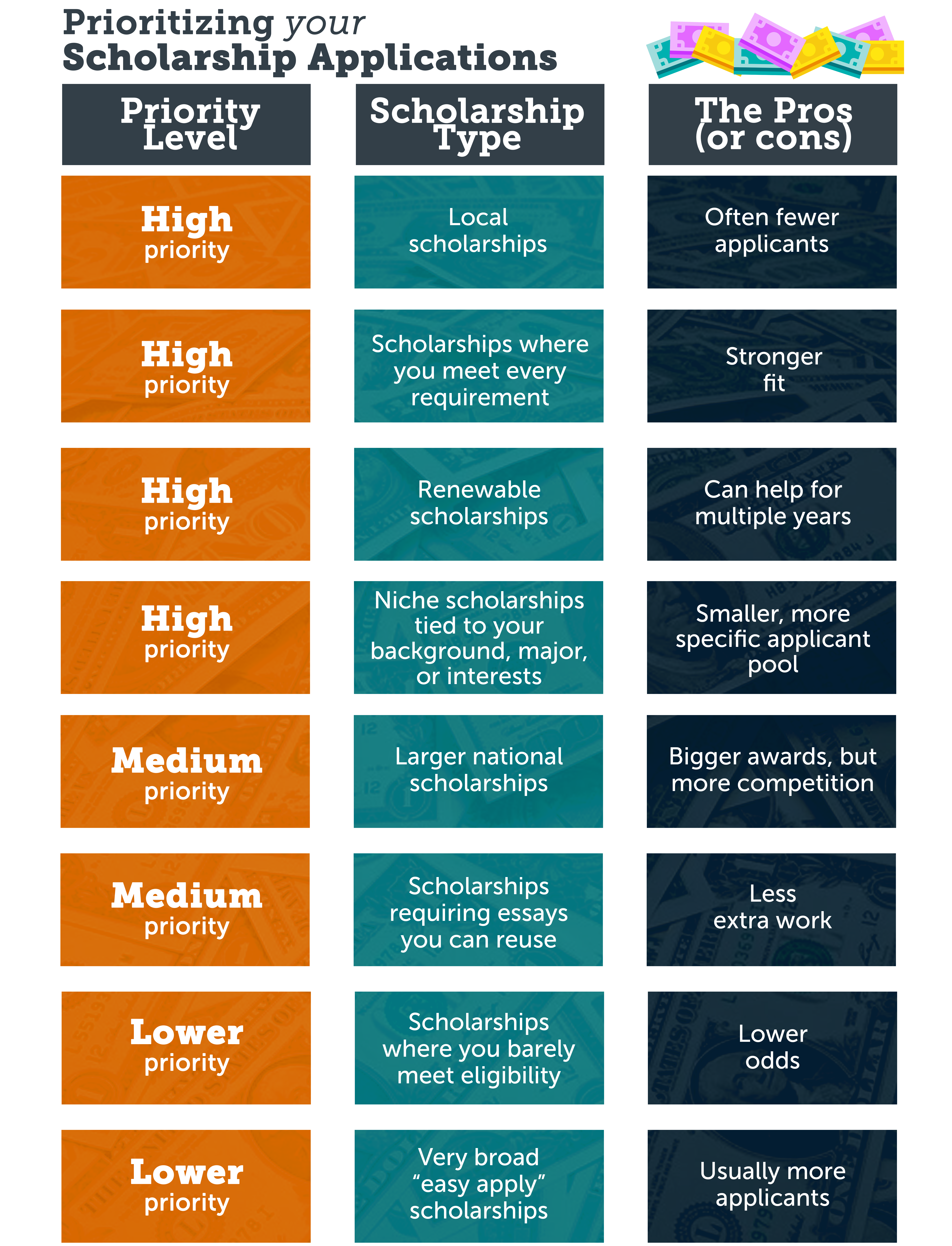
A good rule: prioritize scholarships where you can clearly answer, “Why am I a strong fit for this?”
Search by interests and skills, too. Some essay and writing competitions for high school students award cash, scholarships, publication, or other recognition, but always check how the organizer defines the prize.
What you’ll usually need to apply
Most private scholarship applications ask for some combination of:
- Basic personal information
- GPA or transcript
- Essay or short responses
- Resume or activities list
- Letter of recommendation
- FAFSA or financial need information
- Proof of enrollment or college plans
If you need a transcript, ask your school counseling office early. If you need a recommendation letter, give the person writing it enough time and share details about the scholarship.
The more organized you are, the easier it is to apply to multiple scholarships without starting from scratch each time.
If you win an outside scholarship, tell your college
If you receive a private scholarship from an outside organization, you may need to report it to your college’s financial aid office.
That doesn’t mean you did anything wrong. Colleges just need to know about outside scholarships so they can update your financial aid package and make sure your total aid stays within your cost of attendance.
In some cases, an outside scholarship may reduce what you need to borrow. In other cases, the college may adjust part of your aid package. Appily’s financial aid guidance notes that schools may “repackage” aid when something changes, including when a student wins an outside scholarship.
Before you commit to a scholarship, check:
- Does my college require me to report outside scholarships?
- Will this scholarship reduce loans, work-study, or grants first?
- Is the scholarship renewable?
- Will it be sent to me or directly to the school?
You can also read more about scholarship displacement, which explains how outside awards can affect a financial aid package.
How to search smarter
Scholarship searching gets easier when you use better search terms.
Instead of only searching:
scholarships for college
Try combining keywords like:
- Your state + scholarship
- Your city + scholarship
- Your major + scholarship
- Your identity/background + scholarship
- Your hobby + scholarship
- Your career goal + scholarship
- Your grade level + scholarship
Examples:
- “Ohio scholarships for high school seniors”
- “scholarships for nursing students”
- “scholarships for women in STEM”
- “scholarships for first-generation college students”
- “local scholarships near me”
Small changes in search wording can help you find better-fit opportunities.
How to avoid wasting time
Not every scholarship is worth the same amount of effort.
Before applying, ask:
- Do I meet all eligibility requirements?
- Is the deadline realistic?
- Is the award amount worth the time required?
- Can I reuse an essay or materials?
- Is the scholarship renewable?
- Does the organization seem legitimate?
Also, be careful with any scholarship that asks you to pay money to apply. Legitimate scholarships should not require an application fee.
Watch for scholarship scams
Most scholarships are legitimate, but it’s worth slowing down when something feels off.
A few red flags to watch for:
- You have to pay a fee to apply
- You’re guaranteed to win
- You’re asked for bank account or credit card information
- The offer feels rushed or too good to be true
- You’re told you won a scholarship you never applied for
A good rule: if a scholarship asks you to pay money, pause and verify it first.
For more details, see Appily’s guide to spotting scholarship scams. Appily’s scam guide includes a quick legitimacy checklist, red-flag language, and safe next steps for students who come across suspicious offers.
When should you start looking for private scholarships?
Start earlier than you think.
You can begin searching as early as freshman or sophomore year of high school, even if you’re not ready to apply yet. That gives you time to see what’s out there, save scholarships for later, and notice recurring deadlines.
If you’re a junior or senior, start now. Many scholarships have annual deadlines, so even if you miss one this year, you may be able to apply next year.
A good scholarship routine looks like this:
- Search once or twice a month
- Save strong matches
- Update your tracker
- Apply to the best-fit opportunities first
- Recheck deadlines regularly
How to find scholarships with Appily
Applying for scholarships takes time, but Appily can help make the process easier.
With Appily, you can search scholarships and sort by criteria like grade level, location, gender, ethnicity, academic year, and many other eligibility factors
That makes it easier to find private scholarships that match who you are, what you’re studying, and where you are in the college process.
So don’t wait - get started by creating your free Appily account and building out your scholarship list.
FAQs about finding private scholarships
Where can I find private scholarships?
You can find private scholarships through colleges, employers, community organizations, religious groups, nonprofits, professional associations, and trusted scholarship search tools like Appily and BigFuture.
What is the best way to search for private scholarships?
The best way is to create a scholarship profile, search by specific criteria, and keep a tracker of deadlines and requirements. Focus on scholarships that match your background, interests, location, major, or career goals.
Are local scholarships easier to win?
Local scholarships may have fewer applicants than national scholarships, which can make them a smart place to start. They are often offered by community foundations, civic groups, local businesses, or high school counseling offices.
When should I start applying for private scholarships?
You can start looking as early as freshman year, but many students begin applying seriously during junior and senior year. Since deadlines vary, it helps to search regularly and save scholarships for later.
What materials do I need for scholarship applications?
Common materials include transcripts, essays, recommendation letters, resumes, activity lists, and financial need information. Requirements vary by scholarship, so always read the application carefully.
How do I know which scholarships are worth applying for?
Prioritize scholarships where you meet all eligibility requirements, have a strong fit, and can submit a strong application before the deadline. Local, niche, and renewable scholarships are often worth prioritizing.
Are private scholarships only based on grades?
No. Some private scholarships are based on grades, but others focus on financial need, leadership, service, identity, career goals, hobbies, major, location, or personal experiences.
Can I reuse scholarship essays?
Yes, you can often reuse parts of scholarship essays. Just make sure each essay answers the specific prompt and feels tailored to that scholarship.
Are scholarship search websites safe?
Many are, but use trusted platforms and avoid scholarships that ask you to pay to apply. A legitimate scholarship should not require an application fee.
How does Appily help with scholarships?
Appily helps students search for scholarships and sort opportunities based on criteria like grade level, location, gender, ethnicity, and academic year.
