Best Colleges with Esports in 2027

Imagine getting a scholarship for doing what you love: gaming. Esports isn’t just a hobby anymore; it’s a serious path to college, with universities investing in top-tier programs, scholarships, and professional-level facilities.
If esports is part of your college search, several U.S. colleges offer competitive teams, recruiting programs, scholarships, dedicated gaming spaces, and opportunities to study or work in the esports industry.
Dr. Joey Gawrysiak, Executive Director of Esports at Syracuse University, notes that
“Collegiate esports is expanding, especially at larger universities, as schools invest in competitive gaming to engage students and prepare them for careers in the growing esports industry. Esports has become a pathway to college for many students, especially as more high schools introduce programs, creating a clear route from amateur to collegiate-level play”
For 2027, Appily's Best group includes Ball State University, Baylor University, Columbia College, Cumberland University, Endicott College, Fisher College, Maryville University, Northwood University, Pace University, Stony Brook University, University of Akron, UC Irvine, West Virginia University, and Winthrop University. These schools aren't ranked against one another; each met the criteria below.
The TL;DR
- The colleges in our Best section meet the same minimum standards for current program activity, recent competitive results, and university support.
- For the 2027 Best group, a school had to earn a qualifying national top-four result during the completed 2025–26 academic year.
- A school needs more than a gaming club or a strong esports facility to qualify.
- Varsity games, scholarship amounts, and recruiting requirements can change from year to year. Verify each one on the college's official esports site.
- Compare your estimated net price and academic fit along with the esports program. A strong team doesn't make a college affordable or academically right for you.
How we chose the best colleges with esports programs
There is no single official ranking of U.S. college esports programs. Schools compete in different games, leagues, and tournament systems. That said, we used a consistent set of criteria instead.
A college must meet all three requirements below to be eligible for our “Best” list.
1. The college must have an active, institutionally supported esports program
It seems obvious, but it’s critical! The program must be active during the current academic year and officially supported by the college or university. A student-run gaming club alone does not qualify a college for the “Best” list. College esports programs can change quickly. Teams add or drop games, coaches move, funding changes, and programs sometimes close. Current university information carries more weight than an older championship or an outdated roster page.
2. The program must have a recent top-four result in a qualifying national competition
For the 2027 edition, we gave the greatest weight to results from the completed 2025–26 academic year. A school must have earned at least one of the following during that period:
- a national championship
- a national championship runner-up finish
- a third- or fourth-place finish in a qualifying national postseason or championship
The competition must:
- include qualifying colleges from multiple U.S. regions or conferences
- have a national postseason or championship
- be operated by a recognized collegiate league, game publisher, or tournament organizer
- represent the highest varsity, Premier, championship, or equivalent collegiate division available for that game
Conference and regional championships do not qualify, even if the event or organizer uses “national championship” language, unless schools outside that conference can qualify for the championship. JV, academy, recreational, open, Ranked, and lower-division results do not qualify when a higher collegiate division exists. Conference and regional results can add context, but they do not qualify a school on their own.
3. The college must provide meaningful support beyond competition
A qualifying college also needs documented strength in at least two of these four areas:
Recruiting or financial support | The college has an established recruiting or tryout process, esports scholarships, or other documented support for competitive players. |
Competitive Program infrastructure | The college provides coaches, esports staff, practice or competition facilities, broadcast space, or similar resources. |
Sustained support | The program has operated across multiple seasons or otherwise shows an ongoing university commitment. |
Academic or career opportunities | Students can gain experience through esports-related academics like broadcasting, production, events, management, content creation, game development, analytics, or similar work. |
These criteria keep the focus on what a prospective student can actually find and use at the college. This list is curated rather than exhaustive. Other colleges may meet the same standards, and programs can move into or out of the Best section as new seasons finish and university support changes. The schools below aren't ranked against one another; each met the same minimum criteria, and their order does not indicate relative quality.
Last reviewed September 2026. We used results from the completed 2025–26 season and verified current 2026–27 program information where available.
Best colleges with esports programs
Ball State University
|
Ball State pairs recent national championship success with scholarships, dedicated facilities, and esports production opportunities.
Ball State won the 2026 NACE Rocket League national championship. The university also supports varsity competition in games including VALORANT, Overwatch, League of Legends, Rocket League, and sim racing.
Its esports center provides space for varsity competition and live production. Students interested in the media side of gaming can study esports production and streaming as part of Ball State's academic offerings.
Qualifying out-of-state recruits may be eligible for a $12,500 esports scholarship renewable for up to four years. The scholarship has specific eligibility requirements and limits on receiving other Ball State awards, so students should compare the complete financial aid offer before making a cost decision.
Ball State is especially relevant for students interested in both competitive gaming and production. Review the current scholarship rules and varsity recruiting requirements before adding the award to your college budget.
Baylor University
|
Baylor University is a newer varsity esports program that made an immediate impact in Rocket League.
Baylor's varsity program launched for the 2025–26 academic year. In addition to a top-three performance at NACE, its Rocket League team went 20–0 in Power Esports Conference play and won the conference championship during its first varsity season.
The university also supports varsity competition in VALORANT, Super Smash Bros. Ultimate, and Overwatch. Because Baylor's program is still young, future seasons will give students a clearer picture of its long-term competitive strength.
Columbia College
|
Columbia College in Missouri had a strong 2025–26 season, particularly in VALORANT and Rocket League.
Columbia's VALORANT team finished the spring 2026 season with a 35–2 record, won multiple championships, and reached the national top eight. Its Rocket League program also earned conference titles and advanced to the CECC semifinals.
Columbia has built a competitive esports program across multiple titles, giving students options beyond its highest-profile teams.
Cumberland University
|
Cumberland University has developed a large competitive program with recent national championships across several games.
During 2025–26, Cumberland won national titles in Apex Legends and Fortnite and reached the NACE championship match in Call of Duty. The program has grown substantially since launching in 2021 and now supports a large number of teams and student-athletes.
Cumberland's competitive results make it worth watching closely. Public information about recruiting and esports-specific financial support is less detailed than what some programs provide, so prospective students should contact the program for current information.
Endicott College
|
Endicott College is an emerging esports program with both competitive momentum and an academic connection to the industry.
In addition to placing third nationally in PlayVS Fortnite Builds, Endicott was named the 2026 NACE Emerging Program of the Year after a season that included national and conference-level results. The college also offers a B.S. in Esports Management.
That combination may appeal to students who want to compete while studying the business and operations side of esports.
Fisher College
|
Fisher College offers one of the broader college esports programs, with more than 200 student-athletes and competition across many game titles.
Current rosters include games such as League of Legends, VALORANT, Rocket League, Overwatch 2, Rainbow Six Siege, Counter-Strike 2, Super Smash Bros. Ultimate, Fortnite, and fighting games.
Fisher also posted national-level results during the 2025–26 season, including a runner-up finish in NACE Rocket League competition.
Its esports facilities include 80 gaming stations and broadcast space. Students can participate in competition, production, and events, and Fisher offers an Esports Management concentration for students interested in the business side of the industry.
Esports scholarships are available to eligible students recruited by a coach. The college does not publish one standard award amount for every player, so ask the program what support applies to your roster and how it works with your other financial aid.
Maryville University
|

Maryville combines a long championship history with recent national-level results.
At the spring 2026 NACE Grand Finals, Maryville won championships in League of Legends and VALORANT. Those results continued a competitive record that had reached 20 national championships by 2025.
Maryville offers varsity competition as well as broader gaming opportunities for students who aren't on a varsity roster.
Its financial aid information currently lists an esports participation scholarship of up to $2,000 annually based on tryouts. The game titles on the scholarship page do not fully match Maryville's newer competitive activity, so confirm current eligibility with the esports program before including the award in your financial plan.
Students considering Maryville should compare the current recruiting roster with the scholarship page and confirm that both apply to their game and entry year.
Northwood University
|

Northwood posted one of the strongest multi-game competitive seasons in college esports during spring 2026.
The university reported winning 10 national championships during the spring postseason. Its results included championships and high finishes in VALORANT, Overwatch, Rocket League, Smash, League of Legends, Counter-Strike 2, and additional titles.
That breadth helps distinguish Northwood from programs built around one successful team.
Northwood also offers esports scholarships. Award amounts are determined by the coach and depend on team participation and academic eligibility.
Students focused on national-level competition should review Northwood's current recruiting information for their specific game. Ask the coaching staff about roster openings, scholarship amounts, and the role they're recruiting you to fill.
Pace University
|

Pace University had a breakout 2025–26 season that put its esports program on a much bigger national stage.
Its VALORANT team reached the semifinals of the 2026 Collegiate Esports Commissioner's Cup after entering the tournament as the No. 14 seed. Pace also posted strong national results in Rainbow Six.
The university supports varsity, academy, and club esports, giving students more than one level of competition to explore.
Stony Brook University
|
Stony Brook supports several competitive esports titles and posted national-level results during the 2025–26 season.
Its 2026 postseason included a top-four CECC finish in Super Smash Bros. Ultimate and a top-six finish in VALORANT. Stony Brook has also built dedicated esports space and supports multiple competitive teams.
That makes it worth a look for students who want serious competition at a public research university.
University of Akron
|
The University of Akron offers a broad varsity lineup, current championship-level competition, and published esports scholarship amounts.
Akron currently supports varsity teams in Rocket League, Super Smash Bros. Ultimate, Overwatch 2, Call of Duty, Rainbow Six Siege, Fortnite, and VALORANT. Its program also has a longer history of national success, including multiple Collegiate Rocket League championships.
Recent results support Akron's place on this list. Its Rainbow Six team won the spring 2026 collegiate championship.
Varsity esports students may qualify for $1,000 to $2,500 in scholarships, according to Akron's current program information. Incoming first-year students in any major can apply.
Students interested in esports beyond competition can also explore Akron's Esports Business Certificate and program roles connected to broadcasting, design, technology, and arena operations.
Akron may be worth adding to your list if you want several varsity game options and a published scholarship range. Before applying, use the university's current esports recruiting page to confirm roster openings for your game.
University of California, Irvine
|
UC Irvine runs a focused varsity program in League of Legends and VALORANT. Its League of Legends team finished first in the PlayVS College League Spring 2026 League of Legends Premier, and both League and VALORANT posted strong conference results.
The program also gives prospective students useful details before they try out. Varsity players spend about 15 hours per week on scheduled team activities during the season, with individual practice on top of that commitment.
Current varsity athletes receive partial scholarships of $3,000 or $6,000 per year.
UCI is most relevant to high-level League of Legends and VALORANT players. Compare the esports recruiting requirements with UC Irvine's academic admission requirements, since admission and earning a roster spot are separate decisions.
West Virginia University
|
West Virginia University combines recent national-level results with scholarships, dedicated facilities, and an esports-related degree.
All three WVU teams that competed at the spring 2026 NACE Grand Finals finished in the national top three. VALORANT reached the championship match, while Rocket League and Call of Duty finished third.
WVU supports its varsity program with dedicated staff and competition facilities that include livestream production space. The university also states that scholarships are available for students competing on its esports teams.
Students interested in the industry can pursue a B.A. in Esports Business and Entertainment, with coursework connected to areas such as management, marketing, events, and digital media.
WVU is worth considering if you want competitive esports alongside a related academic option. Review the varsity recruiting process and the degree separately so each one fits your goals.
Winthrop University
|
The Eagles won national titles in Overwatch and Super Smash Bros. Ultimate and swept the League of Legends, Overwatch, Rocket League, and VALORANT titles at the 2026 Big South Esports Championship.
Winthrop currently supports varsity teams in League of Legends, VALORANT, Super Smash Bros. Ultimate, Overwatch, and Rocket League. Academy and club opportunities give additional students a way to participate.
The university actively recruits esports players, but it’s worth noting that the current public information doesn’t clearly state a dedicated esports scholarship amount. Be sure to use Winthrop's esports recruiting information and financial aid resources to confirm what support is currently available.
More colleges with competitive esports programs to consider
The programs below are also worth researching, but based on the public information we could verify for this update, they did not meet every requirement for our Best section.
Some had strong conference or game-specific results without a qualifying national finish. Others have newer programs or provide less public information about recruiting, scholarships, or other student support. That doesn't mean they are a worse fit for you. Your game, major, budget, preferred campus, and recruiting opportunities may make one of these schools the better choice.
Boise State University
|
Boise State supports several competitive titles and publishes unusually detailed information for prospective recruits.
The Broncos finished the 2025–26 season with a 149–70 match record, won the inaugural Power Esports Conference Directors Cup, captured a VALORANT title, and earned additional championships during the season.
Prospective players can also get a clearer sense of the level Boise expects before applying. Its recruiting materials publish game-specific examples of competitive rankings coaches look for, including high-level benchmarks for Overwatch, Rocket League, and VALORANT.
Varsity players in supported games may qualify for scholarships. Boise State says award amounts vary and are renewed annually based on continued eligibility.
Students interested in broadcasting and production can participate in those parts of the program as well.
Harrisburg University
|
Harrisburg University connects competitive gaming with academics and career experience in gaming, technology, and esports.
Its HU Storm program has competed nationally across titles including VALORANT, League of Legends, Rocket League, Overwatch, and Super Smash Bros.
Students can also explore academic and professional interests related to esports management, production, gaming, and technology. That makes Harrisburg worth considering even if your long-term goal isn't professional play.
Michigan State University
|
Michigan State gives students varsity esports opportunities within a large university and gaming community.
MSU currently supports varsity teams in Super Smash Bros. Ultimate, Rocket League, and VALORANT. The university also says a limited number of varsity esports scholarships are available.
Its broader gaming community includes students who compete, play recreationally, and explore gaming through academic programs and campus organizations.
Ohio State University
|
Ohio State supports several premier esports teams and gives students a chance to earn roster spots through tryouts.
Current premier teams include League of Legends, Overwatch, Rocket League, Super Smash Bros. Ultimate, and VALORANT.
Ohio State does not currently advertise esports scholarships, so students should compare the program based on competition, campus experience, academics, and cost rather than assuming esports will reduce the price of attendance.
Seton Hall University
|
Seton Hall combines conference-winning varsity teams with opportunities in esports broadcasting and management.
The Pirates won 2026 BIG EAST championships in Rocket League and League of Legends, and all five varsity teams advanced into national postseason competition.
Students can also participate in the program through roles outside the competitive roster, including broadcasting and management.
Syracuse University
|
Syracuse University stands out for the number of ways students can participate in esports beyond playing on a varsity team.
Syracuse currently supports six varsity teams and has invested in competitive facilities and program staff. The university also offers an Esports Communications and Management degree.
Students can build experience in broadcasting, production, social media, events, and other roles connected to the industry.
That broader view of esports fits with Joey Gawrysiak's point that career opportunities continue to expand beyond professional play.
University of Delaware
|
The University of Delaware offers competitive esports along with partial scholarships for selected players.
Delaware considers factors such as competitive rank, game experience, accomplishments, and team need when awarding esports scholarships.
That published information gives prospective recruits a clearer sense of what the program evaluates.
University of Texas at Dallas
|
UT Dallas combines competitive esports with one of the largest dedicated collegiate gaming facilities on this list.
The university was one of only three programs to qualify teams in all four featured games at the 2026 Collegiate Esports Commissioner's Cup.
Its approximately 16,000-square-foot gaming and esports center includes more than 100 computers, varsity team rooms, competition areas, and broadcast space.
The facility supports both varsity competitors and a wider gaming community, which may appeal to students who want esports to be part of campus life even if they don't make a varsity roster.
University of Utah
|
The University of Utah combines competitive esports opportunities with well-established academic programs related to games and interactive entertainment.
Current 2026–27 esports recruiting information includes League of Legends, Rocket League, and Overwatch, along with opportunities in esports production.
Utah is especially relevant for students who want to connect competitive gaming with interests in game development, design, or related fields.
These programs are only a starting point. College esports teams can add games, change recruiting needs, or adjust financial support between seasons.
This list is also curated rather than exhaustive. Search a college's official website for its current esports teams, recruiting page, and scholarship information if a school you're considering doesn't appear here.
What is collegiate esports?
Collegiate esports is organized competitive video gaming at a college or university.
Programs can include varsity teams with coaches and scholarships, academy or JV squads, university-supported teams, student clubs, and recreational gaming.
Those labels matter. A varsity VALORANT player with required practices and travel has a different college experience from a student who plays VALORANT through a campus gaming club.
Check the current program page for each college to see which level applies to your game.
For more background on college esports, common games, and career options, read Appily's guide on college esports.
What careers connect to college esports?
College esports can give students experience in broadcasting, production, events, business, game development, and other parts of the gaming industry.
Professional play is one possible path, but it represents only a small part of the industry. Gawrysiak has also noted that career opportunities around esports have continued to expand.
Depending on the college, students may work on livestreams, manage events, produce social content, analyze gameplay, or study game design and esports management.
If career experience is important to you, compare each college's academic programs and student roles along with its competitive teams. Look for opportunities that produce work you can eventually put on a résumé or portfolio.
Can you get an esports scholarship?
Yes. Several colleges offer esports scholarships, but the amount and eligibility rules differ by school and roster.
A few current examples include:
- UC Irvine: $3,000 or $6,000 per year for varsity esports athletes
- University of Akron: $1,000 to $2,500
- Ball State: $12,500 renewable scholarship for qualifying out-of-state esports recruits
Before you count an esports scholarship toward your college budget, find the answers to these questions:
- What is the exact award amount for my roster?
- Is the scholarship renewable, and what do I need to do to keep it?
- Does the award change if I move off the varsity roster?
- Can I combine it with academic or need-based aid?
- What is my estimated net price after all grants and scholarships?
Use the college's current esports recruiting page and financial aid page for those answers. Then compare the final cost across your schools in Appily.
How do you get recruited for college esports?
Find colleges that currently compete in your game, review their recruiting requirements, and contact the program before senior-year application deadlines begin.
A good timeline is to identify potential esports colleges by the end of junior year. During the summer before senior year, review current rosters, fill out recruiting forms, and collect the information coaches may request.
Confirm that your game is currently supported
Go to the official esports site rather than relying on an old tournament result.
Find out whether your game is varsity, academy or JV, club, or recreational. Also check whether the team is recruiting for your expected college-entry year.
Review the recruiting requirements
Some programs publish rank expectations. Others use recruiting forms, gameplay submissions, coach outreach, or open tryouts.
Boise State, for example, publishes competitive benchmarks for several varsity titles. UCI provides recruiting information for League of Legends and VALORANT.
Use those requirements to decide whether a program is a realistic competitive fit before you spend time on an application or recruiting conversation.
Prepare your competitive information
A coach may ask for your current and peak rank, tournament results, previous team experience, role, or gameplay footage.
Team behavior counts too. Communication, leadership, and the ability to take coaching can all be part of the evaluation.
Keep this information in one document so you can update it and send it to multiple programs.
Ask about your role and financial support
Before you enroll, find out whether you're being recruited as a starter, substitute, or developmental player.
Ask how many students are on the roster and whether any scholarship is tied to your position. Get the renewal requirements in writing through the program or financial aid office.
How should you compare colleges with esports programs?
Compare the esports program alongside cost, academics, admission likelihood, and campus fit.
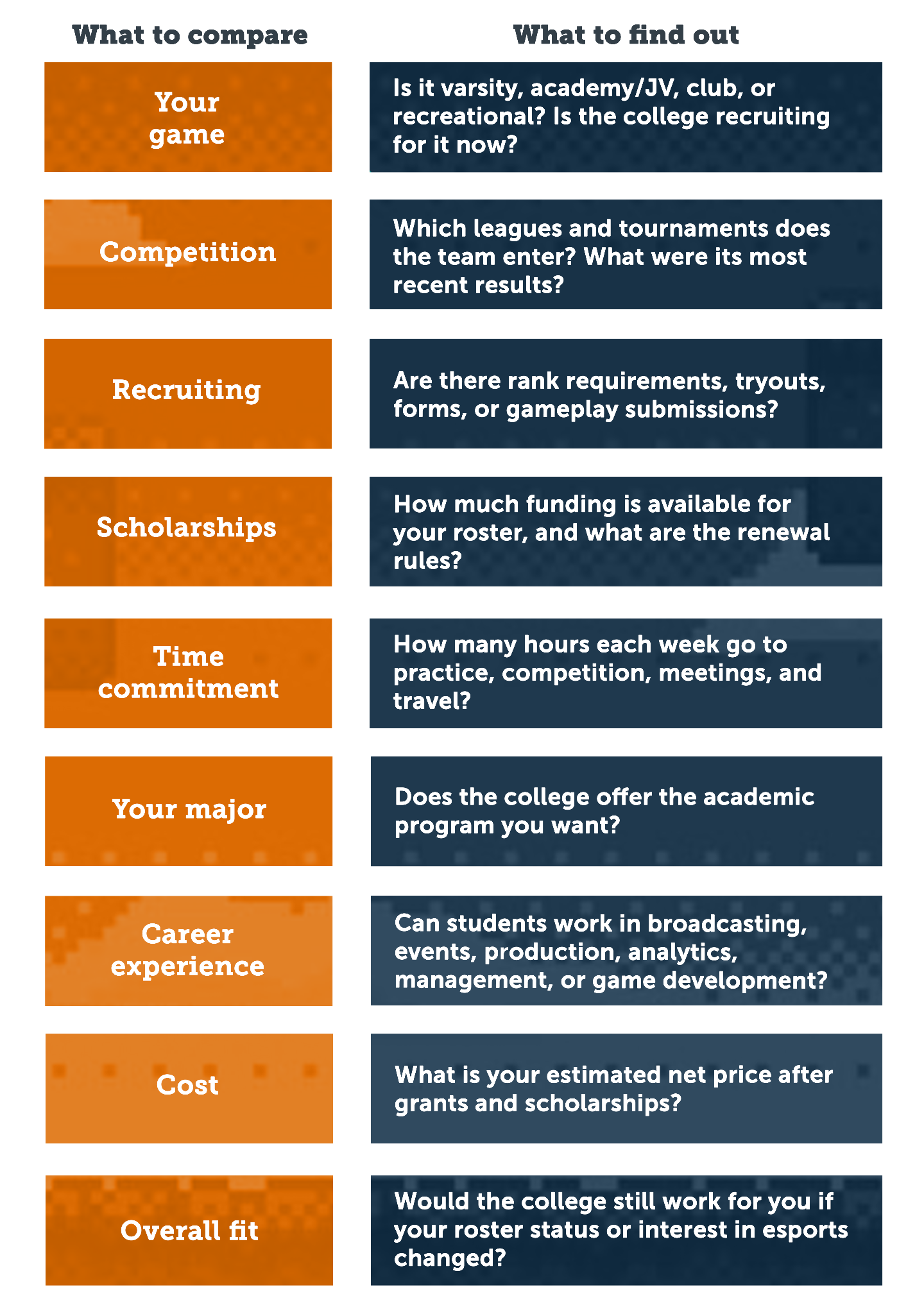
Use this table to narrow your options to a few schools that work both competitively and academically.
Then compare their costs, majors, admission information, and campus setting before deciding where to apply.
Build your college list beyond esports
Esports can help narrow your search. Your final college list still needs to work financially, academically, and personally.
Use Appily's College List Maker to save schools and compare admission likelihood, majors, estimated costs, scholarships, and other college details.
For each school you save, open the college's official esports page in a separate tab and verify:
- your game is still supported
- recruiting is open for your entry year
- any scholarship information is current
- you understand the expected time commitment
If cost is a major factor, use Appily's college cost comparison tool to compare net price, tuition, room and board, and average aid across your options.
A useful next step is to choose three colleges that support your game and compare them side by side. Check their majors and estimated costs first, then review each esports recruiting page before deciding which ones belong on your application list.
Frequently asked questions about college esports
Is college esports an NCAA sport?
College esports generally operates outside the NCAA championship system. The NCAA's current championship structure covers 24 sports and does not include esports. Instead, college teams compete through organizations and tournament systems such as NACE, PlayVS College League, publisher-run competitions, and other collegiate leagues.
Because esports doesn't have one governing body for every college, game, and competition, recruiting rules, roster requirements, scholarships, and postseason formats can differ from one program or league to another.
Can college esports help you get admitted to a college?
Being recruited for esports can help you connect with a college's coaching staff, but it does not automatically mean you'll be admitted.
Admissions and esports roster decisions are often separate processes. A coach may be interested in recruiting you while the college still requires you to meet its regular application and admission requirements.
Before relying on an esports opportunity, ask the coach whether you need to apply and be admitted before receiving a roster offer and whether esports recruiting has any role in the college's admission process.
Do you have to be recruited in high school to play college esports?
Not necessarily. Some colleges recruit players before they enroll, while others hold open tryouts or offer academy, JV, club, and recreational teams that students can join after arriving on campus.
If you weren't recruited in high school, check the college's esports site for tryout dates, interest forms, Discord communities, club teams, or other ways to get involved. Ask whether students can move from a developmental or club roster to varsity later.
Do college esports teams travel?
Some do. Many regular-season matches can be played online, but national championships, conference finals, and other major events may be held in person.
For example, NACE's Varsity Premier national finals bring qualifying teams together for an in-person championship, and PlayVS College League also holds in-person championship events for selected games.
If travel matters to you, ask how often your specific team travels, whether travel expenses are covered, and how competitions may affect classes or other commitments.
What happens if a college stops supporting your game?
There is no guarantee that every college will keep the same esports titles from year to year. Games can be added or dropped as competitive leagues, coaching priorities, player interest, and university resources change.
Before enrolling because of a particular esports opportunity, ask what would happen to your roster spot and any esports scholarship if the college discontinued your game. It's also smart to choose a college that still works for you academically, financially, and socially even if your esports plans change.
Can you transfer colleges to play esports somewhere else?
Potentially, but transferring involves more than finding an open roster spot. You would still need to meet the new college's transfer-admission requirements, determine how your credits will transfer, and confirm any esports eligibility or recruiting requirements that apply to the program and league.
Before transferring for esports, get written information about your expected roster role, available financial support, and the academic credits that will count toward your degree.
How can you tell whether a college esports program is serious?
Look beyond the gaming facility. A strong program should give you clear information about its current teams, coaches or staff, competition level, recent results, recruiting process, practice expectations, and student support.
Also check whether the program has operated for multiple seasons and whether students have opportunities beyond playing, such as broadcasting, production, events, analytics, content creation, or esports-related academics.
A large gaming room can be a great campus resource, but it doesn't necessarily mean the college has a competitive varsity program.
What is the difference between Premier, varsity, academy, Ranked, and club esports?
The terms describe different levels of participation, but they aren't standardized across every college or league.
Varsity usually refers to a college's primary institutionally supported competitive team. Academy or JV teams generally provide another competitive level below varsity. Club teams are often student-led or less formally supported by the college.
League terms can also matter. For example, PlayVS College League currently identifies Premier as its highest national competitive division, while Ranked is a separate rank-based level that can include multiple teams from the same school.
When comparing colleges, don't rely on the team name alone. Check which division your specific team competes in and what that means for coaching, travel, scholarships, practice requirements, and postseason opportunities.
